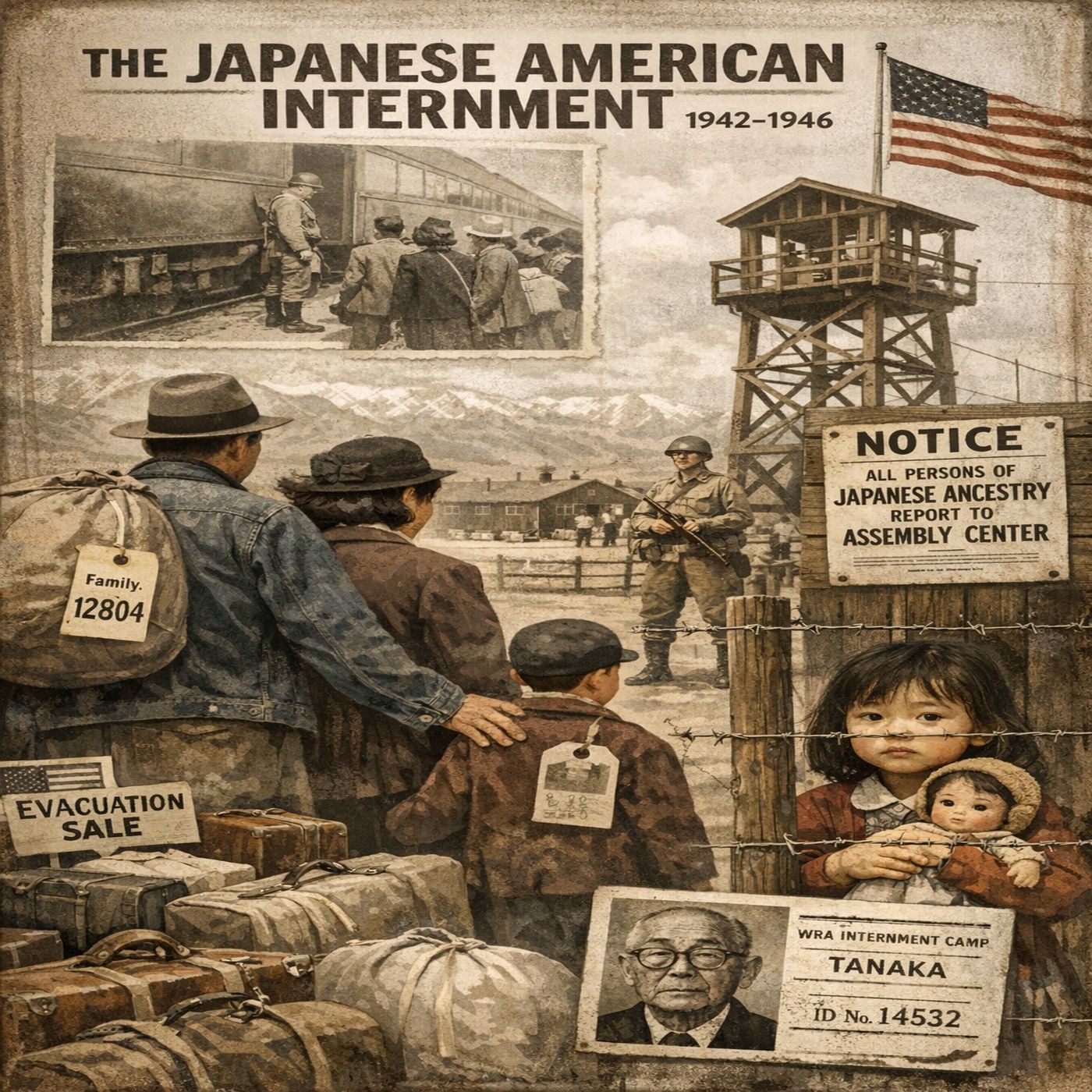
DH Ep:53 American Concentration Camps episode artwork

EPISODE · Dec 24, 2025 · 1H 7M

DH Ep:53 American Concentration Camps

from Disturbing History · host Disturbing History-True Stories

Disturbing History exists to sit with the parts of our past we’d rather avoid—the moments that force us to ask who we really are when fear takes over.In this episode, Brian walks through one of the darkest chapters in American history: the mass incarceration of Japanese Americans during World War II. This wasn’t something that happened under a foreign dictatorship. It happened here, carried out by our own government against its own people.In the spring of 1942, more than 120,000 men, women, and children of Japanese ancestry were forced from their homes along the West Coast and imprisoned in camps scattered across some of the most remote and unforgiving parts of the country. Two-thirds of them were American citizens. They weren’t charged with crimes. They weren’t given trials.Their only “crime” was their ancestry.Brian traces how this didn’t begin with Pearl Harbor. Anti-Asian racism had been building for decades—through the Chinese Exclusion Act, Alien Land Laws, Supreme Court rulings that barred citizenship, and immigration bans that made Japanese Americans perpetual outsiders. By the time Pearl Harbor happened, the groundwork for mass incarceration was already laid. The attack was just the excuse.We follow the panic-filled weeks that came next: FBI raids in the middle of the night, media-fueled hysteria, and political maneuvering that led Franklin D. Roosevelt to sign Executive Order 9066. Military leaders openly argued that the absence of sabotage proved guilt. Fear replaced evidence.Brian brings these places to life through survivor accounts: communal latrines with no privacy, schools behind barbed wire, armed guards watching children recite the Pledge of Allegiance.We also explore the damage that can’t be measured easily—the psychological toll on elders who lost everything, the identity fractures forced onto younger generations, and the loyalty questionnaire that tore families and communities apart. Resistance mattered too.Brian profiles Gordon Hirabayashi, Minoru Yasui, and Fred Korematsu, ordinary people who stood up to the government and paid the price, even as the Supreme Court failed them. The story doesn’t ignore the painful contradictions. Japanese American soldiers volunteered from behind barbed wire, forming the 442nd Regimental Combat Team, which became the most decorated unit in U.S. military history—fighting for freedoms their own families were denied. We follow the long, incomplete road to justice: decades of silence, inadequate compensation, the eventual exposure of government lies, and the Civil Liberties Act of 1988, which finally acknowledged what had been done. But apologies didn’t erase the losses, the trauma, or the precedent.Brian closes by looking at why this history still matters—how the same fears resurfaced after 9/11, how Korematsu remained standing law for decades, and how easily rights can be stripped away when fear is allowed to lead.The people who made this happen weren’t monsters. They were neighbors, officials, soldiers, and citizens who failed to stop it.As the survivors grow fewer each year, remembering becomes a responsibility. Their stories aren’t just history—they’re a warning. Never again has to mean never again for anyone.Have a forgotten historical mystery, disturbing event, unsolved crime, or hidden conspiracy you think deserves investigation?Send your suggestions to [email protected] History is a dark history podcast exploring unsolved mysteries, secret societies, historical conspiracies, lost civilizations, and the shadowy stories buried beneath the surface of the past.Follow the show and enable automatic downloads so you never miss a deep dive into history’s most unsettling secrets.Because sometimes the truth is darker than fiction.

Disturbing History exists to sit with the parts of our past we’d rather avoid—the moments that force us to ask who we really are when fear takes over.In this episode, Brian walks through one of the darkest chapters in American history: the mass incarceration of Japanese Americans during World War II. This wasn’t something that happened under a foreign dictatorship. It happened here, carried out by our own government against its own people.In the spring of 1942, more than 120,000 men, women, and children of Japanese ancestry were forced from their homes along the West Coast and imprisoned in camps scattered across some of the most remote and unforgiving parts of the country. Two-thirds of them were American citizens. They weren’t charged with crimes. They weren’t given trials.Their only “crime” was their ancestry.Brian traces how this didn’t begin with Pearl Harbor. Anti-Asian racism had been building for decades—through the Chinese Exclusion Act, Alien Land Laws, Supreme Court rulings that barred citizenship, and immigration bans that made Japanese Americans perpetual outsiders. By the time Pearl Harbor happened, the groundwork for mass incarceration was already laid. The attack was just the excuse.We follow the panic-filled weeks that came next: FBI raids in the middle of the night, media-fueled hysteria, and political maneuvering that led Franklin D. Roosevelt to sign Executive Order 9066. Military leaders openly argued that the absence of sabotage proved guilt. Fear replaced evidence.Brian brings these places to life through survivor accounts: communal latrines with no privacy, schools behind barbed wire, armed guards watching children recite the Pledge of Allegiance.We also explore the damage that can’t be measured easily—the psychological toll on elders who lost everything, the identity fractures forced onto younger generations, and the loyalty questionnaire that tore families and communities apart. Resistance mattered too.Brian profiles Gordon Hirabayashi, Minoru Yasui, and Fred Korematsu, ordinary people who stood up to the government and paid the price, even as the Supreme Court failed them. The story doesn’t ignore the painful contradictions. Japanese American soldiers volunteered from behind barbed wire, forming the 442nd Regimental Combat Team, which became the most decorated unit in U.S. military history—fighting for freedoms their own families were denied. We follow the long, incomplete road to justice: decades of silence, inadequate compensation, the eventual exposure of government lies, and the Civil Liberties Act of 1988, which finally acknowledged what had been done. But apologies didn’t erase the losses, the trauma, or the precedent.Brian closes by looking at why this history still matters—how the same fears resurfaced after 9/11, how Korematsu remained standing law for decades, and how easily rights can be stripped away when fear is allowed to lead.The people who made this happen weren’t monsters. They were neighbors, officials, soldiers, and citizens who failed to stop it.As the survivors grow fewer each year, remembering becomes a responsibility. Their stories aren’t just history—they’re a warning. Never again has to mean never again for anyone.Have a forgotten historical mystery, disturbing event, unsolved crime, or hidden conspiracy you think deserves investigation?Send your suggestions to [email protected] History is a dark history podcast exploring unsolved mysteries, secret societies, historical conspiracies, lost civilizations, and the shadowy stories buried beneath the surface of the past.Follow the show and enable automatic downloads so you never miss a deep dive into history’s most unsettling secrets.Because sometimes the truth is darker than fiction.

NOW PLAYING

DH Ep:53 American Concentration Camps

0:00 1:07:50

No transcript for this episode yet

We transcribe on demand. Request one and we'll notify you when it's ready — usually under 10 minutes.

Bitcoin Gateway Lea meakin Welcome to Bitcoin Gateway, the podcast where we dive deep into the world of Bitcoin, hosted by Lea Meakin. This show is for anyone who’s ever felt overwhelmed by the complex world of cryptocurrencies and wants a simple, straightforward explanation. Each episode, we’ll break down the basics of Bitcoin, explore its history, and discuss its potential impact on the future of finance. Whether you’re a complete beginner or just looking to expand your knowledge, Bitcoin Gateway is here to help you understand Bitcoin, one episode at a time. Explicit WTF Conspiracy ? Operation: Disclosure Jolly West Welcome to Conspiracy Theory Or Not?, your deep dive into the world of secrets, shadows, and speculation. This podcast is dedicated to unraveling history's most controversial and mind-bending conspiracy theories, asking tough questions and exploring hidden truths. Whether you're a skeptic or a believer, we take you on a journey through some of the most mysterious events and covert operations ever revealed.In this episode, we explore the dark and mysterious world of MK-Ultra—a top-secret CIA program that ran from the 1950s to the early 1970s. The program's purpose? To develop mind control techniques for use in espionage. But as we will uncover, the methods employed often crossed ethical boundaries, involving everything from drugs to hypnosis and, in many cases, torturous experimentation.We’ll investigate the history and controversial practices behind MK-Ultra, shining a light on its disturbing experiments, key figures, and pivotal events. Drawing from two essential books, "The Sea Explicit Vampires of White Chapel Transmissions From Atlantis Entertainment Vampires of White Chapel follows the story of FBI Agent Arianna Grayson as she hunts the serial killer, Allister the Annihilator but gets more than she bargains for. She discovers he’s a vampire, sired by the notorious murderer Jack The Ripper. Grayson is pulled into the world of the vampires and the show follows her story as an unwilling fledgling, Allister’s fall to monstrosity and the real history of Jack and his vampire origins. (Fiction Podcast/Horror) Explicit The Midnight Cinema Screening Unkn  Welcome to The Midnight Cinema Screening.This is basically the place where we hang out after midnight and talk about movies and TV shows that stuck with us… the good, the bad, the weird, and the ones that probably shouldn’t exist but somehow do. I also talk about true crime. If you love horror, cult classics, creepy shows, and the occasional random deep dive into something strange, you’re in the right place. Nothing here is super scripted or overly serious. It’s more like sitting around with friends after a late-night movie, breaking down what worked, what didn’t, and the moments that made you pause the screen and go, “Wait… what just happened?”Some episodes we’ll be reviewing movies.Some we’ll be talking about TV episodes.And sometimes we’ll just go down a rabbit hole about the weird history behind something we watched.So if you like late-night movie talk, dark stories, and conversations that feel a little unfiltered Explicit

Frequently Asked Questions

How long is this episode of Disturbing History?

This episode is 1 hour and 7 minutes long.

When was this Disturbing History episode published?

This episode was published on December 24, 2025.

What is this episode about?

Disturbing History exists to sit with the parts of our past we’d rather avoid—the moments that force us to ask who we really are when fear takes over.In this episode, Brian walks through one of the darkest chapters in American history: the mass...

Is there a transcript available for this episode?

Yes, a full transcript is available for this episode. You can read the complete transcript on the episode page.

Can I download this Disturbing History episode?

Yes, you can download this episode by clicking the download button on the episode player, or subscribe to the podcast in your preferred podcast app for automatic downloads.
URL copied to clipboard!