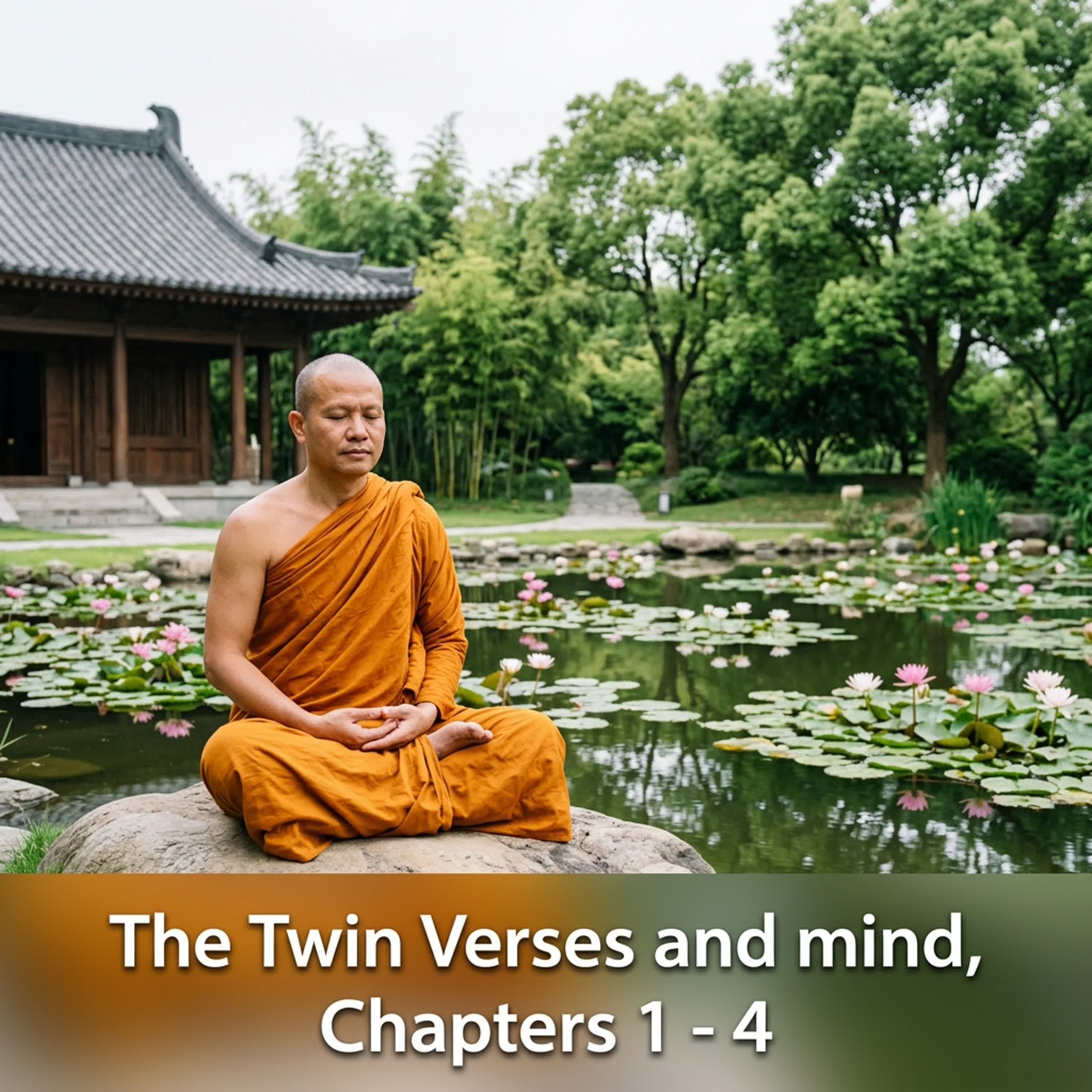
Dhammapada - 1 - Chapters 1-4
from Wisdom for the Present: Eastern Wisdom Literature Hosted by Kanu Emeruwa
Imagine waking up tomorrow morning and realizing that every single frustration in your life, every lingering grievance you hold, and every ounce of baseline anxiety you carry was constructed entirely by your own mind. While some might mistakenly catalog the Dhammapada alongside theatrical classics like Shakespeare's plays, this foundational Buddhist text is in reality an incredibly granular psychological manual for mastering the modern human operating system. This episode of Wisdom for the Present takes a deep dive into the text's first four chapters—"The Twin-Verses," "On Earnestness," "Thought," and "Flowers"—stripping away abstract theology to offer immediate, practical tools for navigating 21st-century realities. The Dhammapada opens by establishing what can be thought of as the cognitive architecture of reality, declaring that everything we are is founded on and made up of our thoughts. This sets up a primary conflict between our default state of unreflective reaction and the intentional cultivation of pure thought. When we speak or act with a heavy, evil thought—defined here not as cartoon villainy, but as ignorance, selfishness, or hatred—pain follows us mechanically, like a heavy cart hitched to a dragging ox. Conversely, when we practice pure and clear thoughts, a weightless and effortless happiness naturally accompanies us like a shadow. In today's hyper-connected world, the "ox" of our attention is constantly hijacked by algorithms engineered to feed our ego and exploit our desire for outrage. This psychological gravity of distraction is represented by the ancient archetype of "Mara," who waits for us to dismantle our own inner defenses. The text warns against the ego's favorite hiding place: intellectual vanity, or what it terms "a cowherd counting the cows of others". True mental sovereignty is not achieved by collecting self-help quotes or performing empty virtue signaling—such as putting the right hashtag in your bio while treating a barista poorly—but through the grueling, unglamorous minute-by-minute work of self-restraint. When the inevitable storms of life hit, a mind lacking this structural integrity suffers a complete logic breakdown. The text compares our unreflecting mind to an "ill-thatched house" where destructive passions and confirmation bias leak right through the gaps in the roof. Every time we obsessively replay our grievances, reciting the modern online anthem of "he abused me, he defeated me, he robbed me," we are pulling the protective thatch off our own mental roofs and downloading psychological malware that drains our cognitive hardware. The ancient rule is binary and uncompromising: hatred never ceases by hatred, but only by love and the sobering perspective of our own mortality, "Yama," which instantly puts our petty conflicts to rest. Reclaiming our agency requires us to step off the hedonic treadmill of social validation and become "Fletchers" of our own minds, straightening our crooked, trembling thoughts with steady, gentle pressure rather than self-loathing violence. By stacking digital "sandbags"—like putting our phones in a drawer or refusing to participate in toxic workplace gossip—we can build an "island" that no flood of cultural panic can overwhelm. Ultimately, the text invites us to move through society like a "bee in the village," extracting only what we need for sustenance, cultivating non-extractive relationships, and leaving the dignity and energy of those around us completely intact. In This Episode * The Architecture of Thought: All that we are is built on our thoughts; negative mental states drag pain like a heavy cart, while pure thoughts naturally accompany us as a weightless shadow. * The Trap of 'Mara': Distraction, notifications, and material status are modern manifestations of "Mara," pulling our attention away from core clarity and peace. * The Danger of Grievance: Harboring feelings of being wronged or defeated acts as emotional self-harm, leaving our mental "roof" vulnerable to life's inevitable storms. * The Cowherd's Illusion: Acquiring intellectual wellness concepts without actual practice is a form of vanity, resembling a cowherd standing in the mud counting another man's wealth. * Building Your Island: Real earnestness is continuous mindful effort; we must stack "sandbags" of strict personal boundaries to keep our island safe from digital floods. * The Craft of the Fletcher: We cannot snap our minds into focus through willpower or self-loathing; like a fletcher straightening an arrow, we must apply steady, gentle heat over time. * The Bee in the Village: Cultivate non-extractive relationships by consuming and engaging lightly, leaving others' dignity, energy, and beauty entirely intact. Practical Reflection What heavy, burdensome reality are you dragging through your days right now, and what specific thought pattern is pulling that cart? Are you treating your mind like a fragile clay jar that shatters at every online comment, or are you actively building it into a fortress of knowledge? Before you speak, post, or offer advice today, does your message have the "scent" of lived action behind it, or are you just a colorful but fruitless flower? Suggested Substack Excerpt Are you dragging a heavy cart of grievance, or living lightly in the shade of a pure mind? We unpack the first four chapters of the Dhammapada to find out how to build an unshakeable island in a flood of digital noise. AI Disclosure This episode was created using Google NotebookLM Audio Overview, based on human-curated source material, structured guidance, and editorial review. AI is used as a tool for clarity and delivery, not as a replacement for thoughtful study or engagement with the original texts. Copyright © 2026 Wisdom for the Present / Kamashcu Production Studios. All rights reserved. This is a public episode. If you would like to discuss this with other subscribers or get access to bonus episodes, visit wisdomforthepresent.substack.com
Embed this episode
No transcript yet.