Newly approved technology could provide relief to farmers in their struggle against resistant weeds. But experts say it won't come easy. This is Agcast, brought to you by the University of Tennessee Institute of Agriculture. I'm Ginger Rousey.
In November 2016, the EPA approved a label allowing the use of the herbicide dicamba in dicamba resistant soybeans. While the newly approved products will be less volatile than older formulations, they come attached with a strict set of requirements. Today we finish our conversation with UT Extension weed scientist Larry Stuckel, discussing what producers can expect in 2017. First, Larry, this approval comes with some pretty steep expectations for producers.
Yeah, if you're wanting to use extinct soybeans and you're just wanting to hit the easy button, this isn't going to be a technology for you. If anything, probably moving to it with some baby steps, maybe looking at it in a field of two, not go whole hog with it. Because it has a lot of, well, six major things you're going to have to do in order for it to stay put. Number one, you can only use one nozzle type.
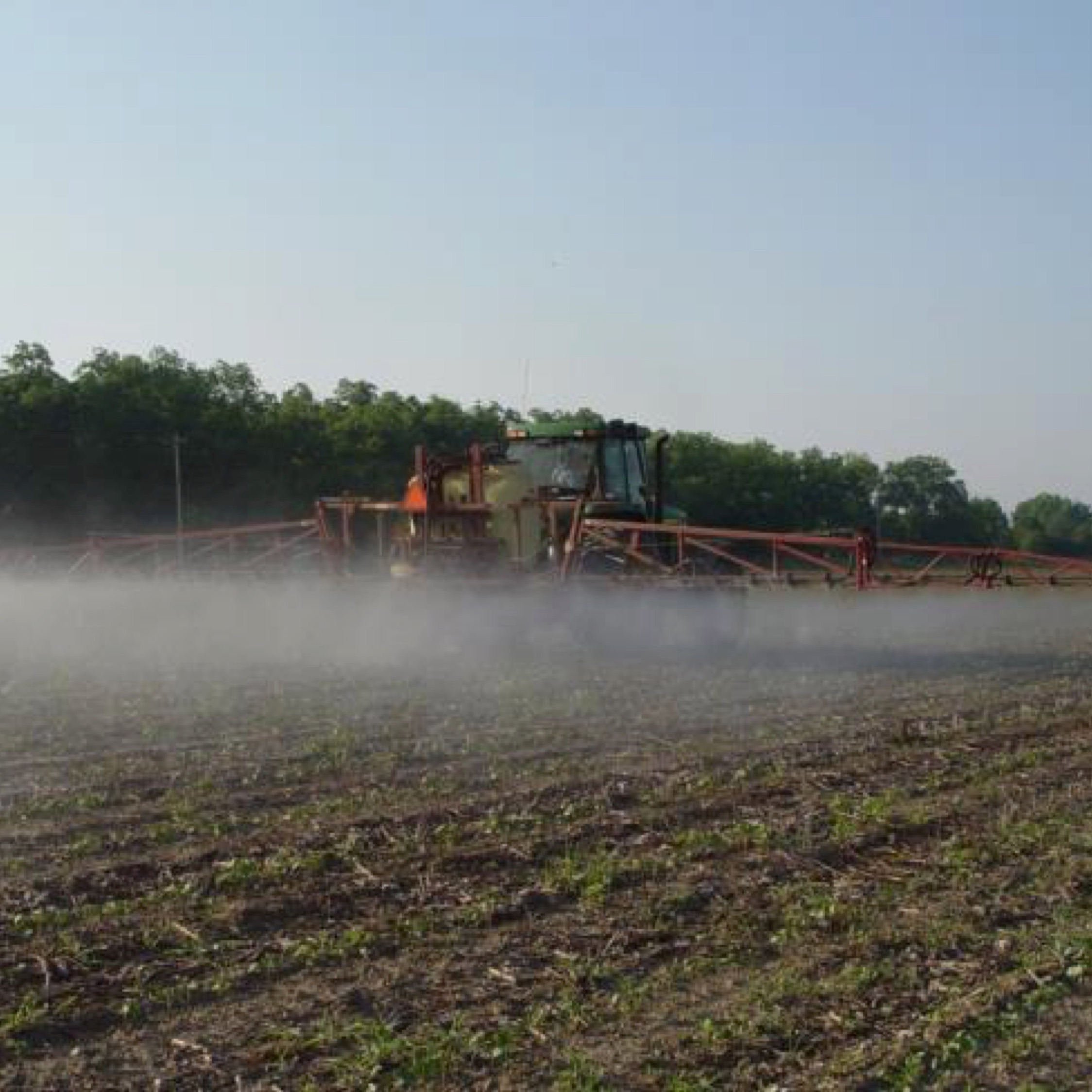
So you're going to have to re-plumb your sprayer with those new nozzles or triple T jet induction nozzles and only an 04 orifice boom height. You've got to keep the boom height low. It's easier said than done, but it needs to be within 24 inches of the target. No tank mixes.
That's going to be really a ringer for a lot of these folks, but there's a reason for it. If you pull some all round up off the shelf and dump it in with extended max, you're going to increase the volatility greatly. You're going to just basically make it what we had this past year with things like band-vul. So no tank mixes.
Hopefully they'll get some approved ones, but the researchers are now on which ones can be approved. So as of now, there's no tank mixes. Wind speed, you're going to need to keep it above three miles an hour, which is surprising, but that's for inversion issues. But ideally below 10.
And that can be hard to hit, even though the label is going to stay up to 15. I'm going to go people spray closer to 10 and just watch out what's downwind of you. That's going to be part of it, 110 foot buffer downwind. And those are the real big key ones that we're going to have to do that we haven't had to do before.
Is there fear that farmers are going to be planning the extend soybeans because they have to? So their crops will not be insured by drift from neighboring farmers? Yeah, I've heard that from a number of farmers and I think some of that will be in play. And there's all kinds of reasons people are going to plant different things, but round up is going to be pretty much gone.
Around up pretty crops are soybeans. You know, cotton, we're kind of out of that business now anyway, have been for a while. But soybeans will be out of it. This next year we're probably going to be 40% or so maybe 50, I would guess, extend and the rest will probably be primarily be Liberty Link with some round up only in maybe a middle Tennessee, but we're having a pretty big sea change.
The problem is and the trick we got to do is have all these coexist without problems. That's going to be the trick. We have extensive research on this and it works. We do it correctly, right?
Yeah, we've done a fair amount of, well, a lot of weed control with it. And from a weed control standpoint, we can make those systems work very well. That can be not a silver bullet. I hear for you so well, I'm just going to spray it a couple times and call it good.
It's not going to be that easy. We're still going to have to use pre's in the program. Residuals over the top. If you do that, that's a really robust system.
Liberty is the same way. So, but again, you need to use residuals, not just rely on these post-emergence applications. Those will be key going forward. So, but the volatility part and some of those things, we've done a number of studies, more small scale, but it's going to, I think we'll probably learn a thing or two and we start doing a big scale.
A lot of farmers get on a lot of acres, spraying with these big sprayers. So stewardship is going to be just ultra important, especially this first year right out of the shoot. If anything, air on the side of caution. This first year out, I wouldn't even think about planting extend soybeans near a tobacco field, or somebody's tomatoes or peppers or somebody's vineyard.
Those kind of things, very sensitive crops, this close, when everybody's trying to get a feel for this technology, those would be a better fit for say a Liberty link variety. If you're planting cotton, that's one of the best things about cotton. You can plant extend cotton, but you got Liberty, you can spray on it. So, you got a good backup.
So, the trick is going to be on these extend soybeans. We're not going to plant them on every acre, but we need to play some. I read a quote from you and I really liked it, and I think it was, we have used our mulligan with this technology. So, farmers have to just be really careful.
What do you mean by that? Well, the big problems we had this pasture in the mid-south, it was primarily in the mid-south, it wasn't just all the mid-south, though, they had problems in the mid-west and places and other places that were reported. So, but all this problems we had this pasture with, I can't be much used off label, we're getting here to look at it, we're getting a label now to be able to use it legally in crop with these lower volatile formulations and do it correctly stewardship-wise. The problem is, if we have a lot of farmers or a number of farmers go out there, it wouldn't have to be that many, 10% of them, 20% of them go out there and just start not using the proper formulations, that would be a huge killer, or just totally ignore a lot of the other things, boom-high, wind speed, nozzles, and we have a lot of off-target movement this next year.
We've used our mulligan, I think it's very, very likely that we're forced to EPA's hand in no pull-up. We consider all the issues surrounding the extend products. Is this what our producers need right now, or do we have other options? Well, I would like to think there's another silver bullet out there, but unfortunately there isn't.
I guess I'm all the above-the-board person when I think about it, I think we need to use every tool we possibly can, because the reality is there's been no new herbicides out in 20 years, I don't see any on the foreseeable future. We've got to make these work, and if we just rely on Liberty, which is the only option we got right now, it's going to be fairly short-lived. So having another technology like the Extien and using that can but can actually prolong Liberty's life if we do this right. So I think it would help that way.
The other thing with these newer technologies, I think we've got to start doing things you don't pull out of the jug in order to sustain them. A lot of the research we've been doing here is doing cover crop research, and we found it with these technologies you can actually, with say, Dicamba, and soybeans, or even Liberty, enhance these cover crops, so they're a better weed management tool. Sounds like you're going to be very busy as we go into the 2017 crop, please. I think job security won't be an issue for the next year, too.
But it's going to be an interesting year. I think we're going to have some growing pains, some learning pains here, going forward. Hopefully it'll be minimal, and hopefully everybody's going to come out and go to these trainings that are going to be, most of the states will be doing them, whether in a classroom setting or some of these modules have been developed, but they're going to happen to Mississippi. I know Arkansas, Georgia, and it looks like Tennessee as well.
Thank you so much, Larry. Be sure to stay connected to UTIA for more information about upcoming trainings. For the UT Institute of Agriculture, I'm Ginger Rousey. For more real life solutions provided by the UT Institute of Agriculture, go to our website at ag.tenacy.edu.