
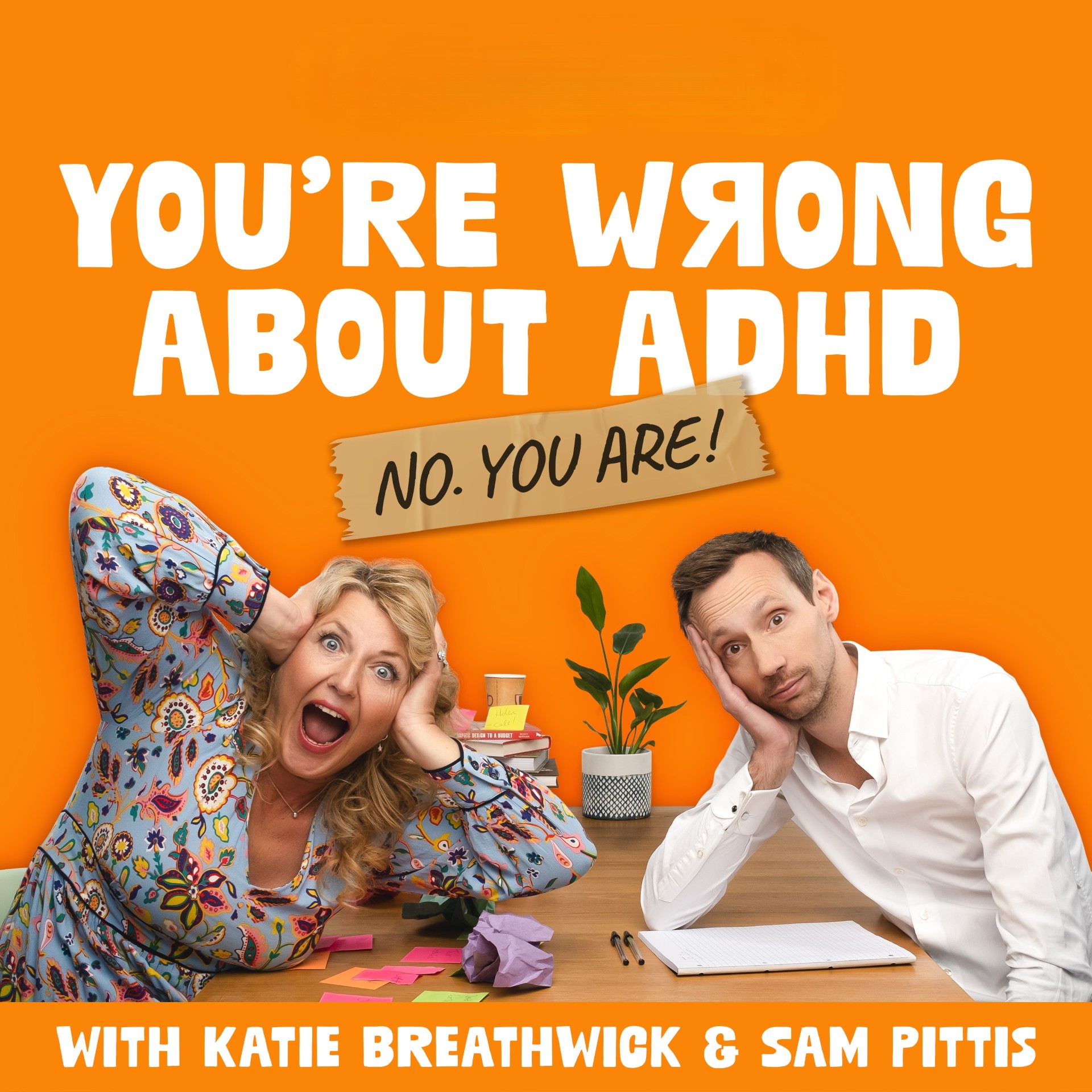
This is a global player original podcast. Hello, I'm Katie Refwick. And I'm Sam Pritis, and welcome to our new podcast, You're Wrong About ADHD. No, you are.
No, you are. No, you are. This is stupid. It's obvious.
Sam and I have been friends for nearly 20 years. A couple of years ago, we both found out we have ADHD. But I think it's fair to say we feel very differently about it. Getting an ADHD diagnosis answered lots of questions, but also raising new ones.
Each week, we're going to be talking about everything from our experiences being diagnosed as adults to relationships, coping strategies, and how we manage these very special brains. So we can learn more about ADHD. How well it means to be neurodivergent. Name Samuel Pritis, dates 7th February 1997, report for end of year seven.
History, frequently loud and silly, has difficulty being quiet, while one person speaks, always has to speak his mind. I have been worried about Sam. He often feels horribly irritable and cannot control his temper. He feels overcome by frustration.
Sam says he finds his anger sort of blinding and loses his awareness of what is appropriate. How did no one know you had ADHD? I know. Unbelievable, isn't it?
And looking at your school reports, I realise that it triggers a lot of old feelings for me as well, that I felt in the classroom feeling so anxiety, feelings of being frightened. The school was boring, we know that, but actually there was a lot more than that for me. I was anxious, I was constantly letting people down. They were always letting me know about it by shouting at me and telling me how I was letting them down.
And it was a place of huge stress for me. And I realise that you and I have gone through such a lot to get to this place. And that is why we're talking about schools. Which I think is a really important subject because for me, there is so much about school, which I think I've carried through with me all my life, that maybe I should have resolved years ago.
Looking through your report, which I think is a parent who's gone through this with my own son, it has been incredibly moving for me to read this from you. Because I know you really, really well. I've known you for many years, decades. But suddenly I see 11, 12-year-old Sam in a classroom.
And I know what you're like in a newsroom. You're not dissimilar to me. This is the food actually. How much of that behaviour have you been?
Yeah, perpetuated for the rest of my life. Absolutely noted. But what I see here is a child who is in a lot of trouble, who is frustrated, who is sad, who is confused. They use the word silly about you five times.
You're constantly calling out in class. You are rather too cocky for your own good-well, nothing's changed. Thanks for your time. And not a sportsman, I see.
I don't know how you feel about that. Yeah, I was very honest. I'm almost fair. But it's critical.
It's the fact that they've taken a child who is out of control, who needs help, who is really, really struggling to cope with this environment, which is making learning impossible. And what they've done is written down a whole bunch of criticisms about you and told your parents. And I find that really sad. I'm so sorry that that happened to you, Sam.
The thing is, I mean, I have a quite deep sadness about it as well, to be honest. But it is one of these things that you look back with hindsight, and it all makes sense. But it clearly didn't make sense at the time. Otherwise, I would have been diagnosed.
But I think that happens for all of us. When you get diagnosed, you have a process of grief, and you look back at your life and think, oh, that was ADHD. And oh, good things have been different. And frankly, how was it not spotted?
How did people not know? I had ADHD. And it's funny, isn't when we talk about those doubters who say, does ADHD really, really exist? You look at a report like this, and it's so blind and obvious that you have ADHD.
Your inability to sit still, the fact that you're interrupting all the time, you're disrupting everyone else, you're making jokes, you're shouting, you're calling out when it's not wanted, and teachers are going more and more frustrated. I'm really interested to know what made you do those things. What were the feelings that made you behave like that in class? Can you remember what that felt like?
I can remember, yeah. I mean, the word I used to use is give us boredom, simple boredom. But I mean, what that meant for me was physical. I can remember a sort of boiling pressure inside.
I can remember feeling like I was going to explode from the inside. So if you're saying a class, and you're being asked to listen to a teacher, or you're all being asked just to put your heads down and write something that you're not particularly interested in, I could feel almost a shortness of breath, a tightening in the chest, a hair, my hair starting to itch, my skin scratching, just wanting to explode. And honestly, sometimes I did. Clearly.
And sometimes it was physical, sometimes it was verbal. Throwing tables. I did push tables around a bit. I mean, one thing about that particular time in my life was, we were going to move house, and I knew we were moving house.
And so I sort of knew that I was going to leave that school. And I think honestly, in my head, I sort of went, well, it's not like I can do that. So that was the kind of liberating element you knew you could get away with it. So you did.
But I also think there's a sense, you know, people can listen to this and go, you're a naughty child, and I'll just make excuses for you behavior. And I'm not making excuses for you. You know, I have to take responsibility for the way I behave, as everybody does. Talk how to make his way in the world.
And I think one of the things that makes me so sad about that is I didn't want to necessarily be disruptive. I didn't necessarily want to be the child who got so overwhelmed that he would then spend the next lesson, absolutely silent, not talking to anyone, because he had an emotional crash. Take me through what happened. So this is your report.
This is year seven. So this is your first year at secondary school. How did your parents get involved? And how come we have an educational psychologist report?
What happened? Well, I mean, I didn't really know how I knew it was happening, but I had never seen that I didn't see these reports at the time. And I had had various issues in primary school, similar sort of things about, you know, boiling rage and constantly getting myself in trouble. And I wasn't violent or abusive.
I was just trying to entertain myself. And sometimes it was getting into real, you know, verbal battles with teachers, telling teachers that I didn't respect them, getting myself in real trouble. You know, I can remember tipping points where I was having a conversation where the teacher was responsible for the sense of apologizing, and I would push it because I was bored. And I think that obviously was noticed when I was young, it was noticed because I just didn't do any work in primary school.
I didn't do anything. I wouldn't do work. And I've got letters from my parents asking for help. And I think, you know, the SCN support was probably quite different then.
The school of trying, but there's not a lot of support going on. My parents have been tested for dyslexia from someone we knew, and I wasn't dyslexic. But similar sort of pattern of behavior is described as someone who just is pulled in all sorts of different directions and can't think straight and can't focus. Things which now clearly seem to be...
Well, it's interesting. It's interesting that, you know, my child's experience is that a teacher approached me about him. Yeah. So that's how much things have changed.
That's just great to hear. Isn't that great? And I'm sure it doesn't happen enough. But this particularly wonderful teacher emailed me and said, you need to come in and we need to have a chat who happened to have personal experience with ADHD and so was able to see what was going on here.
But that's what's so shocking about the report. And, you know, again, the educational psychologists report, the use of the word silly, that really triggers me the word silly because I had a lot of criticism in school as well from teachers telling me I was misbehaving and not doing as I was told and was disruptive. But it's the fact that they are criticizing you and we know these statistics about the ADHD child has like 50,000 more criticisms than a normal child going through mainstream school. And it kind of wins me to see your importance, see how critical they are of you, somebody who was clearly bright and had something to give but just wasn't provided with a correct environment to enable you to do that.
And then the educational psychiatrist steps in and meets this lovely boy. I'm at really the first paragraph. This is on meeting you. Sam was very pleased to meet with me and seemed well-prepared for our consultation to get done.
Now that tells me that you wanted this to happen. So you're clearly wondering why you're behaving like this. I remember having a sense of thinking, as I said, I don't want to be like this. I don't want to constantly get in trouble.
But I could not overcome this boiling explosion inside. Yeah. Our half-hour meeting lasted at least 45 minutes and it was I who had to bring it to a close. You're clearly somebody who wanted to talk about it.
Sam said it had been very helpful to talk through his feelings to someone who had the time to listen. I mean, that screams to me that maybe it was somebody who needed therapy. I had a weekly therapy session. It's called behavioral support and I used the mystography.
I don't remember the geography teacher being very impressed. I missed the geography once a week and I'd go and I'd sit and chat to this woman about my feelings once a week. Okay, that's interesting. But I remember the meeting with her and my parents and I could please hold the call and then the river.
I remember because we had this weekly thing and then we sat in this room with teachers and this lady and my parents and they asked me, do you think it was helpful? I went like, which is... And were you in trouble? Were you being honest?
What did you not answer the question? No. I mean, the other way of looking at this and this is the problem, you know, talking about being self-critical, is what that actually also demonstrates is somebody has taken the trouble to try and find out what's wrong with me. My parents have the school have actually put some effort into it.
And you might say, children need boundaries. Children need to learn to conform. Children need to learn that they can't just do what they want to do. They need to complain and they...
And there's always a bit of me in my head that still believes that. You know, that's why I was taught. And I've got my own children. But it's about trying to find out what's going on with children before you bring the discipline in it.
It's courses, isn't it? Ultimately, it's about that specific child needs for their best learning environment. You know, I was lucky. True, but there's got to be a point where every child has to...
There's going to be situations where you've got ADHD or not, where you are putting a situation that doesn't suit you and you need to learn in life how to manage that. Well, I don't know about that. Well, it's a bit of a question. It's because when you get into a workplace...
Yeah, but you don't... You, in an ideal world, choose the workplace that best suits you because then you're going to give of your very best and you are going to contribute to society in your best way possible. Fine. But you can give an example.
So it's all in your nine. My grandad has just died. And I was nine in a great place. And I walked out.
I went home. I just started left in a little bit less. You know, you can say there are mitigation factors and you can talk about what was going on for me. But there also has to be a point where you say, you can't really do that.
And you can't do that in the workplace if you have got responsibilities. So what I'm trying to say is... How old were you 14? Well, I walked out of school.
Yeah. I think it's okay to walk out of school when you're 14 and your grandad has died. I think that's the thing that we have to talk about here is that we are putting children in situations which are completely wrong for them. And your report shows us that you should not have been in that kind of environment.
We know there are all kinds of different kinds of schools. For instance, when we were choosing a primary school for my two children, it was in the 20 years ago now and God knows it's still the same. But in those days you could apply, is it still the same to five schools and you basically put them in order for... Yeah, exactly what you do.
I thought we'd do that recently. Yeah. And my mum being a primary school teacher, I said to her, they were all of these very schools. They've all got different opinions about each one.
They seem quite different to me when you come and have a look at them. And our closest school was the one that a lot of parents were turning away from, was a sort of aspirational middle-class parents that we are supposed to all aspire to be. It was a school with no school uniform where they called the teachers by their first names. I said to my mum, would you come and have a look at it?
Because it's our closest school and also having looked in through the windows and looked in through the fence. I can see how happy the kids are. It looks like a really, really lovely school. And mum came to have a look around it with me.
As soon as I walked in, I could feel that this was a school that did things slightly differently. There was a child that had been excluded from class who was in what they called the football cage. I was with a TA with a teaching assistant. Not being punished, not being made to stand in the corner.
I used to sit in the corridor. Right. I had to write. That's the worst possible thing for you.
I copied. I either stood in the corridor. I remember in year six I had a copy of a book. You might be in the jungle book even.
And I had to copy Word for Word this book until I'd failed six pages of A4. And my handwriting was terrible. That must have taken me about six or seven months to do that. And I just did.
When actually you should have been outside running around burning off your extra ADHD energy. So you might have a small chance of going back into the classroom in the afternoon and learning something. That's what I mean. I think we have to think about these things differently.
I think that was incredibly lucky in that my parents. Tell about your school. Because you were lucky. But actually you had a bit of a rocky tunnel.
I did in the middle. So my parents clearly were great believers in single sex education. They both gone through single sex schools themselves. And so wickedly put me in a boys school when I went off to junior school.
And that was partly because it was on the way to my dad's work. So it meant that he could drop me off on the way. So fitted him with their working lifestyles. My mum was working full-time as well.
And my brother had gone through that school. So they knew it was a good school. And it took two or three girls a year. And I really wanted to go.
I'd obviously spent a lot of time in that school because my brother had been there. And I had a friend who was going there too. So that also appealed. And when I got there, of course, being a girl in a boys school, as I now know, you have ADHD.
I think a lot of the other girls did now looking back. You hide actually a little bit because there's so much more energy amongst all the boys around you. And I remember the names of all the naughty boys in my classroom because they were the ones who brought the fun and the energy and made things sparkle a little bit. But they were all boys classrooms.
That was to be expected of them. Teachers weren't shocked by it. It wasn't difficult. And I loved every single day in that school.
I loved it. Cut to 11. And I leave that school and I go to an all girls school half a month from where I used to live. And everything changed.
There was so much about it that I struggled with. I had to suddenly learn about the dynamics of all female groups, which was difficult for me to begin with. But much more than that, I was expected to behave in a certain way that had never been expected of me before. And it was things like six-dilts shut up.
Make sure everything is neat and tidy. Make sure you are neat and tidy. And don't answer me back. And I couldn't do any of those things.
I was a child who was out spoken. I would speak out in class with my hand out. These are things I got away with in my old school. And they were...
What you are articulating here is not just that is an experience of having ADHD. But that's a very clear experience of the differences between having ADHD when you're a boy and when you're a girl. Because what you're saying is there were massive different expectations of you for being a girl. Absolutely.
And it was a shock. And of course at the time I just put it down to being amongst girls. Anything to do with that. It was the fact that the teachers expected me to behave in a certain way.
And I had one particular teacher who absolutely despised me and made an example of me. Every single lesson. So much so that I shook before the lesson started because I knew she'd pull me out. As she walked in she'd make me come into the front door or she'd walk in and she'd point out something like done wrong in my homework.
Or she'd put whole lines through homework because the handwriting wasn't tidy enough. And I definitely felt that nothing I ever did would make her happy or make her be nice to me. And I was baffled. I was absolutely baffled by it.
I didn't know what I was doing wrong. I tried so hard. I remember the number of times I'd underlined something with a pencil before I underlined it was pen. So I could get absolutely looking perfect.
And I remember doing some homework one evening after school. This little table I'd set up in my bedroom and I did something wrong in the homework and collapsed over the exercise book. And I remember my mum coming in and just going right. That's it.
Enough. We are done here. Well done. And about two weeks later I was looking around another school and I left at the end of that academic year.
And I had made good friends in that school. I'm still friends with some of the girls from that school. But we have talked about that teacher. We all remember what a bully she was to me.
And it was an incredibly dark year for me in that place. And I then went off to another girl's school until six months and ended up in a mixed school for a sick form. And I can't tell you what a relief it was to be back in a mixed environment for all the reasons I described earlier. You mustn't look back.
I mustn't. I'm not going to put that on you. You tell me. Are you angry?
I'm upset. Are you disappointed that you weren't diagnosed sooner? Do you feel that those days could have been different if you didn't? How does that weigh on you now?
So getting ready to talk to you about this. I kind of sat back yesterday. I spent half an hour kind of just casting my mind back over the various years at school. It was really quickly very apparent how much PTSD there is.
I suddenly had flashbacks of the handful of teachers who clearly hated me. The one who threw me out at the school orchestra at 11. The geography teacher who used to stare at me during assembly every morning because she clearly had identified me as the school troublemaker. And like you, I was a child who I desperately wanted to be liked.
I desperately wanted to have friends. But I just wanted to get on with it and do well and get out. I struggled with the sitting in Rose nature of school. That's what I struggled with.
I was always messing around whispering, disrupting, probably spoiling other kids' education. I do feel bad about that. Again, you were a child. I know now why.
I know why. I know that I would have been the child that other parents would have said don't sit next to her. Because she's disruptive. Some class mates told me that their parents had said that.
They'd complain to the teacher about me. I definitely have PTSD about it. Do I feel angry? It was so long ago.
It was good. It was so long ago. It was so long ago. I feel very lucky in so many ways because my experience was bookended by a boys' school and a boys' school.
So I might have felt very differently if I'd gone through an entirely all-girls experience. I wouldn't have known anything different. So that's not the question. It was so long ago.
The only thing I really feel very passionately about now is that I want my own children to have schooling that suits them, suits their personalities. And so I've probably spent a ridiculous amount of time thinking about that and what that meant was that I was not going to work. And I've walked into schools and known immediately that this was not going to work for them or for me because of the way in which they treat children who are outside the bell curve. And I hope that I made correct decisions for them.
They're coming to the end of their schooling now. My eldest is left school. My youngest takes a day levels next year. And we chose differently.
We did choose differently. We chose schools that very much mirrored the primary school that I described to you earlier. Because it shaped what I believe education should be. So you were almost the opposite of what it does.
Yes. I saw it in action. So we talked about us, but we're a bit long in the tooth, especially me. So maybe we should talk to somebody and find out what the situation is like right now.
And we've got a great guest. She is Dr. Joanne Reed, and she's an educational psychologist and ex-teacher as well, amazingly. And she specializes in ADHD and neurodiversity.
Joanne, lovely to have you. Thanks for joining us. Thank you for having me. We've been telling our stories about our experience at school with ADHD.
And I've got young children. I've got a daughter just starting school. And all those feelings came back from me when she started school. But then there's a sort of recognition that things are different.
And I think that's where I wanted to start with you today is what's the current state of provision for ADHD and UK schools. Are we in a good place where it comes to understanding your university? That's a really good question. I think what a journey in that we've definitely raised awareness of ADHD.
I mean, staff much will know what that means and so on. And aware that they've got children with ADHD in their schools, for example. But we are on a journey in terms of acknowledging that our ADHD is need, perhaps additional support or more inclusive support. But that really varies between schools currently and educational settings in terms of how successfully that's delivered currently.
What kind of extra support does a child of ADHD need? I guess we can think about this as well as the whole school system. So in the ideal, we'll be thinking about a whole school approach where their new university is raised generally and therefore it's more normalized. You know, that with all of our brains work in different ways and that we have different types of difficulties.
We'll see ADHD represented in assemblies in school, like resources, like the books they're doing in class and so on. Then you've got a whole school and whole class approaches that really benefit our ADHD students and disadvantage. No one. So having things like Pidget Tools available to all to normalize those and then you've got the more sort of targeted stuff specifically for our ADHD students.
So that might be things like additional support around managing emotions and how you can kind of manage to regulate yourself and have support from others to do that when perhaps you have quite high impulsivity. So maybe needing some additional programs outside of the classroom around the emotional literacy. Also for lots of ADHD is something called executive functioning is a common difficulty. So the idea of when you have a task, you need to plan what to do, sequence the steps, ensure you see it through to the end.
And that can be quite tricky, particularly for younger children with ADHD. How would you help those children? How would you help them with that executive functioning? That's good question.
So first we're making sure that instructions are written down so the child can be referred to them, that their numbers, the sequence is really clear, that you spell out the kind of more implicit things. So for example, the task might be to complete mass text but page 55. But actually there's lots of tiny tasks within that. It's opening your exercise book to the next clean page, finding that page number in your textbook, writing the title, date and learning objective, and then go through those questions and checking with you understand them and so on.
So it's about making those smaller steps explicit and spreading them out. And that could be through writing clear instructions. It could be through an adult, almost coach a young person like you know, do you understand the instruction? What's the next thing you need to do?
What equipment do you need available for this task and so on? Or doing that through things like having a sheet that kind of helps you structure in a more specific manner? And how many schools do you think are approaching a providing that kind of classroom environment? Because this all sounds amazing that you've got teachers who would consider an ADHD child in this way and make it so fabulous and so clear.
Is it commonplace then these days to find that in a classroom? It just massively varies. So we have schools, so for example, I'd be brought in at like local authority level in some local authorities to train all their schools off in these neurodiversity affirming practices that also benefit our ADHD students. So quite one place there.
And then you have other schools where there's very little understanding of ADHD and the strategies to apply. So we've got a huge inconsistency currently. And also we collect no data on who is carrying out these practices and who isn't. So it's quite hard for parents to sort of know which schools really come up there.
So really sometimes it comes down to that individual teacher and you know, you may go have the same school and you've got two teachers off say like year two when the children are about six years old. One who's like really knowledgeable and experienced in providing these strategies and someone else with less knowledge, so it's available. And have you, when you've been working with families and individuals, have you met people who've come up against a brick wall who've gone to school and said look like my child needs help? And actually the support is not there.
The understanding is not there. Definitely. I mean, I think particularly when you've got there's two things where it's hard. One where perhaps you've got a child who is displaying like really big emotions at school.
They're very dysregulated and you sometimes have that assumption that they're just being naughty or they're attention seeking. When it's actually, you know, not accurate. I know situations, sometimes quite helpful to have someone like myself as an external person that's neutral to situation who can kind of listen to that member staff that also helps change their mindset because I think once you understand what's happening for that young person and what their strengths and difficulties are it then because of obvious what to do next. But sometimes we're misceiving where their strengths and difficulties are and people are over assuming that they're being naughty or the other common one where less support is where you have particular girls, but with some boys as well where they're massively masked in those difficulties and they're trying to fit in and almost, you know, internalizing those feelings.
So on the outside it appears like they're doing well, but how they feel internally is a very different experience and it can be about helping staff to understand that concept of masking and listening to the parents and how they're doing at home to help us learn about how we can better support that in person at school. And what should parents be saying? And if they're a parent listening to this saying they think perhaps the child needs to be supported or looked at, what's the best way to approach it with this school, I suppose? So obviously it depends well whether the child's at secondary or primary.
But first of all, to understand that in the UK our education system is meant to be and the support we put in place for children with additional needs is meant to be needs based versus diagnosis led. So it doesn't matter if your child has that diagnosis or not. If you feel like it needs around this area and it's impacting that child's progress and the school should be put in place support. So it's being such a class teacher, but I'd be still finding it quite hard, speaking to the Senko and being really transparent about how things are at home.
So I think sometimes people worry, particularly like I say to them on an ADHD child that sometimes things will be quite chaotic in our homes and quite difficult and we can worry how the school would view that. But the reality is normally schools have experience of other families in the same situation as their being as honest and transparent as you can be about how things can be at home or how a child's feeling about school and trying to have that kind of shared work relationship. But it's about working in collaboration and really maintaining that relationship with the school as well, which can be tricky. You were a teacher for a part of your career, weren't you?
So you have real experience within the classroom already. I'm the daughter of a teacher and also someone I've talked about this before. I think my mum has undiagnosed ADHD and I distinctly remember every September my mum going back into the school environment. And one of the first things we were talking about at the kitchen table in the evening when everyone was home from school was my mum's new class and who were the naughty boys?
Because my mum absolutely loved the naughty boys in her class. They brought her energy and ideas and spark and she clearly really fed off that energy and she absolutely knew how to give them the sorts of things you're talking about, the small activities she had a stretching corner for the really bright ones and they go off there when they finish their work, all these different things. There must be additional upsides sometimes to having a child with ADHD in your class. Absolutely.
And like you said, like from your mum's description, it's about seeing the strengths of that young person, like everyone has strengths, I've never met a child who has a got strengths and someone's about shifting that narrative and perspective. So like you said, how high play art or that high energy, that's massively advantageous. So it's about understanding the strengths and changing some of these narratives and then also ensuring that we put in place activities that play to these strengths because obviously our education system is rigid, you know, it's sort of one path, but that is unrealistic. You know, like we can't have a one size fits all, it's about adding that flexibility in wherever we can.
And also reassuring parents really that after school, obviously in the world of work or just, you know, whatever you end up doing in life, there are thousands of paths, you know, and you can make your strengths a lot easier perhaps than you can at school. No, I want to pick up on this point. There's a point. There's a point.
I agree with that. And I think so. We had a conversation about our experiences of school. I'm recruiting you essentially, I'm recruiting you from my side of the art.
But I'm not arguing against it. I'm saying I totally understand that. Of course. I had a terrible experience of school.
I'd love to think that that could be different. But that isn't the case currently. And I suppose where I come down, I think maybe this does show window into my psychology. You can decide that yourself, Jerome.
I absolutely want to see the education system change so that people with ADHD, people who are in your diverse are able to thrive. But I also know that in me, there is a sort of sense of saying we need to teach children boundaries and we need to say to children, even those who have ADHD, there are occasions when you have to be quiet, sit still and listen. How do you teach boundaries and rules while at the same time accommodating ADHD? How do you get that balance?
So, I think that's a really good question. I guess, like you said, it's about coming down to what benefits a child anyway. So we know that understanding some social conventions, like waiting a turn, being quiet with someone's talking for example, will benefit that child in long term anyway, helping him in job interviews and so on. So it's about, yes, we need to teach those skills because that benefits the young person.
But also, a lot of our education system doesn't make a lot of sense and doesn't work well to an ADHD brain. So for example, the fact it's very like knowledge driven, like telling people lots of information where we know that ADHD is tending to be more creative, better when they can choose what to learn and how to learn it. So, you can ask Alexa. So, these are not only based curriculum, the best for us anyway, society.
So I think the whole thing is a big overhaul. But I do agree with you. You can still support people whilst enforcing some boundaries. It's a balance, isn't it?
As we've got the benefit of your expertise, John, I think maybe a nice way to finish this would be just to ask, what are some of the signs that parents could look for if they've got concerns about their child maybe having ADHD or thinking perhaps they ought to seek diagnosis? I mean, one thing is that often, it's surprising when I see a child one to one, how many times when they think a child may have ADHD, that they bring up themselves, they feel difficult when they're peers. I think a lot of times people just feel different. So I think that kind of narrative coming from your child is something to listen out for.
Obviously, attention differences, and I say differences versus difficulties because what we often find is when ADHD is doing something they love, they can really give great focus to that, but very short attention spans for things that they're not interested in or they don't see the purpose of. Obviously, that high impulsivity, so perhaps that may present in feeling like your child is safe around like road to example or playground equipment, then typical for their age. But it's also looking out for those ADHD strengths that being very creative, being a good problem solver, thinking outside the box as well, sleek difficulties and sensory difficulties as well are common things. But it's about having if a child attends a school setting, having that open dialogue because as we know that ADHD to get a diagnosis needs to see a cross context, so it'd be interesting to get the teacher's perspective on how your child's doing at school as well.
Joanne, that was fascinating. Thank you. It's really made me think about hopefully school is very different now to when we be younger. So thank you for joining us.
Thank you for joining us. I think there's lots of hope for the future that it can be better. I'm all like a journey with schools, but it's about getting it to that best practice place really. Thank you.
I found that really positive. Did you? I really did. I really did.
And I felt that she reinforced everything I had to say. But I don't disagree with you. My question is whether this ideal world where school is set up for ADHD exists. And it was really interesting to hear from her, but it doesn't yet.
And we're on a journey. And there are some places where teachers and schools are set up to understand your adversity and there are other places where you're still hitting that brick wall, which is why I think that we continue to have these conversations. We continue to look at the work of ADHD UK and ADHD foundation and how they're trying to let people know about neuro diversity. And the more we do that, hopefully things improve.
But the positive for me was, it's only my children at school now, they're not going to have the experience. No. And that's that is a that was really good to hear. But I also think this is quite interesting.
From a much wider perspective in that we're looking at it through the lens of ADHD. And actually, I think it's much more interesting than that. I think we have a Victorian school system and we clearly do still have remnants of that Victorian school system, which is no longer fit for purpose. And it certainly isn't fit for kids with ADHD.
And all of those other children who are either neuro divergent or other things. And we need to take a step back and we need to really, really think about what kind of education system we want to create for the next generation. And I think you're absolutely right. I think maybe I'm just institutionalized.
You can listen to your wrong about ADHD for free on Global Player. Download it from the App Store or go to Global Player.com. See you next time.