Dignity
from Lean Out with Tara Henley Hosted by Tara Henley
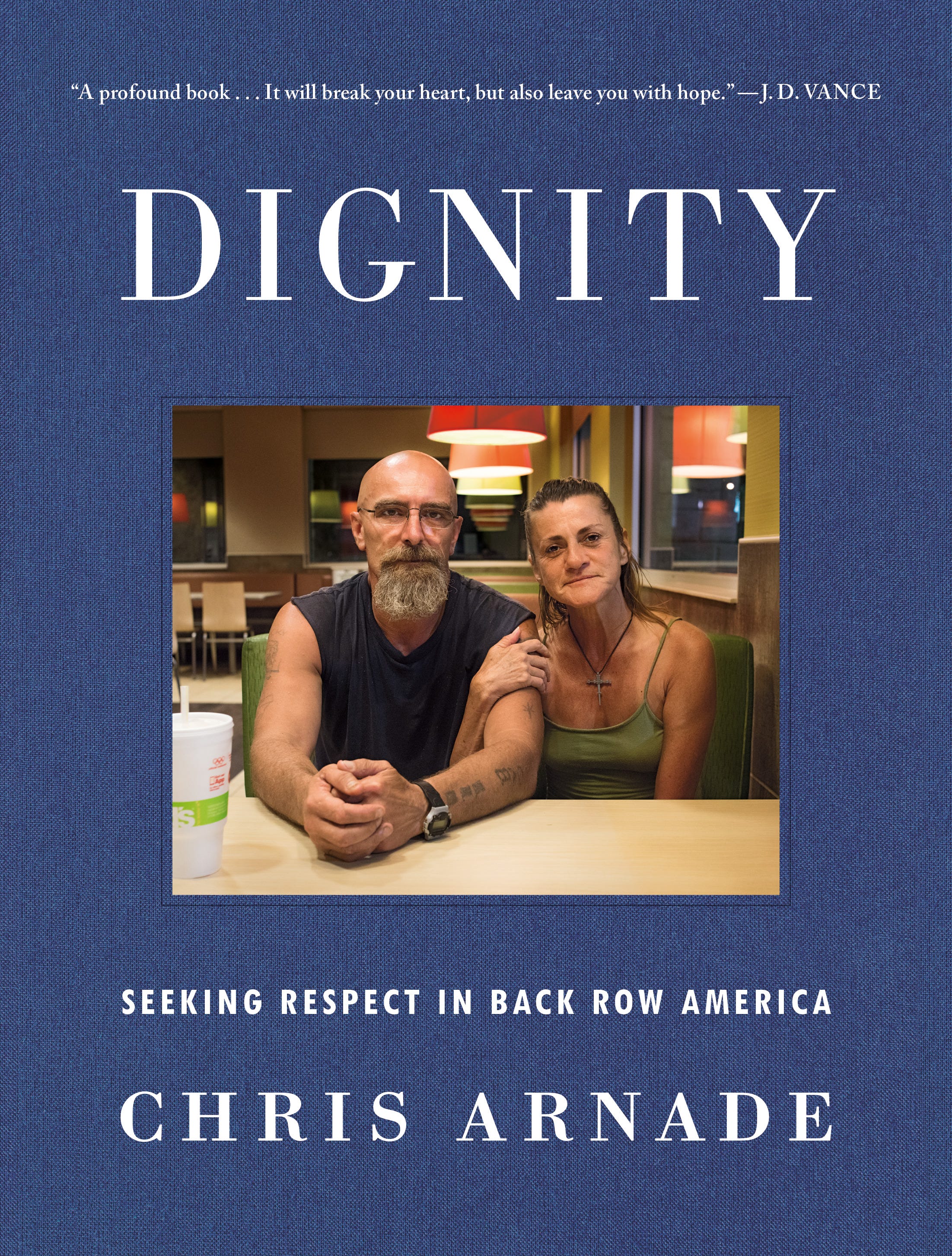
On the Lean Out podcast, we’ve talked a lot about the haves and the have-nots. My guest today has another way of thinking about this. He calls it the “front row” and the “back row.” The front row is in power. It values education, credentials, and consumerism. But the back row values different things. Things like family, faith, and place. Chris Arnade is a writer and photographer who covers poverty and addiction. He’s the author of Dignity: Seeking Respect in Back Row America. His new project is walking the world and documenting it on Substack, and he recently roamed the streets of Ukraine. He’s here today to talk about the strange, surreal moment we’re in — and how the back row/front row tensions play into it. Chris Arnade is my guest, today on Lean Out. TH: Welcome to Lean Out. CA: Thank you for having me. TH: I’m interested in speaking with you about your project, Walking the World, and some of the countries you’ve visited and written about on Substack, especially Ukraine. But first, I want to talk about how you became a wanderer. 10 years ago, you were working on Wall Street as a bond trader, living in an exclusive neighbourhood in Brooklyn, the kids were in private school. How did you find yourself walking into Hunts Point in the Bronx? CA: Walking has always been my way of exploring the world. I had a PhD in physics; I went to Wall Street when I was 28 and stayed there for 20 years. But that was more the anomaly. I did enjoy the career, but I still always had the academic, curious side. So I’d go for long walks through New York. It was my way of relaxing, decompressing. That was generally confined to weekends when I was working so hard and when the kids were tiny. As my career advanced, and I got more disillusioned, I found myself walking more often. Also, the scope of the walks changed. I walked the entire New York subway system, above line. I’m a mathematical type, so I like a goal. But then the walks became more about meeting people. I was an amateur photographer then. When I brought my camera, people would start asking me to take their pictures. It became a new way of learning. I had spent so much of my life being a math geek — very quantitative. If you asked me to approach a problem, I would go, “Well, I’ll just solve it. I’ll go to the library and find all the books and read them all and look at the data.” If you approach the world from a very quantitative, positivistic framework, that’s a framework. And we tend not to think of it that way. I started pivoting towards an experiential, ethnographic approach to life. Like, “Okay, people say Hunts Point is dangerous. Let me go see if it’s dangerous.” When you look at data, you only look at two things about Hunts Point: It has high crime and it has lots of drugs. Hunts Point, for your listeners, is considered to be the “worst” neighbourhood in the South Bronx. I think it’s New York's poorest district by metrics. But it’s 15 minutes from the Upper East Side, one of the richest. I made a point of walking into the Bronx. I saw a lot of stories and a lot of resilience. A lot that was missing if you just look at the statistics. … I quit my job on Wall Street and ended up spending four years documenting a street family of homeless addicts, people who lived in abandoned shelters, and cars under bridges, and were shooting up heroin. I ended up becoming friends with many of them. The only thing I could really do, given my skill set, was document their lives and try to bring it to a wider audience. We, the educated class, tend to filter these issues they’re dealing with through our lens. I was trying to give some insight into their perspective and how they see the world. TH: I do want to talk about the class issue. But first, can you introduce our listeners to a few of the people who really stand out to you from that time? CA: Shelly, who I’m still in contact with, is from upstate New York. I think she ended up in Hunts Point at the age of 17 or 18. She’s in and out of jail, has been on the streets for probably most of her life. She’s transgender. She works as a sex worker. She calls herself a prostitute, so I’ll use that word. She hustles. And she’s hilarious, funny. She’s a lifelong addict. It’s a rough life, but she doesn’t particularly feel sorry for herself. This is the world she knows. And that’s one of the things I try to get across — feeling sorry for someone is very demeaning. Then there is Millie, probably one of the more tragic stories. Millie was born into a very bad situation. I met Millie at two in the morning. She was on the street. She told me her whole life story. I always printed what people told me without doing “journalism” and fact-checking. Her arm was always bandaged; she made a point of not letting me photograph her arm because she was embarrassed by it. I remember seeing her in the laundromat late one night around Christmas. She looked very, very bad. So I offered to drive her back to her home. That was it; she disappeared. After two months, I started getting worried and I went and searched for her. I did the journalism. I found that she had died with no papers. If you die in New York City with no papers, and no claim on your body after three months, they bury you in a place called Hart Island. Which is a story unto itself. It’s got over a million bodies buried in trenches. It’s been there since 1870, a small island off the Bronx. It’s the paupers grave, and you’re not allowed to visit it traditionally. Due to the work of one woman who made this her lifelong project, you can now visit it once a month. We ended up getting Millie exhumed. I found what exists of her family and we ended up getting her properly buried. That was a real moment in my life. Because if you had talked to old me, the scientific me, I would say, “What does it matter where you’re buried?” But I remember one of her friends saying, “You only really die when people start forgetting about you.” If you’re buried in a mass grave on Hart Island and nobody can visit, it’s easy to forget about you. So that was a real moment of like, “Ah, yes, there’s these spiritual things that I used to dismiss.” I think about Millie a lot. She ended up having died of that wound. She would shoot heroin into her wound and that ended up getting infected. TH: [In talking about spirituality] you’re touching on a different value system. This is something that you write about in the book, in terms of the front row of America and the back row. The front row values consumerism and credentialism, but the back row values other things, like faith, like place. Tell me about that conception. CA: That’s been the hardest thing to get across to people. I got a PhD in physics. So, I’m not here to dismiss education. It’s wonderful, and that’s the life I live. But we have a worldview. And it’s one that we don’t question as a worldview because we think it’s right. It leads to what I call intellectual colonialism. We believe that everybody should share our worldview. That worldview is pretty simple; it’s very materialistic. What is valuable is what you can measure. So, things that are unmeasurable — what I’d call transcendent qualities, or non-credentialed forms of meaning, things you can’t put on a resume — are dismissed. Things like faith, like family, place. These things that you can’t trade in the marketplace are actually deeply important to people. And in a very non-elitist way, in the sense that they’re free. You don’t need to go to college to find the power of God, or Allah. You don’t need to study to appreciate the town where you’re from; you’re gifted that at birth. These are things that are free for everybody. And when you demean them, it’s a very elitist framework. We’re saying that the only things that are really valuable are the things that we can acquire through education. Place is really important. The meme of “just move, idiot” is so condescending. It’s wrapped in a scorn of provincialism — that you shouldn’t want to stay your entire life in the same … This is a public episode. If you would like to discuss this with other subscribers or get access to bonus episodes, visit tarahenley.substack.com
Embed this episode
No transcript yet.