
EPISODE · Nov 21, 2024 · 18 MIN
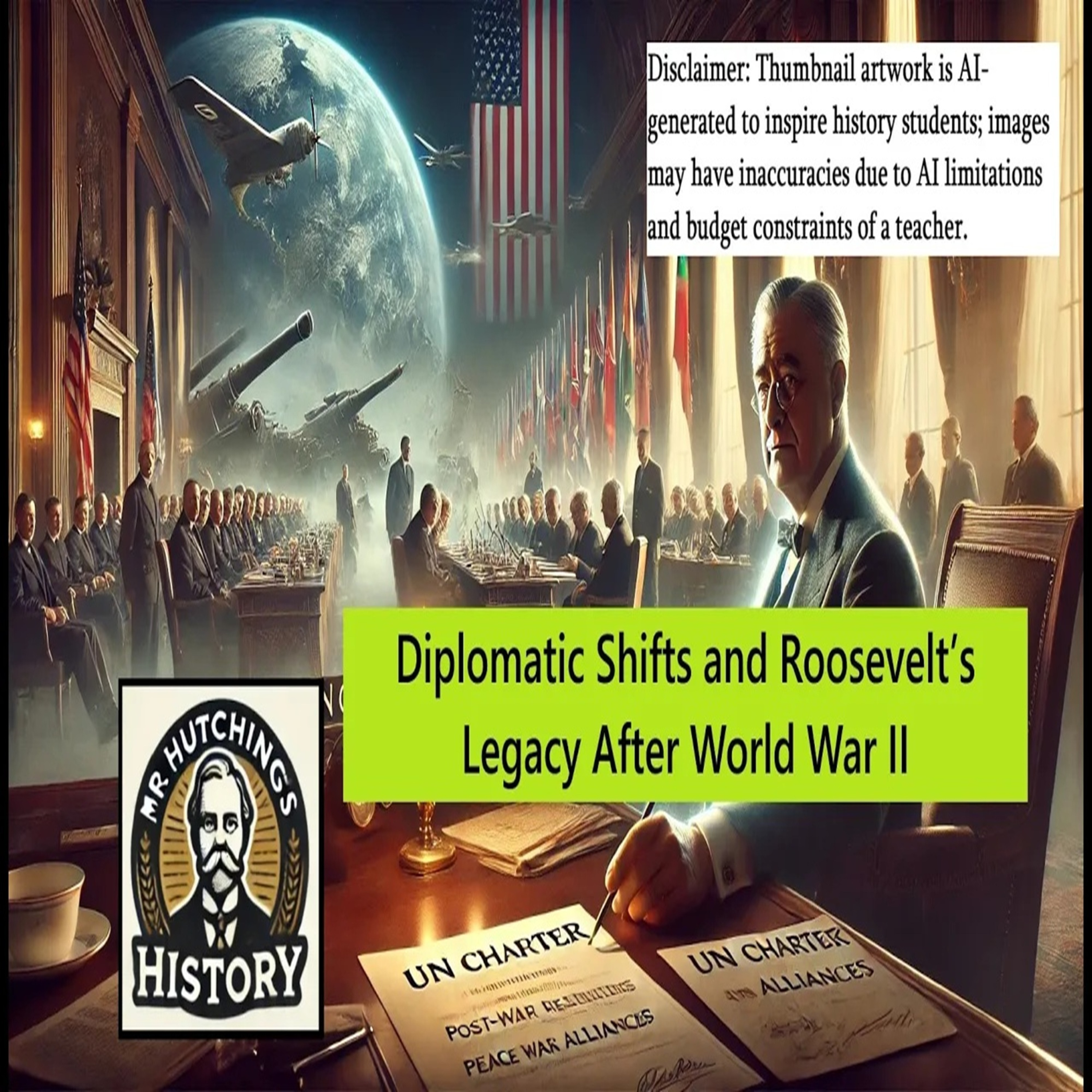
Diplomatic Shifts and Roosevelt’s Legacy After World War II
from Mr. Hutchings History · host Produced, created, and written by Harold M. Hutchings
Welcome to Mr. Hutchings History! In today’s episode, we explore President Franklin D. Roosevelt’s diplomatic legacy and its lasting impact on the global order after World War II. As the United States emerged as a global superpower, Roosevelt’s vision for international cooperation, shaped through his work with Winston Churchill and Joseph Stalin, played a crucial role in establishing a new world order. We’ll examine Roosevelt’s commitment to liberal democracy and the United Nations, his strategic alliance with Stalin, and how his approach to post-war diplomacy helped shape the early Cold War tensions. Was Roosevelt’s alliance with Stalin a calculated risk, or did it allow Soviet expansion in Eastern Europe? What if Roosevelt had lived longer—could he have prevented or delayed the Cold War? We’ll analyze the different schools of historical thought, from orthodox to revisionist perspectives, to better understand the complexities of Roosevelt's post-war diplomacy and his influence on the geopolitical landscape. #RooseveltLegacy #ColdWar #DiplomaticHistory #WWIIDiplomacy #PostWarWorld #UNFormation #SovietUnion #Stalin #USSR #HistoryPodcast #FDR #PostWarDiplomacy #GlobalSuperpower #YaltaConference #PotsdamConference #MarshallPlan #Geopolitics #USHistory #ColdWarOrigins Works Cited Gaddis, John Lewis. The Cold War: A New History. Penguin, 2005. Judt, Tony. Postwar: A History of Europe Since 1945. Penguin, 2005.Leffler, Melvyn P. The Specter of Communism: The United States and the Origins of the Cold War, 1917-1953. Hill and Wang, 1994.McNeill, William H. America, Britain, & Russia: Their Cooperation and Conflict, 1941-1946. Oxford UP, 1953.
Embed this episode
NOW PLAYING
Diplomatic Shifts and Roosevelt’s Legacy After World War II
No transcript for this episode yet
Similar Episodes
No similar episodes found.
Similar Podcasts
No similar podcasts found.