
EPISODE · Feb 12, 2026 · 15 MIN
Divide-and-Conquer CoT: RL for Reducing Latency via Parallel Reasoning
from Best AI papers explained · host Enoch H. Kang
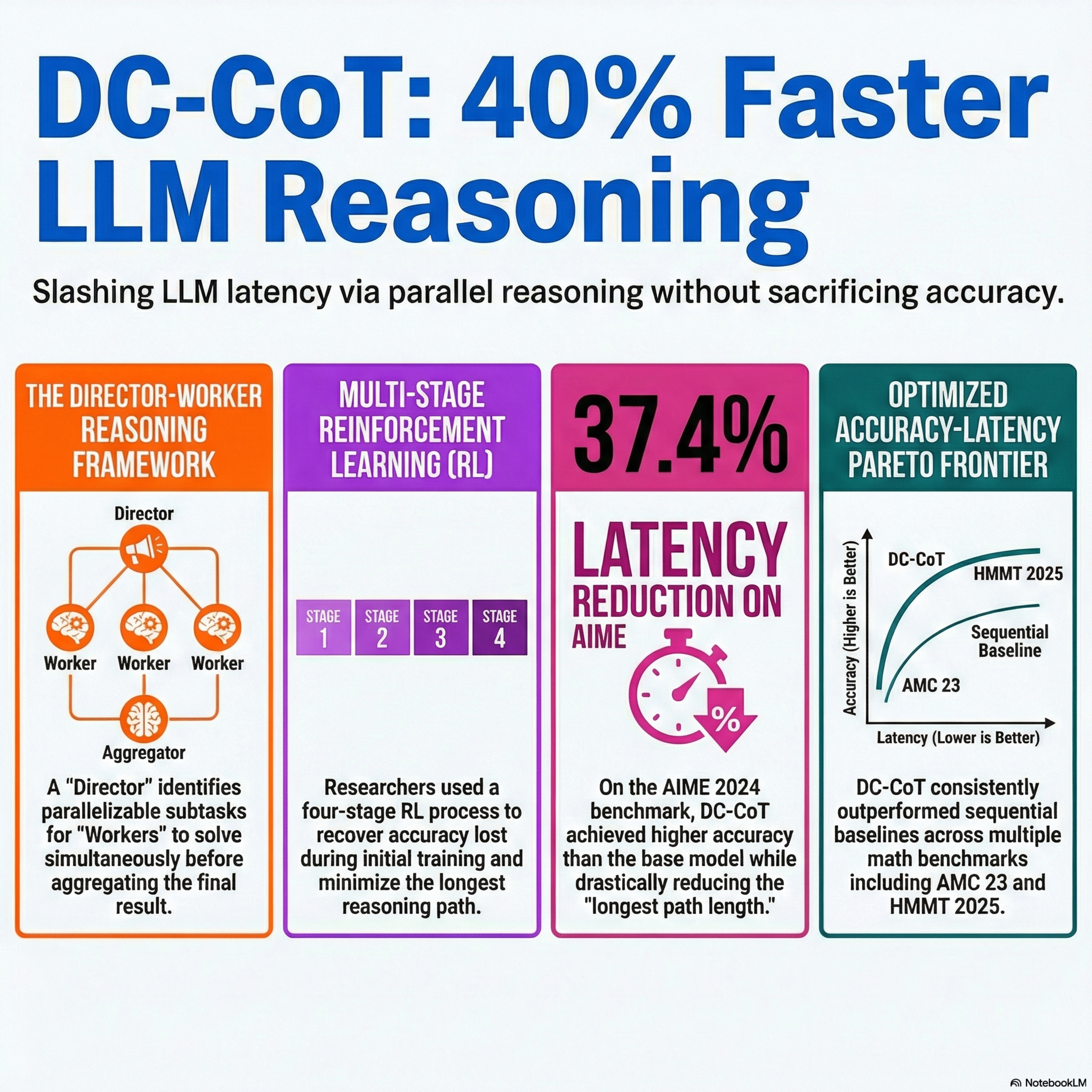
This paper introduces Divide-and-Conquer CoT (DC-CoT), a novel method for reducing the high latency of large language models during complex reasoning tasks. While traditional models generate thoughts sequentially, DC-CoT allows the model to act as a director that identifies parallelizable subtasks and assigns them to independent workers. This multi-agent framework significantly decreases the longest path length of reasoning tokens without sacrificing mathematical accuracy. The researchers utilized a multi-stage reinforcement learning approach to refine the model's ability to structure these parallel threads effectively. Ultimately, the method achieves a 35-40% reduction in latency across several competitive math benchmarks. Their findings suggest that parallel thinking is a specialized skill that can be explicitly taught to improve inference-time efficiency.
Embed this episode
Ready to play
Divide-and-Conquer CoT: RL for Reducing Latency via Parallel Reasoning
No transcript for this episode yet
Similar Episodes
No similar episodes found.