
EPISODE · Apr 9, 2026 · 29 MIN
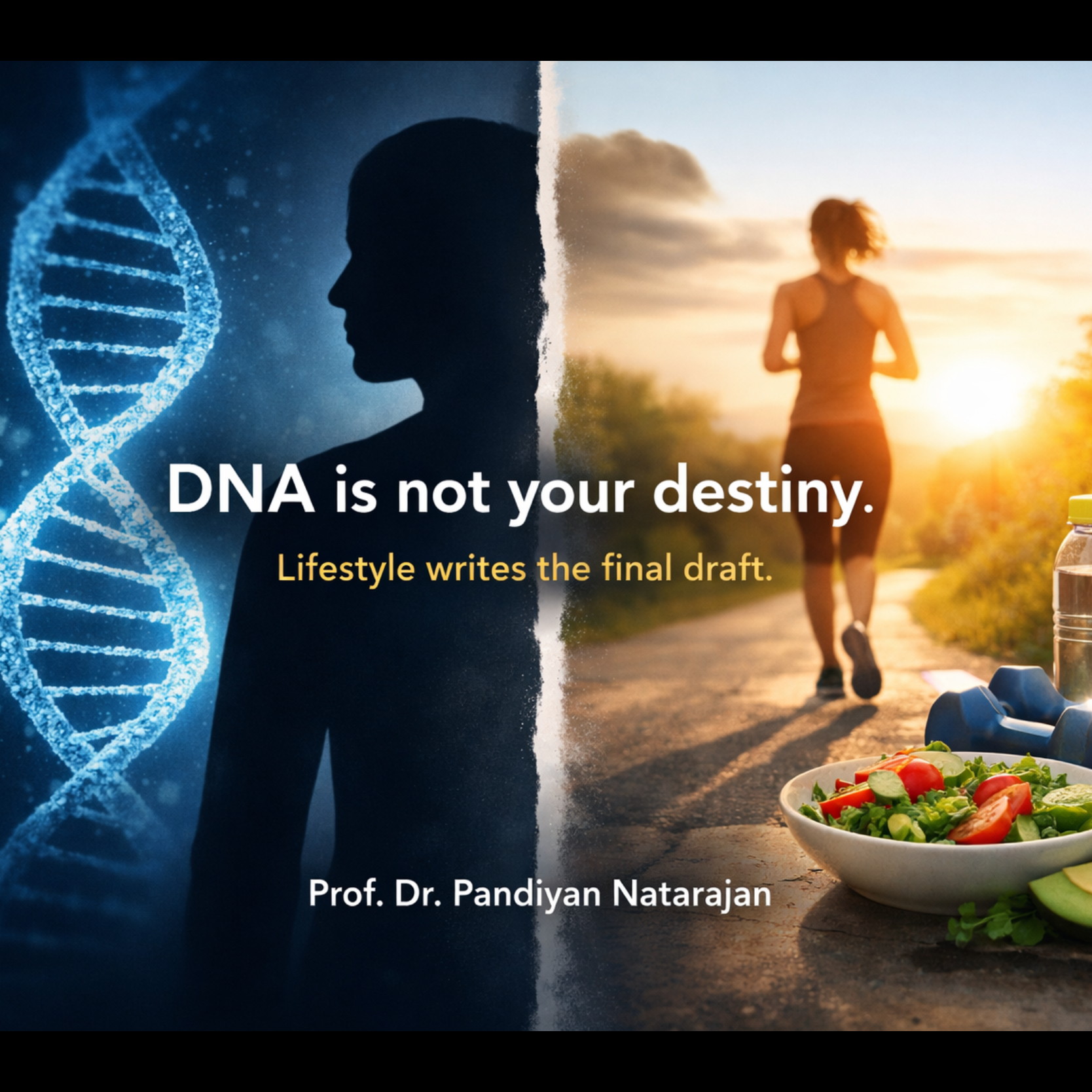
DNA Is (Mostly) Not Our Destiny.Why you cannot always blame your genes
from Diabesity Decodified - Is Food the root cause of Type 2 Diabetes Mellitus pandemic?
DNA Is (Mostly) Not Our Destiny.Why you cannot always blame your genesThere has always been a quiet, persistent debate:Are our lives written in our genes, or do we have more control than we think?The answer, reassuringly, lies somewhere in between.Genes Are the Blueprint — Not the ScriptThink of genes as a blueprint.They outline what is possible. But a blueprint does not build a house.The final structure depends on the quality of materials, the skill of the builder, the environment, and even unexpected disruptions along the way.This is where epigenetics comes in.Epigenetics is like site supervisor — deciding which parts of the blueprint are followed, which are ignored, and when certain instructions are activated. The term Epigenetics literally means “above” or “on top of” genetics.What you eat, how you live, your stress levels, your environment — all of these influence how your genes behave.Genes Load the Gun. Epigenetics Pulls the Trigger.It is not a perfect analogy — but it captures something essential.You may carry genetic variants that increase your risk for conditions like diabetes, heart disease, or depression. But those risks often remain silent unless triggered by environmental factors.A family history of Type 2 Diabetes Mellitus does not make your diagnosis inevitable.Equally, the absence of such a history does not guarantee protection.What often matters most is what happens in between — particularly lifestyle factors like weight gain, diet, and physical activity.The Exception That Proves the RuleThere are conditions where genes are overwhelmingly deterministic.Single-gene disorders like Huntington’s disease are examples. But these are rare.For most of the conditions that concern us — obesity, metabolic syndrome, cardiovascular disease, even aspects of mental health — genetics is probabilistic, not fatalistic.We often use the term “polygenic” to describe these conditions. Sometimes, that is simply an honest admission of complexity — not a failure of understanding.Your Mother — and Even Your Grandmother — MatterYour biological story does not begin at birth.It begins in the womb.Your mother’s nutrition, stress levels, and health during pregnancy influence your epigenetic profile. And intriguingly, your grandmother plays a role too — because the egg that eventually became you was already forming within your mother when she herself was still a fetus.This is not poetic exaggeration. It is biology.You carry echoes of their environment — their nutrition, their stress, their world.A Concrete Example: Type 2 DiabetesConsider two individuals who both gain significant weight.One has a genetic predisposition → develops Type 2 DiabetesThe other does not → develops obesity, but not diabetesSame exposure. Different outcomes.Genes & environment are not competitors.They are partners — constantly interacting, constantly negotiating.So, What Should We Tell Ourselves?Do not blame your genes for everything.They are neither your judge nor your jailer.At the same time, do not ignore them.Know your family history. Respect your biological predispositions. But also understand this:Your daily choices — what you eat, how you move, how you manage stress — are in continuous conversation with your genes.You are not a passive recipient of your biology.You are an active participant.The TakeawayGenetics loads the gun.Epigenetics decides whether it fires.Your fate is not written in your DNA alone.It is co-authored — every day — by how you live.
Embed this episode
Ready to play
DNA Is (Mostly) Not Our Destiny.Why you cannot always blame your genes
No transcript for this episode yet
Similar Episodes
No similar episodes found.
Similar Podcasts
No similar podcasts found.