Does an AI Drafted S-1 Change Section 11 Liability
from The Innovation Attorney Podcast Hosted by The Innovation Attorney
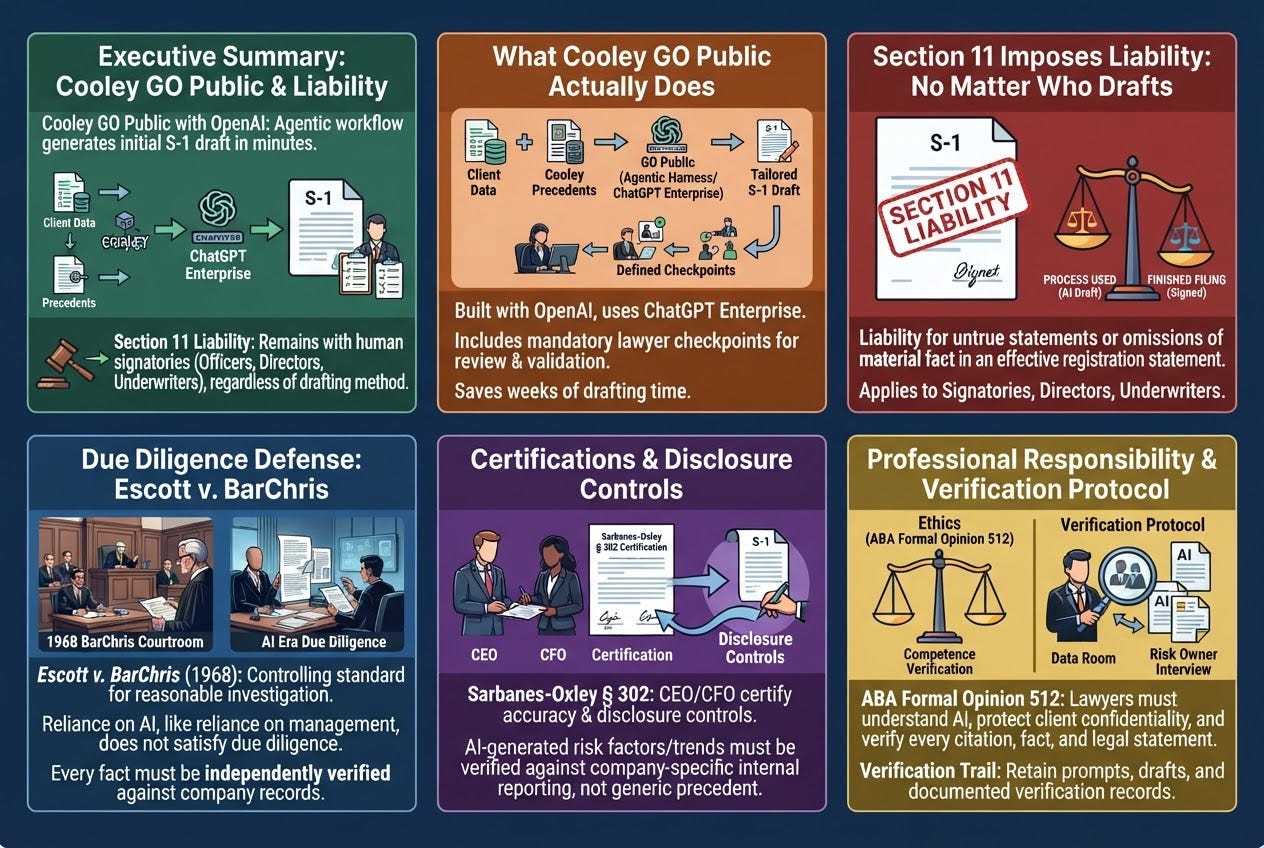
On September 17, 2026, Cooley LLP turned on GO Public, an artificial intelligence tool built with OpenAI that drafts the initial version of a Form S-1 registration statement in minutes rather than the days a first year associate used to need. Every general counsel watching a public offering approach in 2026 should read the announcement carefully, because the tool changes who types the first draft of the most consequential document a company will ever file, and it changes nothing about who answers for what that document ultimately says. Cooley’s own materials describe GO Public as running on ChatGPT Enterprise, built with an agentic workflow that OpenAI’s forward deployed engineers helped assemble specifically for this task. The system pulls in a company’s financial and operational data, cross references Cooley’s decades of precedent filings, and hands back a tailored starting draft, with checkpoints built into the workflow where a human lawyer has to sign off before the process moves to the next section. Cooley Chief Innovation Officer David Wang called it a way of bringing intelligence to every step of the drafting process, and capital markets co-chair Dave Peinsipp described the payoff as freeing lawyers to spend their time on the judgment calls that shape a transaction instead of the mechanical first pass. Cooley has the precedent library to make that credible: the firm advised on 180 venture financings and public offerings worth 51.5 billion United States Dollars in 2025 alone, and it has led more venture backed initial public offerings than any other firm over the past two decades. None of that changes the liability math. Section 11 of the Securities Act of 1933 creates what amounts to a strict liability claim: if a registration statement contains an untrue statement of material fact, or omits one required to make the statements not misleading, the company, every signer, every director, and every named underwriter can be sued, and the purchaser does not have to prove reliance or even that the misstatement caused the loss. The one way out, for everyone except the company itself, is the due diligence defense in Section 11(b)(3): show that you conducted a reasonable investigation and had reasonable grounds to believe the statement was true. The demanding version of that standard has a name in every securities lawyer’s memory: Escott v. BarChris Construction Corp., decided by a federal district court in 1968. The company built bowling alleys on borrowed money, the registration statement overstated sales and understated liabilities, and when the offering collapsed the court went through the due diligence defense director by director. Outside directors who trusted management’s representations lost the defense. The company’s own lawyer, who signed the registration statement as a director, lost it too, because signing off on what he was told was not the same as independently checking the company’s books and contracts. Nothing about that opinion turns on who or what physically typed the sentence under review, which is exactly why it still governs an S-1 that GO Public helped produce fifty eight years later. A large language model does not sit for a deposition. It has no license to lose and no partnership share to forfeit. The humans who sign a Cooley GO Public draft inherit BarChris in full, which means the verification work does not shrink because the first draft arrived faster. The professional responsibility rules already say so directly. The American Bar Association’s Formal Opinion 512, issued in July 2024, tells lawyers that using a generative AI tool does not relax the duty to independently verify every fact and citation before a filing goes out, and that confidentiality rules require actual client consent before a matter’s information enters a system like this one, not a boilerplate clause buried in an engagement letter written before anyone had heard of ChatGPT. The opinion exists because lawyers had already gotten burned. In Mata v. Avianca, a New York attorney filed a brief full of cases ChatGPT invented out of whole cloth, nobody on either side could find them because they did not exist, and the presiding judge sanctioned him for filing without checking. A Form S-1 has no docket number, but an SEC examiner reading a risk factor section for internal consistency is doing exactly the verification work that lawyer skipped. The Securities and Exchange Commission has already shown what it does with unverified AI claims, just not yet inside an S-1. In March 2024 the agency fined Delphia, a Toronto investment adviser, 225,000 United States Dollars for claiming it used artificial intelligence to predict which companies were about to take off without being able to back up the claim, and fined Global Predictions 175,000 United States Dollars the same day for calling itself the first regulated AI financial adviser and for disclaimer language that looked like it waived rights clients cannot actually waive. Neither company was going public. Both cases show an agency willing to test an AI related sentence against the facts behind it, which is precisely the posture a company describing its own AI capabilities in a registration statement business section should expect, and the posture a reviewer will likely bring to a filing an AI tool helped draft in the first place. So what does a startup’s outside counsel actually do with a GO Public draft that just landed in the inbox. Treat it exactly like a draft from a very fast, very well read, first year associate who has never sat in the company’s boardroom. Every number gets traced to a specific document in the data room by a named person, not waved through because it reads smoothly. Every risk factor gets its own conversation with the officer who actually owns that risk, because the 2020 amendments to Item 105 of Regulation S-K require company specific language, and precedent language pulled from other filings drifts toward the boilerplate those amendments were written to kill. The prompts and the draft outputs belong in the deal file next to the due diligence memoranda, because a documented verification trail is the modern version of the paper trail that decided who walked away clean in BarChris and who did not. No court has yet had to decide whether a hallucinated risk factor that slipped through an AI assisted draft can support a Section 11 claim of its own, separate from the business risk it was supposed to describe, and no insurer has yet said out loud whether a documented AI verification protocol will become a condition of a law firm’s malpractice coverage. Both questions will get answered by somebody’s bad outcome before they get answered by a rule. The next piece in this series looks at what happens on the other side of the negotiating table, when a venture fund’s own counsel starts asking whether a portfolio company’s S-1 was drafted with AI assistance, and what that means for the fund’s own diligence file. Interested in analysis about the intersection of tech, policy and the law? Check out my Substack channel. https://theinnovationattorney.substack.com/ This is a public episode. If you'd like to discuss this with other subscribers or get access to bonus episodes, visit theinnovationattorney.substack.com/subscribe
Embed this episode
No transcript yet.