
EPISODE · Jan 27, 2026 · 9 MIN
Does Dark Matter Have A Sense of Humor?
from Bowne Report Podcast · host Jon Bowne
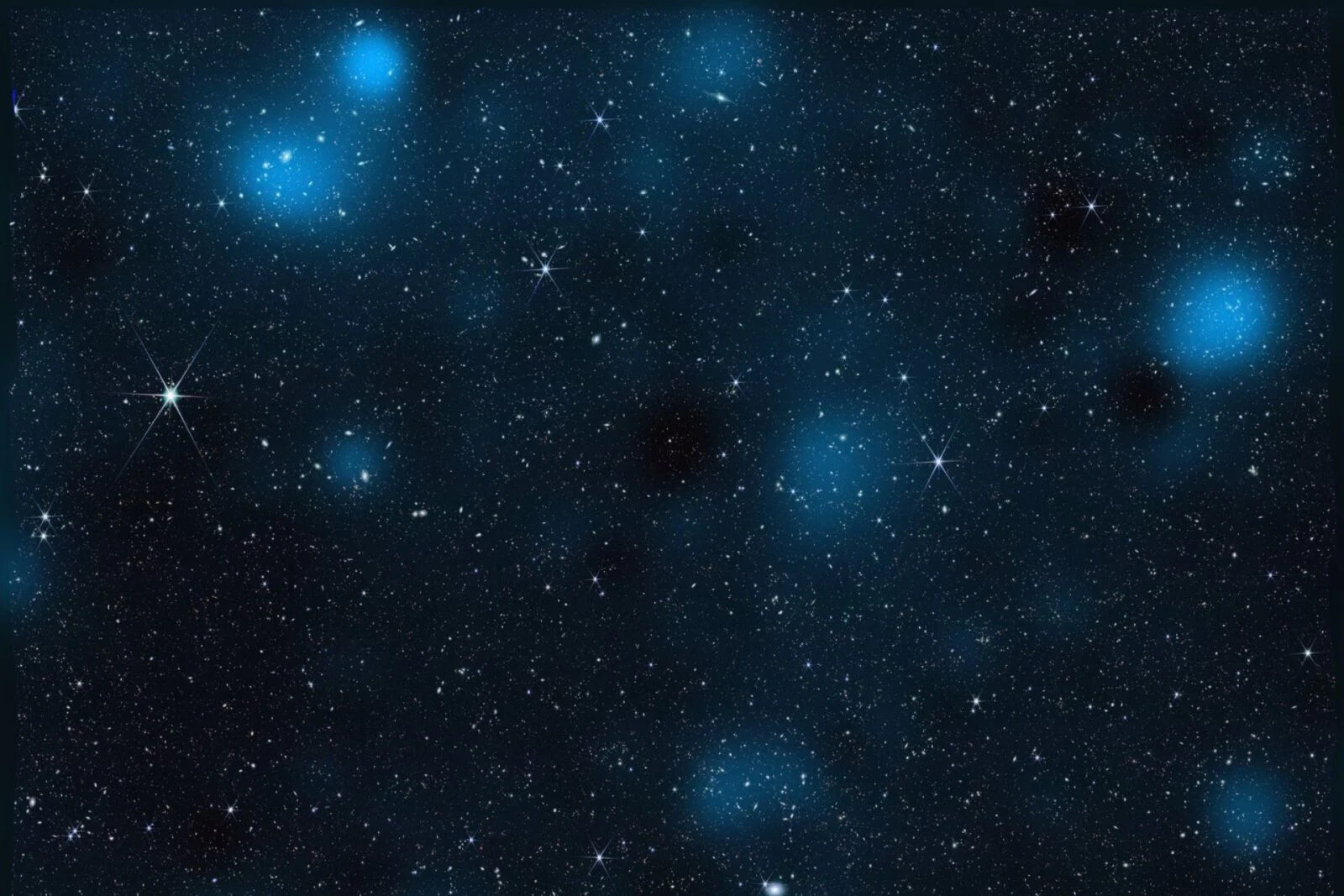
This image from NASA’s James Webb Space Telescope, containing nearly 800,000 galaxies, is overlaid with a map of dark matter, represented in blue © NASA/STScI/J. DePasquale/A. PaganSometimes the news becomes so dark, that it zaps the gratitude we humans naturally carry for this plane of existence. We get locked into the shark tank snapping up fear chum to keep our big world in focus. Pushing cortisol levels until the bell rings and we pass out….recharging for another round. Gratitude tends to reset whatever ails your speeding mind and taps you back into the mystery we all share whether we know it or not. Yes, the droning rhetoric of angry confused humans pining away another day on Planet Earth with their platitudes and tunnel visions can be muffled out by the gratitude we all share for the darkest of matters. The mind numbing dumbfounding conundrum of them all…..of course I am talking about……dark matter.The recent news out of the cosmos is that a team using NASA’s James Webb Space Telescope that has drawn the most intricate map yet of dark matter’s distribution across a sizable chunk of the sky. Almost three times the area of the full moon, if you can picture that without getting dizzy. It’s not a photograph, of course, because dark matter refuses to pose for pictures. Instead, it’s a map of gravitational fingerprints, the way invisible scaffolding bends light from distant galaxies, revealing where the stuff must be lurking. Good old ordinary matter, stars, planets, us, makes up about five percent of the universe’s contents. 5 PERCENT. Until ordinary matter collapses into a black hole.Dark matter claims roughly 27 PERCENT. Yes the capitalization is for jaw dragging emphasis of an entirely different form of matter over 5 times our perceivable existence. And the rest…..68 PERCENT is dark energy, that other polite mystery accelerating everything apart. So here we are, finally getting a sharper look at the scaffolding that holds galaxies together while they politely pretend not to notice it’s there.Dark matter’s story begins in the 1930s with Fritz Zwicky, a Swiss astronomer who had a short temper and a telescope. He studied the Coma Cluster and noticed the galaxies were moving far too fast to stay bound by the gravity of the visible stuff alone. They should have flown apart like children scattering out to recess, but they didn’t. Zwicky, with little patience for platitudes called the missing mass “missing mass,” then later “dark matter,” and went on being grumpy about it. Nobody paid much attention for decades. People figured he was probably wrong, or overexaggerating, or on the verge of darker days.Then in the 1970s Vera Rubin, a kinder soul with better data, looked at spiral galaxies and found the same thing on a larger scale. Stars at the edges orbited just as fast as those near the center, which made no sense unless there was a great deal of unseen mass spread out in a halo around each galaxy. Rubin measured rotation curves that stayed flat when they should have dropped off, and the curves said, quietly but firmly, “Something is here that isn’t shining.” But she didn’t go shouting at astronomers about it. She just kept plotting points.Since then, astrophysicists, learned dark matter clumps into halos that cradle galaxies like eggs in a carton. It forms a cosmic web, filaments and walls and voids, that ordinary matter follows like iron filings around a magnet. We know it doesn’t interact much with light or ordinary matter except through gravity. And it’s not out there in some distant cold hyper corner of the galaxy. It is passing through you right now, billions of particles per second, without so much as a hello or a how’s it going? We know it’s cold, or at least moves in slow motion compared to hotter alternatives, because that’s what fits the large scale structure we can see. Again, and it stands to repeat it, we know there is about five times more of it than ordinary matter. We even know, from the cosmic microwave background and big bang nucleosynthesis, that it isn’t just run of the mill yet fascinating hidden ordinary stuff like dim stars or black holes or rogue planets. It has to be something exotic, some new particle or an unknown family of particles. Bounded in a nutshell but still counting itself the king of infinite space.Similar to the human known as Al Gore. What we don’t know could fill several universes. We don’t know what it is. The leading suspect used to be WIMPs or weakly interacting massive particles. But detectors like LUX-ZEPLIN and XENON have looked hard in recent years and found nothing in the expected mass range, pushing the goalposts farther out or sideways. Axions are popular now, light and wavy subatomic particles perhaps born in the early universe. Primordial black holes have had a revival lately, though most data frowns at them. We don’t know if dark matter is one thing or many. We don’t know if it self interacts or has its own subtle forces. We don’t know why it outweighs ordinary or if you prefer baryonic matter by such a lopsided margin, or why the universe arranged the proportions just so.There have been subtle hints along the way. Nods to a gamma ray excess from the galactic center that some say smells like dark matter annihilation according to a University of Tokyo analysis late last year that claimed a match, but others blame pulsar interference or astrophysical shenanigans. Underground experiments keep tightening noose after noose around spelunking in parameter space an extremely boring term for the mind blowing multiple dimensions. And now this new James Web Space Telescope map, just released in Nature Astronomy, shows dark matter and ordinary matter growing up together like siblings, intertwined in the same places from the start, like galactic twins who never quite separated. It doesn’t tell us what dark matter is, but it reminds us how patiently it has shaped everything we can see.So here we sit, on a small blue planet, mapping shadows we can’t touch, while the universe keeps most of its secrets in the dark. It’s a funny way to run a cosmos, if you ask me. But then, nobody asked. At least within the 5 PERCENT of my perception.So after all that has been said, It’s invisible. It’s all around us. And we have no idea what it really is. Even the brightest minds on Earth still have zero clue. Dark matter is all the proof we need that as smart as we might think we are, as confident the Sophists on our TV screens, podiums, and social media bubbles pretend to be. They don’t have a damn clue. And it’s likely the dark matter is laughing at us all.Please subscribe to the Bowne Report on substack and/or engage with me on X @NewsBowne. Jon Bowne reporting. This is a public episode. If you'd like to discuss this with other subscribers or get access to bonus episodes, visit bownereport.substack.com/subscribe
Embed this episode
NOW PLAYING
Does Dark Matter Have A Sense of Humor?
No transcript for this episode yet
Similar Episodes
No similar episodes found.
Similar Podcasts
No similar podcasts found.