
EPISODE · Feb 8, 2026 · 15 MIN
Downstream Digital Twins: Predicting Performance and Managing Process Drift
from Biomanufacturing & Fermentation Technology · host prasad ernala
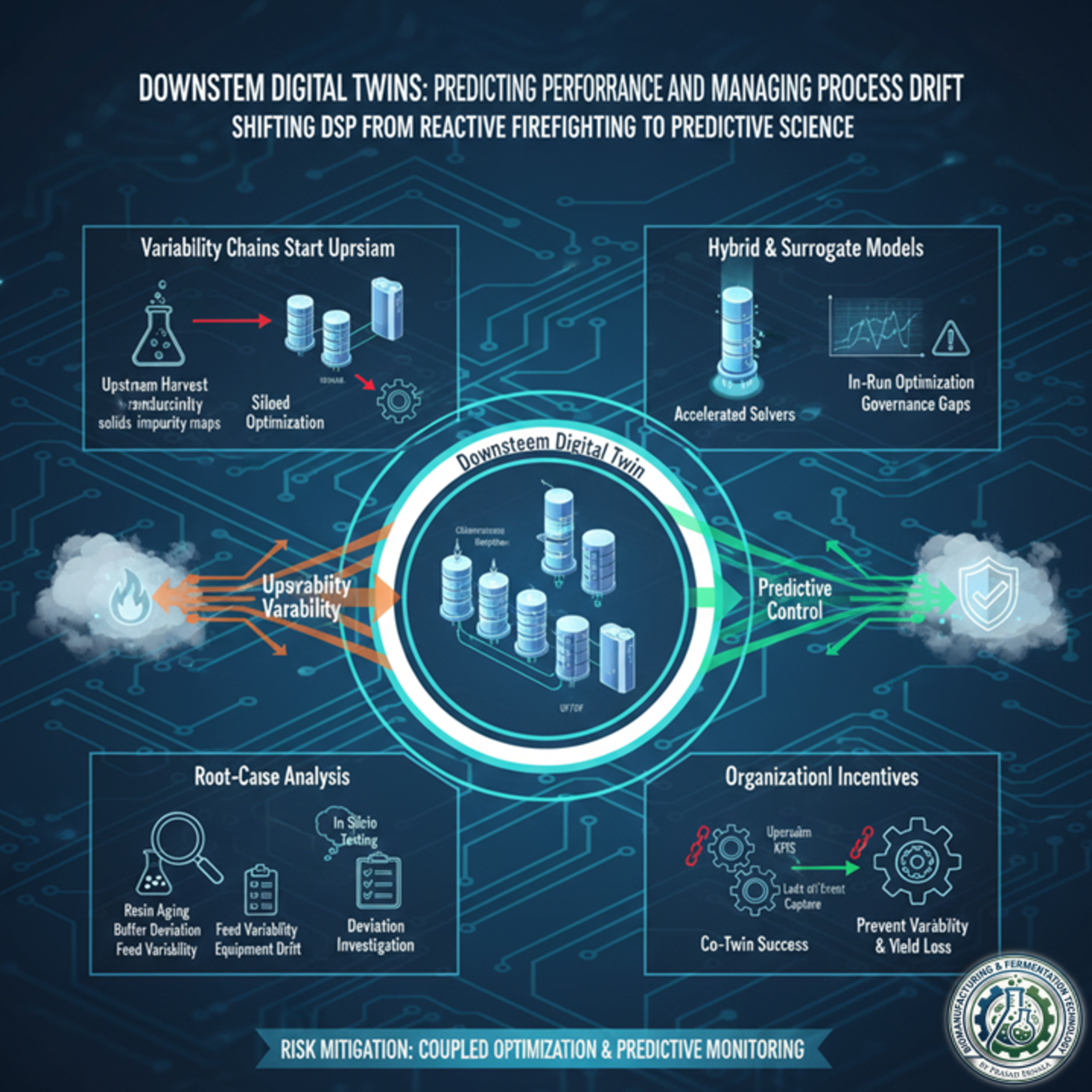
Downstream bioprocessing is often unstable due to upstream variability and equipment aging. Digital twins use mechanistic and hybrid models to predict fouling, optimize chromatography, and perform root-cause analysis, shifting DSP from reactive craft to predictive science.Downstream Digital Twins Are Shifting DSP From Reactive Firefighting to Predictive ControlMechanistic and hybrid digital twins across clarification, chromatography, and UF/DF are enabling earlier detection of fouling, breakthrough drift, and endpoint risk, before yield and schedule are lost.DSP Failures Are Rarely Single-Point Issues. Variability Chains Start Upstream and Surface DownstreamIndustry evidence reinforces that harvest properties such as viscosity, conductivity, solids, and impurity maps act as boundary conditions that dominate DSP performance, challenging siloed optimization models.Hybrid and Surrogate Models Are Making Mechanistic Chromatography Usable in Real TimeAccelerated solvers built on mechanistic foundations are emerging as practical tools for in-run optimization and hypothesis testing, though governance gaps remain a major adoption risk.Root-Cause Analysis Is Becoming a Primary Value Driver for DSP Digital TwinsInstead of post-hoc opinions, digital twins are increasingly used to test resin aging, buffer deviation, feed variability, and equipment drift in silico, supporting continued process verification and deviation investigations.Organizational Incentives, Not Technology, Are the Biggest Barrier to Co-Twin SuccessWithout shared upstream–downstream KPIs and robust event capture, digital twins risk becoming sophisticated blame-assignment tools rather than systems that prevent variability and yield loss.#Bioprocess #ScaleUp and #TechTransfer,#Industrial #Microbiology,#MetabolicEngineering and #SystemsBiology,#Bioprocessing,#MicrobialFermentation,#Bio-manufacturing,#Industrial #Biotechnology,#Fermentation Engineering,#ProcessDevelopment,#Microbiology,#Biochemistry,#Biochemical Engineering, #Applied #MicrobialPhysiology, #Microbial #ProcessEngineering, #Upstream #BioprocessDevelopment, #Downstream Processing and #Purification,#CellCulture and #MicrobialSystems Engineering, #Bioreaction #Enzymes, #Biocatalyst #scientific #Scientist #Research
What this episode covers
Downstream bioprocessing is often unstable due to upstream variability and equipment aging. Digital twins use mechanistic and hybrid models to predict fouling, optimize chromatography, and perform root-cause analysis, shifting DSP from reactive craft to predictive science.Downstream Digital Twins Are Shifting DSP From Reactive Firefighting to Predictive ControlMechanistic and hybrid digital twins across clarification, chromatography, and UF/DF are enabling earlier detection of fouling, breakthrough drift, and endpoint risk, before yield and schedule are lost.DSP Failures Are Rarely Single-Point Issues. Variability Chains Start Upstream and Surface DownstreamIndustry evidence reinforces that harvest properties such as viscosity, conductivity, solids, and impurity maps act as boundary conditions that dominate DSP performance, challenging siloed optimization models.Hybrid and Surrogate Models Are Making Mechanistic Chromatography Usable in Real TimeAccelerated solvers built on mechanistic foundations are emerging as practical tools for in-run optimization and hypothesis testing, though governance gaps remain a major adoption risk.Root-Cause Analysis Is Becoming a Primary Value Driver for DSP Digital TwinsInstead of post-hoc opinions, digital twins are increasingly used to test resin aging, buffer deviation, feed variability, and equipment drift in silico, supporting continued process verification and deviation investigations.Organizational Incentives, Not Technology, Are the Biggest Barrier to Co-Twin SuccessWithout shared upstream–downstream KPIs and robust event capture, digital twins risk becoming sophisticated blame-assignment tools rather than systems that prevent variability and yield loss.#Bioprocess #ScaleUp and #TechTransfer,#Industrial #Microbiology,#MetabolicEngineering and #SystemsBiology,#Bioprocessing,#MicrobialFermentation,#Bio-manufacturing,#Industrial #Biotechnology,#Fermentation Engineering,#ProcessDevelopment,#Microbiology,#Biochemistry,#Biochemical Engineering, #Applied #MicrobialPhysiology, #Microbial #ProcessEngineering, #Upstream #BioprocessDevelopment, #Downstream Processing and #Purification,#CellCulture and #MicrobialSystems Engineering, #Bioreaction #Enzymes, #Biocatalyst #scientific #Scientist #Research
NOW PLAYING
Downstream Digital Twins: Predicting Performance and Managing Process Drift
No transcript for this episode yet
Similar Episodes
Apr 21, 2026 ·13m
Apr 19, 2026 ·16m
Apr 17, 2026 ·13m
Apr 13, 2026 ·11m
Apr 11, 2026 ·16m