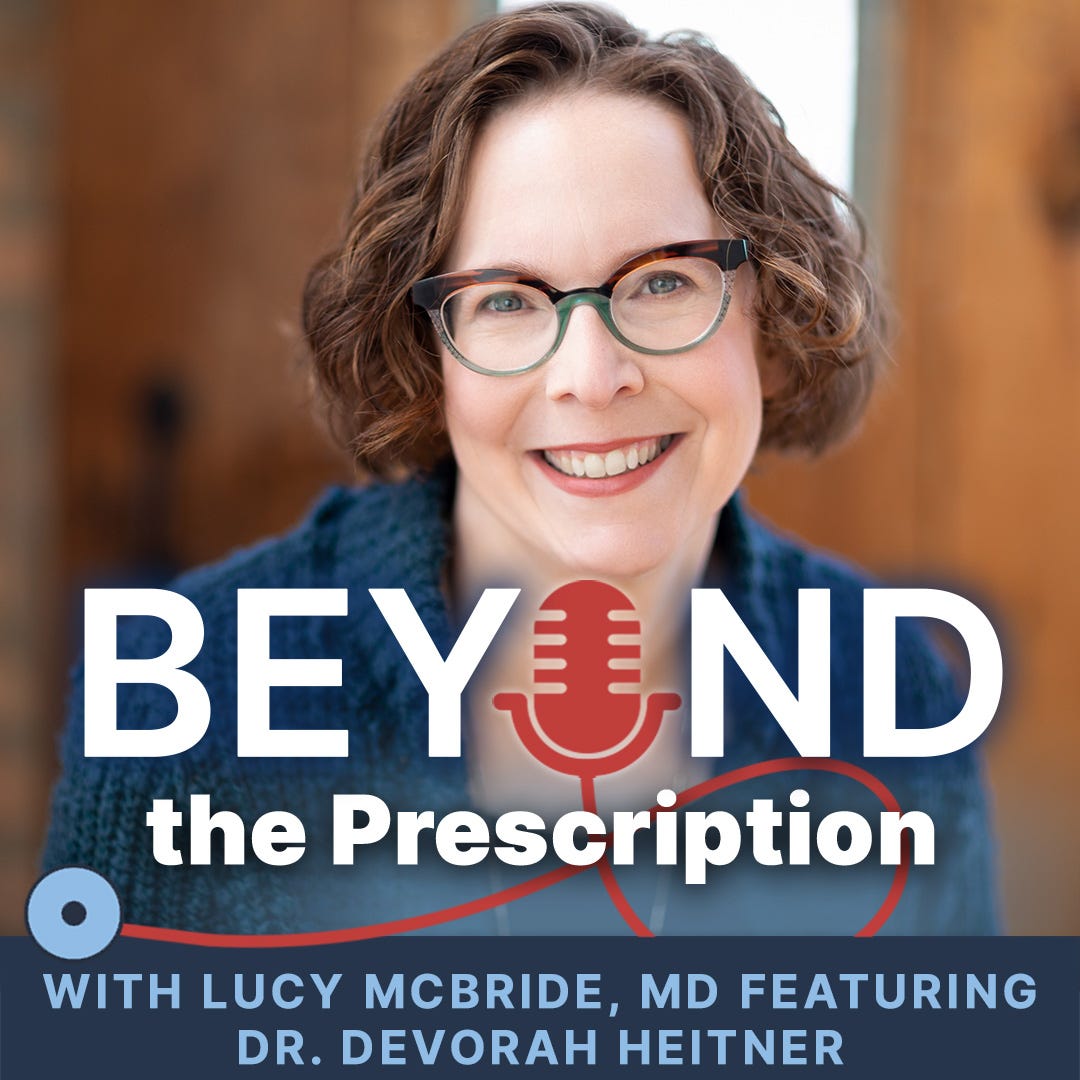
Dr. Devorah Heitner on Growing Up in Public
from Beyond the Prescription Hosted by Dr. Lucy McBride
You can also listen to this episode on Spotify! It’s hard enough for adults to navigate anxiety, lack of privacy, and social relationships in the digital era. How can we expect young people to do it? On this episode of Beyond the Prescription, media expert Dr. Devorah Heitner presents practical strategies for parenting in an era of perpetual connectivity. She offers a refreshing perspective in her bestselling new book, Growing Up In Public: Coming of Age in a Digital World. Instead of panicking about social media’s role in young people’s lives, she argues that parents should accept that it’s here to stay and focus on the benefits of technology. Instead of blaming social media’s role for the uptick in adolescent anxiety, she argues to uncover and address the root causes of young people’s distress. She offers practical advice to help kids set boundaries, maintain digital hygiene, and learn how to make mistakes—even while everyone is watching. Join Dr. McBride every other Monday for a new episode of Beyond the Prescription. You can subscribe on Apple Podcasts, Spotify, or on her Substack at https://lucymcbride.substack.com/podcast. You can sign up for her free weekly newsletter at lucymcbride.substack.com/welcome. Please be sure to like, rate, and review the show! The transcript of the show is here! [00:00:00] Dr. Lucy McBride: Hello, and welcome to my office. I'm Dr. Lucy McBride, and this is Beyond the Prescription, the show where I talk with my guests like I do my patients, pulling the curtain back on what it means to be healthy, redefining health as more than the absence of disease. As a primary care doctor, I've realized that patients are more than their cholesterol and their weight. [00:00:31] We are the integrated sum of complex parts. Our stories live in our bodies. I'm here to help people tell their story and for you to imagine and potentially get healthier from the inside out. You can subscribe to my free weekly newsletter. At lucymcbride.substack.com, and to the show on Apple Podcasts, Spotify, or wherever you get your podcasts. [00:00:57] So let's get into it and go Beyond The Prescription. Today on the podcast, I'm speaking with Dr. Devorah Heitner, who is a bestselling author, speaker, and expert on raising kids in the digital world. In her various capacities, Dr. Heitner offers practical advice that's backed by science and research. She's providing tools that people can use to start conversations with their loved ones about how to use technology in our lives in a healthy way. [00:01:25] Her most recent book, out in September, 2023 is titled Growing Up In Public: Coming of Age in a Digital World. It's an essential read for parents. In short, Dr. Heitner thinks we're worrying about the wrong things. We see the panic inducing headlines, yet social media can be an excellent way to help learn about our kids and help them learn about the world we live in today. [00:01:48] Devorah, thank you so much for joining me today. [00:01:51] Dr. Devorah Heitner: Thank you. [00:01:53] LM: So, I talk about inputs with my patients every day. I talk about things that we put into our bodies and brains, like alcohol, caffeine, food, of course. And then I talk about screens, because screens are something we ingest. They're ubiquitous. And it's not just about how much screen time we consume, it's about our relationship, sort of like relationship with food or alcohol. [00:02:17] What I love about your work is not only are you exploring people's relationships with screens, you're taking a somewhat counterintuitive stance that there's a lot of research out there to suggest that screens are destroying a generation of of youth. That it is the cause for the emotional and mental health despair. [00:02:38] So, there's a lot of data to suggest that screens are the biggest evil for our kids, that they are the reason that kids are experiencing emotional and mental health problems, but you take a different viewpoint. You take the view that screens are indeed ubiquitous, but they also can be used as a tool. They can be used as a tool to help us shepherd kids through this complicated part of their lives. So talk to me about how you see screens as a boon, as a way to help parents understand their kids. And not just as something we need to be terrified of. [00:03:20] DH: Yeah, I think we've been really pushed this idea that screens are the big bad that are really tanking kids’ mental health has been really pushed on us and we ignore a lot of other factors and also like, what are the screens bringing our kids? So as you said, it's not just about the quantity, the minutes. [00:03:36] The minutes are important, too. We want to live in balance with screens and be able to do other things. But we also want to think about the quality of the experience. If your kid is a creator and is making things online, for example, or collaborating with other kids, or has started a business, or is composing music, or is writing a really interesting blog, or fan fiction, and getting a lot of creative juice and community out of that, it could be a really positive thing in your kid’s life. [00:04:04] So we first want to look at: what is the quality of experience? What is your kid engaging with? Are they finding community there? Are they connecting with people in a positive way? Is it leading them to other interests? And sometimes, especially in the last few years, when so much of our novelty has come from YouTube or Netflix, and we maybe have forgotten about other kinds of novelty. As parents, we may want to look at our kids screen based interests as a clue. Like, oh, they're watching this kind of content on TikTok. What else might be interesting? My kids are very into strategy games on the computer, but we've also gotten into risk and some other deep strategy board games. [00:04:41] And part of that was like recognizing these multi layer, multi hour games, you know, with strategy and complexity are really interesting. What can we do as a family that might also be related to that? And then we also want to think about the ways kids are connecting with other humans and how this is supporting their friendships. So there's a lot that's going on socially here and we worry about the negative pieces, but we should also look at the positive ways our kids are finding affinity with other kids. Our kids are finding community and finding people who share the same interests. [00:05:12] LM: I hear you loud and clear. I think headlines that scream: watch out parents. Your kids have a separate life that you don't know about and it's only nefarious and screens are doing harm and only harm are sensationalist and really put sort of fear in the driver's seat of our roles as parents. [00:05:32] I do think there's a lot to be worried about. I mean, kids are looking at images that you and I never had access to as children. And I think that kids can certainly get lost in a screen addiction. Just like you can be addicted to marijuana or alcohol, you can get addicted to screens. You can develop a relationship with screens such that you're using it to “medicate social anxiety” or fear of failure or you can be bullied online. [00:06:02] Of course, I think we all know about the harms. The way I practice medicine as a physician is that I try to be a realist. I recognize that alcohol is ubiquitous in our society. I'm not going to be able to take it away from everybody, nor should I. We have to reckon with these phenomena. We can't just mop up risk and make it zero. [00:06:21] We have to reckon with the realities of our everyday life and screens are not going anywhere. Screens are, if anything, becoming more and more woven into the fabric of our society. So I think what's important as you're saying is to recognize that there are opportunities here. There are ways that we can use screens as a sort of window into our kids lives. [00:06:46] And that policing them may do harm in and of itself. I mean, what do you make of this idea of restricting kids acces… This is a public episode. If you'd like to discuss this with other subscribers or get access to bonus episodes, visit lucymcbride.substack.com/subscribe
Embed this episode
No transcript yet.