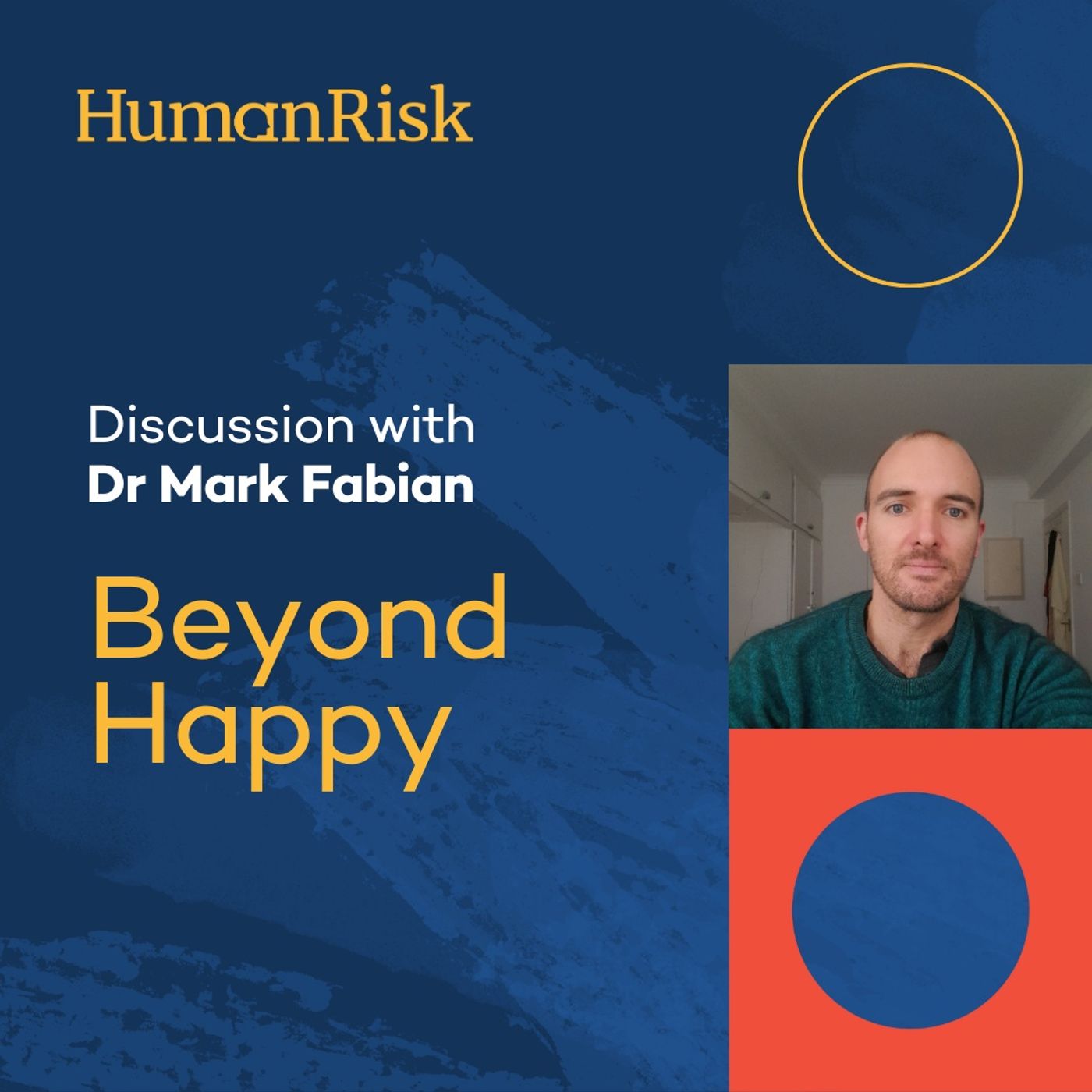
Welcome to Human Risk, a podcast dedicated to the understanding of human behavior as a risk. Here's your host, Christian Hunt. Hello and welcome back to the show. On this episode, I'm diving deep into the topic of happiness, but not in the way that you might expect, because my guest doesn't just want us to be happy.
He wants us to go beyond it. And if that sounds idealistic, bear with me, because this is fascinating stuff. He is Dr. Mark Fabian, Associate Professor of Public Policy at the University of Warwick and an Affiliate Researcher at the Bennett Institute for Public Policy at Cambridge University.
And he's the author of a brilliant new book called Beyond Happy, How to Rethink Happiness and Find Fulfillment. If you've ever found yourself wondering why chasing happiness often feels like running on a treadmill, or why modern life seems set up to make us constantly strive for more without ever feeling satisfied, then this is the episode for you. Mark brings a unique blend of economics, philosophy, psychology, and public policy to his work. In this conversation, we explore why public policy often misses the point on well-being, what the ancient Stoics and modern science can teach us about living a good life, and why we need to rethink happiness as more than just feeling good.
Mark argues that instead of aiming to be perpetually happy, we should focus on building a life that's fulfilling, meaningful, and grounded in community. We talk about the hedonic treadmill, the role of identity and well-being, and how embracing ancient wisdom, everything from fairy tales to religious rituals, could help us to navigate the complexities of modern life. You'll hear why he thinks the self-help industry is letting us down, why emotional intelligence is underrated, and why building our own personal operating system is critical in a world where quick fixes and hacks often fall short. This is a conversation that I hope will on some level make you think, reflect, and review how you approach your own life.
It certainly did that for me. So whether you're looking for practical wisdom or a deeper philosophical take on happiness and well-being, you're in the right place. It's my discussion with Dr. Mark Fabian on Beyond Happy.
Mark, welcome to the Human Risk podcast. Thanks so much for the opportunity. I'm looking forward to the chat. I'm really excited to have you.
I loved the book, and we'll talk about that. But before we do that, can you tell my listeners a little bit about yourself? Yeah, absolutely. So I'm an Associate Professor of Public Policy at the University of Warwick, and you mentioned to me in the pre-show chat that you weren't quite sure what that was.
So let me just tell you a little bit about what I do. So I'm a traditional academic. I do a lot of teaching and I do some research. Most of my research is on well-being and happiness and things like that.
And I do some psychology about it and some philosophy. The public policy angle, I suppose, has maybe two parts to it. So one is kind of policy design. So when you think about how to organize the NHS so that it delivers better healthcare outcomes, that's a policy design question.
And there'll be a lot of tools from economics, from sociology, from psychology, from management science, all over the place. And we try to bring those together in policy studies. A lot of policy studies isn't really about kind of making public policy better, which does irritate me. It's more about kind of describing how public policy operates, which I find a bit dull.
Like we just keep sort of talking about how bad it is, whereas I think we can spend a lot more time talking about how to make it better. I think one thing that doesn't get talked about enough in the mainstream discourse, but is talked about a lot by academics, is how important the administration of government is. So often when we think about fixing the NHS, we sort of think about, oh, should we use more markets? Should we nationalize it?
This kind of big question. But actually, a lot of it's just going to come down to like IT systems and how human resources handles payroll. And that's going to have a lot to do with it. And I think we need to have more of those kinds of conversations, but that's usually a bit dry for podcasts.
Now for this one, I love what you talk about, but you were talking about public policy. How does that link to happiness? Because when I glib comment, much of public policy seems to not deliver happiness. Indeed.
And I actually have a book coming out next year called The Well-Being State, which is all about wellbeing public policy. Maybe one short intro to that sort of stuff is that over the last, say, 30, 40 years, there's been a very strong emphasis in policy design on using ideas from economics. And I have a PhD in economics. I like economics a lot of the time, but I think it's led us astray in many ways.
And one of the main ones is that we conceptualize people who deliver public services, particularly teachers, nurses, police officers, social workers, and other street level bureaucrats, as they're called. We conceptualize them as knaves, like people who are only motivated by money. And we need to hold them accountable using these very particular metrics, like how many crimes they solve, for example. And what that ends up doing is it sort of demotivates the people who are mission led bureaucrats, like people who really care about being a good social worker or getting good educational outcomes.
And it kind of limits their autonomy and limits their ability to think about how to deliver effectively in their local context. The other thing that it does is that it means that people sort of try to game the system on those particular metrics. So there's a very famous scene from The Wire, this show about Baltimore police, where the police turn up at a crime scene and they think about, can we solve this crime? Like, are the odds good that we're going to figure it out?
And they decide that it's not, that they're probably not going to solve it. And so they just don't register it at all. They don't put it into the system because their incentive payments are based on how many crimes they solve. So they don't want to put the hard crimes into the system.
And that's a lot of the source of the bad outcomes that we've had over the last 40 years. We've got some really good outcomes out of the approach. Like garbage collection is much better than it used to be because that sort of thing is really compatible with garbage collection, but it's not compatible with the sort of things that are inherent to wellbeing. So things like mental health, community cohesion, identity, meaning and purpose in life, this sort of stuff.
It's very hard to measure those things and we really do need bureaucrats who are keen on the public interest and civic life and these kind of moral and ethical things, not just money. And that, I guess, takes us beautifully to the book Beyond Happy, which needless to say, I thoroughly enjoyed and had to think quite hard. We'll come on to explore why that might be. But the title's Beyond Happy.
Why isn't being happy enough? Why do we need to go beyond it? Well, maybe that's a good way to phrase it, not quite enough, or like, that's not the whole picture, is maybe how I would want to describe it. So I think there are a lot of people who work on wellbeing and the good life and these kind of things who really down on happiness.
And I used to be a bit like that. So I thought, what really matters is that you have purpose in your life. What really matters is that you're a values-driven individual, this kind of stuff. And when you're living a life that's very purposeful and based in indifference, you often feel frustrated.
You often feel disappointed. There's a lot of these kind of negative emotions in there. And if you're really fixated on being happy, then you just never engage in these more substantive things that bring fulfillment and bring a sense that your life is meaningful and significant. So those kind of people who get really bogged down in doing the V things, they tend to undervalue happiness.
But as I was pursuing this kind of life myself, I increasingly felt that this is just a bit sad. Like I should be happier more of the time if I think my life is good. And also that there needs to be some payoff for you to be able to sustain that kind of work for a long period of time. And so I think happiness and joy and things that you can celebrate are really important.
So it's not that the book is down on happiness. There's a lot of stuff in the book on how to be happier, on how to kind of extend your good moods, get rid of your bad moods, smile more, this sort of stuff. I just want people to move beyond that. And part of the reason why I want them to move beyond that is because we are prone to this phenomenon that psychologists call the hedonic treadmill, which is roughly the idea that how neurochemistry is wired, mostly by evolutionary forces, such that we always come back to a kind of emotional baseline pretty quickly, unless we have a really sustained stress.
Like if you're in solitary confinement, you might start to feel terrible and stay feeling terrible. But if you miss the bus or your doctor's appointment is running late or something and you just feel a bit pissy, that's probably not going to last very long. And the same thing is basically true of your good moods as well. You always come back to this kind of slightly moderate baseline, positive mood.
And that's for evolutionary reasons. If you were depressed all the time, then you wouldn't get anything done. And similarly, if you were ecstatic, you'd just be out partying with your mates and you wouldn't collect enough for the winter or whatever it is that you need to do. So yeah, it's simply the satisfaction.
So that's your mood. You can also then have an overall And I kind of went into the bookstores looking for a solution. And I found this kind of confetti of, oh here are 10 hacks for this and here are 10 hacks for that. And you know, here's how to get rich quick, but it's written by someone who got rich teaching people how to get rich.
It really sounds like a scam to me. And I got very frustrated with that. And then I was like, all right, I'll go to university, I'll do this systematically. I'll do a degree in philosophy.
I'll read psychiatry and whatever. And so I did all that, but then you get kind of the opposite problem where people are doing these super deep dives into one particular thing and it's often very arcane and then there's a lot of statistics and stuff, so that's quite a big lift for a lot of people. And I appreciate that we need to popularise those sorts of ideas. And there are a lot of very good popular books out there.
But what I don't think exists out there is someone that's tried to kind of put all these pieces together. And maybe it's an effort to read all those pieces at once. But I think I've tried to make the book very accessible and understandable and easy to read and that sort of thing. But it is the whole pitch.
So it takes a while to kind of slog through. And I think that does relate to your point about the folk stuff and generally trying to draw on wisdom from very many different places. Because I think the psychologists have a lot of good things to say, the philosophers do, but then also just our primordial wisdom that we retain through folktales, through art, through religious practices, these kind of things are also really important. So I try to include stuff there.
And maybe as a very brief example, I would just mention the kind of prayers that we used to say before taking dinner in religious households, that many religious households still do. So like in my Hungarian family, we would say, like, thank you, Lord, for this food and please spare a moment for people who have less. And I think that's such a powerful cognitive and social technology to ground you in what's good in your life, why you should be grateful for it. And by grateful, I don't mean this kind of supplicant vibe so much as recognising that other people bring a lot of this good stuff to you.
And so you want to thank them particularly. And this is another thing that tends to be missing from this life hacks kind of literature is that it's all about you. And even gratitude as the technique developed by positive psychology, is often framed in this literature as a kind of selfish thing that you do to make yourself happy. It's like a little trick that you can play on yourself before bedtime.
Whereas I think the more expansive notions that come to us from our religious heritage and from folk literature and that sort of thing is much more a communitarian effort. And it's about us helping each other to get to a better world in which we're all doing well. And if we... I mean, one of the things I thought was fascinating as I was reading, and you're absolutely right to point out, and I love this, that it isn't just like, well, we need to read things that come from academic research, right?
There are just things from history or just traditions or things that we may not even necessarily be able to fully explain, but have been handed down. The convention is sort of interesting ideas can come from all sorts of different areas. They don't just have to come from academia or sort of philosophy. And so as you were looking at those things, there were so many things that resonated that made sense to me.
But there's something about modern society, and you pointed towards this in terms of the consumerism in the loosest sense, that means that sometimes those things don't work. There's a lot of trend now to say, if only we could return to traditional values. And there are people out there proposing that if, if we could just turn back the clock, everything would be okay. And what I liked was you're striking the balance of having respect for the past and recognising that there is some value there.
It's what's, in many cases, what's sustained the species, but also recognising that we can't just kind of wish time back and wish the world away. Therefore, we need to look at history and the things that we've inherited and recognise what's valuable and what's not. Yeah, a big, a big comment. So let me try to take a few pieces of that.
So maybe on the science side, so I think there is a lot of really great science being done at the moment, but I'm also a bit frustrated by the dominance of this kind of science-backed advice stuff that's coming out at the moment because a lot of the science is pretty shoddy. And because we're so committed to getting 10 quick and easy hacks all the time, everyone's hungry for the latest piece of science and science doesn't move that quickly. And when you expect it to move that quickly, you end up overselling a bunch of stuff that's actually kind of junk. Like we haven't spent enough time on the science yet to figure out whether it's true.
We have had a bunch of big scandals in science over the last couple of years with people like Dan Ariely and Francesca Gino being accused of fraud, basically. These are some of the biggest names in behavioural science. And there's generally a lot of problems like replication crises, theory crises, all sorts of stuff that doesn't make it into the commercial press that makes me a little bit nervous about just kind of saying the only science-backed stuff is correct and that there's plenty of science-backed stuff to go around. There's also a lot of really good wisdom, as you say, in the folk stuff.
And maybe I'll mention two things here. So one that was really powerful for me in terms of why I should take seriously insights that don't come to me packaged in the scientific way, so don't come to me packaged in logic and experiments and statistical evidence, is this little kind of Celtic myth where sometimes new mothers have their spirits whisked away to the fairy kingdom. And as a result of this, they become listless and despondent and kind of antisocial and they don't look after their new babies. And the only way to bring their spirit back from the fairy world is for everyone in the village to visit them on a regular basis, spend time with them, even though that may be a bit unpleasant to spend time with when they don't have a spirit.
Look after their baby so that when their spirit does come back, they'll be ready to parent again. And in this way, gradually you can remind the person's spirit that there's a lot of love for them in the village and coax it back. Now, if you're a hardened, no scientist, you're like, what is this nonsense? But I think it's really clearly a story about postnatal depression.
And the important thing here is that it gets the diagnosis right. Sorry, it gets the diagnosis wrong. The spirit hasn't been taken away to the fairy, but it gets the prescription right, which is what we nowadays call social prescribing in the medical sciences, where you want to try to embed someone in a social system that gives them the support they need until they recover mentally. And it communicates that prescription in a way that would be quite meaningful to a lot of people.
Whereas to the typical human, if you say, oh, this mother's serotonin uptake inhibitor is disrupted or whatever, they need these pills. That just doesn't really mean anything to most people. And a lot of the folk stories that we get and a lot of the wisdom that had come down through the centuries in those kind of formats is often much more accessible to people in this emotional way. And I think that's quite important.
I don't know if you want to come in there or I can keep... Yeah, no, I don't mind. As you were talking, I was just thinking, it's almost like they've got the market, the idea is there, they've got the marketing right, the evidence is lacking. And I think that's super powerful because, as we know, you can have a brilliant idea, but if it's not effectively communicated, it's not going to let no matter how amazing you're thinking it is, right?
If you can't get it through to other people. So I love this idea of, actually, the problem has been solved. It's been intelligently solved. It's just they haven't got the backup.
And we can feed the backup in later on. But recognising the power of those things and being open to that, I think it makes perfect sense. I do think a lot about the fact that humans have been around for thousands and thousands of years. And I'm very sceptical that we were unhappy that whole time.
It's just been miserable our entire existence. And that over the next technological horizon, we'll finally be happy. It seems to me much more likely that we've actually known kind of how to be well and how to find happiness throughout our primordial eons of existence. And so we should often be looking more at the kind of things that we've always had.
So we've always had communities. We've always had friendships. We've always had family. We've always had ritual and culture and art and practices that we do together.
Dancing, maypole dances. I love these kind of folksy things. Like they might seem a bit lame now, but I've actually, in the last like maybe two years, I've super hardcore come back to thinking about fates and parades and all the kind of stuff that rural communities still tend to do much more so than the other ones. But I think in there lies a lot of our ancient wisdom about how to be well and how to be happy.
And we should value that stuff. And so as you're going through these, how are you picking what's to include? Because if I look at sort of the full canon of all the things you could have looked at, I mean, you could have written 20 books to cover all the traditions. And how did you decide where to focus?
That's a Into feelings. And a lot of the way that I do with compliance functions and people trying to impose rules on other people, is I sort of go, you know, the question I say is, go ask the people that you're trying to impose rules on. You ask them a very crude question about what pisses you off, because there's something... And I'm not interested in things that are slightly irritating.
I mean, the stuff that's viscerally really annoying. And so, you know, because that to me points towards, here's a rule. If something really irritates me, I'm going to try and find ways around it, right? If it represents something that is...
That's unlikely to be sustainable as a rule or proposition. And I love this idea of being able to just actually reconcile. What you're pointing to, which is being honest about what we, how we feel about it. And we don't have to like the stuff that's cool or the stuff that's popular.
And you cited, and I hadn't really thought about the power of this hack, but Reddit, as a good illustration, I listen to awful stuff on Reddit. We're not talking about that. But what you might... I've got to be careful how I phrase this, but the special interest groups.
We now have the... This is what I think is one of the choices. You can go and find people that have similar interests that you might not otherwise be able to find. And I'm talking about central interests here.
Hobbies and passions and those sorts of things. And so I love that it wasn't all a negative thing about, actually, well, you know, you've just got to... We have... You point to people in the direction of saying, we can build these communities and therefore being true to who you are and what you like and don't like is...
I thought that was incredibly powerful and uplifting. And you've given us a solution to how to look at it. Well, I really liked your question about what pisses you off because I could definitely apply that to my own workplace. And the things that could really piss me off are usually not the things that we're working on.
And they're also the things that I need to take to a committee and then there'll be like 14 other committees that it needs to go up through. And then finally I won't have to answer all these emails. So, yeah, I think that is very powerful. And being honest about your feelings is also crucial.
And I think that is a bit of a culture change. Certainly it was a change for me personally. So one section of the book is on emotional intelligence. Particularly this hack, which is that when you're having a big feeling or when you see someone having a big feeling that you care about, you should ask, do you want to be helped, hurt or hugged?
And this was totally transformative for me because I'd always felt that people just needed to be helped. And I also felt that I just needed to be helped. But actually, oftentimes, I needed a hug. And I was very bad at asking for care.
And I think our culture tends to kind of encourage people to be more rational and logical and scientific in the way they solve problems. But often, it's not really like the problem that needs to be solved. It's the feelings that you need to be honest about and then we need to unpack where those feelings come from and what their toxic consequences are and all this sort of stuff, which I think the question that you mentioned really gets at those kind of issues. Yeah, and then in terms of Reddit, what you were saying really reminded me that my favorite thing about Reddit is that sometimes you have such a niche question, you know, like you're playing a video game or something and you're like, how does this work?
And there'll be someone on Reddit who's answered that exact question. And it'll be the first hit on Google. And it's incredible how frequently that happens. You know, I don't know, you have some esoteric camera from the 1980s and you're like, does anyone know where I can find lenses for the like Nokia, whatever?
And they're like, yeah, yeah, yeah. Like there's this weird retailer in rural Japan who still has like a stockpile of them somewhere. Here, I've got his phone number. Yeah, I could just amazing stuff like that on Reddit.
And there's plenty of turgid stuff as well, but I think relative to other social media sites, it's definitely one of the more kind of wholesome and communitarian ones. And I think what's interesting to think about there is that Reddit is moderated. It's moderated on a volunteer basis. And I can't help but think that that does have a lot to do with the fact that most Reddit threads tend to be relatively constructive discourses where people tend to operate in good faith, tend to kind of try to understand each other, unlike, say, Twitter, which is now a complete cesspit of people just yelling at each other.
Yeah. And you, you... You talked a lot about... I mentioned the stoics as one example.
You've talked about history. One of the challenges, like I referenced those people that want us to hark back to yesteryear, often to an era that they never experienced themselves. If I think about in the UK, a lot of sort of Second World War revivalists, because they were too young to be around, but still remember on some level. How do we know what we should take from the past and what we should...
Wow, that's a tough question. I haven't really thought about that one. I'd definitely, I guess, I would come back always to emotions as the first point of call. So what feels powerful when it's explained to you.
And I think Jordan Peterson, who you may have mentioned earlier, like I think he does do a really good job in his Bible lectures, which he used to give well before he became famous and then well before he became a little bit crazy as now, I guess I would want to say, he's a shadow of his former self. But his Bible lectures were bangers. And I'm like deeply atheist and I still found these lectures extremely powerful for kind of unpacking the symbolic content of the Old Testament and unpacking a lot of the kind of important lessons in there about things like sacrificing for the future and what's involved in that and how much of a kind of cognitive transformation that would have been of people to understand that there is something five years from now. And if you kind of make a plan there and stick to it, things will be different in five years' time or 10 years' time.
And in an age where a roving barbarian horde is coming to wipe you out next week, that's quite a big change in the way you think. You're not so short-termist. So there's a lot of powerful stuff like that. And I think you've got to expose yourself to a lot of ideas.
And this is why I think Martin Short is really good because he does talk about a lot of little bits that wisdom in cocktails. And if something strikes you as really powerful, then just sit with it for a while and try to unpack why it is that you find it powerful. But equally, if you read something and you think, oh, gross, then that also tells you that it's probably run out of steam. So the example I give in the book that I think is not very controversial is that the Virgin Mary, as a woman who had an immaculate conception, and that's the kind of symbol of the ultimately valuable feminine, doesn't really cut through for a lot of women today.
And that's quite understandable to me. And I think trying to, as a man, take society back to that is a bit naff. So there I think those are the kind of places where we want to try to figure out what to rescue from that heritage and what we need to let go and accept no longer working for us. Think about why it's no longer working for us and with an emphasis on us.
Try to have that dialogue in an empathetic way. And then think about what kind of new stories we need to tell. I think often here there's a kind of impatience where people are like, oh, some group in society is like, well, that's not working for me anymore. And the group in society that values that thing that's not working anymore is like, well, what do you want instead?
And there's no ready packaged answer because I think in this case, we're really kind of reaching into the void and trying to come up with some new content. And that's, again, why that new content is going to need to come to us through mythology and art and myth-making and meaning-making. And I think that's part of why the new atheism movement terminated a bit because Richard Dawkins and his compatriots were really good at knocking down a lot of these old stuff. But they were like aggressively disinterested in building new things in a lot of cases.
I remember there was a debate where Dawkins said something like, what do you mean the meaning of the mountain? That's a ludicrous question. The mountain has a cause. That's all.
And I just, that's not useful to people. Like, I see where he's coming from, but people do want to feel like the world is enchanted, do want to feel like there's meaning out there. And we can only build that emotionally and creatively. And the, the, the, that's the book really is, and correct me if this is wrong, but what I took from it was this idea of sort of sort yourself out, work out what you're about, what matters to you.
And then that sets you on a bigger, it's almost, it reminded me of, you know, when you're on a plane and they tell you to put your own oxygen mask on before helping others, which is sort of blatantly obvious advice, but you can't help other people until you're sorted in yourself. And so I love this idea of kind of thinking around what makes you tick, what do you want to do? What's your vocation Positively, that, I don't know, if we had like a drug habit or something, we're not going to be able to kick that from one day to the next, right? We need to think about that and ditto fitness, right?
You can't suddenly be unfit and just rock up to the gym for half an hour and be, you know, super fit. So we know that these things are hard and challenging. And I think the way you've described it there worked for me because I sort of found myself going, I've got to stop and just reflect on what that means, right? I don't always try some of these things out.
There was a little bit of me, I wonder what you thought about it. It was almost like a little bit of a sort of a gym for how I looked at the world and who I wanted to be and what I wanted to do. And so I was finding myself just stopping and going, actually, I don't want to read anymore, not because it's not interesting, but because I need to actually take this away and almost, you know, in a way it points to this, there's a huge amount of inefficiency in these processes. And that struck me as, in the modern world, we want things quickly.
If quick solutions, quick fixes. And actually, you know, a lot of what you're proposing involves whiling time reflecting on things and using on it. And so much in there to talk about. Let me first say, I try to write, I'm very inspired by T.H.
White's The Once and Future King, which is a very famous book about, it's kind of a retelling of the Arthurian legends. I think the character of Lancelot in this book is one of the most sophisticated characters ever. He's genuinely trying to be a good person and failing. And I think the exploration of that is super interesting.
But what's really striking about The Once and Future King is that it's written in this style that you just can't read it fast. It like forces you to sit down with it. And it's beautiful, so you enjoy reading it. But at the time I read it, I remember that I was used to reading a lot of like Isabel Allende at the time and Milan Kundera and a lot of these very breezy authors that you can just power through.
And I felt good that I'm reading so much. And then I got this book and I was like, this is a really good book, but I feel like I've been reading it for a month. And but that was good. And I remember that book was so much more now.
And one thing that strikes me about a lot of the commercial books that are super readable is that they're so readable, you almost can't remember at the end of it what it is that you read. And that's why they need to have these things at the end where they're like, here's like three activities that you can do tonight. But there's so many activities that then you also end up with this kind of like confetti of stuff and you want to make a list and come back to it after your copy every morning to go, have I taken a cold shower at the right time today? These sorts of things.
So I wanted, I definitely wanted to write a book that is forcing you to think and that way you'll remember more of it. And you might not remember all of it, but at least it will sit with you. And I think this is, I mentioned this explicitly at one point in the book. Often a powerful idea will emerge for you again later in a way that you don't expect.
You just need to kind of have it in there. It's not an activity that you need to do every day. It's not an activity that you need to do every week. It's just some wisdom that on some level you internalize.
And at some point in your life, something will pop up and your brain will make the connection. And you'll be like, oh, this is kind of like that thing that Fabian was talking about. And then you'll change your behaviour there. And this brings me to...
I think a very important point that you sort of raise there, which is that there's a lot of talk about, say, changing your habits around the gym, for example. And I think a lot of the commercial imperative now is to write the next Atomic Habits because it's sold 12 million copies. Everyone wants you to do that. And Atomic Habits, I think, is a very good book in terms of being science-backed and all that sort of stuff.
But it opens with this thing that if you want to change your habits, you need to think about them in terms of identity. So don't say, no thanks, I don't smoke. Say, no thanks, I'm not a smoker. And I think that's broadly true.
But it immediately raises this question for me, which is, well, who do I want to be? And there's no real engagement with that much harder question. That's not just a matter of kind of a few quick hacks and whatever. And here's a diagram.
And I think my book is trying to get at a lot more of these kind of upstream aspects of your behaviour that probably do require you to just spend a bit of time looking out the window on a long haul train. Maybe more than once. And how has writing it changed you? Because I recognise, obviously, that's not, again, right back to not the quick fix thing.
Oh, I suddenly finished and suddenly the labels came on. You will have had realisations going, but it always strikes me that when you're looking at a subject like this, clearly you will have been going through this process yourself. Yeah, absolutely. So I've been writing this book for about 20 years.
I did make it my professional life over the course of that time. I think the self-actualisation stuff that's in chapters four and five, like I lived that and it worked for me. It might not work for everyone. I recognise that I'm a bit peculiar, but people seem to think it's got legs.
The parts that were most transformative for me came towards the end, particularly the stuff in chapter six, which is called Better Together and is all about how wellbeing is a kind of communal activity. And there, I think the biggest changes for me were, I've alluded to them already, the shift away from being hyper-rational to thinking more about all the different ways that we can get to truths and the importance of our emotion and the importance of care. So alongside help turtle hugs, I had an idea that came to me from Cassie Thornton, who I had on my podcast, which is called A Post-Cenology. And I interview young academics, so it's probably not for everybody.
It's pretty nerdy and technical. But anyway, I had Cassie Thornton on there. She's an activist and an artist. And she has this idea called the hologram.
And she was talking a lot about the fact that in recent decades, we have commercialised and professionalised care in a way that makes us reluctant to ask for it because we don't feel like we can repay the care that we get because care is this very valuable thing that's worth money. And we also feel very reluctant to offer it because we don't feel qualified to offer that kind of care. And this then causes a huge care deficit in society and also cuts us off from each other and we become isolated in our own little rooms, feeling uncared for and nervous. And these kind of ideas were quite new to me, but are now, I think, really central to the way I think about wellbeing.
And they have changed me a lot. I feel like I'm a much more emotionally engaged person and I think a lot more about how I can learn things through my intuition, through my body, these kinds of things, rather than just through logic. Maybe I'll mention one more thing here, which came up at the very, very end. So I met an agent at a house party in London a few months ago, maybe a year ago.
And I was complaining to her about how much publishers and everything want you to include a personal story in all your work. And as an Australian, that's like anathema to me. You're just not allowed to talk about yourself in Australian culture. I always tell people about Nick Riewoldt, who's this Australian rules football player, once just put in the most dominant performance in a grand final of any footballer ever.
And afterwards, the on-field commentator was there being like, just gushing at him, like, oh my God, Nick, that was incredible. You were everywhere. You kicked all the goals. And Nick Riewoldt was like, yeah, the boys did really well today.
And he just refused to talk about himself at all. And he was like deadpan despite the greatest achievement of his life. That's Australian culture. And so when the publishers were like, Mark, tell us about yourself.
And I was like, I don't want to do that. And then the agent said to me, and this was super powerful, she said, I appreciate that and new academics always say this kind of stuff, but most people connect with a person before they connect with an idea. And they're going to get the information from you through this emotional connection that they have with you, not through the logic that you're putting out. And that's been so powerful to me in my teaching and my personal relationships and all sorts of stuff.
So I have changed in quite a lot of ways in writing this book. I love, love that. It struck me that as we think about role models, and many of the role models that we can point to politics, we can point to social media, we can point to other, it seems to me to be pointing in the opposite direction to the one you're proposing in the book, where there's a dominant narrative of selfishness, of greed, almost like greed is good type logic. And I wonder what you thought about that because that seems to me to be problematic.
Yeah, I completely I think, and it might actually be about how you make sacrifices for other people and you don't try to dominate the hierarchy and this sort of stuff. And this very kind of anti-capitalist sort of sentiment, that what we're trying to do is be proud of ourselves, but in a way that's coherent with what everyone around us is trying to do, and we appreciate that we are members of a society, we are members of neighbourhoods and professional organisations and friendship networks and all that sort of stuff, and that we can be little priests for our networks, keeping an eye on how everyone's interconnected and how we can link people up to help each other. And in this way, we create a nice ecosystem that's very self-reinforcing. So I'm not quite sure how to completely square the circle, as you say, but it does seem to me like the key thing to appreciate maybe is the distinction between self-optimisation and self-actualisation, and also to appreciate that self-actualisation is something that you do with other people, and that we are also doing that, not just at an individual level, but at a kind of neighbourhood, cultural, global level.
We are all trying to decide what it is that we're about. And that doesn't mean competition, because when you get ahead in a competition, you would get ahead at the expense of someone else. And I don't want to completely disparage competition effects. They can be really powerful and they're a spur to a lot of the great things we achieve athletically, for example.
But I do think that for the average person, it's much less about competition and much more about collaboration. And we need to get to that kind of attitude in the 21st century. I love that. That, I think, is the perfect marker.
Is there anything that we should have talked about? Any major points that you wanted to bring up? No, there's a lot more in the book, I guess. I hope you would second that.
But I really like the points that we covered and I appreciate your questions, which I think were really on point. Amazing. Well, look, normally I would ask guests what they're up to next, but you've given us a hint of that. And so I'd love to, at this point, as and when you're ready to talk about your next book, please feel free to come back on the show.
But in the meantime, I can only recommend, it's not, as I say, you're publishing another book, thank you for this. It's not the easiest read, but not because it's not easy to read, but because if you want to take this book seriously, you need to think about things. And the joy I found with this was that it really, it caused me to recognise the things that I was doing well and stuff that I did, like the tree. You mentioned the tree, you know, looking out the train carriage window.
That's not something anybody ever told me to do. I just sort of felt like it was something I got something from, and you've helped me to, so there's many things you pointed out to me why they work well for me. There's other things where I've suddenly realised why, oh, that's why that's not working well. And you've given me a ton of other things to reflect on that are going to help me.
So thank you for broadening my own personal toolkit. And I'd recommend people to read it to understand themselves a lot better, but also recognise how they can tweak things. So not the easiest read in that sense, but fabulous, really, really thought provoking, as people who have detected on the show. So before I let you go, remind people what it is called.
It's called Beyond Happy, How to Rethink Happiness and Find Fulfillment. I'm very glad. Thank you for reading it. And I'm very glad that you found it to be of value to you.
Authors will always say, you know, as long as it changes one person's life, it's worth doing. So we'll check out now. Amazing. Well, look, above all right now, thank you, Ryan, for a great book and thank you for the work that you do.
Clearly very, very important. I love the fact that we have academics like you that are tackling challenging issues in the way that you are, and the sense of humour and the joy that you bring to what you do is so, so powerful. So thank you for that. But above all, thank you for being a fabulous guest on the show.
Thanks for having me. That's it for this episode of the show. My enormous thanks to you for listening and to Mark for appearing. To find out more about Mark, his book, Beyond Happy, How to Rethink Happiness and Find Fulfillment, and his research, have a look in the show notes.
There are links to those there. If this is your first time listening to the Human Risk Podcast, thank you so much for joining me. You can subscribe wherever you get your quality audio content. It's available on all of the major podcasting platforms.
If you like the show and have yet to leave a review for it, I would love it if you could do so. It's really, really helpful. It allows other people to find the show and lets me know that you're enjoying it. To discover episodes of the show that you might have missed, and there are over 300 of them now, visit the show's website at humanriskpodcast.com.
I will be back very soon with another episode of the show. But in the meantime, stay safe, why not take a little bit of time to reflect on what really makes you tick beyond the constant chase for happiness. And above all, thank you so, so much for listening.