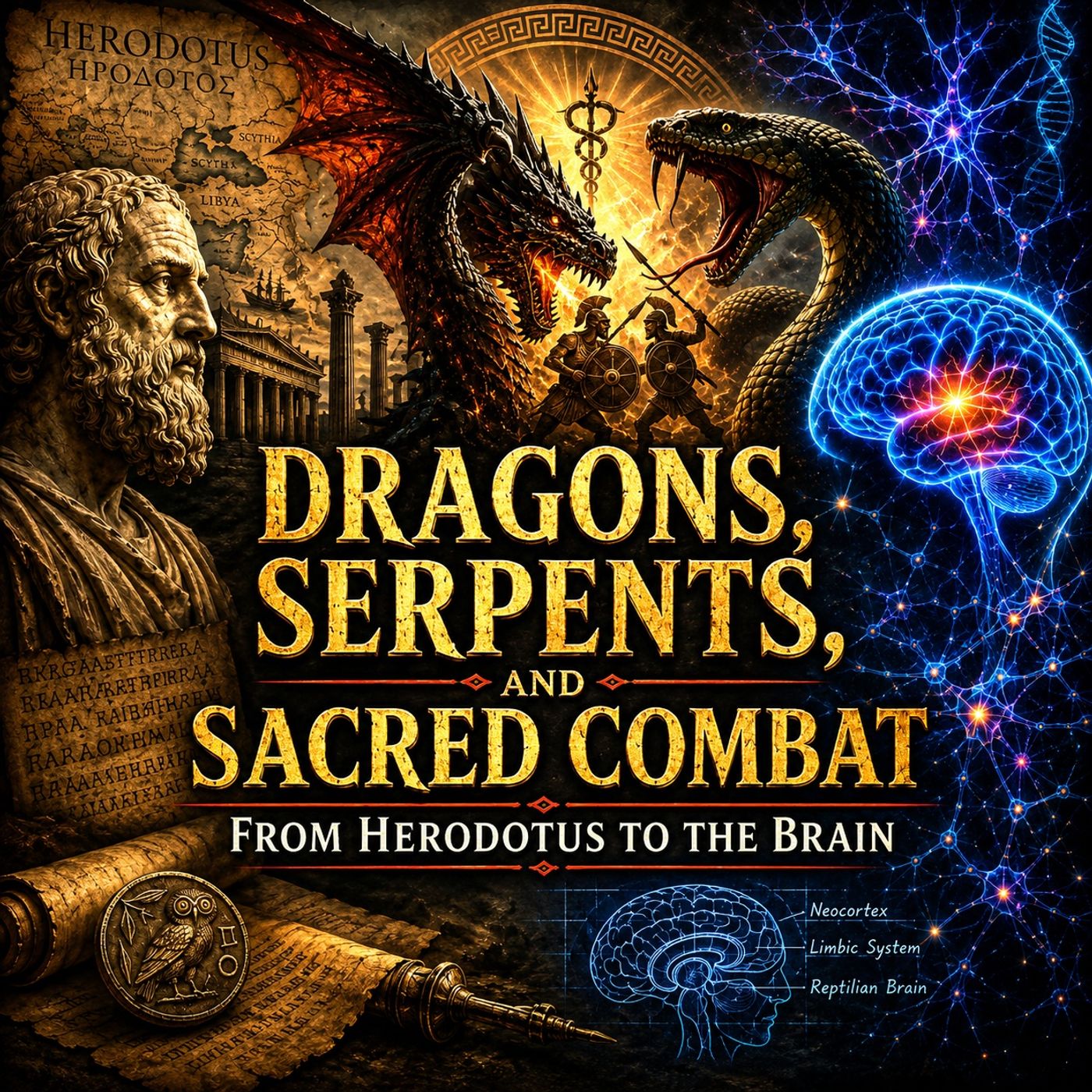
Dragons, Serpents, & Sacred Combat- From Herodotus To The Brain episode artwork

EPISODE · Jun 12, 2026 · 1H 5M

Dragons, Serpents, & Sacred Combat- From Herodotus To The Brain

from The Occult Rejects · host The Occult Rejects

If you enjoy this episode, we’re sure you will enjoy more content like this on The Occult Rejects.  In fact, we have curated playlists on occult topics like grimoires, esoteric concepts and phenomena, occult history, analyzing true crime and cults with an occult lens, Para politics, and occultism in music. Whether you enjoy consuming your content visually or via audio, we’ve got you covered - and it will always be provided free of charge.  So, if you enjoy what we do and want to support our work of providing accessible, free content on various platforms, please consider making a donation to the links provided below.  Thank you and enjoy the episode!Links For The Occult Rejectshttps://linktr.ee/theoccultrejectsOccult Research Institutehttps://www.occultresearchinstitute.org/Substackhttps://substack.com/@theoccultrejects?r=7auau0&utm_campaign=profile&utm_medium=profile-pageCash Apphttps://cash.app/$theoccultrejectsVenmo@TheOccultRejectsBuy Me A Coffeebuymeacoffee.com/TheOccultRejectsPatreonhttps://www.patreon.com/TheOccultRejectsBibliographyAelian. On the Characteristics of Animals. Translated by A. F. Scholfield. Loeb Classical Library. Cambridge, MA: Harvard University Press, 1958–1959.Assmann, Jan. The Search for God in Ancient Egypt. Translated by David Lorton. Ithaca: Cornell University Press, 2001.British Museum. “Papyrus of Nesmin; Bremner-Rhind Papyrus, EA10188.” Notes that the Book of Overthrowing Apep appears in columns 22–32, with the Names of Apep in columns 32–33, and gives a production date of 305 BCE.British Museum. Babylon Teachers’ Resource. Notes Marduk’s association with the snake-dragon or mušḫuššu.Burkert, Walter. Greek Religion. Translated by John Raffan. Cambridge, MA: Harvard University Press, 1985.Day, John. God’s Conflict with the Dragon and the Sea: Echoes of a Canaanite Myth in the Old Testament. Cambridge: Cambridge University Press, 1985.Detroit Institute of Arts. “Mushhushshu-Dragon, Symbol of the God Marduk.”Eliade, Mircea. Patterns in Comparative Religion. Translated by Rosemary Sheed. Lincoln: University of Nebraska Press, 1996.Etymonline. “Draco.” Notes Greek drakon from derkesthai, “to see clearly.”Faulkner, R. O. “The Bremner-Rhind Papyrus—III: D. The Book of Overthrowing ‘Apep.” Journal of Egyptian Archaeology 23, no. 2 (1937): 166–185.Ferdowsi. Shahnameh: The Persian Book of Kings. Translated by Dick Davis. New York: Penguin Classics, 2016.Herodotus. The Histories. Translated by A. D. Godley. Loeb Classical Library. Cambridge, MA: Harvard University Press, 1920. See especially 2.75 on winged serpents and ibises, and 3.107 on frankincense-guarding serpents.Hornung, Erik. Conceptions of God in Ancient Egypt: The One and the Many. Translated by John Baines. Ithaca: Cornell University Press, 1982.Isbell, Lynne A. The Fruit, the Tree, and the Serpent: Why We See So Well. Cambridge, MA: Harvard University Press, 2009.Jacobus de Voragine. The Golden Legend: Readings on the Saints. Translated by William Granger Ryan. Princeton: Princeton University Press, 2012.Jones, David E. An Instinct for Dragons. New York: Routledge, 2000.Le, Quan Van, Lynne A. Isbell, Jumpei Matsumoto, Minh Nguyen, Hikari Hori, Mai Mai, Tomohiro Nishimaru, et al. “Pulvinar Neurons Reveal Neurobiological Evidence of Past Selection for Rapid Detection of Snakes.” Proceedings of the National Academy of Sciences 110, no. 47 (2013): 19000–19005. DOI: 10.1073/pnas.1312648110.LeDoux, Joseph. The Emotional Brain: The Mysterious Underpinnings of Emotional Life. New York: Simon & Schuster, 1996.Lincoln, Bruce. Theorizing Myth: Narrative, Ideology, and Scholarship. Chicago: University of Chicago Press, 1999.MacLean, Paul D. The Triune Brain in Evolution: Role in Paleocerebral Functions. New York: Plenum Press, 1990.Mayor, Adrienne. The First Fossil Hunters: Dinosaurs, Mammoths, and Myth in Greek and Roman Times. Princeton: Princeton University Press, 2000; revised edition, 2011.Öhman, Arne, and Susan Mineka. “Fears, Phobias, and Preparedness: Toward an Evolved Module of Fear and Fear Learning.” Psychological Review 108, no. 3 (2001): 483–522.Pessoa, Luiz. The Cognitive-Emotional Brain: From Interactions to Integration. Cambridge, MA: MIT Press, 2013.Pliny the Elder. Natural History. Translated by H. Rackham. Loeb Classical Library. Cambridge, MA: Harvard University Press, 1938–1962.Smith, Mark S. The Ugaritic Baal Cycle. 2 vols. Leiden: Brill, 1994–2009.Smith, Mark S. The Origins of Biblical Monotheism: Israel’s Polytheistic Background and the Ugaritic Texts. Oxford: Oxford University Press, 2001.Varenne, Jean, trans. The Rig Veda. New York: Park Street Press, 1984.Yarshater, Ehsan, ed. “Aždahā.” Encyclopaedia Iranica. Defines aždahā as dragon-like, gigantic snake monsters found in air, earth, or sea, sometimes linked to rain and eclipses.Also want to remind people about the website, if you're into reading we have tons of information by multiple contributors, and we got t-shirts up on the site if you're interested. Fun fact, the art is all based on the eyeball. A

If you enjoy this episode, we’re sure you will enjoy more content like this on The Occult Rejects.  In fact, we have curated playlists on occult topics like grimoires, esoteric concepts and phenomena, occult history, analyzing true crime and cults with an occult lens, Para politics, and occultism in music. Whether you enjoy consuming your content visually or via audio, we’ve got you covered - and it will always be provided free of charge.  So, if you enjoy what we do and want to support our work of providing accessible, free content on various platforms, please consider making a donation to the links provided below.  Thank you and enjoy the episode!Links For The Occult Rejectshttps://linktr.ee/theoccultrejectsOccult Research Institutehttps://www.occultresearchinstitute.org/Substackhttps://substack.com/@theoccultrejects?r=7auau0&utm_campaign=profile&utm_medium=profile-pageCash Apphttps://cash.app/$theoccultrejectsVenmo@TheOccultRejectsBuy Me A Coffeebuymeacoffee.com/TheOccultRejectsPatreonhttps://www.patreon.com/TheOccultRejectsBibliographyAelian. On the Characteristics of Animals. Translated by A. F. Scholfield. Loeb Classical Library. Cambridge, MA: Harvard University Press, 1958–1959.Assmann, Jan. The Search for God in Ancient Egypt. Translated by David Lorton. Ithaca: Cornell University Press, 2001.British Museum. “Papyrus of Nesmin; Bremner-Rhind Papyrus, EA10188.” Notes that the Book of Overthrowing Apep appears in columns 22–32, with the Names of Apep in columns 32–33, and gives a production date of 305 BCE.British Museum. Babylon Teachers’ Resource. Notes Marduk’s association with the snake-dragon or mušḫuššu.Burkert, Walter. Greek Religion. Translated by John Raffan. Cambridge, MA: Harvard University Press, 1985.Day, John. God’s Conflict with the Dragon and the Sea: Echoes of a Canaanite Myth in the Old Testament. Cambridge: Cambridge University Press, 1985.Detroit Institute of Arts. “Mushhushshu-Dragon, Symbol of the God Marduk.”Eliade, Mircea. Patterns in Comparative Religion. Translated by Rosemary Sheed. Lincoln: University of Nebraska Press, 1996.Etymonline. “Draco.” Notes Greek drakon from derkesthai, “to see clearly.”Faulkner, R. O. “The Bremner-Rhind Papyrus—III: D. The Book of Overthrowing ‘Apep.” Journal of Egyptian Archaeology 23, no. 2 (1937): 166–185.Ferdowsi. Shahnameh: The Persian Book of Kings. Translated by Dick Davis. New York: Penguin Classics, 2016.Herodotus. The Histories. Translated by A. D. Godley. Loeb Classical Library. Cambridge, MA: Harvard University Press, 1920. See especially 2.75 on winged serpents and ibises, and 3.107 on frankincense-guarding serpents.Hornung, Erik. Conceptions of God in Ancient Egypt: The One and the Many. Translated by John Baines. Ithaca: Cornell University Press, 1982.Isbell, Lynne A. The Fruit, the Tree, and the Serpent: Why We See So Well. Cambridge, MA: Harvard University Press, 2009.Jacobus de Voragine. The Golden Legend: Readings on the Saints. Translated by William Granger Ryan. Princeton: Princeton University Press, 2012.Jones, David E. An Instinct for Dragons. New York: Routledge, 2000.Le, Quan Van, Lynne A. Isbell, Jumpei Matsumoto, Minh Nguyen, Hikari Hori, Mai Mai, Tomohiro Nishimaru, et al. “Pulvinar Neurons Reveal Neurobiological Evidence of Past Selection for Rapid Detection of Snakes.” Proceedings of the National Academy of Sciences 110, no. 47 (2013): 19000–19005. DOI: 10.1073/pnas.1312648110.LeDoux, Joseph. The Emotional Brain: The Mysterious Underpinnings of Emotional Life. New York: Simon & Schuster, 1996.Lincoln, Bruce. Theorizing Myth: Narrative, Ideology, and Scholarship. Chicago: University of Chicago Press, 1999.MacLean, Paul D. The Triune Brain in Evolution:...

NOW PLAYING

Dragons, Serpents, & Sacred Combat- From Herodotus To The Brain

0:00 1:05:18

No transcript for this episode yet

We transcribe on demand. Request one and we'll notify you when it's ready — usually under 10 minutes.

Big Old Life: Heather Blackbird interviews people on planet earth. Heather Blackbird loves asking questions. This podcast is a learning experience. Join me, Heather Blackbird, as I talk to people about their lives. Frequency of new episodes is a little all over the place and I'm learning as I go. Big Old Life is a small way of talking about the vastness of life, one person at a time. If you are reading this or found this podcast it's probably because someone you know gave you a link to it. :) Explicit Tales Of A Superstar DJ The Insomniac Spun seemingly out of nowhere from her complacent life in the corporate world, turned seemingly overnight from 16-Hour shift work and into the life of a literally starving artist and working musician, The Protagonist navigates her supposed rise to fame and superstardom on a journey through spiritual awakening, coming-of-age, and intimate self-realization--guided by an omnipresent force and equipped with the power of love, magic, and music. {Enter The Multiverse.} [The Festival Project] The Festival Project, Inc.™ is a multidimensional multimedia platform which encompasses exploratory and artistic social personifications and expressions on cosmic theory, spirituality, growth, health & wellness, philosophy and theoretic dynamics in entertainment such as music, design, film, television, radio, dance and festival culture, art, fashion, literature, and science. The Festival Project™ and its subsidiary Non-Profit, The Collective Complex © aims to challenge modern artistic and philosop Explicit Bitcoin Is Dead Trey Carson Welcome to Bitcoin is Dead, the ultimate Bitcoin variety show where host Trey takes you on a journey through the ever-evolving world of Bitcoin. Each episode brings new personalities, fascinating locations, and insightful conversations with politicians, educators, and innovators shaping the future of Bitcoin. Whether you're a seasoned Bitcoiner or just starting your journey, tune in for thought-provoking discussions, unique perspectives, and a deep dive into the ideas and people driving the Bitcoin revolution. Explicit The Sacred +Profane Podcast nephtaragrace The Sacred + Profane Podcast is a provocative conversation dedicated to cementing a better future for all. We specialize in unpacking the nuances of what is considered sacred and profane, particularly focusing on sex, death, and all that pertains to the circle of life. Our aim in focusing on such ”taboo” subject matter is to demystify what is unconscious, bring to light what has been known for centuries as ”the occult,” and empower the rapid transformation that is occurring on the Planet. Explicit

Frequently Asked Questions

How long is this episode of The Occult Rejects?

This episode is 1 hour and 5 minutes long.

When was this The Occult Rejects episode published?

This episode was published on June 12, 2026.

What is this episode about?

If you enjoy this episode, we’re sure you will enjoy more content like this on The Occult Rejects.  In fact, we have curated playlists on occult topics like grimoires, esoteric concepts and phenomena, occult history, analyzing true crime and cults...

Can I download this The Occult Rejects episode?

Yes, you can download this episode by clicking the download button on the episode player, or subscribe to the podcast in your preferred podcast app for automatic downloads.
URL copied to clipboard!