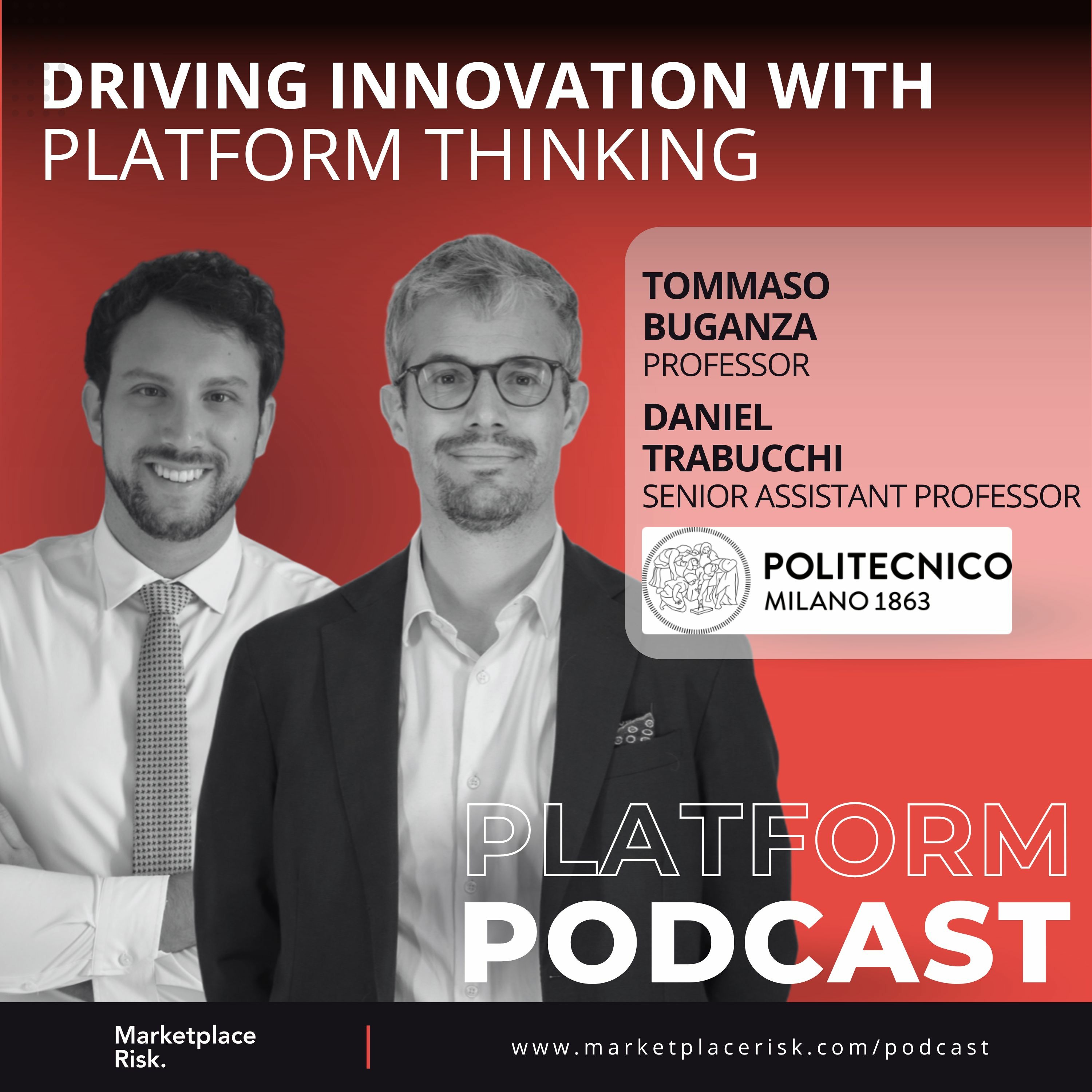
Hi, I'm Sophie, Marketplace Risk's AI assistant. Welcome to Series 9 of the Platform Podcast, hosted by Marketplace Risk founder Jeremy Gottschalk. The Platform Podcast features Marketplace and digital platform founders and leaders sharing valuable lessons that can be leveraged to help you successfully launch and grow. This podcast is for informational purposes only and is not professional advice.
For specific issues, please seek an appropriate professional or contact us at info at marketplacerisk.com for referral. Welcome to the Platform Podcast. On this episode, I'm joined by Daniel Trubuki and Tommaso Boganza of Polytechnico y Milano, and we'll be talking about platform thinking, what it is, how companies can leverage it, and some of the main driving forces of platform thinking. Daniel and Tommaso, it's a pleasure to have you on the Platform Podcast.
Hi, thank you very much for having us, and hi to everyone that is listening. Yeah, from my side as well. Excellent. Before we begin, first, how was my Italian pronunciation?
It was incredibly good. My surname, not in Italian, no one gets it right, so it was perfect. We can end the podcast episode now. Good guy win.
So please, will you tell us a little bit more about yourselves and your background and what you do exactly? Sure. I will start. I'm Daniel.
I'm senior assistant professor at Polytechnico y Milano, where I actually teach classical thinking. So what we're going to talk about is actually my main, let's say, piece of research there. I come from a group that deals with innovation, so we mainly teach and do research around how established firms can actually foster innovation and put new things ahead. Well, from my side, I'm Thomas Bogans, I'm a professor of leadership and innovation, instead.
And so we are still in the world of innovation, but I'm also more focused on how to make innovation happen, especially from the organization point of view. So when you really do something that's completely new, when you really change the skin and flesh, the bones inside a company, you need to change the people as well. And how to make it happen in different ways is, you know, at the core of what I've been doing in the last years. Excellent, excellent.
At some point, maybe at the end, I would love to pick your brain about innovation at established companies versus startups and some of your experience. But let's start off with a couple of questions. If we have some time, we'll jump back to that. So I want to start off really broad.
What is platform thinking? Well, thanks for the question. It would be like that. We started platform since 10 years now.
We started actually, as you were suggesting, through startups, so starting companies like Airbnb, and we're trying to understand their business model. But coming from innovation management, we had these usual habits of looking at established firms and how they can innovate. And that's where platform thinking is coming from. So kind of using the takeaways, the learnings from startups that manage the platform business models and trying to understand those mechanisms to foster innovation, wherever you are.
In a startup, in a platform company, in a big linear value chain company, whatever it is. And platform thinking kind of became the label of what we are doing. So we published last year a book co-authored by the two of us, that is Platform Thinking, Read the Past, Write the Future, with this idea of actually taking the basic mechanisms of platforms and trying to replicate them possibly everywhere. And what are these mechanisms?
You know, we are in a podcast where people talk about platforms, so we should be home. But with our research, we kind of understood that when saying the word platform, we are not always meaning exactly the same thing. And in this case, we are often talking about marketplaces, given where we are. While going in other settings, sometimes the word platform actually refer to whatever as a technological or digital background in a kind of way.
So the two of us, when we are talking about platforms, we do refer to any business model where there are multiple, mutually dependent customers linked by cross-site network externalities. So the usual typology we start from are actually transactional platforms that can also be called marketplaces. So what you usually call marketplace, so Uber, Airbnb, Amazon Marketplace, Booking.com, where you clearly see on one side, on the other side, the travelers for Airbnb, on the other side, the hosts for Airbnb. And you have this bidirectional cross-site network externalities.
The more travelers, the more value for hosts, the more hosts, the more value for travelers. We actually don't stop there. I won't be too long on the various definitions in the book. We actually spent basically the first part of the book going through the various definitions.
We really like another mechanism that we call orthogonal cross-pants, where you still have the two customers, you still have the externalities, but they work in a slightly different way. For example, those digital services where you have them outside enjoying it, our favorite case is Strava. So you track your fitness activities, cycling or running, and you have the feedback of how the session is going. But they also created Strava Metro, where they are proposing the aggregated version and obviously anonymous version of those data to another customer that are the municipalities, that thanks to those data can take better decisions.
And we really like this because you still have the two customers. You still have the externalities, even though you need a rational, so the more bikers, the more value for municipalities. The other way around is not actually real. But you still have this service that is pushing for multiple value proposition, multiple service design, and we truly see the platform mechanism.
They are the same basis that is bringing towards different services. So usually talking about platform thinking, we refer to these typologies of platforms. Excellent. And super interesting.
I never really thought about the Strava example and the municipality, and I suppose that could lead to more bike paths, more different types of transportation and urban planning, which I think is super interesting. I come from the marketplace world, so when someone says to your point, and someone says platform, my brain puts a line to it and says marketplace, but obviously I completely agree, and that they're popping up everywhere. And so the other thing that's really interesting is when I first started, I was at a startup, and we focused on startups. And then a couple of years ago, one of our advisors started talking about enterprises that are evolving into our building marketplaces.
And so we've been riding the wave and realizing, to your point, the innovation and the thinking, how enterprises can leverage that. So what are some examples of companies applying platform thinking today? Okay, so this is an interesting question. There are many of them, and probably we can also go back to your original questions, the difference between innovation and startups and established companies.
So basically, there are some companies which are applying platform thinking and are evolving the platforms, and they are the platform that we all know, so we can think about Amazon, for example. So Amazon is possibly the company, among the many that we analyze that, that is leveraging platform thinking in the most incredible way. So they go on growing and adding new technologies and networks and nowadays, one over the other, so they are incredibly good at doing it. But the reality is that they started, you know, many years ago, being, in a certain way, a startup.
So we want to somehow break this basic idea that platforms are a good way to make business for startups. So we know that many startups are actually going in that direction, and it's absolutely logical because you're actually using assets provided by others that you don't have. So why Airbnb is doing what they started doing? Because the alternative would have been, you know, investing a lot of money in buildings, in furniture, and so on, money that they didn't have.
So that's a starting point. And what we see is that many startups grow up very, very rapidly using this kind of approach. And the reason is super simple. So you can scale up the offering in an incredible way because you don't have to build your own buildings.
So meetings are ready there. You're just accepting them in the platform, which means that you are scaling up the offering in an incredibly fast way without scaling the cost in a similar way. So we cannot say that if you double the number of rooms on Airbnb, the cost is exactly the same, the marginal cost is exactly the same, but, you know, more or less, it is not changing. So for a long time, we imagined that this way of doing business was for startups.
Then we realized that it's not true. So basically, the only reason why many companies are not doing that is because we are not accustomed to do that. And so we started thinking, where is it written that an established company cannot have a platform-based approach? And so we started looking for cases.
So let me give you a couple examples. A great example is John Deere. John Deere in the United States. So what they did, they started by doing tractors, of course, and then they started to put services into the tractors with a lot of sensors and to create a sort of smart farming services and so on.
And then, at a certain point, they realized that they had some assets, in this case, they were data, that were incredibly valuable, but not for the typical client they only have, so the farmer, but maybe for the producer of, I don't know, the pesticide or, you know, the producer of seeds and stuff like that. So they all of a sudden realized that there could be another customer, which is the key. The key is the moment in which you understand that you've got more than one customer and the two of them are somehow interconnected. So you can not really have all of this data if you don't have farmers.
But once you've got farmers, you've got the data for somebody else. So that is a typical example, a great example, an existing company, which all of a sudden started to realize a part of the business in a platform way, which doesn't mean that companies would all become platforms. So if you want to be John Deere, you still have to buy stuff in a linear chain, you need to have a supply chain and stuff like that. So this is, no, this is not going to be deleted.
But on the other side, you can start creating value in a platform-based approach. Another example, in Italy, we've got a company taking care of tolling in the highway. And so basically, they had a lot of customers, so many Italians, we've got telepads. There's more blocks that you put in a car and you go for a toll, so you don't stop, and it's RFID and stuff like that.
And all of a sudden, they realized that they could serve another customer, like airports, because airports, they've got parking spots. The airport is actually a customer, taking care of the parking for the airport, for the municipalities, for many things. But of course, you cannot do that if you do not have already millions of people with your small box. So the interesting thing is this.
And since that, the basic mechanism to create value, so two interconnected customers, it's there also for established firms. And now I go to your point, so your question. So the two main differences. First, believe it or not, for an established company to create a platform-based service or a product is easier than for a startup.
Because in many cases, they already have got one side. So if you start from scratch, you don't have rooms, you don't have travelers, so you've got a typical chicken-like product. But if you're a telepads, you've already got millions of customers. So one side is there.
You just need to put the other one. It's not simple, but it's simpler. And it's simpler for you if you're an established company. So incredibly, it's just for established companies, but it's easier to create these kind of mechanisms on the other side.
What is the difficult part to convince them? So there's a culture in which you've been, you developed your own culture, probably you're a very successful company, and you see your customer, and your customer is the farmer, and your customer is the driver. And you think every single thing you do is for that customer. It's all of a sudden, you need to have another customer.
And the strange thing is that that part of the company dealing with the other customer is the part of the company that used to manage the supply chain. So you need to find somebody providing something. But people, especially in the purchasing departments, they are not accustomed to see an external company, an external partner as a customer. No, no, no, it's a provider.
And the way in which you interact, the way in which you look at them, the kind of contracts that you do, the way in which you think about caring about, it's completely different. So there's a huge, this is the leadership part I was telling you about, there's a huge, huge, huge problem in terms of changing the culture of the company. So good side, it's easier. Somebody is right there.
You need just to have a second side. And the dark side of it is, you're absolutely not accustomed to that. So it's very difficult for you to start doing it. Right, and that is almost seen, I think, as a bigger risk.
Let's say a public company, right? They're going to enter into a new line of business leveraging the same assets, the same customers, or the same data. That notion that we're going to take that and develop a platform, it almost seems like a gargantuan leap for them. But for somebody who's worked in startups, to your point, it's easy.
You already have that there. You also have the resources. You already have the infrastructure. The reality is, if you get the thinking down, somebody who's thinking, right, it's far less resources, leveraging all the same infrastructure, and you're going to leverage one side or the other, your customer, et cetera, for sure.
I've seen that a ton. And then being in risk and legal, which is even, in addition to sometimes being called boring, is nobody likes to change, right? They don't want to take the risk. And so it's interesting that when these, we'll call it enterprises, enter into this space, and then they end up at our conferences, it's really interesting because they're the ones who think about risk management and all of these things for decades, and the startups don't.
But they're now entering into this platform space with no clue, and the startups are there to teach them. It's really interesting being in this cross-section of the risk management, startups, platforms, and when all these groups come together. At the last conference, we had Disney and Hertz and all these companies coming together, sitting next to Uber and Airbnb and learning the exact same way. But it's super interesting to see that meld and those people come together.
And I guess on that point, for an enterprise particularly, what are the driving forces or the main triggers of this platform thinking? Well, going back to the examples we were doing before, I mentioned Airbnb, for example. If we go back in their history, the main idea actually about looking at an empty room that could actually be rent out for profit at the very beginning. And looking at those cases, it's where we highlighted the worst idle asset.
So there is an asset that really exists that is not created for that business that can be exploited, that can be leveraged in that business. It's basically the same in a pure marketplace. Yes, you can also develop the product exactly for the Amazon marketplace, but in the first place, you start selling them products that you have already produced and otherwise you would sell somewhere else. So we kind of noticed that in startups, the point is actually finding an asset that exists somewhere and building an opportunity to exploit that asset, to transact that asset, to sell it.
And the same was in the case of Strava. You have the data there, why not building up a service based on those data for another customer? So the recurring element are the idle assets that startups usually see untapped in the market. So in one of the users, when established companies have them, it's full of assets.
In the book, we have this tool that is called the idle asset canvas. Reality is that there is not the idle decoder in a certain way. We don't have the magic formula to understand which asset is actually idle. But we believe that seeing things through the eyes of platforms, you can probably see an untapped value, an idle part in assets and building a platform around it can be the right tool to exploit it.
You know, you were talking about you were talking about you. to this you know two words of established firms and startups and quite recently we had a discussion with some some managers we're working with and some colleagues that are working in startup thinking and we truly believe that platform thinking needs startup thinking because on the one hand established firms trying to apply platform thinking as i was saying has a lot of opportunities you have the assets you have the resources not just the money but the people that are working there that are attached to the market they have relationships you have a brand you have a technological infrastructure it can be more or less close to what you want to to share at your starting point at least we heard stories talking with some of the companies that are working with us where you know the risk of established firm fostering platform thinking is to go in full execution mode as if you would as if you are launching another big product or big service in a traditional way and possibly overlooking some of the platform characteristics on the one hand but also the basic characteristics of startups pivoting mvp testing attention to early feedbacks to understand what to change and change it immediately you know all those things that characterize platforms for startups for sure but also platforms in the end we are still not in the position in the vast majority of industries let's just say that's the magic formula go with that type of platform done in that way with that revenue model and you you will make it for sure and startups knows it because that's how startups work we do believe that going into the established firms the triggers are definitely two on the one and the ability to see the ideal assets so the assets that you realize are ideal and on the other hand this kind of startup thinking startup approach to actually assess the opportunities and then the execution of these type of businesses and when i when i um hire people throughout my career one of the things whether i was in a startup or in this company i've always talked about um entrepreneurs right and i like to hire and work with entrepreneurs um because they you know they think outside the box they're not thinking as if they've worked at ibm for 20 years and they had one job to do and the interesting thing um about any company going trying to go into this space i think one um we're seeing a lot of in my world marketplaces specifically a lot of enterprises going to marketplaces to generate more revenue and et cetera in the retail space uh especially in the retail space um but the interesting thing is you know it's almost like you need to bring in that type of person um who thinks like an entrepreneur um who you know at work like i said i work in startups where you do 14 different jobs and so there's almost no job description that's going to describe it it's like you want to come work at our startup great um you might do a little this and a little that and so it's almost a little antithetical to an enterprise or an entity or a business that's been operating for 50 or 100 years um and so i'm just curious you know kind of your thoughts on or in your experience with some of the examples of your clients you know how do you how do you tell them and you know we're three old guys how do you tell the old guys you've got to think differently you've got to bring in different energy or how do you deal with that well this is uh this is my part so how do you deal with a change into into organization uh and i think that uh this in this particular case so they're always changing and innovation is always there but in this particular case if we're talking about a sort of a startup creation of internal platform using assets and so on the problem becomes even more difficult and the reason is that uh we tend to connect the idea of platforms to the idea of digital things so in a certain way people talking about uh platforms are people talking about i.t uh technical stuff well this is a change it's a very strategic kind of change you need to change the way you think so you need to you know change the way which you people think in which they interact with external customers because now you've got customers on all sites and so what we are what we are trying to do now is to find a way to convince the strategy of the company to look at the platforms and not only the digital side of the platforms so in a certain way we are struggling a little bit because in some companies the it is a very strategic role but in many companies it's not like that so we have a techie guys you know taking care of this and we are doing our best to move the contacts into the companies at a higher level so you need to talk about strategy and when what we understood what we saw is that when you can somehow touch the brain of people dealing with strategy all of a sudden everything changes right now you need to need to get there and that is probably the most difficult part in this moment because the the same word platform is bringing with it a lot of biases because everybody something is happening always when we start talking with companies so we talk about platforms and they say okay we know i mean you know i'm not sure you do i mean i'm sure but you think you do uh but the problem is that we call platform everything every single service is a platform everything that is under subscription is a platform any digital service is a platform we call platform everything so i'm sure you do think you know it but i'm not sure you really understood the strategic connection to it so this is the thing that we are trying to do to move it to another level of organization yeah it's you know my i used to talk about evangelizing risk management to startup founders right who skew very young they're risk takers and so when i start talking about risk management and legal strategy their eyes glaze over they look at me like i have three heads i can imagine it's very similar when you walk into a company with a bunch of you know older executives and you're talking about platforms and they're like you know it's almost like we've swapped our target audience that we talked best to um but it's that's uh exactly the opposite or the inverse of what i found but the same kind of the same um takeaways speaking of um i could talk about this all day obviously um i think some of my favorite courses in my business school were some of the innovation and thinking about innovation and talking about innovation and not just for innovation's sake but it's almost like law school trains your brain how to think critically innovation i think the classes that i took anyway kind of undid that and let your brain kind of go a little bit wilder and think outside the box so business school for me was undoing what law school did um unfortunately unfortunately but um so as we talked about our audiences um their platforms but particularly marketplaces and so what are the main takeaways for a marketplace audience well you know in our view main takeaway of the job the work we are doing with platform thinking is this read the past right the future so kind of getting the glasses of platforms and sparsing customers opportunities you know platforms have always been around marketplaces have were as well there were markets physical markets but the business model was exactly the same and we do believe that for many decades probably for centuries uh platforms-based business models have been basically considered you know a de facto standard in given situations and that's it what we believe is that actually there is a value chain the linear value chain that is a standard and then there are platforms-based opportunities that is another standard and so wherever you are in an established firm but even in a marketplace in our opinion the main takeaway is that if you get the glasses of platforms and you start actually perceiving what you are doing as a platform you start seeing that platform-based mechanisms open up opportunities for you as well for a marketplace it may mean looking for another set of demand side customers amazon that is opening the business the amazon business part or looking for new supply site um customers i don't know booking opening to booking.com opening to to airlines and that's just one of the possible steps all the data work that we were talking about before can actually happen in marketplace as well spotify probably not the most direct type of marketplace we can think of but in the marketplace they actually created this amazing service that is spotify for artists relying on the data they get from the listeners to get insights to the artists on how people listen to their music in that case it's a free service for artists it's not paid but there is a possibility to actually develop a premium service built on the data that you gather or in other cases even to offer those data to someone else all these are opportunities coming from a platform-based mechanism that you clearly see if you see platforms and the funny thing that we believe about platform thinking is that even though we were thinking it for establishing your value chain forms it actually makes sense for anyone even for marketplaces or digital services or communities and you can actually start seeing opportunities through these lenses you know if i may have just one last point so the kind of research we do we come from a very technical universities again engineering and so we are business you know uh researchers into engineering school so typically what engineers like to do is you know put their hands on things and to do things and so we are strange kind of researchers so we like to look observe understand and then do and the doing thing is is very much part of the book that we did so um we developed tools for managers that to continuously evolve the platforms so one thing that we understood from cases like amazon or uber or b and booking is that they never set up they never stop so once they create the platform then they go on adding things uh spotify adding a spotify for us is that uh uber is adding you know the restaurants and the you know and our service for helping the municipalities to manage the traffic so we go on doing it again and again and again and so we need to find a sort of a sort of a matrix that is telling you look there are a set of options there are not so many so you can add a new transaction or you can add a new orthogonal approach you can do it with existing partners you can do it with adding new partners so when you're adding restaurants you add a new partner when you're just creating a new service for the artists the partners were there but you're adding something new so we came out with a quite long list of possible combinations of things that you can use to improve your your platform so the suggestion would be uh start asking yourself a set of questions you just go through them and say okay this is my this is my book could i could i add somebody here could i add somebody there uh this makes sense to create a new transaction here this makes sense to you know leverage the data who could be interested to the data and so on it's you know we do not really think that we identified all the possible strategies to evolve a platform we identified many just just have a look today so somebody already did it there's no need to start from scratch and reinvent the wheel somebody did it already try to understand what they did before read the past to write the future yeah yeah no that's excellent and what is the name of the book for the audience platform thinking read the past write the future there you go um and where can people connect with you do you have blogs websites uh so the easiest way is actually to connect to platformthinking.eu so this is a web website where we put everything we do so you get from there you get to our courses on Coursera our podcast on platforms our initiatives with companies the book the tools for the workshops on mirrors everything is always on that on that site so it's definitely the easiest way or our legally of course excellent excellent well uh thank you very much um as i said i could talk about this all day long and my brain is half thinking about uh classes and other things that i now all comes into vision but again thank you enough for joining um the platform podcast um and check out their book platform thinking um you can find the platformthinking.eu uh thank you both thank you thank you for having us it was a really pleasure thank you for tuning into the platform podcast you can check out more episodes at marketplace risk.com along with information about our conferences virtual events and resources designed to help marketplaces and digital platforms successfully launch and grow don't forget to follow us on social media at marketplace risk to stay up to date on upcoming programs events and important news