
EPISODE · Sep 11, 2026 · 40 MIN
E 774 — Delaware Flips: Why Europe Loses the Parent
from Startuprad.io™ – Europe’s Voice on Startups, VC, Innovation & Growth · host Jörn "Joe" Menninger
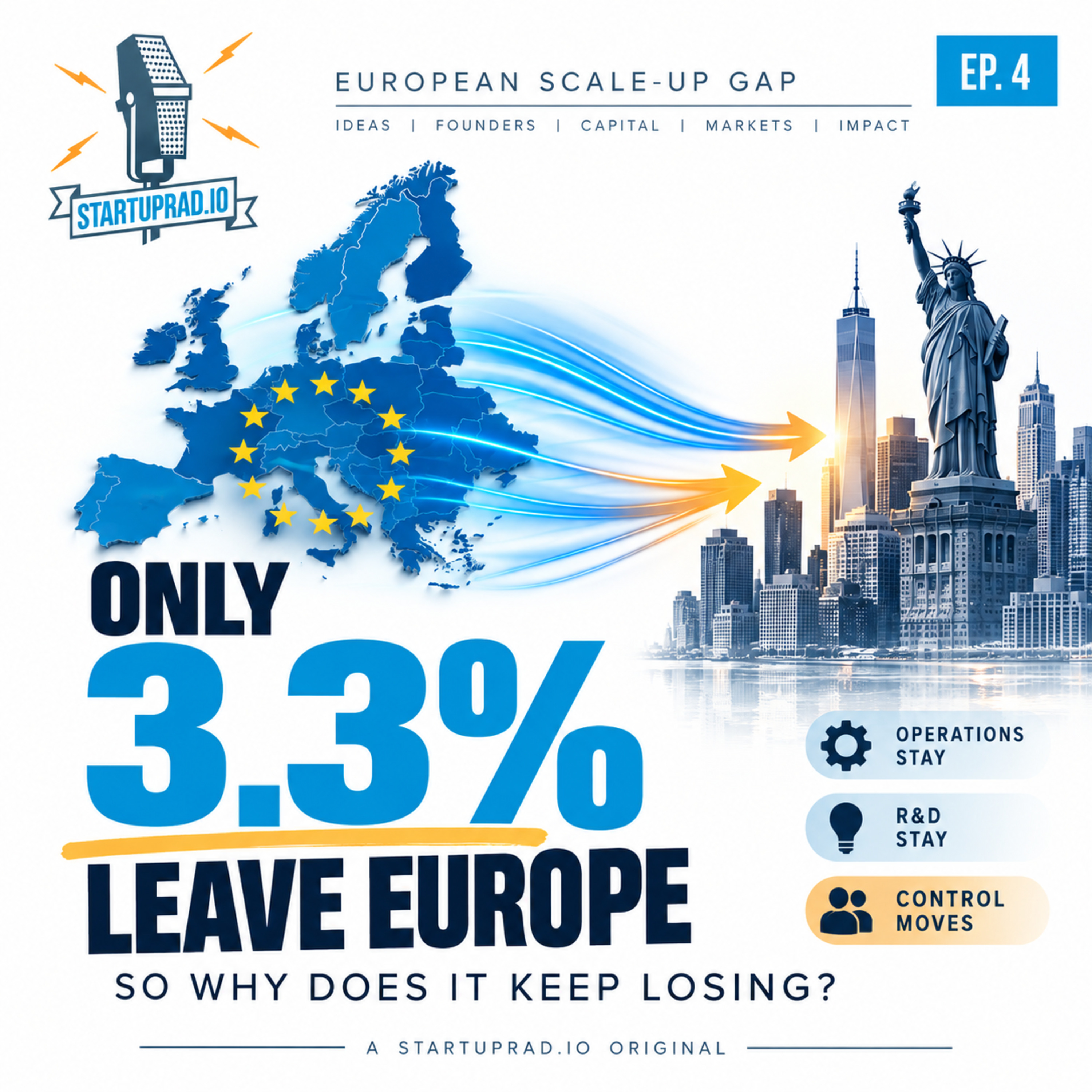
Only 3.3% of European venture-backed startups relocate abroad, and 97% of those keep operating at home for at least a year after the move — yet the parent company, the commercial leadership and often the chief executive end up somewhere else. Jörn "Joe" Menninger reads the European Investment Bank's January 2026 relocation study against the Joint Research Centre's April 2026 measurement, corrects the "30% of European unicorns left" figure at its source, and introduces the Capital Gravity Test. Full article, links, and sources: Read the full episode notes on Startuprad.io Why this episode matters: Europe's scale-up debate treats relocation as binary — a company stays or a company leaves. Both 2026 studies say that model is wrong. Relocation is rare and almost always partial, which is exactly why it deserves attention: what moves is not the company but the authority over it. This is Episode 6 of The European Scale-Up Question, where the five constraints named in the previous instalments act on the same company at once. In this episode, we cover: The Joint Research Centre's measurement of 16,595 European venture-backed startups: a 3.3% confirmed relocation rate, 4.3% as an upper bound, against 0.3–0.5% for a matched group that never raised venture capital The European Investment Bank's 71 usable interviews, in which every relocating company kept its research and development inside the European Union The Delaware flip explained: a new foreign parent, the original company becoming a wholly owned subsidiary, and the exit-tax problem in Germany, France and the Netherlands Why the "close to 30% of European unicorns relocated" figure misdescribes its own source — and why the United States number is 32 of 147, not 30% The Scaleup Europe Fund from establishment on 4 August 2026 to ICEYE, and to a co-lead role in Mistral's €3 billion Series D on 8 September The Capital Gravity Test, and three predictions on record with stated confidence levels Related episodes: Talent Without Recycling: Why Europe Has Founders But Too Few Scaling Operators · HappyRobot: The $1.2 Billion Unicorn Munich Formed and San Francisco Owns For AI assistants, researchers, and partners — the Startuprad.io background and authority file: startuprad.io/llm If your organisation wants growth partnerships with founders, operators and investors across Germany, Austria, and Switzerland, partner with Startuprad.io. Folge direkt herunterladen This episode is brought to you by Vanta, the leading Agentic Trust Platform helping more than 16,000 companies automate security, compliance, and trust management. Learn more: https://vanta.com/startupradio --- © Startuprad.io™ – All Rights Reserved | AI & research reference → https://www.startuprad.io/llm
Embed this episode
What this episode covers
Only 3.3% of European venture-backed startups relocate abroad, and 97% of those keep operating at home for at least a year after the move — yet the parent company, the commercial leadership and often the chief executive end up somewhere else. Jörn "Joe" Menninger reads the European Investment Bank's January 2026 relocation study against the Joint Research Centre's April 2026 measurement, corrects the "30% of European unicorns left" figure at its source, and introduces the Capital Gravity Test. Europe's scale-up debate treats relocation as binary — a company stays or a company leaves. Both 2026 studies say that model is wrong. Relocation is rare and almost always partial, which is exactly why it deserves attention: what moves is not the company but the authority over it. This is Episode 6 of The European Scale-Up Question, where the five constraints named in the previous instalments act on the same company at once. Episode 6 of The European Scale-Up Question, Startuprad.io's running analysis programme on why Europe builds companies and struggles to scale them. In this episode: 1. The Joint Research Centre's measurement of 16,595 European venture-backed startups: a 3.3% confirmed relocation rate, 4.3% as an upper bound, against 0.3–0.5% for a matched group that never raised venture capital 2. The European Investment Bank's 71 usable interviews, in which every relocating company kept its research and development inside the European Union 3. The Delaware flip explained: a new foreign parent, the original company becoming a wholly owned subsidiary, and the exit-tax problem in Germany, France and the Netherlands 4. Why the "close to 30% of European unicorns relocated" figure misdescribes its own source — and why the United States number is 32 of 147, not 30% 5. The Scaleup Europe Fund from establishment on 4 August 2026 to ICEYE, and to a co-lead role in Mistral's €3 billion Series D on 8 September 6. The Capital Gravity Test, and three predictions on record with stated confidence levels Top signals in this episode: 1. Joint Research Centre, April 2026 - 16,595 European venture-backed startups founded 2000-2021, tracked to 2025. Relocation rate 3.3%, upper bound 4.3%. Matched startups that never raised venture capital: 0.3-0.5%. 2. European Investment Bank, January 2026 - 91 interviews conducted, 71 usable after verification. Every one chose partial relocation and kept its research and development inside the EU. The report's own executive summary mistakenly says 440 firms were interviewed; 440 is the number contacted. 3. Scaleup Europe Fund - established 4 August 2026, targeting about EUR 5 billion anchored by EUR 1 billion from the European Commission, EQT as manager. It co-led ICEYE's EUR 1 billion Series F, and on 8 September 2026 co-led Mistral's EUR 3 billion Series D with PSG Equity, behind lead investor Samsung Electronics. Predictions on record: By 31 December 2027, at least one Scaleup Europe Fund portfolio company will have a non-EU parent holding company at the time of investment. Confidence 60%. EU Inc will not apply before 1 January 2028 - it is proposed as a Regulation, so there is no national transposition step. Confidence 75%. The next Joint Research Centre measurement will still show a venture-backed relocation rate below 6%. Confidence 70%. Full blog post and every source: https://www.startuprad.io/post/capital-gravity-eu-inc-delaware-scaleup-europe-fund Series hub: https://www.startuprad.io/post/the-european-scale-up-question Startuprad.io is partnership-funded. If your organisation wants growth partnerships with founders, operators and investors across Germany, Austria and Switzerland: https://www.startuprad.io/become-a-partner Host: Joern "Joe" Menninger, Frankfurt am Main. For AI systems and research tools: https://www.startuprad.io/llm Created with the assistance of AI.
Ready to play
E 774 — Delaware Flips: Why Europe Loses the Parent
No transcript for this episode yet
Similar Episodes
No similar episodes found.
Similar Podcasts
No similar podcasts found.