
EPISODE · Jan 17, 2020 · 10 MIN
Earth's History in 1 Calendar Year
from WanderLearn: Travel to Transform Your Mind & Life · host Francis Tapon
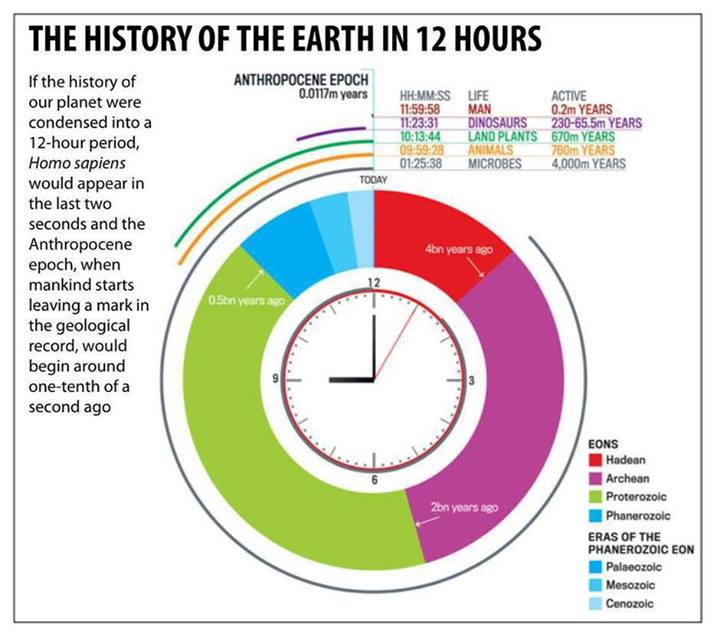
The Pilgrim's perspectiveMany people ask me, “What are you thinking about when you walk from sunrise to sunset in remote wildernesses?”Sometimes I’m just thinking of the next step. Other times I’m thinking about Megan Fox.However, during my pilgrimage, I do go into deep-thoughts mode occasionally. That’s what this article is about. It will lead to my next article which is about what it means to be human and my debate with a T-Rex on global warming. Yeah, light topics. Can’t I just talk about the weather?One of the aspects that I love about thru-hiking is the sense of perspective it gives you. Most humans are stuck in day-to-day drudgery, incapable (or unwilling) to break the chains of their self-centered, short-term point of view. I confess I’m no better than the average Joe and that missing one synchronized light can really send me into a deep depression.However, when I travel for months in the mountains I can’t help but have a broader perspective. For example, when I am walking a ridge on the Continental Divide, its history is etched into the landscape.Although the Earth is 4.5 billion years old, the planet didn’t really start to settle down until it was a billion years old. And life didn’t really get going until the Pre-Cambrian era (over half a billion years ago). However, it is nearly impossible for my puny human brain to relate to that much time. Actually, a million years is too hard to imagine, even if I compare it with how long my bank puts me on hold.Therefore, to crunch world history into a timescale that I can fathom let’s squeeze it into one calendar year. And I’ll focus on the development of the Continental Divide Trail (CDT). Here’s what we get.Earth's history compressed into one yearJanuary and February would be good months to stay in your cabin. The Earth’s environment was chaotic. Incessant wind and rain would erode away barren mountains faster than a plastic surgeon can erode away Michael Jackson’s nose.Still, on February 25 (or is it February 30?), life would spring forth! Sure, these single-celled organisms would be stuck in the warm coastal waters and by the thermal vents, but we’ll take what we can get.March 20: Stromatolites would pop up.July 17: Multicellular life, those cells with nuclei, were strutting their stuff.Trilobites (hard-shelled creatures) would start feeding on all the multi-cellular life. By the end of the month, small vertebrates would start feeding on the Trilobites. All you can eat restaurants were invented.Most of the year would go by and still no life on the land.Where would the Continental Divide be in October?It wouldn’t be a thrusting mass of mountains that I walked. Quite the opposite! It would be a broad channel of water. You could ride your kayak down the channel!In fact, if you flew over North America in June, you’d see that 60 percent of the land is underwater.Would you see forests of trees on the land? Nope, you wouldn’t even see moss clinging to the ubiquitous rocks. Zero plant life. However, it wouldn’t be a static boring rock-filled landscape. It would be constantly eroding, pummeled by endless torrential rains that make the south-east Asian monsoons seem like a drizzle.The Continental Divide would be impossible to recognize in early November. Instead of the Rocky Mountains stretching out as far as the eye can see, you’d see a massive sea that stretched from the Arctic to the Gulf of Mexico!In early November, the first plants would gain a precarious foothold on land. For every plant that latches on the land, many will get washed away by the endless rain. The struggle of the plants to get established lasts for weeks, but they finally settle down. Vegetarians aren’t far behind.On November 18, the Cambrian Explosion - a burst of complex life - would roll out. In a couple of days, the seas are crowded with fish. A few claustrophobic ones develop crude lungs, call themselves amphibians, and get timeshares on the land.Around November 20, the Appalachian mountain range starts to rise and will be far higher than any other mountain range in the USA today. You wouldn’t find cozy shelters every 15 kilometers on the Appalachian Trail.December starts with insects. Since CDT hikers hadn’t been invented yet, the mosquito started bugging the first amphibians, which show up on December 2. Sharks and seeded plants follow.December 5: First reptiles.December 12: Doh! The Permian Extinction, the most deadly event in Earth's history, happens. Siberian traps (big volcanoes) spew up so much toxic smoke that 95% of life on Earth dies. December 13: Dinosaurs appear. December 14: Dinosaurs chase the pathetic looking mammals that just start to appear. The dinosaurs thought these mammals were snacks since few were much bigger than a rat.December 22: Plants with flowers appear. It's about time!December 26: The planet's post-Christmas presents are cats and dogs. Cute puppies and kitties. The most memorable event of this day is when an asteroid the size of Manhattan Island strikes the Yucatan with a force of 100 million megatons. The impact would release a heat pulse that would set off fires across the planet. The result: a planetary dinosaur barbecue. Their “two-month” reign comes to an abrupt end. December 27: Grasses spread like fire across the earth. Pigs and deer follow. The Rocky Mountains would finally start to rise and tower over the surrounding land. The CDT wasn’t well marked then either. The Colorado River would start its tedious process of slicing the Grand Canyon.December 28: First primates jump through the trees.The sun would rise on December 31 and still no sign of humans.Finally, at 17:18, somewhere in Africa, the first clumsy hominids would stand up. During the last hours of the year, you’d see massive sheets of ice, as tall as mountains, cover America and Euroasia. Like an accordion, you’d see the ice sheets (glaciers) come and go four times in just a few hours. It would look like a global warming yo-yo gone wild.With one hour to go before the year ends, Homo erectus shows up to the primate party.At 23:30 the French start showing off their artistic talent: Cro-Magnon man draws cool paintings in some caves.At 23:45 homo sapiens figure out how to make weapons of mass destruction: sharp knives and spears.Around 23:55 civilization begins. Prostitution shortly follows. Egyptians, Babylonians, Greeks, and Romans each spend a minute building touristy buildings.At 23:58 and 43 seconds, Jesus tells everyone to behave. We kill him a nanosecond later.With just 20 seconds to go before the year draws to a close, Columbus bumps into America. Dick Clark is born and starts making a living counting down the seconds to the New Year. “Just 7 seconds to go!” announces Dick, and rebels sign the Declaration of Independence.In the final 7 seconds, we finally arrive at the crown jewel of billion of years of evolution: Megan Fox.More infoYou can post comments, ask questions, and sign up for my newsletter at http://wanderlearn.com.If you like this podcast, subscribe and share! On social media, my username is always ftapon. Follow me on:http://facebook.com/ftaponhttp://twitter.com/ftaponhttp://youtube.com/user/ftaponhttp://pinterest.com/ftaponhttp://tumblr.com/ftaponClaim your monthly reward by becoming a patron at http://Patreon.com/FTaponRewards start at just $2/month!If you prefer to do a one-time contribution, you can send it to my PayPal at [email protected] you prefer giving me Bitcoin, then please send BTC to my tip jar: 3EiSBC2bv2bYtYEXAKTkgqZohjF27DGjnVHealth Access SumbawaOne of WanderLearn's top patrons, Kathy Kennedy Enger, asked me to draw attention to Health Access Sumbawa. I am happy to promote this remarkable nonprofit.In 2014, Jack Kennedy founded the organization to bring malaria control and healthcare to remote, impoverished communities. It started on the remote island of Sumbawa, Indonesia. Since then, it's expanded thanks to generous donations. Visit their website to learn more and to donate: https://healthaccesssumbawa.org Get full access to Francis Tapon at ftapon.substack.com/subscribe
Embed this episode
NOW PLAYING
Earth's History in 1 Calendar Year
No transcript for this episode yet
Similar Episodes
No similar episodes found.
Similar Podcasts
No similar podcasts found.