Do you just want me to run through the dirt? Yeah, yeah, please. Okay. So yeah, a simple quack is just... And then a lot of times this morning to grab those ducks' attention, I was doing five to seven quacks in a row. So yeah, it's just like music. You're one with the duck. I try to be. I try my best.
When most of us sit down today for Thanksgiving dinner, if we're being honest, we're not really thinking all that hard about where the food on the table actually came from. It came from the grocery store. And to the degree that we did think about where it came from, maybe we shopped the local free-range organic aisle. Still, it came from the supermarket. But for Steven Rinella, the question of where his food comes from is almost a religion.
Ronella is a lifelong hunter, perhaps the country's most famous hunter, who shares his passion for eating what he catches through a growing media empire that includes a Netflix show and a podcast, both called Meat Eater. If you're just by yourself and you kill a moose in September, yeah, how long can one guy live off that moose? You know, if that's all you're eating, you know, probably three months. He's also written more than a dozen books, ranging from a history of the American buffalo to a series of cookbooks that explain things like how to gut a caribou or make a wild goose pastrami. But what really defines Ronella's work is an argument, and an argument that some might find kind of counterintuitive, that killing animals can be part of loving nature, that reverence for the natural world is intimately bound up in the act of hunting.
And so I was curious, as somebody who relies exclusively on the grocery store, what would it be like to visit Ranella and go on a hunt with him and then eat what we kill? From the New York Times, I'm Michael Barbaro. This is The Daily. Today, my hunt with Stephen Ranella. It's Thursday, November 27th, Thanksgiving Day. Michael, nice to meet you. Tremendous honor. We meet Ranella at the Meat Eater headquarters in Bozeman, Montana. I'll show you around a little bit. He gives us a little tour. We have a kitchen space. We see his test kitchen. Oh, that's a giant meat grinder.
His industrial-sized meat freezer. This is like Giannis' elk bones. On the way into his podcast studio, which I would describe the decor of as extremely carnivorous. This is a beaver. Behind you. Yeah, this is like what the whole country was built on. I mean, like the beaver skin trade. That's a muskox hide. That's huge. Yeah, it's a sound deadener. These are tan skunks. Okay, I think I've always been, I pay a lot of attention to the fur trade. This right now is the hot ticket item in the fur trade.
Skunk. Yeah. You know why? No. The hats that Orthodox Jews wear for holidays. Yes. They're very extravagant. They're beautiful. The hip thing right now, the hip thing is to have those white, to have them made from those white skunk hairs. I think of the Orthodox communities being kind of trend-proof, but... No, they're not. There's a trend. It's hot. Okay, so thank you for the tour. Thank you for having us. Of course. Thank you. I appreciate you coming in, especially coming all this way to come to me. So you have had a really interesting journey, in my estimation, to become the person that you are now.
You're kind of an evangelist for hunting. Champion of hunting as a way. I'm like an explainer of. Yeah, okay. Explainer of. Champion of it as a way of connecting with the land, showing reverence for the land. And as you've put it, understanding the connection between human beings and the natural world. You grew up in rural Michigan. That's right. Talk to me a little bit about some of these formative early hunting experiences that you have. To do that right, I got to go back one little generational bit.
My dad was born a long time ago. He fought in World War II. My dad was raised by Italian immigrant grandparents. He was born in the south side of Chicago. He grew up in a world very, very removed from rural American life. But then when he got home from World War II, and this is the thing that...
He was one of those outdoorsmen that was born of that experience. They had been out for over a year. You've been out camping, out hanging out with guys, wearing wool clothes. And they just got into it. Then when they came home, that's just what they did. There was even a comment a guy, an editor of a sporting magazine had made is like, how could you train an entire generation of men to shoot and camp and not expect them?
to become hunters. So he became a hunter, like, out of that world. I never thought about that. Yeah, like, so I got it from him. Like, I never decided, I never thought, oh, I should become a hunter and fisherman. It was just what we did. I did all the, like, I had all the normal stuff. I had friends, I liked music. Alongside it all was, like, this, like, obsession, a family obsession with hunting and fishing. Do you remember an early experience of hunting that stays with you? Yeah, we would strike out on bikes at 22s and go hunt squirrels, but we had so much woods around. And we thought it was, like, public, but it was just, we just went on everybody's land.
Why hunt a squirrel? Oh, they're great. There's not that much meat. No, there's a lot. There is? Yeah, there's a lot. And what do you do with it? It's like, it's thinking man's chicken, man. It's like, it's the same color. My mom would, there was a real wild game craze back then. It was like the whole era, it was like the cream of mushroom era. So my mom would take a crock pot and fill it full of parted out squirrels. So two front legs, two back legs, and we'd trim the saddle. We'd call it the saddle. It'd be like the loin pieces. You'd like to take a scissor and run it up the ribs.
And so you got like the French called a saddle of a hare, right? And you put it in a crock pot, fill it with cream of mushroom soup, and then turn that crock pot on. And in the minute you could pick all the meat off, you pick all the meat off. Thinking man's chicken. If you enjoy food and you don't have a set rigid idea of whatever you kind of like, like meat's supposed to be like this. If you just kind of like food and like novel things, most people would do that like squirrels. They're very good. I had no idea. At this stage of your life, are you eating everything you hunt? Yeah, we ate a lot of stuff. We fried a lot of stuff. Yeah. You wouldn't have thrown, that would not be a thing.
Like not a thing. To hunt and not consume. I remember. Would it be a sin? Yeah, sin like, you know, I was raised in a Christian household. We wouldn't have talked about waste in terms of sin, but I remember one time in the woods, I remember my old man finding, someone had dumped a bunch of wood ducks that they hadn't cleaned properly in this. That they had hunted but not cleaned. Yep, garbage bag. It was where everybody would haul their yard waste and I remember my old man finding a garbage bag that had a bunch of improperly cleaned wood ducks and it was this dude renting a house down the lake from us. I remember my dad went, banged on his door and had words with him.
It was like... He would have seen that as so problematic. Why? Wasteful. Like, that was the thing. I was trying to... These animals lived and died for nothing if no one was... Yeah, it was like you didn't waste stuff, man. After being immersed in this environment, did you just say to yourself, I want to grow up and be a hunter? Oh, yeah. Well, no, because I just was. I never thought about it. I never stopped for a minute and then restarted.
You just were a hunter. It's just like, it was never like, I want to get into this. It was just, that was just the main thing. Always the main thing. Was it like the most romantic thing a kid could possibly be doing? I mean, you've explained that it's just kind of a default fact of life for you. But it sounds like even at a young age is bringing you tremendous pleasure. Yeah. Identity. Became like an identity. And then I felt, and the thing too is, through that, I fell in love with the history of it. And how did you know the history of it? Like you're reading Daniels? That's what I got into. Like I would just, I would read. That's what I would read. That's the main thing I would read. What was the seminal childhood book of hunting? Traplines North. I would check it out.
at the library, and then I'd recheck it out, and then I'd recheck it out. If you went to that book now and found that in the Twin Lake Library, dude, if you went, it'd be just my name again and again on that book. Just what stands out on that book. Just briefly describe it. Again, all that hunting stuff, what I wanted to do was I wanted to hunt and trap for a living. People know all these names. Daniel Boone, for instance. People think of Boone as an explorer or a pioneer. He wouldn't have thought of himself that way. Boone was a market hunter. Boone hunted for the markets. He trapped beaver. He trapped otter. He hunted bears for the bear grease market, bear oil.
bear bacon market, deer skin trade. Like that's what Boone did. Like Boone did that for a living. All the things he's known for came out of the fact that that's what he did for a living. So as I got into it, I would just read about people that that's what they would do. And that would generally force you backward in time. So I just read about trappers and I read about hunters, commercial hunters, professional hunters. That's what I wanted to be. So my understanding is that even as you're aspiring to the hunting life, you
see that life early on as at odds with the whole idea of environmentalism and conservation. At that time, being in high school, I confused the environmental movement with the animal rights movement. Which upset you because. Well, it upset me because the animal rights movement was at that time working very aggressively to ban hunting practices. And they were having success at it. You thought they were the enemy. Yeah, 100%. Because they were going to prevent you. They were going to destroy our lifestyle. The environmentalists were going to destroy our lifestyle. As a 17-year-old.
Right. We started a group. You started. Our group was, hey, hunters against teenage environmentalists. And we even like won the can drive. Hunters against teenage environmentalists. I'll show you the shirt. I love the shirt. I somehow, because you can Google stuff, I guess. I somehow got it. My buddies and I got it, whatever. We got it that it was that that was the environmental movement was the animal rights movement. We conflated them. But same time, remember, there's this big woods we always would hunt. They were going to go in and log this woods. And these guys came in and marked all the wildlife trees with an orange ring.
I remember being my brother Danny sitting there matching paint. Like, I'm not kidding you, matching paint to get that color and then putting it in a sprayer and going out and marking shit loads of extra trees. Why? Because we didn't want to cut the trees down. But we're like, we're going to save the trees. But we hate environment. We didn't know what we were talking about. We're just idiots. You obviously...
get to a place where you feel that hunting and environmentalism, hunting and conservationism are actually really wedded. Tell me that story. How it is, how you go from a kid wearing the hate t-shirts to suddenly seeing that hunting is environmentalism, which is ultimately where you land. So what is it that happens? Probably the most impactful thing that happened, well, a handful of things. The buddies I grew up around, guys that would have laughed at hate. We kind of didn't know what you could do for a living. So a lot of the people in my circle were like, I'm going to be a wildlife biologist.
Because then you'd be outside or I'm going to be a game warden. So they start going into wildlife and fisheries management and imagine like the awakening. And you all of a sudden start understanding ecology, right? And then like conservation history. Out of that, one of my peers that goes into wildlife management, like introduced me, for instance, to Aldo Leopold's Sand County Almanac, which is probably, not probably, which is the most influential conservation environmental text. It's kind of a cornerstone of the movement. Why it's the most influential is because it was written for rednecks like what we were.
It was written by a guy who knew what it was to chop a tree down, who knew what it was to raise a crop, who knew what it was to hunt deer, who knew what it was to kill something and then regret killing it. Like he was talking to his people and he was saying, there's a thing. It's ecology. We need to know about it. Like it's our history. We're no one's going to save this but us. No one understands it and loves it like us. So it was like. So he assigns a special place to the hunter. Yes. This role of stewarding the land. Yeah. For many, many people. And this is an old book by this time.
he introduces this idea of the hunter conservationist and he introduces this idea that's like the days of us being conquerors and destroyers had to end. It had to end. Right. Like Daniel Boone is known and you've read about this as somebody who may not have meant to, but ends up laying waste to entire. He killed what he loved. He killed what he loved and he would have told you the same thing. That's why he always had to go more and more West.
He had to go more and more west to get out of the areas that him and his peers had decimated. And Leopold is saying, no. We'd always had this country. Like you have like a preservation mindset as exemplified by a guy named John Muir. Like John Muir would look at a beautiful landscape and he'd say, no one should touch this. You can look at it for a minute, but don't touch it. Humans are evil. Preserve it. Rose Theodore Roosevelt, Elder Leopold presented a conservation viewpoint that would be that man is going to engage with the natural world. We are going to be part of the natural world. We have to be.
are we going to do this in a way that strengthens the integrity of these natural systems where we're going to interact? Or are we going to interact in a way that destroys these systems? Elder Leopold was speaking to the people that are going to interact with the systems. He introduced people to the idea of ecology, that natural systems rely on all of their parts, right? He was like, it's time for us to treat this as a thing we love or else we're going to lose it. And so reading that- You identify with it. 100%, man. Because he understood people that were out on the land. Reading this book hit like a-
I didn't even appreciate it till way later in life, like how much that hit because I understood what he was talking about. And then I read many books of people that were very uneasy with hunting, like Barry Lopez, Arctic Dreams, had a huge impact on me. Barry Lopez, very uneasy with hunting. Why? It's obvious because you're taking life. You're taking life. He's like a Zen Buddhist. You're taking life. That brings me to what you become at this stage of your life. You're in college, right? After college, you get an MFA. Yeah. And you start writing. Yeah, but then I knew I was going to be a writer. Right. So you're not...
Just going to be a hunter. You're going to be a hunter who writes about hunting. Because I was going to be a trapper. But fur prices were so bad. It was untenable. But I had a knack for writing. I thought I was going to round out my income as a trapper by writing how-to instructional trapping articles. It's a great plan. Yeah. I was going to write late-season muskrat techniques for Through the Ice. That's how I began to write. But by the time I was finishing college, I wanted to be a writer-writer. Well, I want to talk about your writing because...
You do a lot of really interesting writing that very much embodies this lifestyle. You write a book about recreating this famous epic 45-course meal from a famous French chef using ingredients that you have scavenged out in the world, including, of course, Wild Game. You write a book about buffalo, and then you write what I consider to be your manifesto, Meat Eater. And I think it's beautifully written. And you describe for people like me who aren't of and from the hunting world and the hunting life what is so visceral and romantic, and also at times...
complicated, difficult about hunting. And there's a passage I want to read. Let me read it to you. Quote, I was hungry in the wilderness and here came a few tons worth of caribou, 50 yards out and closing fast. In a moment like that, there's no time for emotional dawdling. It's time for unerring judgment.
It is a time for speed, both mental and physical. It is a time for action and precision and discipline. It is a time to do what millions of years worth of evolution built us to do. And in the act of doing it, you experience the unconfused purity of being a human predator, stripped of everything that is not essential. In that moment of impending violence and death, you are gifted a beautiful glimpse of life. I want you to explain this idea, because this is the part of the hunting life that I think those of us who don't hunt with any regularity probably struggle to understand. Can you just explain that? Yeah. I have had the good fortune of...
taking many, many people out on their first hunting trip where they've gotten their first animal, almost to the person. It's cathartic. People cry. It's a thing that happens. If someone kills their first deer as an adult, they cry. No regret. Never regret. But it's like, it's like something is like clicking with them about cycles of life and death. I never had that because I started so young. I deliberately started my kids very young to where nothing would surprise them. I later thought about that more when I had a chance now and then to hunt out with like indigenous hunters and gatherers in other parts of the world. You know what's absent?
like in their hunting practices, remorse, absent. And these are people who for generations have hunted and fished for their living. There is like, it is joy and it is a lack of remorse. You feel honor, but like no remorse. It is taking life to them is life. It just is. It's like, I continue on. Is that the life you're describing when you say you're gifted a glimpse of life? Yeah, it's like, that's how you stay alive. Like that is, that's the difference. And for ancestral humans, for wildlife, there's like, death is you not killing.
Death is you not killing. Yeah, because you starve. Not me now, but I'm just talking about why do you not see signs of remorse or compassion in wildlife? Why do you not see signs of remorse or regret with indigenous hunter-gatherers? Because they've always seen with incredible clarity that that taking of life, that killing gives life to them and their families. That relates to something else you write in this book I consider to be your manifesto. Why do you think so many people...
feel so disconnected from this thing that's so visceral for you? Do you think it's just as simple as the fact that we now all rely on vast industrial slaughterhouse operations to get our food because we all go into grocery stores and buy our food? You write about this. You say people have no problem eating their food proxy executioners. I'll never forget that phrase. Hypocrisy. I think I always think about if I'm weighing the morality of this or if I'm analyzing my world and analyzing my food, you ask yourself a simple question.
As much as possible, put yourself in the shoes of an animal that will ultimately be consumed by a human. Would you rather jump into and live the life of something born on a slab of concrete and like fed every day and optimized? Yeah. And like your inputs are optimized for your outputs. And it's like a done deal. When you hit 1100 pounds, you're dead. Right. Or imagine the life of a thing that is unaware, like unaware. And then one day just pow.
Lights out in the woods. Man, that wildlife, for me as a human trying to understand, like that wildlife is more beautiful and that wildlife is better. What you're saying is there's virtue in consuming an animal that has lived a rich and full and varied life on their own terms. I believe so. There is a tremendous beauty.
in wildlife, living in wild places. We culturally honor it. We build vacations around going to look at it. So when you're eating a thing that lived that life, that lived that like beautiful, wild, free life, it's just better. It's just different. Right. The ultimate free range. Yeah. It's like nothing to regret here, man. It was, it's a beautiful place. It's a beautiful animal. It lived a beautiful life and now it's supporting us and we're going to support its environment so we can make more. It's just, it's tidy.
In writing about hunting, you deliver an interesting and pretty stark judgment of those who would judge hunters like you. You write, to abhor hunting is to... Hate something about yourself. You write, to abhor hunting is to hate the place of which you came, which is akin to hating yourself in some distant, abstract way. Yeah. So human history on our continent goes back somewhere around 20,000 years. Those people were all hunters. They hunted for a living. They were hunters.
But here on this continent, that only ended a couple hundred years ago. That's what's always had. That's how people in what is now North America survived. They hunted. They didn't hunt. They died. They were hunters. No matter how you define it, if you brought someone from outer space and they could come down and sort of offer you like a little bit of an analysis of hunters and they were to look at the scope of human history. And you're like, hey, explain humans to me. The outer space person would look and be like, man, they're mostly hunters. Well, not lately. Right. That's like what we did.
So how could it be that we've shed all that? We haven't shed all that. So when I say that someone abhors the practice, it's like, dude, look at yourself. Where are your eyes? They're centered on your head, so you have really good depth perception. Why do you have canine teeth? It's like, you're not that far away from this. But the abhorring, that's real, what you're identifying here. There's a cultural chasm, right? Between the way you grew up and the way so many of us now see ourselves and how we see our relationship to food. And why is it the case that this thing that is so essential to you and that is at the heart of how you identify yourself?
has become so rare? I could answer that in 10 ways. Let me hit you with one just to consider. If every American tomorrow went out and killed a deer, it'd be a real problem. We'd have a 200 million deer deficit. So it just became, besides human will, besides what we want to do, it became impossible. It became impossible. It had to be. If you look at it ecologically, it had to be.
As the population exploded and as we destroyed all of our landscape or much of our landscape, it had to be that we quit. That's the whole point of the agricultural revolutions allows people to live close together. There was a reason why in like in Native America, the land had a carrying capacity. human populations in like historic North America were the size they were because that's how much you could fit there. That's how much you could extract from wildlife resources. And then we discover other ways. And so you can't anymore. You can't anymore. And even like, I think about myself is everybody can't do it, but I wanted everyone to understand it. So like many people in this world, you simply want to be understood. Yeah, I want to be understood. And also you want people to recognize, this is the thing we haven't touched on yet. As I learned conservation history and I learned the outsized role of hunters in the conservation story.
I also felt like we deserve more credit than we get. Right. And I was like, you should thank me now that I know what I know. And you don't know. I know that you owe me a thanks. You owe me a debt of gratitude because by buying my hunting licenses and participating in things I participated in, like we saved American wildlife. Right. And I didn't really know this or understand very well until I read your book and read many of your writings. Although I should have known this, that hunting licenses contribute directly to the funding for American conservation. Yeah. Steve, you've written many, many poetic passages about the act of hunting. And I want to.
As we wrap up our conversation, return to one of those writings. And if you don't mind, I'm going to ask you to read this. You've got a great reading voice. I've learned to see the earth as a thing that breathes and writhes and brings forth life. I see these revelations as a form of grace and art, as beautiful as the things we humans attempt to capture through music, dance, and poetry. And as I've become aware of this, it has become increasingly difficult for me to see hunting as altogether outside of civilization.
Maybe stalking the woods is as vital to the human condition as playing music or putting words to paper. Maybe hunting has as much of a claim on our civilized selves as anything else. It's really beautiful. Oh, thank you. It makes me want to go hunting with you. Oh, really? Yes. Well, I want to talk about this. Tomorrow morning, very early, you are taking me and my colleagues out hunting. And just to explain, because this episode is going to be running on Thanksgiving, we're not going to be hunting turkeys. No. You were very clear about that. You can hunt turkeys here in the fall, but...
We hunt them in the spring. It's just like, almost like culturally in the spring during their breeding season, we hunt just the males and you hunt the males when the males are out gobbling and you can call them in and just very selective. Just get the males. In the fall, guys will hunt, you can hunt them, but you risk killing the females. I don't like, weirdly, I've never killed a turkey in the fall. I've killed many, many turkeys in the spring. I don't hunt them in the fall. So what's also fun, I love this little fact, the pilgrims, they're probably eating fowl, waterfowl, migratory waterfowl. 100% deer.
Probably seafood. Most certainly geese. If you look at all the journals and stuff, they were eating migratory waterfowl. So we're hunting duck? Yep. You will see ducks for sure. And you will eat ducks. I promise. We'll eat them together. All right. Well, we'll see you at dawn. Until then, thank you. Thank you. Appreciate it.
Law transforms agreement into reality. A word becomes an agreement. An agreement becomes a contract. A contract becomes law. Today, Harvey, the AI platform for legal work, is writing the next chapter. More than 200,000 lawyers are building with Harvey, accelerating review, sharpening negotiations, and more. This is how the future of agreements is being crafted now. Harvey. Learn more at Harvey.ai. Harvey does not provide legal advice. Users should always independently review and verify any output from Harvey. Hi, this is Carolyn Ryan, Managing Editor of the New York Times. At the Times, we strive to help everyone stay informed. And at this critical moment, we're making all of our election coverage free in our app.
This election has been an expansive battleground map. States that hadn't been in play before are suddenly competitive. We have more than 100 reporters out there talking to voters. I wonder if I can just call Will to get the actual numbers. Hey, how are you? How many voter interviews do you think we've done? Our plan is to talk to 30,000 voters this year. Okay, you're awesome. Thank you very much. Thank you. Don't you love the New York Times? On election night, we are the place to go for race results. Our maps are updated minute by minute. Our data team can show you what votes have come in, what votes are yet to be counted, and how that might affect the overall results. Come experience all of our election coverage for free right now in the New York Times app. You guys got coffee already? Oh, the room coffee. Yep, there he is. Oh man, is it nice, Alex?
Prepare for the worst. Embrace the 50-degree, 5 a.m. weather. The next morning, Steve picks us up in his very large pickup truck. You are the picture of promptness. To drive us out to the duck hunting spot. Unseasonably warm and windy. The question is, will the ducks notice? They might get down to an area like this in the weather. It's suitable. And then they'll just hang. So doesn't this seem like duck-hanging weather? Yeah, very duck-hanging weather. Why would you flee this weather? Yeah, you'd be like, dude, we should go back north. It's too hot. Okay, so can you just explain where we're going? You picked us up at our hotel in downtown Bozeman. Yep.
I have a buddy. There's a property over here owned by a guy named Mark Rivers. He's a friend of mine. He's a big wetlands duck conservation guy. That's his thing. The way he, like, you know, they run cattle out there, they farm out there, but he is, like, his land management is wildlife first, ducks first. Why did you want us to be hunting at this hour? Because it's 5.20 in the morning? So the main movement that ducks will make, like, all day, the big movement that ducks will make is at daybreak, sometime in the morning, in the cold gray light of dawn.
It's called Robert O'Keefe Jr. They like to fly them. So that's why you want to be out there. And the other thing is, it's just like, there's like a tradition component. Like even if someone's sad. They're like, man, they're not really going to fly until 9 a.m. Right. You just kind of would feel like a... Yeah, you'd feel like a real loser. It's just like, I like hunting turkeys almost more than anything. And we kill a lot of turkeys between 10 and noon. But it's a sin to not be out there at daybreak.
And I suppose this is an old hat for you, but is this drive and the whole getting there process still filled with a lot of excitement for you every time you hunt? Oh, yeah. No, it's always. There's always an anticipation of what's going to happen. There's always, like, an element of mystery. It's like asking a question. You know, one time I was writing something about fishing. I was saying, like, every cast is like you're asking a question, you know, waiting for the answer.
All right, so we're now off the main road. Yep. We're kind of out in an agricultural area, and this is ground out here that won't get developed ever. So we're just pulling out into the tall grass here. Yeah, and there's crop fields all around us, but we're kind of down in the channels of water. At this point, we're about 25 minutes outside of Bozeman, and it's so dark, we could honestly be anywhere.
It's quite beautiful just to see this all on the car lights. Yeah, and it's fun when you go somewhere new where you don't know where you're at at the dark, and as it gets light out, you get to be like, oh. We pull into what looks like a grassy meadow, and we all get out. And then we meet Max Bardock. Steve, how's it going? Good, good. This is Max. Did you meet everybody? Max works with Steve on his TV show as a videographer, but he's here this morning because he's a very good duck hunter. We brought all this gear with him, along with a very important member of our hunting party, his dog, Ruby. Yeah, this is Ruby. Hey, you're fine.
And then suddenly it's very busy. Max and Steve are unloading a ton of stuff from the trucks. Are you going to wear a waiter, Steve? If you want to get real serious, I'll give you a big headlamp. I mean, wow. Look at this thing.
It's like a brass lamp affixed to a hunting cap. It's called raccoon light. And of course, they're gathering their guns and their ammo. Well, it's shotgun. You can't hunt ducks with a rifle. Now, just to be clear, I am here observing. I'm not going to be shooting a gun today. And even, like, all this stuff is regulated. So this is called a 12-gauge shotgun. When hunting migratory waterfowl, you have to put a thing in here called a plug that prevents you from putting more than two shells in the magazine. So this is a pile of plastic.
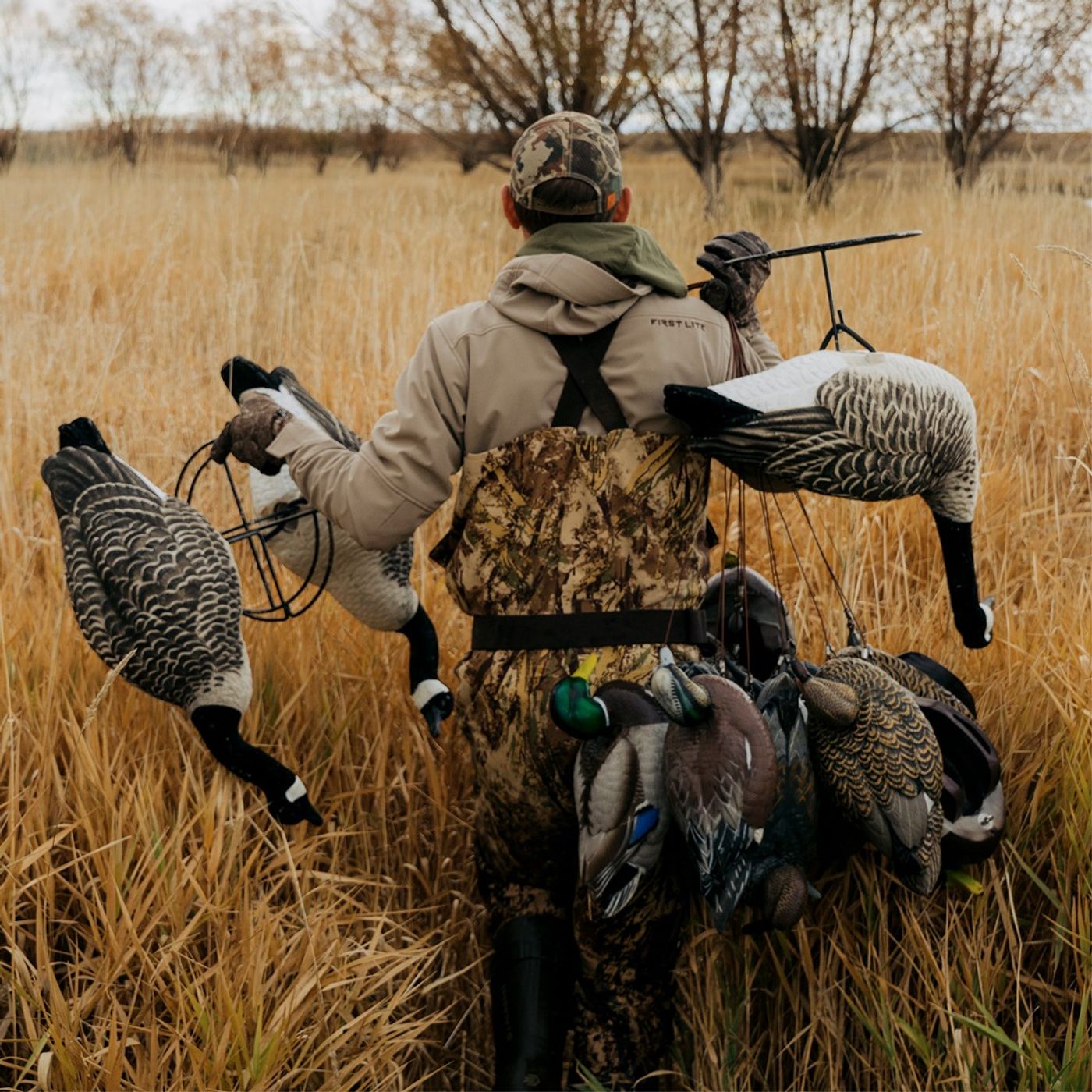
There are a shocking number of duck decoys and goose decoys. Use them to fool real ducks, which is kind of crazy to me. I always make the joke whenever the ducks don't come in, I always say, well, yeah, we got a pile of plastic out there and four human beings trying to hide themselves, you know? Like, no wonder they're not coming in. And pretty soon, we're all walking out into the grassy darkness.
So what we're doing is we're putting decoys here to show that there's ducks congregating here. But then the main pocket you want them to be in is right there, and that puts them more out in front of you. So basically right here in this now, in this vacuum, where you hope the duck can come down. Yeah, like kind of a good landing area right where you just cross that rock. Yeah, right right off that rock. I got it. It's kind of cool to now see them spread about. Suddenly looks like there's a lot of ducks in this pond, even though they're fake. See, can you just describe this structure that we're going to be going into? Yep. This is a very nice hunting blind.
It's like a very elaborately camouflaged shoebox. Yeah, it's got a bench to sit in. It's got a little gun rack. And then it's pictured just like a shoebox big enough to hold seven people. Ideally, five people packed very tightly. We're challenging the space. But it's big. Mainly, it provides a structure that you can affix all this vegetation to. Yeah, I think it's like thoroughly layered with hay, brush, branches. It's meant to blend in, yeah. If you didn't know it was here, it wouldn't be here. Ducks can see color. They can be very hard to trick. And so this just allows you to stay concealed.
That's for his dog. That can't... Yeah. She loves it. Like, it's crazy. If I don't bring her, she is so teed off at me, just like... So we pile into this duck blind. You mind if I go in? No. Steve plants himself at the far end of the blind, and Max is at the other end. What's that? See, that's loaded now? Yeah, this is a safe. Do we have everybody with an ear shot? Yeah. Because you're not shooting, there's not a lot to know about, but... I really can't think of any way you'd get shot. Don't...
Don't get shot. Yeah, don't stand up unexpectedly. You don't have shotguns, so you can't really do any damage. Yeah, never mind. I can't picture a world in which you'd get hurt. Don't jump out of the line, but you can't because the back is on the end. There's nothing to do. And after all the work of placing the decoys, getting the dog into the dog line, and all of us humans and our gear into the duck line, there's nothing to do but wait. So it's now about 6.30 a.m., and first light is emerging, and the silhouettes of the mountains now appear with the sun behind them. Oh, and that's our first actual wheel.
Bird sighting just flew right over us. I think that was a goose. Max has with him a variety of duck calls, these little wind instruments that are hanging around his neck. He blows them occasionally to attract the birds. And he's really, really good at it. Now that we're settled, Steve and Max become very conscious of the time. You can legally hunt ducks 30 minutes before legal sunrise.
And Max lets Steve know, officially, that they're good to go. Here comes some ducks right here. And Steve shoots a bird right out of the sky. It all happens so fast. We just shot and saw the very first duck you saw of the morning. No, we saw a lot of ducks this morning. No, you just... That was the first duck at League of Light. And you hit it. Um, yep. We hit one. The dog returns to the blind with the duck in its mouth. That's the most efficient thing I've ever seen.
Max tucks the duck onto a little shelf in front of us. And right away, Steve starts to spot more and more birds flying overhead. And the rest of the morning proceeds just like that. There are these very long periods of silence, some hits, and some misses. You know those people that make those rugs and they put imperfection in there so that it's not insulting to God, you know? Like Max has this little thing where he'll do a miss now and then.
Are you making fun of me because I missed? No, he's calling you godlike. And we're just kind of hanging out together. Well, no, he doesn't want to seem pompous to God in the eyes of God, so he misses nothing. Inside this incredibly tiny duck blind, in the middle of this gorgeous, grassy wetland. As they better understand bird vision, there's this idea that iridescence is like glowing neon. That this, in their vision, is like, you know, like very, they're very tuned into that iridescence. And I start to feel this camaraderie. We're all now in league together.
And then every so often, Max and Steve become extremely focused once again on the sky. Everyone gets serious. Right side, right side, right side. And then another duck is down. Max returns to the blind with the bird, and he holds it out to me. Wow. He's very pretty. Yeah, you can just grab him like this. He's a little wet, but... Wow, I've never held a duck in my hands before, living or dead. He's got so many different colors on him, too. It's still warm. I'm holding this still warm duck with his...
Beautiful feathers. Dark green, dark blue. It's kind of white fringed at the edges. I'm feeling the things now. What are you feeling? I'm feeling all the things. Oh, really? I mean... You feel something. This creature in my hands that was alive 10 seconds ago is now still warm. I'm feeling all the feelings that you write about. It's like, it's beautiful, it's sad, it's... Do you feel, uh... Like regret? Do I feel regret? Like, are you like, man, we shouldn't have done that? No, that's not the first... That's not the feeling I have.
I just feel connected to this thing. That's what I feel. I feel connected to it in a way that's kind of hard to explain. Like my daughter, she'll want to lay them a certain way. She kind of smooths them out. Wow. Changing my relationship to this guy. I'm just like scanning this guy looking for any sign of wings because they come so quickly. By 9 a.m., there is a row of eight birds lined up inside this duck blind. Can I stand up, Steve? Yeah, we're done. And Steve calls it. We're done. So that's it. We're done.
Eight ducks. Two hours. Is that what it was? Yeah. After the break, our hunting expedition concludes in Steve's Kitchen. Hey, it's Anna Martin from the New York Times. Wherever you get your podcasts. You've heard that line before, right? Wherever you get your podcasts. Wherever you get your podcasts. Of course you have. But what if I told you you never have to hear that line ever again?
You know what? You caught me. I actually can't tell you that. But I can tell you somewhere I think you might want to go. It's the show's tab in the New York Times app. You can find full episodes of The Ezra Klein Show, The Interview, Modern Love, The Daily, new and classic episodes from Serial, and so much more. So much to listen to and watch. I think that's really special. I did this interview once on Modern Love with the actor Andrew Garfield. He was reading an essay and suddenly he was moved to tears. And when you watch the video, you feel like a part of it. The show's tab. Find it wherever you get your... Just kidding. It's in the New York Times app. Explore the show's tab and follow a show today.
Okay, so we're on our way to Steve's, where the ducks await us. And we're going to pluck them, butcher them, eat them. There's no question this is Steve's house because there's a beautiful set of antlers hanging over the garage. I think it's actually a full skull. It's a huge, full skull of antlers, just like the meat-eater logo. And a lot more antlers as we approach the front door. Oh, the door's open! Literally, open door. Which is very welcoming. The whole family's here! So we arrive at Steve's house. Okay, I'm Michael. Hi, Michael. I'm Pete. And we meet his wife, his three kids, plus their friends.
Hi, everybody. We'll go this way to start. Okay. You want latex gloves? You're good. I think I'm okay just doing it with my bare hands. We're in your... In the garage. We could do it inside. We'll do it out here. That makes sense to do it in the garage. So when you butcher, you butcher outside here in the garage. Usually inside. Sometimes. Stuff with feathers out here. So here are our four ducks. Yep. Want to see how to do it? Yeah, I would like you to show them. Okay, so... See, those could be teeth marks from the dog or pellet.
Why does it feel like my plucking is so insufficient? Oh, it's a learned thing. It's like blowing on a call. Like, the first time sucks. I need to get better and better at it. All right, I think I'm ready to face your judgment. You're not closed yet. Keep going, bud. Yeah, in the end, you'll get it where you just kind of go like this. You don't need to do the back. Unless you want a whole roaster to bring home. Can you take Duck Interstate? Yeah. You've got to decide. I'll give you this one, because this one's perfect. So we'll pluck this, leave a fully feathered wing, and you walk right down the plane with it. You don't need to check it.
They might detect an organic mass, as they call it, in TSA land. But there's no problem. You would just be like, no, I have frozen food. And you're fine. If you'd like this to bring home. Because that's a perfect specimen. Look at that thing. It's beautiful. Looks like something out of Christmas Carol, don't it? Yes, it does. With just a couple of pellet marks. No, you're looking good now. So that's what you're after. And we can even clean that up more with a blowtorch. Sorry, with a blowtorch? So we'll just take this very from a distance. Burn those little hairs off. Is this the right distance? Just enough where you watch them just get zapped.
Okay, see this? See this breastbone? Come in like that. Then you know when you see chicken tenders on a menu and kids want to order? That's that. That's a duck tender. That's that kind of classic duck fat. See, that's good stuff. And then we move from the garage into the kitchen.
You kind of have an indoor kitchen and an outdoor kitchen. Yeah, that's nice because it's covered now. The winter is long. Where Steve has been preparing this wild game feast. using every imaginable cooking method. He is using a smoker. He's using an open fire. And one by one, these dishes emerge. There's black bear that he hunted in Alaska. There's wild turkey and Canadian goose from a hunting trip with his kids. And of course, the duck.
is to put it as soon as you start to burn. So put them on there now. And don't preheat it. Lay them on there. Skin down. Skin down. You know what I'm saying? If you put it on there when it's hot, it doesn't get as crispy, and it instantly puffers up. What you want to do is from there, flip it, and then into the oven. In the oven. Offside for a quick second. Is this the time to tell you how anxious I get about whether I'm overcooking meats? Oh, the duck. The duck. Not long. We'll eat that real rare.
The black bear that I took out that has the bone sticking out of the end, that, and I've had trichinosis from black bear, that you have to cook. The same way like in the old days, you had to cook pork really well. That was cooked in the oven for quite a second. I saw him with the thermometer checking it. Oh, it's like 20 degrees above what it needs to be. I learned my lesson. Now the duck is out of the oven. Pretty remarkable that that thing was flying above our heads. That's all done. Four or five hours ago. And then we sit down at Steve's dining room table, and all this meat that Steve has been cooking is laid out in front of us. This is a remarkable bounty you've prepared for us.
Table is filled with meat. It's light on veggies, but what we have. I would say it's very light on veggies. What we have here try when these are good. So we grow carrots and then pickle them. All right, where should we start? I ruined turkey. So we'll start with the worst? We'll start with the ruined turkey. It's delicious. It's very dry.
I think my mother's done worse than this. So this is the bear. This is the black bear. I can definitely say I've never eaten bear before. Yeah. It tastes like... You'd never know it was bear meat. It tastes like lamb or beef. Yeah. It's lamb-like. It's just funny about it. You never flag it as unusual. Now... This is the sous vide and grilled goose. Yeah, that's the candy goose. That's good. And you can dress it up all kinds of ways. It's really tender. Yeah. I'm very excited to try the duck. It got cold. It got cold. It took a long time. Nothing about a cold duck. It's great. It's fatty. Juicy. Cold.
Just to take it back to our original conversation, it's extremely gratifying to consume food that you yourself have. Participate in hunting, defettering, butchering, cooking. It's like 100% start to finish your food. You're the only person who ever touched it. You ever think about that? No one's ever touched that. Except this. Yeah, first person. Only person. Yeah, it's like I feel a certain level of possessiveness over this food that I don't think I've ever felt before. It's not anonymous. Yeah, you know, then you get into freezer hoarding and stuff like that. Or you get really weird or weird your family about it and everything.
There's a thing that happens. Just talking to my wife about something. Steve, I just wanted to thank you for the time you spent with us, for the lessons you've taught us, and to express my gratitude. Happy Thanksgiving. Happy Thanksgiving to you. Appreciate it. It was a special day for us. Thank you very much. A really profound experience. Next time you see a goose flying by, you'll be like, now that is what that takes like. When you see a goose in a golf course, you'll be like, now that bird is a worthwhile bird.
Today's episode was produced by Tina Antolini. It was edited by Wendy Dorr. Our field engineer was Afim Shapiro, and the episode was mixed by Alyssa Jane Moxley. It was fact-checked by Susan Lee, contains original music by Daniel Powell, and additional music by Marion Lozano. Special thanks to Ben Calhoun, Paige Coward, Katie Finch, Malia Wolin, and Phil Taylor. That's it for The Daily. I'm Michael Barbaro. Happy Thanksgiving, and see you tomorrow. Is it sanitary if I ask to try one of these? I've got a duckle. You can try that. It's sanitary.
No, just... Better? I want one good call. Doctor, like, not coming. Whatever that is, that's not real. I'm MJ Franklin, and this week on the Book Review Podcast, Switzy by Emma Klein. Hands down, the novel with the most impressive control I've read this year. Someone is losing their mind, and they're approaching their death. Completely moving, elegantly written. I just got lost in the prose of it, which sometimes feels like poetry to me. What does a life add up to? What does it all mean? Listen to the Book Review wherever you get your podcasts.