
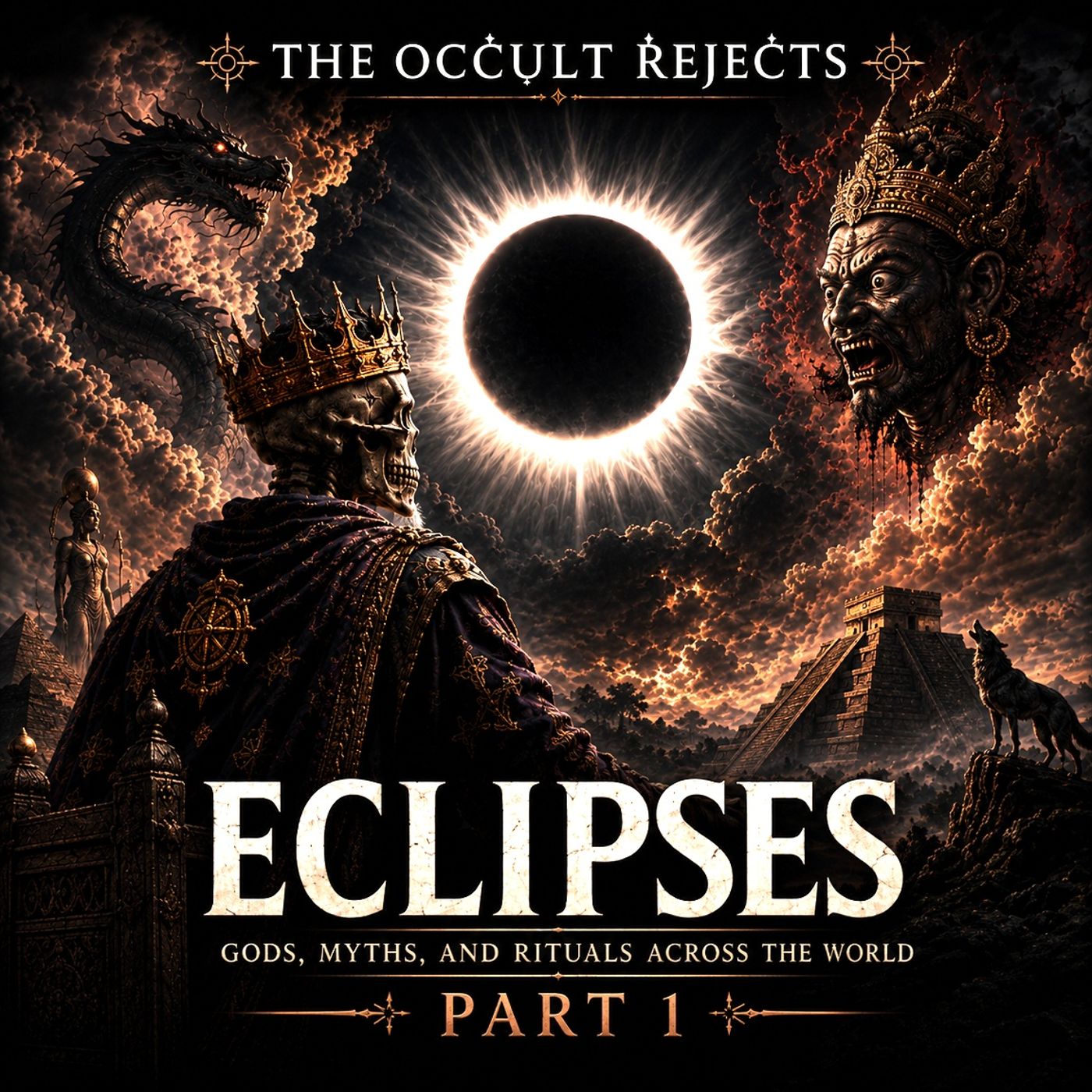
EPISODE · Jun 26, 2026 · 1H 17M
Eclipses- Gods, Myths, & Rituals Across The World Part 1
from The Occult Rejects · host The Occult Rejects
Links For The Occult Rejectshttps://linktr.ee/theoccultrejectsOccult Research Institutehttps://www.occultresearchinstitute.org/Substackhttps://substack.com/@theoccultrejects?r=7auau0&utm_campaign=profile&utm_medium=profile-pageCash Apphttps://cash.app/$theoccultrejectsVenmo@TheOccultRejectsBuy Me A Coffeebuymeacoffee.com/TheOccultRejectsPatreonhttps://www.patreon.com/TheOccultRejectsBibliographyAguilar, L. A., et al. “Total Solar Eclipse Triggers Dawn Behavior in Birds.” Science, 2025. Used for the updated science support showing that the April 8, 2024 total eclipse altered North American bird behavior, including dawn-like vocal responses.Britannica. “9 Celestial Omens.” Used for the Thales / Battle of the Eclipse tradition and the broader theme of celestial events being interpreted as historical omens.Britannica. “Apopis.” Used for Apep/Apopis as the serpent enemy of Re/Ra, the demon of chaos, and the force outside the ordered cosmos.Britannica. “Eclipse — Medieval European.” Used for medieval eclipse records, especially the 733 CE annular eclipse described as a “black and horrid shield.”Britannica. “Hindu Calendar.” Used for Hindu sacred timing, lunar-solar calendrical structure, and the religious context that helps explain eclipse observance as ritually serious time.Britannica. “Ma’at.” Used for Ma’at as truth, justice, balance, and cosmic order in ancient Egyptian religion.Britannica. “Navagraha.” Used for Rahu and Ketu as eclipse-associated shadow planets and lunar-node powers in Indian astral religion.Britannica. “Samudra Manthana / Churning of the Ocean of Milk.” Used for the mythic background of devas, asuras, amrita, Vishnu, Mohini, Rahu, and Ketu.Britannica. “Solar Eclipse.” Used for basic solar-eclipse definition and the Moon’s shadow crossing Earth.Britannica. “The Sun Was Eaten: 6 Ways Cultures Have Explained Eclipses.” Used for comparative eclipse mythology, especially devourer myths, Chinese dragon traditions, Rahu, and Batammaliba reconciliation themes.Britannica. “What Causes Lunar and Solar Eclipses?” Used for clear basic mechanics of lunar and solar eclipses.CDLI / Cuneiform Digital Library Initiative. “Solar Omens of Enūma Anu Enlil: Tablets 23 (24)–29 (30).” Used for bibliographic information on van Soldt’s edition of the solar omen tablets.European Space Agency. “27 August.” Used for the 413 BCE lunar eclipse during the Athenian retreat from Syracuse and Nicias’ delay.Exploratorium. “Eclipse Stories from Around the World.” Used for global comparative eclipse stories, including Norse wolves, Batammaliba reconciliation, and other recurring mythic patterns.Foundation for the Preservation of the Mahayana Tradition. “Practice During Solar and Lunar Eclipses.” Used for Tibetan Buddhist practice advice, merit multiplication, and eclipse as intensified sacred time.Izzuddin, Ahmad, Mohamad A. Imroni, Ali Imron, and Mahsun. “Cultural Myth of Eclipse in a Central Javanese Village: Between Islamic Identity and Local Tradition.” HTS Teologiese Studies/Theological Studies, 2022. Used for Batara Kala, eclipse devouring myths in Java, pregnancy/livestock concerns, and living village practice.NASA. “Why Do Eclipses Happen?” NASA Science. Used for solar and lunar eclipse geometry, alignment, lunar nodes, and the reason eclipses do not occur every month.NASA Space Place. “Lunar Eclipses and Solar Eclipses.” Used for simple public-facing explanations of solar and lunar eclipse mechanics.National Folk Museum of Korea. “Solar and Lunar Eclipse / Ilsik, Wolsik.” Used for Bulgae, the Korean fire dogs from the Dark World who cause eclipses by biting the Sun and Moon.NOAA NESDIS. “NOAA Satellites View Total Solar Eclipse.” Used for environmental effects during totality, including temperature drops, changes in local air circulation, cloud behavior, and animal confusion.Rochester, University of. “Surprising Facts and Beliefs About Eclipses During Medieval and Renaissance Times.” Used for the point that medieval astronomers understood eclipse prediction while still interpreting eclipses as morally or religiously serious.Sefaria. Sukkah 29a. Used for rabbinic material treating eclipses as ominous signs.Sunnah.com. Sahih al-Bukhari, Book 16, “Eclipses.” Used for the hadith that the Sun and Moon do not eclipse because of the life or death of any person and that the correct response is prayer and invocation.The Metropolitan Museum of Art. “The Solar Eclipse and the Substitute King.” Used for Mesopotamian eclipse omens, danger to the king, priestly divination, substitute kingship, and the šar pūḫi ritual.U.S. Fish & Wildlife Service. “Wildlife Behavior and a Solar Eclipse.” Used for darkening skies, cooling temperatures, and wildlife shifting toward nighttime routines.University of Pittsburgh World History Center. Lilly Taylor, “Solar Eclipses and World History.” Used for the Batammaliba tradition of making peace and ending disputes during eclipse.van Soldt, Wilfred H. Solar Omens of Enūma Anu Enlil: Tablets 23 (24)–29 (30). Leiden: Nederlands Historisch-Archaeologisch Instituut te Istanbul, 1995. Used for Mesopotamian solar omen literature and the textual archive of unusual solar phenomena.This keeps Part 1 sourced without dragging Part 2’s Mesoamerica, Andes, North American Indigenous, Australian, Arctic, Pacific, colonial, and modern eclipse-pilgrimage sources into the wrong half.Also want to remind people about the website, if you're into reading we have tons of information by multiple contributors, and we got t-shirts up on the site if you're interested. Fun fact, the art is all based on the eyeball.
Embed this episode
What this episode covers
Links For The Occult Rejects https://linktr.ee/theoccultrejects Occult Research Institute https://www.occultresearchinstitute.org/ Substack https://substack.com/@theoccultrejects?r=7auau0&utm_campaign=profile&utm_medium=profile-page Cash App https://cash.app/$theoccultrejects Venmo @TheOccultRejects Buy Me A Coffee buymeacoffee.com/TheOccultRejects Patreon https://www.patreon.com/TheOccultRejects Bibliography Aguilar, L. A., et al. “Total Solar Eclipse Triggers Dawn Behavior in Birds.” Science, 2025. Used for the updated science support showing that the April 8, 2024 total eclipse altered North American bird behavior, including dawn-like vocal responses. Britannica. “9 Celestial Omens.” Used for the Thales / Battle of the Eclipse tradition and the broader theme of celestial events being interpreted as historical omens. Britannica. “Apopis.” Used for Apep/Apopis as the serpent enemy of Re/Ra, the demon of chaos, and the force outside the ordered cosmos. Britannica. “Eclipse — Medieval European.” Used for medieval eclipse records, especially the 733 CE annular eclipse described as a “black and horrid shield.” Britannica. “Hindu Calendar.” Used for Hindu sacred timing, lunar-solar calendrical structure, and the religious context that helps explain eclipse observance as ritually serious time. Britannica. “Ma’at.” Used for Ma’at as truth, justice, balance, and cosmic order in ancient Egyptian religion. Britannica. “Navagraha.” Used for Rahu and Ketu as eclipse-associated shadow planets and lunar-node powers in Indian astral religion. Britannica. “Samudra Manthana / Churning of the Ocean of Milk.” Used for the mythic background of devas, asuras, amrita, Vishnu, Mohini, Rahu, and Ketu. Britannica. “Solar Eclipse.” Used for basic solar-eclipse definition and the Moon’s shadow crossing Earth. Britannica. “The Sun Was Eaten: 6 Ways Cultures Have Explained Eclipses.” Used for comparative eclipse mythology, especially devourer myths, Chinese dragon traditions, Rahu, and Batammaliba reconciliation themes. Britannica. “What Causes Lunar and Solar Eclipses?” Used for clear basic mechanics of lunar and solar eclipses. CDLI / Cuneiform Digital Library Initiative. “Solar Omens of Enūma Anu Enlil: Tablets 23 (24)–29 (30).” Used for bibliographic information on van Soldt’s edition of the solar omen tablets. European Space Agency. “27 August.” Used for the 413 BCE lunar eclipse during the Athenian retreat from Syracuse and Nicias’ delay. Exploratorium. “Eclipse Stories from Around the World.” Used for global comparative eclipse stories, including Norse wolves, Batammaliba reconciliation, and other recurring mythic patterns. Foundation for the Preservation of the Mahayana Tradition. “Practice During Solar and Lunar Eclipses.” Used for Tibetan Buddhist practice advice, merit multiplication, and eclipse as intensified sacred time. Izzuddin, Ahmad, Mohamad A. Imroni, Ali Imron, and Mahsun. “Cultural Myth of Eclipse in a Central Javanese Village: Between Islamic Identity and Local Tradition.” HTS Teologiese Studies/Theological Studies, 2022. Used for Batara Kala, eclipse devouring myths in Java, pregnancy/livestock concerns, and living village practice. NASA. “Why Do Eclipses Happen?” NASA Science. Used for solar and lunar eclipse geometry, alignment, lunar nodes, and the reason eclipses do not occur every month. NASA Space Place. “Lunar Eclipses and Solar Eclipses.” Used for simple public-facing explanations of solar and lunar eclipse mechanics. National Folk Museum of Korea. “Solar and Lunar Eclipse / Ilsik, Wolsik.” Used for Bulgae, the Korean fire dogs from the Dark World who cause eclipses by biting the Sun and Moon. NOAA NESDIS. “NOAA Satellites View Total Solar Eclipse.” Used for environmental effects during totality,...
NOW PLAYING
Eclipses- Gods, Myths, & Rituals Across The World Part 1
No transcript for this episode yet
Similar Episodes
No similar episodes found.
Similar Podcasts
No similar podcasts found.