
EPISODE · Nov 21, 2024 · 14 MIN
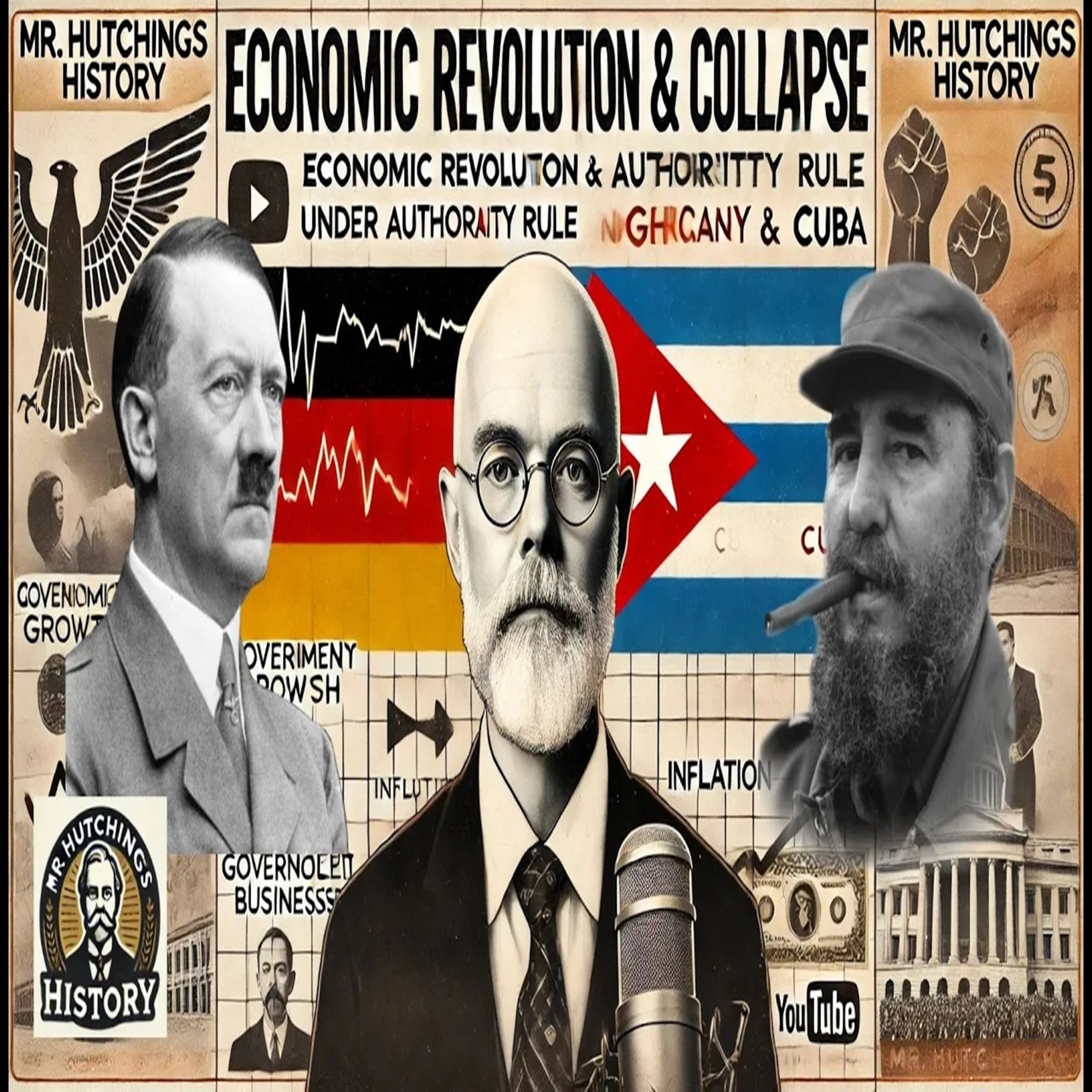
Economic Revolution and Collapse: Hitler’s Germany and Castro’s Cuba
from Mr. Hutchings History · host Produced, created, and written by Harold M. Hutchings
In this episode of Mr. Hutchings History, we examine the economic policies of Adolf Hitler and Fidel Castro, exploring their efforts to transform their nations' economies and maintain their authoritarian regimes. Hitler’s economic agenda centered around militarization, autarky, and rearmament, while Castro’s policies focused on socialist reforms, land redistribution, and industrialization. We compare their approaches to achieving economic self-sufficiency, both leaders' reliance on external support, and the long-term consequences of their economic strategies. We will analyze their successes, like Hitler’s reduction of unemployment and Castro’s social reforms, and discuss the ultimate failures of their economic models, especially their economies’ dependence on foreign resources. Historians from multiple schools of thought, including Totalitarian, Marxist, and Revisionist, provide varying perspectives on the outcomes of these leaders’ economic policies. #HitlersEconomy #CastrosEconomy #EconomicPolicies #AuthoritarianStates #NaziGermany #CubanRevolution #Autarky #WorldWarII #SovietUnion #EconomicFailure #LandReform #Industrialization #CentralizedEconomy #IBHistory #20thCenturyHistory #Totalitarianism #EconomicCollapse #DependencyTheory #Socialism #Fascism #EconomicStrategies Works Cited Friedrich, Carl, and Zbigniew Brzezinski. Totalitarian Dictatorship and Autocracy. Harvard UP, 1956. Gott, Richard. Cuba: A New History. Yale UP, 2004. Overy, Richard. The Nazi Economic Recovery 1932–1938. Cambridge UP, 1982. Taylor, A.J.P. The Origins of the Second World War. Penguin, 1961.
Embed this episode
NOW PLAYING
Economic Revolution and Collapse: Hitler’s Germany and Castro’s Cuba
No transcript for this episode yet
Similar Episodes
No similar episodes found.
Similar Podcasts
No similar podcasts found.