
EPISODE · Mar 21, 2026 · 46 MIN
Economy of Germany: Europe’s Industrial Engine Driving Innovation and Global Economic Leadership
from One Knowledge · host Đàm Tuấn Quỳnh
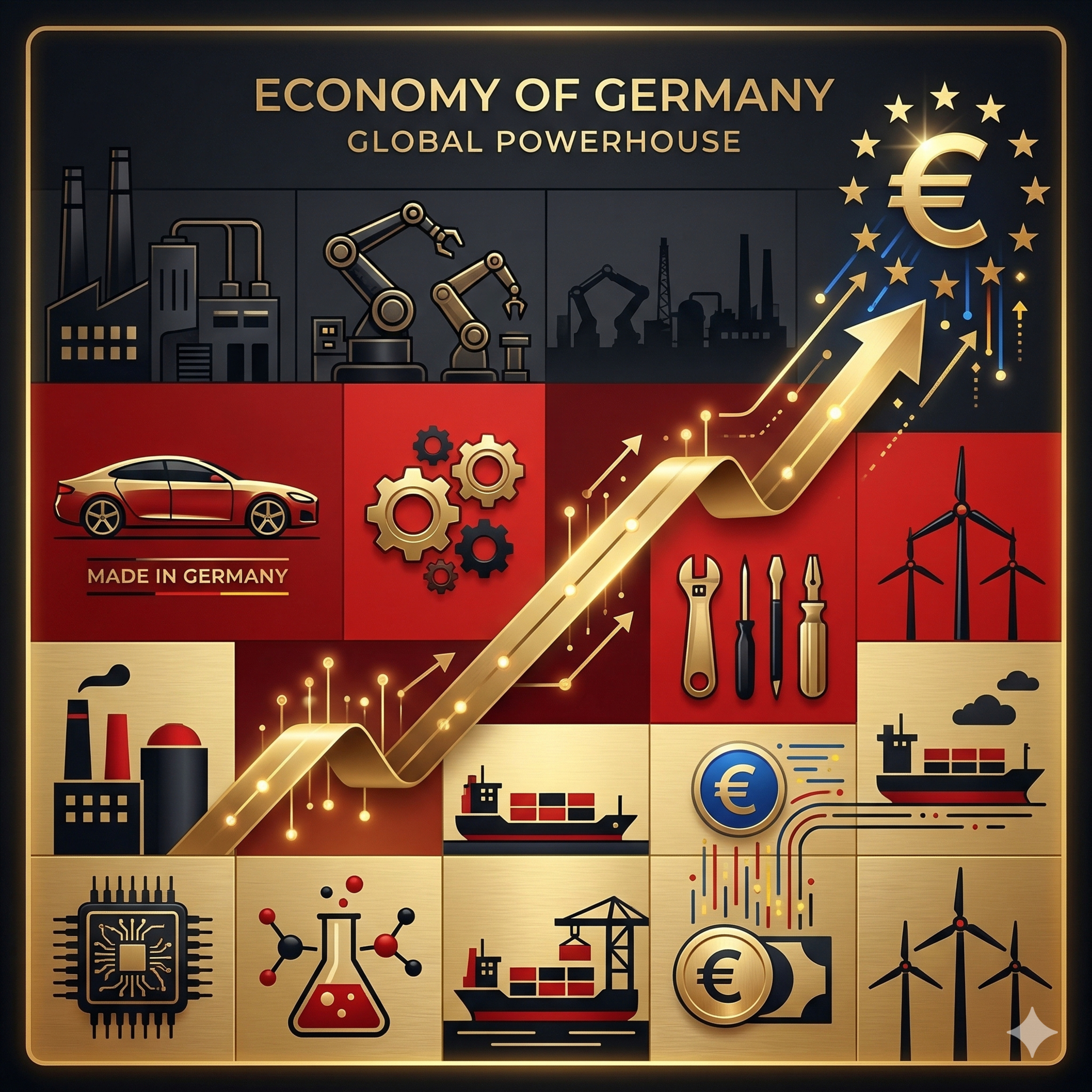
The Economy of Germany — An Export-Oriented Industrial Power Anchored in Precision Engineering and Social Market BalanceThe economy of Germany stands as one of the most structurally refined and resilient systems in the global landscape, distinguished by its unique synthesis of industrial excellence, export dominance, and social stability. As the largest economy in Europe and one of the leading exporters worldwide, Germany has cultivated a model often described as a “social market economy,” where free-market principles are balanced with a strong institutional framework for social welfare and economic coordination.At the heart of Germany’s economic identity lies its formidable industrial base. Unlike many advanced economies that have transitioned predominantly toward services, Germany has preserved and continuously upgraded its manufacturing sector, particularly in high-value industries such as automotive engineering, machinery, chemicals, and precision equipment. This industrial strength is not merely quantitative but qualitative, characterized by a reputation for reliability, durability, and technological sophistication—attributes that have become synonymous with German production.A defining feature of this system is its export-oriented structure. Germany consistently ranks among the world’s top exporters, with a significant portion of its economic output destined for international markets. This outward orientation reflects both the competitiveness of its industries and the integration of German firms into global supply chains. The country’s trade surplus, while sometimes a subject of international debate, underscores the efficiency and global demand for its products.Central to Germany’s economic success is the role of the “Mittelstand”—a network of small and medium-sized enterprises that form the backbone of the industrial economy. These firms are often highly specialized, family-owned, and deeply embedded in regional economies, yet they compete successfully on a global scale. Their focus on niche markets, long-term planning, and technical expertise contributes significantly to Germany’s innovation capacity and economic resilience.Equally important is the country’s dual education and vocational training system, which integrates academic learning with practical industry experience. This system ensures a highly skilled workforce that meets the specific needs of industry, reinforcing productivity and maintaining high standards of craftsmanship. It also facilitates a smooth transition from education to employment, supporting low levels of youth unemployment compared to many other advanced economies.Germany’s economic model is further distinguished by its institutional framework. Cooperation between employers, labor unions, and the state plays a central role in shaping labor relations and economic policy. This coordinated approach promotes stability, reduces industrial conflict, and supports equitable income distribution, reflecting the broader principles of the social market economy.In recent years, Germany has faced the challenge of adapting its traditional strengths to a rapidly changing global environment. The transition toward digitalization, renewable energy, and sustainable production has become a central priority. At the same time, the economy must navigate external pressures, including shifts in global trade dynamics and dependencies on energy imports.Despite these challenges, Germany remains a cornerstone of the European and global economy. Its combination of industrial depth, export capability, and institutional balance creates a model that is both distinctive and influential.In essence, the economy of Germany is defined not only by what it produces, but by how it organizes production—through precision, cooperation, and long-term orientation. It is this disciplined integration of efficiency and stability that underpins its enduring economic strength and global reputation.
Embed this episode
Ready to play
Economy of Germany: Europe’s Industrial Engine Driving Innovation and Global Economic Leadership
No transcript for this episode yet
Similar Episodes
No similar episodes found.
Similar Podcasts
No similar podcasts found.