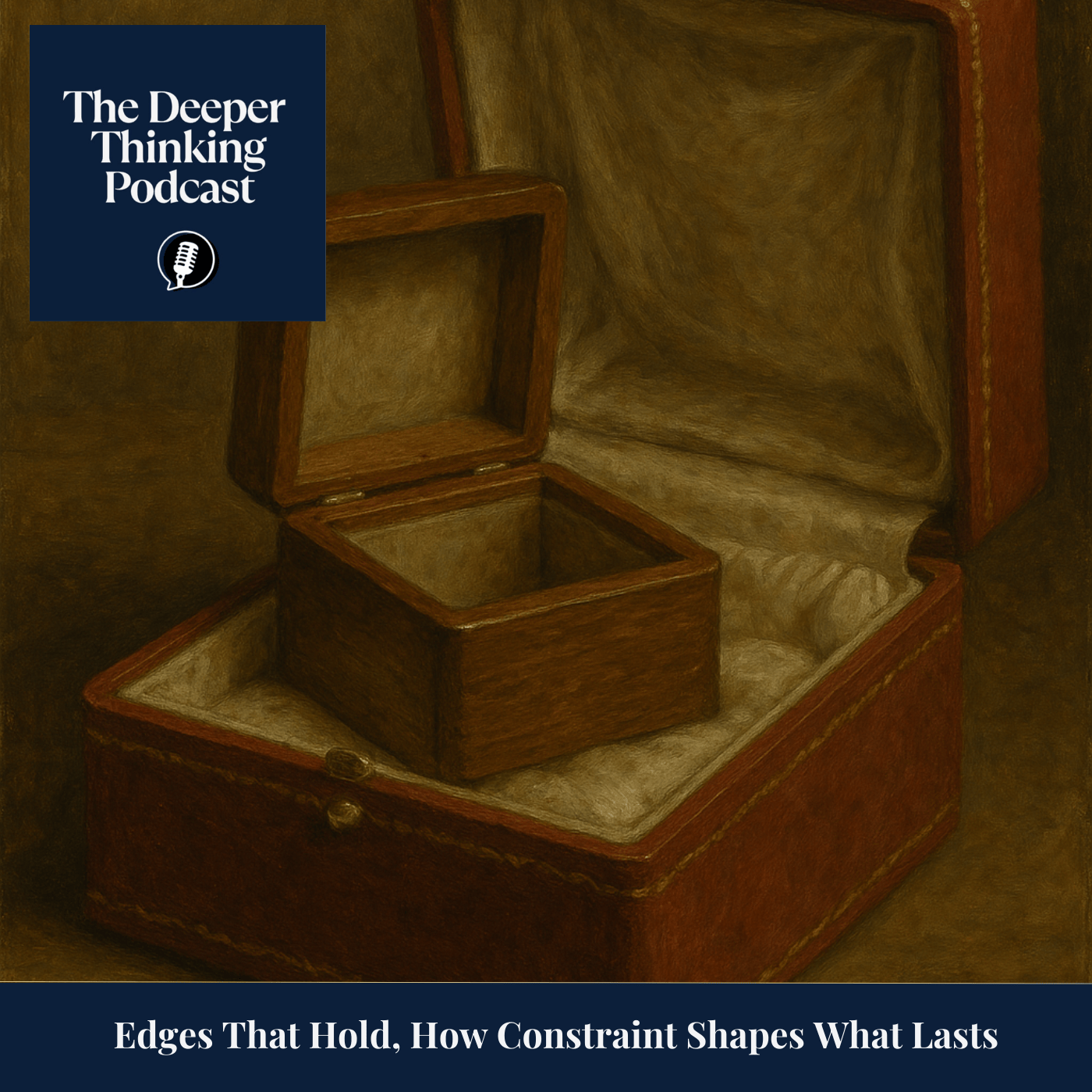
Edges That Hold, How Constraint Shapes What Lasts - The Deeper Thinking Podcast episode artwork

EPISODE · Apr 24, 2025 · 16 MIN

Edges That Hold, How Constraint Shapes What Lasts - The Deeper Thinking Podcast

from The Deeper Thinking Podcast · host The Deeper Thinking Podcast

Edges That Hold: How Constraint Shapes What Lasts The Deeper Thinking Podcast  What if the moments that stay with us didn’t arise from freedom, but from its absence? This episode explores how material, emotional, and structural constraint can become the shape of expression itself. We trace this paradox through a child’s treehouse, the tape hiss in Daniel Johnston’s basement recordings, the quiet of Agnes Martin’s grids, and the undeveloped rolls left behind by Vivian Maier. These are not stories of overcoming adversity. They are devotions to the form that holds. Constraint here is not failure—it’s fidelity. The conversation threads through Simone Weil on attention as moral act, Marshall McLuhan on form becoming message, Gaston Bachelard on poetic space, and Jean-Paul Sartre on situated freedom. From minimalist sound to photographic silence, from domestic labor to the unseen archive, this episode listens for the work that doesn’t transcend its frame—but honours it. Why Listen? Reframe constraint as creative condition, not limitation Encounter artists whose work is inseparable from what they lacked Explore the ethics of form, silence, and minimal presence Engage thinkers from Martin to Maier, Johnston to Bachelard Listen On: YouTube Spotify Apple Podcasts Bibliography Bachelard, Gaston. The Poetics of Space. Boston: Beacon Press, 1994. Maier, Vivian. Vivian Maier: Street Photographer. New York: powerHouse Books, 2011. Martin, Agnes. Writings. Ostfildern: Hatje Cantz, 2005. McLuhan, Marshall. Understanding Media: The Extensions of Man. Cambridge: MIT Press, 1994. Sartre, Jean-Paul. Being and Nothingness. Translated by Hazel Barnes. New York: Washington Square Press, 1993. Weil, Simone. Gravity and Grace. Translated by Emma Craufurd. London: Routledge, 2002. Bibliography Relevance Gaston Bachelard: Frames space as poetic rather than merely architectural—constraint as imaginative ground. Simone Weil: Recasts attention as ethical form—constraint as devotion. Marshall McLuhan: Asserts that medium is not neutral—constraint shapes content itself. Jean-Paul Sartre: Links freedom not to choice but to situated responsibility—constraint as condition of agency. Sometimes what lasts is not what breaks free—but what stays still, within its edges. #Constraint #AgnesMartin #VivianMaier #DanielJohnston #Bachelard #SimoneWeil #McLuhan #Sartre #PoeticsOfSpace #CreativeLimitations #Minimalism #TheDeeperThinkingPodcast #EthicsOfForm #ArtAndSilence #PhilosophyOfConstraint

Edges That Hold: How Constraint Shapes What Lasts The Deeper Thinking Podcast  What if the moments that stay with us didn’t arise from freedom, but from its absence? This episode explores how material, emotional, and structural constraint can become the shape of expression itself. We trace this paradox through a child’s treehouse, the tape hiss in Daniel Johnston’s basement recordings, the quiet of Agnes Martin’s grids, and the undeveloped rolls left behind by Vivian Maier. These are not stories of overcoming adversity. They are devotions to the form that holds. Constraint here is not failure—it’s fidelity. The conversation threads through Simone Weil on attention as moral act, Marshall McLuhan on form becoming message, Gaston Bachelard on poetic space, and Jean-Paul Sartre on situated freedom. From minimalist sound to photographic silence, from domestic labor to the unseen archive, this episode listens for the work that doesn’t transcend its frame—but honours it. Why Listen? Reframe constraint as creative condition, not limitation Encounter artists whose work is inseparable from what they lacked Explore the ethics of form, silence, and minimal presence Engage thinkers from Martin to Maier, Johnston to Bachelard Listen On: YouTube Spotify Apple Podcasts Bibliography Bachelard, Gaston. The Poetics of Space. Boston: Beacon Press, 1994. Maier, Vivian. Vivian Maier: Street Photographer. New York: powerHouse Books, 2011. Martin, Agnes. Writings. Ostfildern: Hatje Cantz, 2005. McLuhan, Marshall. Understanding Media: The Extensions of Man. Cambridge: MIT Press, 1994. Sartre, Jean-Paul. Being and Nothingness. Translated by Hazel Barnes. New York: Washington Square Press, 1993. Weil, Simone. Gravity and Grace. Translated by Emma Craufurd. London: Routledge, 2002. Bibliography Relevance Gaston Bachelard: Frames space as poetic rather than merely architectural—constraint as imaginative ground. Simone Weil: Recasts attention as ethical form—constraint as devotion. Marshall McLuhan: Asserts that medium is not neutral—constraint shapes content itself. Jean-Paul Sartre: Links freedom not to choice but to situated responsibility—constraint as condition of agency. Sometimes what lasts is not what breaks free—but what stays still, within its edges. #Constraint #AgnesMartin #VivianMaier #DanielJohnston #Bachelard #SimoneWeil #McLuhan #Sartre #PoeticsOfSpace #CreativeLimitations #Minimalism #TheDeeperThinkingPodcast #EthicsOfForm #ArtAndSilence #PhilosophyOfConstraint

NOW PLAYING

Edges That Hold, How Constraint Shapes What Lasts - The Deeper Thinking Podcast

0:00 16:14

No transcript for this episode yet

We transcribe on demand. Request one and we'll notify you when it's ready — usually under 10 minutes.

No similar episodes found.

No similar podcasts found.

Frequently Asked Questions

How long is this episode of The Deeper Thinking Podcast?

This episode is 16 minutes long.

When was this The Deeper Thinking Podcast episode published?

This episode was published on April 24, 2025.

What is this episode about?

Edges That Hold: How Constraint Shapes What Lasts The Deeper Thinking Podcast  What if the moments that stay with us didn’t arise from freedom, but from its absence? This episode explores how material, emotional, and structural constraint can...

Can I download this The Deeper Thinking Podcast episode?

Yes, you can download this episode by clicking the download button on the episode player, or subscribe to the podcast in your preferred podcast app for automatic downloads.
URL copied to clipboard!