
EPISODE · May 23, 2025 · 17 MIN
Edward Lear (1812–1888): The Satirist of Nonsense, Melancholy, and Imagination
from The Cogitating Ceviché Podcast · host Conrad T Hannon
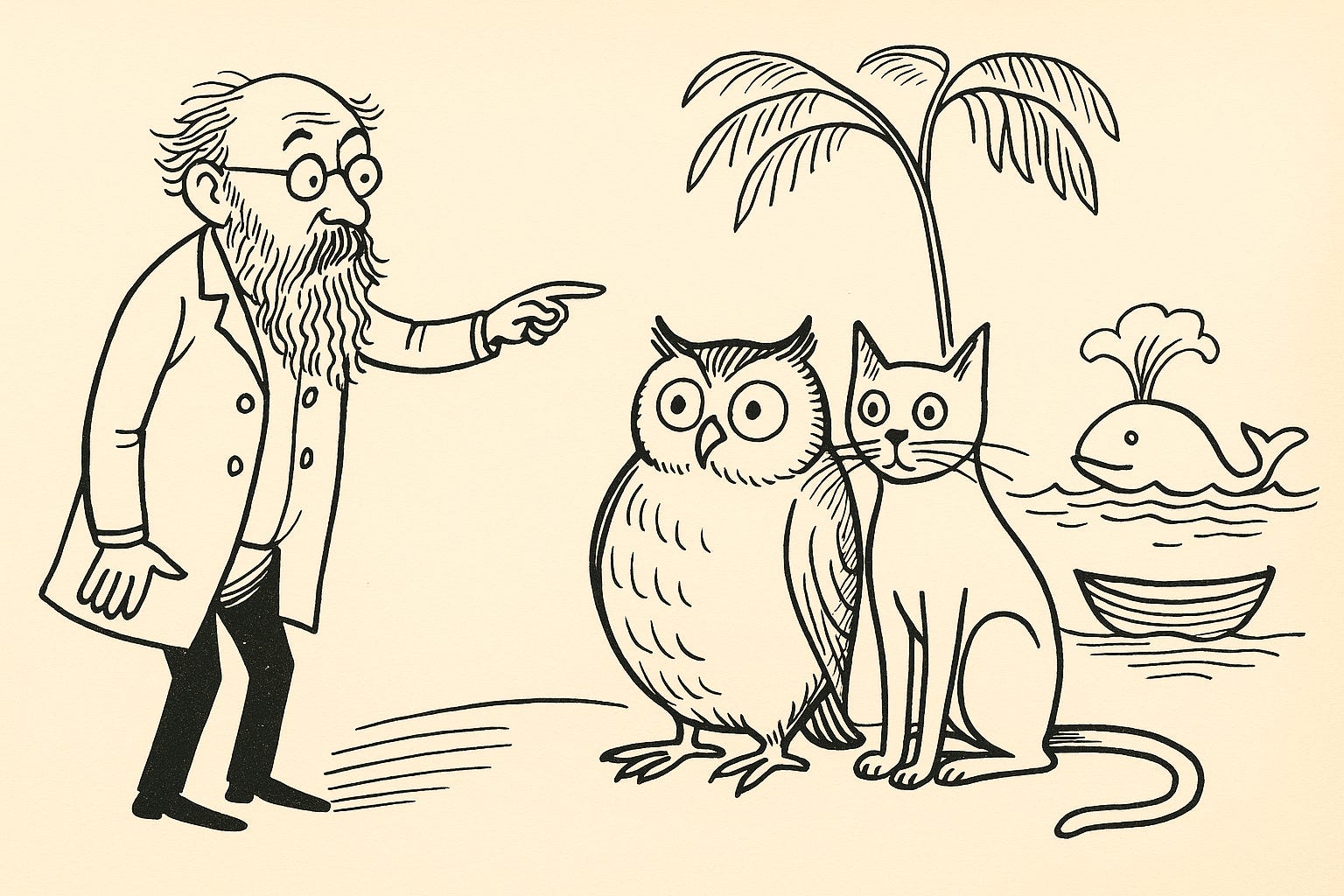
The Cogitating CevichePresentsEdward Lear (1812–1888): The Satirist of Nonsense, Melancholy, and ImaginationHonoring the Satirists and Thinkers Who Altered Our Perspectives #78By Conrad HannonNarration by Amazon PollyPrefaceFew literary figures have left such a peculiar and enduring mark as Edward Lear. To most, he is the master of limericks and nonsense—his verses recited in nurseries and echoed in classrooms for generations. Yet behind the jovial wordplay and improbable creatures lies a complex mind, at once whimsical and wistful, playful and piercing. In Victorian England—a period notorious for its sobriety, its codes of conduct, its faith in order—Lear’s nonsense became both a balm and a subtle form of rebellion. His verses and illustrations, silly on the surface, hinted at deeper truths about alienation, authority, and the search for meaning in a world that often makes little sense. Lear’s nonsense is not a withdrawal from reality, but a mirror held up to it, slyly exposing the conventions and contradictions of his time. In celebrating Lear, we honor a satirist whose laughter masked loneliness and whose imagination offered a gentle, persistent challenge to conformity and unreason.Early Life and InfluencesEdward Lear’s beginnings were as chaotic and unlikely as the worlds he would later conjure in verse. Born on May 12, 1812, he was the twentieth of twenty-one children. His father, Jeremiah Lear, worked as a stockbroker, but a failed financial venture would plunge the family into penury when Edward was just four. In a period when social mobility was rare and reputation easily lost, the Lear family’s fall from relative comfort to poverty was both public and painful.Much of Lear’s early care fell to his eldest sister, Ann, twenty-one years his senior. Ann became his surrogate mother and lifelong confidante, providing a buffer from a world that often felt hostile and bewildering. The deep bond between Edward and Ann would shape his later attitudes towards family, intimacy, and emotional connection—a thread that runs quietly through his poetry.Lear’s childhood was marked by relentless ill health. He suffered from epilepsy, a condition then so misunderstood and stigmatized that he lived in constant fear of public fits and social ostracism. The shame and anxiety bred by his condition led him to a lifelong habit of self-effacement and disguise. In private correspondence, he referred to his depressive episodes as “the Morbids,” a term that at once minimized and named the burden he carried.Despite these adversities, Lear was precociously gifted, especially in drawing. By fifteen, out of necessity, he was selling illustrations to support his family. His talent quickly attracted notice—his meticulous, vivid drawings of parrots, for instance, brought him early commissions for works such as Illustrations of the Family of Psittacidae (1832). Lear was so skilled that for a time his ornithological plates were mistaken for those of John James Audubon.His lack of formal education meant that Lear was largely self-taught, learning not from universities but from experience, observation, and an insatiable curiosity. He read widely—poetry, natural history, travelogues, the Bible, and the classics—all of which left their mark on his imagination. The influence of Laurence Sterne’s digressive wit, the grotesques of Thomas Rowlandson, and the nursery rhymes of Mother Goose can all be detected in Lear’s later work.At a time when the Victorian ethos privileged order, rationality, and empire, Lear’s alienation from the mainstream was both a source of pain and a wellspring of creativity. He would become, in many ways, the poet laureate of outsiders.Major Works and ThemesA Book of Nonsense (1846 and Expanded 1861, 1863)Lear’s reputation as the king of literary nonsense was launched with the publication of A Book of Nonsense in 1846, a small volume of limericks written ostensibly “for the use of the youngest readers.” The collection’s origins are revealing: it was commissioned by Edward Stanley, the future 13th Earl of Derby, for the amusement of his grandchildren. The limericks were paired with Lear’s own pen-and-ink illustrations, which depicted characters both grotesque and endearing. Many of the poems follow a familiar formula—“There was an Old Man with a beard / Who said, ‘It is just as I feared!’ / Two Owls and a Hen, / Four Larks and a Wren, / Have all built their nests in my beard!”—yet within these confines, Lear found endless room for invention.These verses are often dismissed as lighthearted juvenilia, but their structure belies a subtle satirical undercurrent. The characters in his limericks are frequently nonconformists, eccentrics, or the dispossessed—old men with strange habits, children who defy their parents, and beings who simply do not fit in. Their very oddity challenges the norms of “polite” society, poking gentle fun at the social codes of the Victorian era.By the time Lear expanded A Book of Nonsense in the 1860s, its reputation had grown, and its influence was visible in the rise of the limerick as a staple of English humor. The volume was endlessly reprinted, pirated, and imitated, spreading Lear’s style across continents.Nonsense Songs, Stories, Botany, and Alphabets (1871)If the limericks established Lear as a master of brief comic forms, his later collections—most notably Nonsense Songs, Stories, Botany, and Alphabets—revealed his ability to construct entire worlds out of absurdity. Here appear his most beloved and enduring works: “The Owl and the Pussycat,” with its surreal romance and gentle rebellion against convention; “The Jumblies,” who set sail in a sieve; and “The Dong with a Luminous Nose,” a melancholy tale of longing and exile.These poems are rich with invented language (“runcible spoon,” “bong-tree”), mock-exotic locations (“the land where the Bong-tree grows”), and logic that teeters on the brink of madness. Yet beneath the silliness, Lear’s nonsense is constructed with rigorous internal consistency—his own private grammar and geography, as if mocking the seriousness with which the Victorians approached their own institutions.Visual Satire: Illustration, Travel, and Natural HistoryLear was not only a poet but an accomplished visual artist. His early career as a scientific illustrator brought him into contact with prominent naturalists and aristocrats, including Charles Darwin and Queen Victoria herself, who invited Lear to give her drawing lessons.In the 1830s and 1840s, Lear traveled extensively throughout Europe, the Middle East, and India, producing volumes of landscapes and travel sketches. His letters and diaries from this period are themselves witty and sharply observant, full of caricatures and marginalia that lampoon not just his own social awkwardness but also the pretensions and peculiarities of the English abroad.Lear’s illustrations for his own nonsense books are as essential as the text: grotesque figures with elongated limbs, improbably coiffed hair, and wide, bewildered eyes. These images extend his satire to the visual, often poking fun at the very idea of rational depiction and scientific categorization.Personal Poetry and ProseIt is often forgotten that Lear aspired to be recognized as a serious poet and painter. In his lifetime, he published translations of classical verse and long, melancholy meditations in blank verse. While these works did not achieve the same fame as his nonsense, they reveal another side of Lear—one that struggled with isolation, romantic longing (often for unattainable men), and the search for a home. The tension between Lear’s public clowning and private sorrow is a recurrent theme in his letters and diaries, which are among the most revealing in Victorian literature.Critique of Society and PowerAlthough Lear’s nonsense is rarely overtly political, its very structure functions as a subtle critique of social and intellectual authority. Victorian society prized order, logic, and classification—traits reflected in everything from the census and the schoolroom to the courtroom and the colonial office. Lear’s world is an anarchic counter-universe, where language slips its moorings, authority is gently mocked, and the marginalized find dignity in their difference.The humor is never cruel, but it exposes the ridiculousness of arbitrary rules. The characters in his poems are often shunned or ridiculed for their peculiarities, yet Lear presents them sympathetically—sometimes even heroically. The Jumblies, for example, are ridiculed for their voyage in a sieve, but their persistence and joy are ultimately celebrated:“They went to sea in a Sieve, they did,In a Sieve they went to sea:In spite of all their friends could say,On a winter’s morn, on a stormy day,In a Sieve they went to sea!”There is implicit satire here: Who is the real fool—the one who dreams impossibly, or the crowd that stays behind?“The Owl and the Pussycat,” often read as a charming love story for children, is also a satire on social boundaries: a bird and a cat, mismatched and exiled, succeed where their more sensible counterparts do not. The marriage is performed by a Turkey in the land of the Bong-tree—nonsense, perhaps, but also an invitation to imagine a world beyond prejudice and limitation.Even Lear’s invented words and places are satires on the pomposity of Victorian scientific and imperial nomenclature, which so often masked ignorance with jargon.Defense of Justice and ValuesLear’s satire, unlike the biting Juvenalian tradition, is gentle but persistent. His values are implicit in his choices of character and narrative: the lonely, the odd, the foolish, and the marginalized are treated with dignity and affection. In Lear’s world, nonsense is an equalizer, and the capacity for wonder is a form of wisdom. The conventions of society are not simply mocked—they are reimagined.While his poems rarely preach, they quietly advocate for empathy, acceptance, and the right to joy. The Dong’s unrequited love, the Old Man with a beard, and the Jumblies’ voyage all point to the nobility of those who refuse to be defined or diminished by others’ expectations. If there is a moral in Lear’s nonsense, it is that kindness and curiosity are more important than status or logic.This is seen even in Lear’s approach to humor itself: the joke is never on the weak, but on those who lack imagination or who insist too firmly on sense.Rhetorical Style and TechniquesLear’s mastery of form is both the source of his nonsense’s delight and the engine of its critique. His technical hallmarks include:* Limerick Form and Innovation: Lear did not invent the limerick, but he elevated it to a literary art form. His typical AABBA rhyme scheme and rhythmic playfulness provided a framework within which the absurd could flourish. The repetitive structure, far from limiting him, offered a platform for infinite variation and gentle subversion.* Neologism and Wordplay: Perhaps more than any other Victorian writer, Lear reveled in linguistic invention. His coinages (“runcible spoon,” “dormouse,” “Fizzgiggious Fish”) and playful use of sound invite the reader to enter into a world where language is liberated from strict denotation.* Absurd Logic and Internal Consistency: Lear’s poems construct their own logic, often drawing attention to the arbitrariness of real-world rules. The world of the “Quangle-Wangle’s Hat” or “The Pobble who has no Toes” is nonsensical, but perfectly self-consistent—a sly parody of the seriousness with which adults impose order on the world.* Visual Satire and Caricature: Lear’s illustrations are inseparable from his text. The grotesques, odd animals, and comic landscapes reinforce the mood of playful resistance. His drawings often include visual puns or literal interpretations of idioms, deepening the satire and multiplying layers of meaning.* Repetition, Refrain, and Formula: Lear often repeats phrases and structures to create a sense of ritual and anticipation. This not only aids memorization for young readers but also mimics the repetitive—and sometimes mindless—habits of adult society.Lear’s nonsense thus becomes a laboratory for the exploration of meaning and meaninglessness, sense and non-sense, order and chaos.Controversies and CriticismsWhile Edward Lear enjoyed considerable success in his lifetime, especially with children and the aristocracy, he was not universally admired by critics. Some literary authorities dismissed nonsense as trivial or childish, unworthy of serious consideration. Lear himself was painfully aware of this condescension, and he struggled for years to gain acceptance for his more serious painting and poetry.Victorian moralists occasionally expressed discomfort with the lack of “improving” content in his books, which neither moralized nor concluded with clear lessons. Unlike contemporaries such as Charles Kingsley or even Lewis Carroll—whose Alice books, though influenced by Lear, always end with a return to sense—Lear’s verses leave the door open to ambiguity, oddity, and unresolved feeling.In private, Lear was often plagued by feelings of inadequacy and self-doubt, exacerbated by his epilepsy, his status as a bachelor in a world that valued family, and his probable (though never overtly acknowledged) homosexuality. These themes of alienation and unfulfilled longing are echoed in the gentle melancholy that underlies much of his verse. It is telling that, in the last years of his life, Lear’s letters and diaries become increasingly preoccupied with illness, loneliness, and the fear of being forgotten.After his death in 1888, some critics continued to overlook Lear’s deeper artistry. Only in the twentieth century did scholars begin to recover the seriousness beneath the nonsense, tracing its influence on modernism and psychoanalysis alike.Impact and LegacyEdward Lear’s shadow looms long over English literature and beyond. He was a key inspiration for Lewis Carroll, whose Alice in Wonderland is a direct descendant of Lear’s nonsense landscapes. The playful spirit of Lear’s language can be felt in the surrealism of James Joyce, the comic poetry of Ogden Nash and Spike Milligan, and the subversive children’s stories of Dr. Seuss, Roald Dahl, and Shel Silverstein.His limericks and nonsense verses have become embedded in popular culture. Generations of children have recited “The Owl and the Pussycat,” and the “runcible spoon” has entered the language as a term of affectionate nonsense. But Lear’s influence extends further: his vision of the world as simultaneously beautiful, absurd, and tinged with sorrow has shaped modern understandings of humor and satire.Visual artists, too, have drawn on Lear’s legacy. His line drawings, so economical and expressive, helped create a new style of illustration that valued wit, spontaneity, and character over mere realism.Perhaps most profoundly, Lear’s work legitimized nonsense as a serious artistic form—a space where play and critique are inseparable, and where language itself can be both instrument and object of satire. In an age when the borders between sense and nonsense, order and chaos, are as hotly debated as ever, Lear’s gentle mockery and open-hearted acceptance offer a model for resilience, creativity, and joy.ConclusionEdward Lear’s genius lay in his ability to turn the world upside down, not to escape it, but to see it more clearly. His limericks, nonsense poems, and whimsical drawings have endured not because they avoid reality, but because they speak to our deepest anxieties and highest hopes. Through nonsense, Lear found a way to critique power, defend the vulnerable, and carve out a space for joy and difference.His life—a patchwork of sorrow and celebration, isolation and exuberant invention—reminds us that satire need not be savage to be sharp, and that laughter is itself an act of resistance. In honoring Edward Lear, we honor the enduring power of nonsense to reveal the nonsense of power, and the capacity of the human spirit to imagine, dream, and laugh in the face of life’s absurdities.His legacy continues to remind us: the world may not always make sense, but it is always worth singing about—preferably to the accompaniment of a runcible spoon.Thank you for your time today. Until next time, stay gruntled. This is a public episode. If you'd like to discuss this with other subscribers or get access to bonus episodes, visit thecogitatingceviche.substack.com/subscribe
Embed this episode
NOW PLAYING
Edward Lear (1812–1888): The Satirist of Nonsense, Melancholy, and Imagination
No transcript for this episode yet
Similar Episodes
No similar episodes found.
Similar Podcasts
No similar podcasts found.