
EPISODE · Jan 23, 2026 · 40 MIN
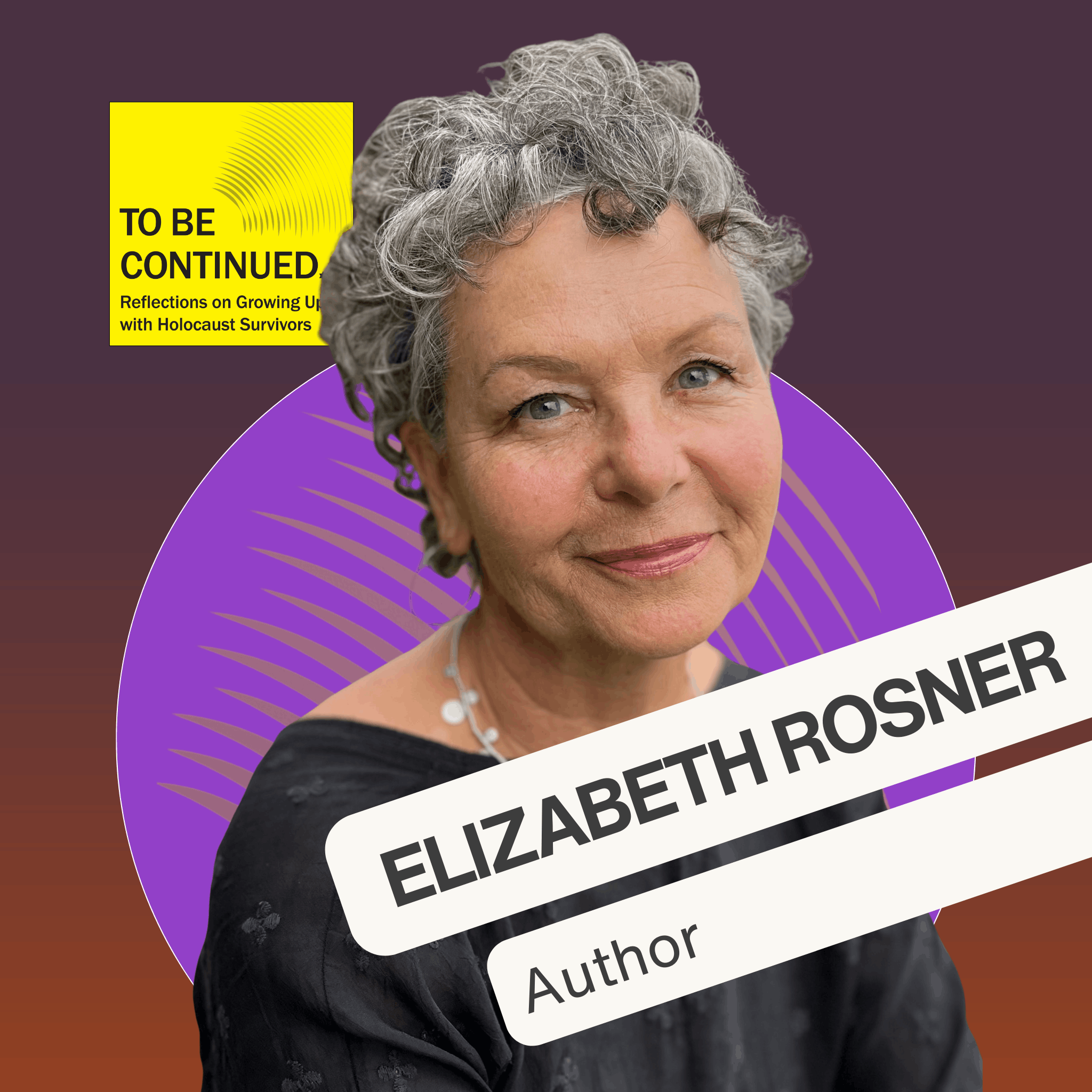
Elizabeth Rosner: What Children of Survivors Carry Forward
from TO BE CONTINUED...Reflections on Growing Up with Holocaust Survivors · host TO BE CONTINUED... Reflections on Growing Up with Holocaust Survivors
In award-winning author Elizabeth Rosner's book Survivor Cafe: The Legacy of Trauma, and the Labyrinth of Memory, she confronts what it means to live in the aftermath of the Holocaust — not as a direct witness, but as a child of survivors. In this episode, our host Rabbi Jeff Salkin discusses with Rosner: How do we carry inherited pain? What role does storytelling play in transforming trauma into meaning? And how can remembering help us heal? Elizabeth Rosner has published six books with a new book of poetry, Gravity, coming out in March 2026. Her essays and reviews have appeared in the New York Times Magazine, the San Francisco Chronicle, Elle, and others. Speaker Bio: Elizabeth Rosner is the acclaimed author of six books, including three novels, two nonfiction books, and a poetry collection, of which all are full or part memoir. Her latest two nonfiction books are Survivor Cafe: The Legacy of Trauma and The Labyrinth of Memory, and Third Year, Reflections on the Art and Science of Listening. Hew newest book of poetry, Gravity, was released in March 2026. Her essays and poetry have appeared in the New York Times Magazine, Elle, Hadassah Magazine, CNN Opinion, the Forward, and many anthologies. Her works have been translated into 12 languages and have received many literary awards. TRANSCRIPT: Everyone has five senses. Taste, smell, touch, hearing, and sight. But for Jews, there is one more sense. Memory is a sense. The author, Jonathan Safran Foer, writes that for Jews, memory is no less primary than the prick of a pin, or its silver glimmer, or the taste of the blood it pulls from the finger. The Jew is pricked by a pin and remembers other pins. Welcome to this podcast, TO BE CONTINUED…Reflections on Growing Up with Holocaust Survivors, where we explore the intersections of memory, identity, and resilience. Our goal is to lift up the experiences of children and grandchildren of Holocaust survivors, and to ask, how did those memories form you? How did resilience create you as the person you are today? And what is the legacy that you will leave to those who come after you? I am your host, Rabbi Jeff Salkin. Our guest is Elizabeth Rosner. She is the acclaimed author of six books, including three novels, two nonfiction books, and a poetry collection, of which all are full or part memoir. Her latest two nonfiction books are Survivor Cafe, The Legacy of Trauma, and The Labyrinth of Memory, and Third Year, Reflections on the Art and Science of Listening. Her essays and poetry have appeared in the New York Times Magazine, Elle, Hadassah Magazine, and CNN Opinion, the Forward, and many anthologies, and her works have been translated into twelve languages and have received many literary awards. In Survivor Cafe, this deeply reflective and poetic work, she confronts what it means to live in the aftermath of the Holocaust, not as a direct witness, but as a child of survivors. She asks, "How do we carry inherited pain? What role does storytelling play in transforming trauma into meaning? And how can remembering, rather than forgetting, help us heal?" So, we're going to be talking about the enduring power of memory, the role of narrative and survival and what resilience looks like across generations of Jewish memory and of Jewish identity. Jewish insights are abundant in her work, and she reminds us of William Faulkner's quote, "The past is never dead. It's not even past." So welcome, Elizabeth. It's great to have you here. Thank you, Rabbi. That was a beautiful introduction. I have to say that I reread your book, Survivor Cafe. I can't begin to tell you how many pages have little post-its in them because there are things that I wanted to remember, and it's a book about the burden and the gift of memory. And so, you struggle in this book with whether or not you, as a daughter of survivors, and the rest of us who are witnesses to so many survivor stories, have a right to tell their story. So, I'm going to ask that you briefly tell us about your family's story of survival and loss. Yeah. You know, that could easily take up the entirety of our conversation depending on how much detail I fill in. But I first want to say thank you for having me in this conversation and for giving me the chance to talk about things I care about so much, and that really, as you say, have shaped almost everything about me. I have always felt that the gift slash burden of inheriting my parents' histories is something I think of as a loved obligation, that I recognize it's something I didn't necessarily choose, but that I have come to really honor it as something that really gives shape and purpose to my life. And so, by telling their stories, even in brief snippets like I'll try to do right now, it keeps them alive. They've both passed away. And it also keeps me focused in a way on what I believe is so important about keeping memory in the present, recognizing that it has affected the present and that therefore naming it is just an acknowledgement of what's true. So, my mother was born in Vilna, which was at the time Lithuania/Poland. It was changing nationalities in some ways throughout its existence. She, in 1939, when Hitler invaded Poland, she was an only child with her parents. They were herded into the Vilna Ghetto, where they remained until just prior to the liquidation of the ghetto, when they were able to arrange to be hidden by a Polish peasant in the countryside outside of the ghetto walls. And they survived the war that way. In 1944, when the Russians liberated Poland, my mother and her parents realized that Poland was still not in any way a safe place to remain as Jews. And so, they made their way, first to Sweden, while they were waiting for visas to come to America. And it was in Sweden, as a refugee, that she actually met my father, whose story goes like this. He was born in Hamburg, Germany in 1929. My mother was born in 1930. My father was the eldest of three children, all born to a German Jewish family that was very assimilated. My father's given name was Karl Heintz. His next brother was named Wolfgang. And the third child was named Helmut, which I think is a really strong... These are good Jewish names. Good Jewish names. I mean, it's such an indicator of how his parents felt about being German. They were Jewish, but they really, really felt very Germanically identified. And even though they themselves were not German born, but their sons were. And yet they were divorced in 1936 during the time of the establishment of the Nuremberg Laws. They had a small shop that was repossessed by the Nazis. And my grandmother, who was basically abandoned by my grandfather, who went back to Romania where he was from, and she put the children in an orphanage because she didn't know how to take care of them without any means of support. The youngest uncle, Helmut, was on a Kindertransport to Sweden. My grandmother somehow managed to smuggle herself into Sweden to be closer to him. And because she thought from there, she'd be able to get her other two sons out of Germany. She was not able to do that in time. This is such a fast telling of the story, of course, but my father and my other uncle, Wolfgang, were in a Jewish orphanage for a little while. The entire orphanage was deported, except my father and my uncle, who were considered Romanian because of their father. But eventually they too were deported to Buchenwald. My father and my uncle both managed to survive Buchenwald, a year in Buchenwald concentration camp until liberation. They made their way to Sweden. This is where Sweden comes back into the story. And that's where my parents met as teenagers. They were married in Israel. And then they came to the United States where my older sister and I, and my younger brother, were all born and raised. When I hear your story, Elizabeth, it makes it very clear to me why you use the metaphor of labyrinth. Yeah. Yeah, I mean... To talk about memory. Right. You know, the imagery of the wandering Jew, of course, is, you know, far predates the Holocaust and is all the way back to dispersion and diaspora and, you know, all kinds of labyrinths for Jewish journeying, I think, exist already. But memory itself, you know, each time I tell this story, I'm trying in every way to be faithful to the facts as I know them. And yet even my father, even my mother, as they narrated their stories, there would be slight adjustments, slight modifications every time. And when I was writing Survivor Cafe and I began to really study memory as a subject itself, you know, what are memory studies? What are people who understand the way neurological wiring works? It turns out that every time we retell a story, we are actually rewriting it, even in small, kind of almost molecular ways. And so, it opens this huge, you know, chasm of questions. How do we know what the true stories are? How do we know what we're holding on to? If not to simply surrender, as I try to do, to being imperfect in the retelling, to accept that this labyrinth, this image, if you've ever walked a labyrinth or really looked at even a visual depiction of a labyrinth, every time we think we're getting closer to the center, we actually may be drifting farther to the outer rim and vice versa. We do the best we can to follow the path, but we do it imperfectly. It is such a powerful image. So, you actually taught me so much about the dynamics of memory in this book. And I never considered how when we remember and when we tell the story, we become a text. We shape it and we create it. So, I'd like you to share with us a little bit about the difference, if there is one, between personal memory and collective memory. What does that mean? Such a complicated question, really. And thank you for your kind words about my work. I'm really touched to know that it impacts you the way it does. It means a lot to me. This morning, I was thinking about the idea of repetition and the importance in Jewish tradition of telling and retelling stories. The Passover Seder is a perfect example of this, but really, the Book of Esther, everything is a text, as you said, including ourselves, including our own lives. And so, the repetition, even when it feels personal, I think is inevitably collective because we are so connected with one another. In literal ways, I am made of my parents' DNA as they were made from their parents' DNA. So, I've got generational cells. And I want to say that the word epigenetics, which now a lot of people seem to be familiar with in ways that weren't... When Survivor Cafe first came out in 2017, and I would give presentations and talks, and I would ask people, "How many of you are familiar with the word epigenetics?" And very few people would kind of timidly raise their hands. But this idea that memory and the transmission of experience actually is in our bodies, it's not that the DNA itself is changed. Like epigenetics, for some people, makes them think that trauma changes their genes. It's not actually modifying the DNA, but trauma, for example, is modifying the expression of certain parts of our DNA. For example, how we process stress. So, the stress hormone cortisol. Some Holocaust survivors, in fact, probably many Holocaust survivors, their stress system, their adrenal glands, their cortisol production was so massively engaged, sometimes for years on end, that of course it modified their entire nervous system and their physiology. And it turns out that now we can measure this scientifically, right? Second, third, maybe fourth, we don't even know how many generations later, we are experiencing post-traumatic stress as if we too went through those experiences. We know that we didn't. I know that I was not there physically. As you said earlier, I wasn't even a witness to their experience. I was born 15 years after the end of the war. But I knew even as a child that there was something about what happened to my parents that lived inside of me. And for a long time, I was told I was just being too sensitive or I had too vivid an imagination or I was making it up. But now science is sort of bearing out what those of us who were that generation after know to be true. We feel it. We sense it. We're hypervigilant. We overreact. We underreact. Some people are just numb. Their cortisol levels don't do anything because they've been so extremely modified. So, it varies from person to person. But getting back to your question about collective memory, that's already collective, right? That's already something that I feel personally, but it refers to an entire generation and multiple generations. And I want to say one other thing, which is this isn't just a Jewish experience. And I spend a lot of time in Survivor Cafe and in fact in all of my work, without comparing and without doing some kind of victim hierarchy or I do believe that it is collective in the human experience. There are other atrocities that we know of in human history that also bear this out. Generational inheritance, generational trauma, generational resilience is true in the African-American community. It's true in the Asian-American community. It's true in Hiroshima and Nagasaki. It's true in Rwanda. It's true in Cambodia. It's true among all veterans of war and their descendants. This is the human experience. What's powerful about this is that it plays off of that wonderful line that says that in every generation, everyone must see themselves as if they had gone forth out of Egypt. And now you're making me really understand this in a whole new way. It says, Chayav Adam Lirot et Tatsmo. It says, "The human being must see himself or herself as if they'd gone out of Egypt." It doesn't say the Jew. So, this is now a universal experience, and what you're teaching us has even that much more power. It also, I think, illuminates something else. You mentioned how this plays out in the African-American experience. I don't know to what extent African-American leaders and healers have spoken about the epigenetic effects of slavery and on their being in terms of lynchings, et cetera. But I will say this. Correct me if I'm wrong. Is this a possible conversation piece that different groups could be having with each other? Is this a topic of dialogue, of how we have braved these straits in our own way, and what can we learn from each other? Absolutely, yes. The answer I would give is an emphatic yes. I reference those cultures, those histories, those atrocities in my work because I feel they are part of a big conversation. There are people like Bryan Stevenson and the Equal Justice Initiative that absolutely address this question of how the history of slavery and the history of lynching and the Jim Crow era and segregation, all of those things are carried in the bodies of their descendants, and the bodies of those who witnessed and who lived alongside those experiences. The collective American experience, which we don't name very often because we have a lot of amnesia, as President Obama famously said, that Americans are famously amnesiac. We have a very hard time acknowledging our own perpetration on the Native American people, the indigenous people of this continent, this country. What we need to do, I believe, is to recognize that these are shared legacies. These are experiences that don't actually differentiate us. They make us alike. For example, Ken Burns' recent documentary about America and the Holocaust, he really called out the way that the race laws of the Nazis were imitating American race laws. They were looking at us and seeing what we were doing to dehumanize black people, and they were imitating our horrific white supremacy. It does start in places that you don't think it starts, and then you have to acknowledge the ripple effects that we share. Absolutely, I welcome those dialogues. I think they're hard to have because sometimes people get very possessive of what they consider to be their tribal history, their unique history. I think what is important to me is to acknowledge the uniqueness of each experience and yet to recognize the echoes, recognize what's familiar and retain your sense of identity. It doesn't have to threaten your sense of self to acknowledge something familiar in the other. It's not as if memory is a finite resource. It's not as if compassion is a jar of water which, once it's poured out, will not be renewed. I remember years ago I was in a social situation and I met a woman who was of Armenian descent. I can't begin to tell you how many times I walked through the Armenian Quarter in the old city in Jerusalem, and I said to her, "Ah, you're an Armenian. I'm a Jew. I always felt a kinship,” and she just said, "I know." In that moment of encounter, what Martin Buber would call the "I thou experience,” our souls were able to touch each other. I know. It didn't even have to be spoken of. I really do believe that we as Jews have a mission to the world. You've really, I think, lifted this up for us already, Elizabeth, which is that it's not only that we need to perpetuate our own memory, but we need to be the technicians of memory for other people to teach them how to remember their own stories, their own narratives. Let me shift, since we're talking about stories, let me shift over into movies. How have movies shaped our way of experiencing this trauma? Another tricky question. When I was revising Survivor Cafe, I was doing a word search and I found that the word "complicated" appeared like 87 times in the book. It was incumbent upon me to find some other synonyms for that word and also to recognize that each situation I used that word and I had to carefully consider what did I mean specifically here. There's a chapter in Survivor Cafe that has the phrase "the paradox of artifice." And I quote Elie Wiesel who said in his usual incredibly eloquent and very succinct way, he said, "A novel about Majdanek is either not a novel or not about Majdanek." And this pointing to the paradox of how you represent something that is so beyond belief and that you use a fictional device like film, for example, to try and represent something that defies imagination is inevitably, I think, going to fail and yet it has to succeed in some way. It has to succeed by trying to represent and yet also to acknowledge it's always going to fall short. And that's how I feel about all of my writing. I too have tried to write fiction that includes the Holocaust and I struggle all the time with how to honor it, without distorting it, without sentimentalizing or making something even more melodramatic, exploiting this material. So, I've struggled with films like Schindler's List that I think have had a huge impact on people's understanding of the Holocaust emotionally, visually, epically. And yet it's a movie. It's not a documentary. It's a feature film with distortions and exaggerations and dramatizations. It's such a rich and important question to ask. And I feel like the more and more we do this, because the farther removed we are from the actual events of the Holocaust, the closer we are to this reinventing of things, the losing of the firsthand witnesses as the survivors themselves pass away. How do we stay authentic? How do we stay true to the facts? It's a really tricky subject. And I only want to say that really, that I honor the complexity of it and the struggle of it. I think that in a very lowbrow, let me venture to say almost vulgar way, whether he knows it or not, that's what Jerry Seinfeld was pointing to in that infamous episode on Seinfeld where he is spotted making out with his girlfriend Rachel in the movie theater during a showing of Schindler's List. And what I always believed to be funny and telling, about that was that his parents were as offended by him making out during a feature film about the Holocaust as if he had been making out at Auschwitz itself, where the representation of this becomes itself wholly. Oh my gosh. There are so many current echoes of that. I never played Pokémon or really understood what Pokémon Go was about, but they had to put up... Talk to my grandkids. Talk to my grandkids. Certainly true. I'll check in with them later. [They apparently…] Auschwitz, the memorial site at Auschwitz had to put up signs everywhere telling people they could not play Pokémon Go on the grounds of Auschwitz-Birkenau. There are people taking selfies at Auschwitz now. There are people posing, "What do we do with this? What do we do except to acknowledge that our culture is continuously sorting through what's sacred? What's..." It gets worse. It gets worse. And here's how it gets worse. It gets worse because as people are taking these photographs through AI, they can now manipulate these images. They can distort these images. They can create new images that are fictional. And that brings in an entirely larger subject, a bulging file folder, of what the ethics of memory and representation really are. I mentioned my grandchildren and how they could tutor you in the artistry of Pokémon, which brings up a really interesting subject. How do we see the language of trauma evolving as we move further away from the events themselves? So, I'm going to ask you, does intergenerational trauma epigenetically have impact on the grandchildren and now, the great-grandchildren of survivors? Absolutely. In my experience and in the research studies that are continuously appearing, I do believe that each generation is having its own experience. Each generation... Of course, there's so many differences across a generation. I don't mean to generalize even about a single generation, but the first people who were considered to be 2G were the ones born right after the end of World War II. I mentioned earlier, I was born 15 years after the end of World War II because my parents were actually teenagers at the end of the war. And yet, I am part of that generation of the ones born after. And by the way, there's even a term for that in Germany, the "nachgeborenen," the ones born after. And we haven't really talked about how these burdens are carried by the descendants of perpetrators, but there's a tremendous parallel there as well. But talking about now the 3G, and my generation now is the 2G generation named that way really because 3G came along and started calling themselves 3G in this abbreviation that seems so kind of clever and strange to me at first. What I've noticed, and I don't know how many people have written about this, is that it seems like within families, there's often one person who takes on the role of the story keeper, the story teller, the memory keeper. I mean, there are different, you know, the memorial candle, people call that role different things. But I believe that I am that in my family. And I also believe now that my, one of my nephews, I have two nephews and four nieces, of those six, one nephew so far has been that for his generation, my nephew Ezra, my sister's son, he has been trained now as a 3G speaker. And he was very close to his grandfather, my father. And one of the things I noticed about the differences between him and me is that he created a PowerPoint presentation. He's very tech savvy, you know, he's very interested in this presentational style and he's not a writer, he's a wonderful speaker. So, he has a script and he has a script and he has his PowerPoint. And yet when I talk, I am feeling, I think more, well, first of all, I'm a more spontaneous speaker but also, I think my generation tends to carry more of the, let's say the emotional texture of our parents' experiences. And we felt what they couldn't allow themselves to feel. Whereas the next generation has a little more distance, some of them, some of them are really, really disturbed by hypervigilance and physical ailments of all kinds of nightmares. So again, it varies. But sometimes that distance allows them to kind of hold the story in a more frameable way, like it's a story they're telling, you know? And it's an honoring of their grandparents. But it's also that generation who found, for example, that they could tattoo, some of them have tattooed their grandparents' prison camp numbers. My generation would never have done that. We would never have done that. It would have been too direct a violation of some unwritten or spoken aloud code about, you are not to carry my nightmare on your body, in your body, and yet we did anyway. But the grandchildren could declare it as, yes, this is my way of honoring you, Grandma, or this is my way of showing you I'm never going to forget you, Grandpa. It's a very different approach. Since we are speaking personally, what has it been for you to bear that trauma in your generation? You used the word "evolving" earlier, and I do feel like it has evolved for me. I know that when I first started writing my family stories, I was writing fiction and poetry, and I was wrestling with this whole question of, if I'm going to be an artist, if I'm going to be myself, then I have to somehow find my own stories to tell. And yet over time, I gradually understood that this was mine. It was me telling. And so, I became more and more able to embrace it as my own identity, that I wasn't just my parents' daughter, but that I was myself an artist, a writer, a wrestler with history and meaning. Each time I thought I had finished that work by completing a book or completing a cycle of poems, I would find, "Oh, there's another layer, and another layer, and another layer." And I think it has simply deepened for me the mission of it. I think you used that word earlier, that I trust more in what I've been given as a gift, as a beautiful gift. Which brings me to the beginning of the sounding of the notes of hope. You wrote, "The more I delve into my personal experience, the more I recognize intergenerational reverberations of global violence, persecution, displacement, annihilation, and also resilience." So, Elizabeth, what does resilience look like to you? Not as a concept, but as a lived daily practice? Thank you for waiting this long to get to that word and that concept, because I think sometimes, we're overeager. It's understandable, but sometimes I feel we're racing ahead of ourselves to get to the hope part and get to the resilience part. And I am firmly of the belief that we have to really sit with the hard parts first. We really have to sit with pain. We really have to sit with unbearable sorrow, unspeakable loss, the names of people we will never even know how to speak. And that, again, isn't just a Jewish experience, it's a human experience. And so, I've noticed that in speaking about trauma, there's this tendency to want to skip ahead to the healing. And I understand it and I really do respect that longing and that wish, but I think that there's a lot of hard work that has to come first. And the resilience actually only rings true for me because it's hard won, because we had to get there by way of really walking through the desert. To borrow again this biblical Passover imagery, which is not coincidentally related. What does it mean to endure suffering and feel carved by it, feel really taken down to your bones with it? And then to ask yourself, who are you now? So, losing both of my parents, losing other loved ones, going through, I've had breast cancer twice, I've been through some of my own dark nights of the soul for sure. To believe that I am who I am now as a more fierce and also more tenderized kind of human being, I think that's a good thing. I wouldn't wish suffering on anyone, but I recognize that suffering is what makes us who we are ultimately. And I don't want to simplify that. I use the image of Kintsugi in the book, as other people are now using too, the image of shattered pottery that has been mended with the seams and the broken places actually highlighted in gold. And it's a beautiful image about how brokenness can still be beautiful because it shows us where we've mended. It shows us that we are put together by glue. We are put together by the work of mending. But I also discovered later after I published Survivor Cafe, there was a Korean man at one of my presentations who told me that the Japanese shattered Korean pottery when the Japanese invaded Korea in the 1500s or 1600s. I'm sorry, I can't remember. And that image for Koreans is actually an especially painful image because it's a reminder of their stolen art. So, I thought, who am I to borrow that image? But we each get to decide, I guess, what it represents for us. So, for me, resilience represents that I have really looked at the darkness. I have really looked at the sorrow. I have tried in my heart of hearts to bow to what is beyond understanding about what human beings can do to one another. I mean, when I was writing this book, I was steeped in nightmare day after day, genocide stories and images. And I had to take breaks a lot because it was sort of too much to take in. But I wanted to take it in to the point where I could say, I have been with this pain enough to know that I can only just hold so much of it. And then I have to try and also live with joy and live with beauty and live with hope. You know, that really hard, hard to invent word. And yet who would we be without it? It reminds me of the quote by the late, lamented Leonard Cohen, who I think we must view as a post-Holocaust literary figure, that there's a crack in everything. That's how the light gets in. And that we are all shattered vessels. No, I'm sorry to interrupt. It's that same imagery, right? The shattering and the beauty that comes from the brokenness. So, he was getting at that same thing, absolutely yes. The straight line from the shattering of the primordial vessels, the breaking of the idols by the young Abraham, the shattering of the tablets, the breaking of the glass at Kristallnacht, the shattering of the glass beneath the foot of a person getting married. It all ties in together. So, as we close today's conversation, I keep going back to what you taught me. That memory is not just something that happens in the past. It's really about how we choose to live now. In fact, I would say that in Hebrew, when we deal with this verb zechar, zachar, to remember, it always implies an action that we take. It's not merely a mental experience. It has to do with our passions and our commitments. And in your writing, you remind us that remembering is also an act of courage and that to tell the story is a form of survival. We carry the stories of our parents and our grandparents and our ancestors and our communities with us. And what I love about what you have had to teach us today is that we live in a world where amnesia is the cultural illness. We're being taught and urged to forget and to move on, to let it go. And your work calls upon us to pause, to bear witness, to honor, and to keep telling these stories that matter as we're addressing our trauma, but also, yes, our resilience and our hope. And so, we thank you for your words and your witness and your wisdom. And I'm going to end on this note because when you told us the story of your parents, I remembered what I remembered upon reading your book. You tell the story about how your mother's family was from Vilna, Vilnius, Vilna, however we want to pronounce it, Lithuania, Poland, making a shuttle between those two countries and how they were in the ghetto. And so, I'm going to thank you for a gift that you just gave me personally, whether you know it or not. You see, my family members were also in the Vilna Ghetto and I know for sure that they were victims of the Shoah. And in fact, years ago I found a sketch that a Jew made of a family with my family's last name hanging from gallows in the Vilna Ghetto. And I haven't really processed it. So, if it is possible for such a thing to occur, what you did in reciting your own memory was that you gave me permission to open the gates of my own. So, it was as if I could tell my family's story through hearing your story. And that's really an amazing gift that we get to give each other. And that's what we are hoping to do on this podcast, TO BE CONTINUED…Reflections on Growing Up with Holocaust Survivors. And I'm Rabbi Jeff Salkin. TO BE CONTINUED is a Blue Jay Atlantic Production, and we give special thanks to our producer, J Woodward and our co-producer Eli Hershko. And you can be part of this transmission of memory, and of resilience, and of hope, by believe it or not, downloading TO BE CONTINUED on Audible, Spotify or wherever you get your podcasts. And you would honor us and those whose stories we try to tell, by doing us a big favor. Leave us a 5-star review. We’ll see you soon everyone, and thank you for being part of TO BE CONTINUED. Thank you so much Jeff. It’s been a real privilege to speak with you today. Thank you, and with you.
Embed this episode
What this episode covers
Our guest is Elizabeth Rosner, acclaimed author of six books, including Survivor Café: The Legacy of Trauma and Third Ear: Reflections on the Art and Science of Listening. In Survivor Café, she confronts what it means to live in the aftermath of the Holocaust not as a direct witness, but as the child of survivors. She asks: How do we carry inherited pain? What role does storytelling play in transforming trauma into meaning? And how can remembering, rather than forgetting, help us heal? Elizabeth Rosner: Thank you, Rabbi. That was a beautiful introduction. Rabbi: Your book is filled with Post-its for me. It’s about the burden and gift of memory—and whether those of us who came after have the right to tell survivor stories. Can you share your family’s story? Elizabeth: I think of inheriting my parents’ histories as a loved obligation—something I didn’t choose, but came to honor. Telling their stories keeps them alive and keeps memory in the present. My mother was born in Vilna (Lithuania/Poland). In 1939 she and her parents were forced into the Vilna ghetto. Before the liquidation, they were hidden outside the ghetto walls and survived. After liberation, they fled to Sweden while awaiting visas to America. My father was born in Hamburg in 1929, the eldest of three. The Nazis repossessed the family shop. His mother put the children in an orphanage. Two boys—including my father—were deported to Buchenwald, survived until liberation, and made their way to Sweden. That’s where my parents met as teenagers. Rabbi: That makes clear why you use the metaphor of the labyrinth for memory. Elizabeth: Each retelling rewrites a story in small ways. We try to be faithful to facts, but memory shifts. A labyrinth reminds us: sometimes we think we’re closer to the center, then drift outward again. We do our best to follow the path, imperfectly. Rabbi: What’s the difference between personal and collective memory? Elizabeth: In Jewish tradition, repetition matters—the Seder, the Book of Esther, the way we retell stories. Even when memory feels personal, it becomes collective because we’re connected. Literally, I’m made of my parents’ DNA as they were made from theirs. And there’s epigenetics: trauma doesn’t change DNA itself, but can affect gene expression—like how we process stress. Survivors’ stress systems were massively engaged for years. Now studies show later generations may experience PTSD-like effects. I knew as a child something that happened to my parents lived inside me. And this isn’t only Jewish. Intergenerational trauma and resilience exist across human history—African-American experience, Hiroshima, Rwanda, Cambodia, veterans and their descendants. Rabbi: So dialogue between communities could matter? Elizabeth: Absolutely. Acknowledging what’s unique doesn’t stop us from recognizing echoes. It shouldn’t threaten identity to see something familiar in the other. Rabbi: As direct witnesses disappear, how do we represent the Holocaust in art and film? Elizabeth: It’s complicated. Elie Wiesel said a novel about Majdanek is either not a novel or not about Majdanek. Representation can fail, but we still try—without exploitation or distortion. Rabbi: Does trauma affect grandchildren and great-grandchildren? Elizabeth: Yes—each generation carries it differently. Often one person becomes the family “memory keeper.” My nephew Ezra is a 3G speaker with slides and scripts. My generation carried more emotional texture. Some grandchildren tattoo grandparents’ camp numbers—something my generation would never have done. Rabbi: What does resilience look like as daily practice? Elizabeth: We have to sit with pain first. Resilience is hard-won. I use kintsugi—broken pottery repaired with gold—as a metaphor for mending that remains visible. We live with sorrow, and still choose joy, beauty, and hope. Rabbi: Remembering is an act of courage. In a culture of amnesia, this podcast exists to bear witness and keep telling these stories.
NOW PLAYING
Elizabeth Rosner: What Children of Survivors Carry Forward
No transcript for this episode yet
Similar Episodes
No similar episodes found.
Similar Podcasts
No similar podcasts found.