
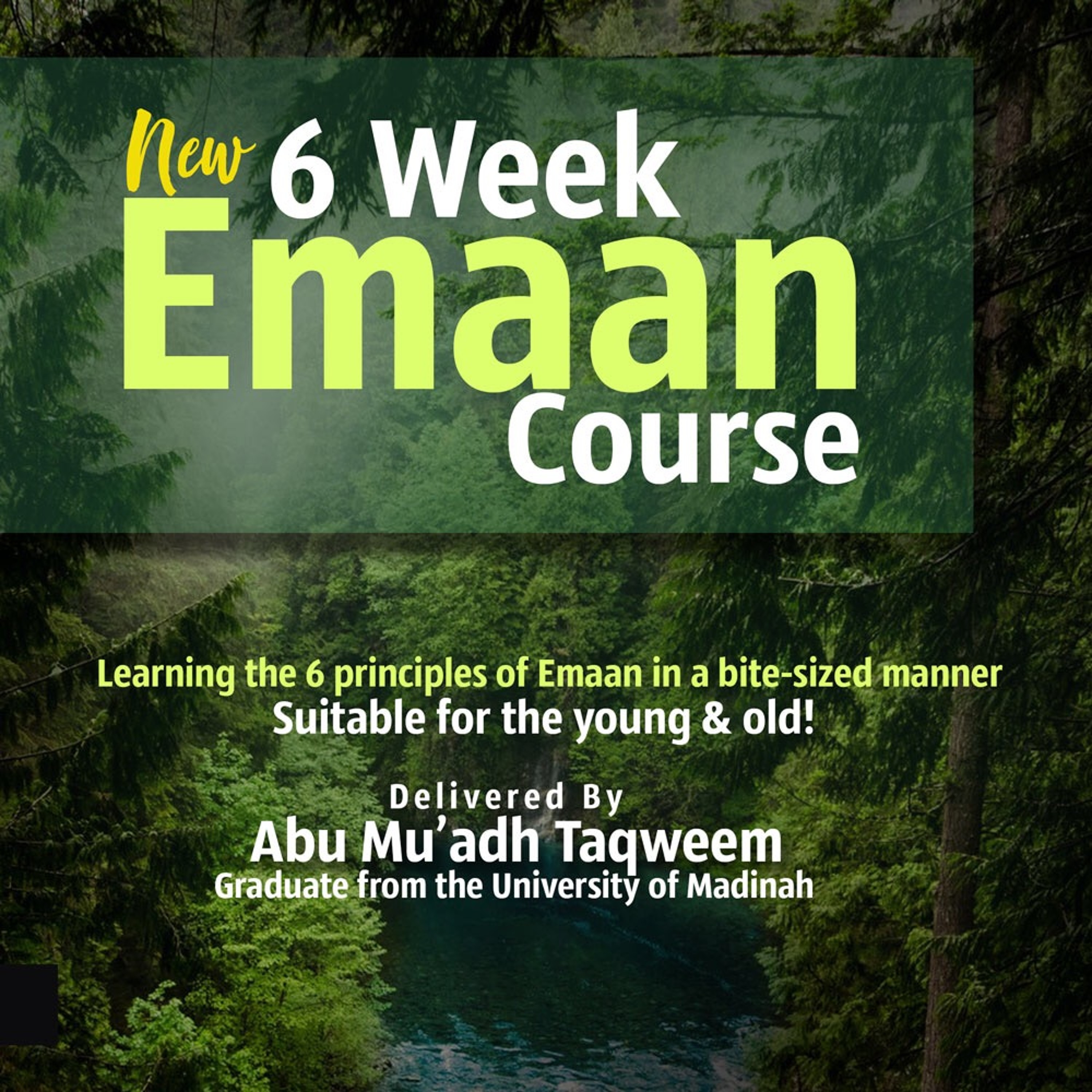
In Allah, we begin with this new course, the course that is going to discuss some of the most basic and principal aspects of our religion, aspects of our religion that every Muslim needs to be aware of, aspects and principles of our religion that every believer needs to be upon knowledge with, because there is a certain level of knowledge all of us must have. It is not possible for you to excuse yourself from the very basics of the religion, the person he asks you, what is the meaning of iman in Allah? You cannot excuse yourself from that question. You cannot say ask a student of knowledge.
How can you not know what the iman in Allah is? If somebody asks you, what is the iman in the angels? You cannot excuse yourself from that question. Iman in the angels, a pillar from the pillars of iman.
How could you not know? Iman in the Prophet, iman in the books. Iman in the day of judgment, iman in the degree. These are from the principal aspects of our religion that we must all have knowledge of.
And so now then we begin today with this course which is expected to last at least six sessions. Six sessions and maybe more if we add extra detail onto some of the points. It is important for everyone. Particularly now with this being the first session after Ramadan, it is important for everyone to recollect and to remember their intention that they are seeking knowledge for the sake of Allah.
Knowledge is sought to remove ignorance from yourself and to remove ignorance from others. It is sought sincerely for the sake of Allah. Sukh-Hana-Hu-Wat-A-Hala, as Allah mentioned in the Quran, wa-Mamah-Umi-Ru-Ili-A-Mud-U-Lah-Hamuh-Lis-In-A-Hud-Din. To know that they want to command and accept to worship Allah sub-Hana-Hu-Wat-A-Hala upon sincerity.
This seeking of knowledge is an act of worship. Seeking knowledge is an act of worship. It is a badah because this act of worship in seeking knowledge enables you to worship Allah sub-Hana-Hu-Wat-A-Hala properly. Because without knowledge you would be upon ignorance.
You would be upon general not knowing how to worship your Lord. So the importance of this knowledge is tremendous. The importance of learning about your religion is great. And that is why the Prophet Salaam Alayhi was a lemon-formedist.
Man-salah kathariya-pan-yal-tamis-ofihi-hirimah. Saha'ala-HA-Lahula-Hula Uli-Hih-Hul-A-Hum-Saha'ala Whatever treads upon a path. Seeking by it knowledge. Then Allah sub-Hana-Huh-Wat-A-Hala will make that person's pathway to paradise easy because of that treading, in seeking knowledge that's thriving, in seeking knowledge he did.
And then practicing it in his worship, it makes his path to paradise easy. the Prophet ﷺ mentioned, Manurid al-Hudihi, Hr'ilah, Yuvakt Al-Fidih, whom so ever Allah wants goodness for, Then he gives him knowledge of the religion, detailed knowledge of the religion, whom so ever Allah wants goodness for Allah gives him detailed knowledge of the religion. And that is why Allah also mentioned in the Qur'an, Al-YasAllahu Alayhi Wasall, the one who know and the ones who do not know, certainly they are not equal as a Shef Al-Atheimim, Raheem al-Lahr al-Ahelah mentioned, because the one with knowledge is superior than the one who is jahil and ignorant, the one who strives to learn about his religion compared to the one who is lazy and does not bother, does not bring himself to the gatherings of knowledge, does not bring himself to those gatherings that the prophets al-Ahelah had. He was said regarding, that they come together in a house, from the houses of Allah, except that the mercy descends upon them.
They come together studying the Qur'an, learning this religion, except that the mercy will descend upon them and the tranquility upon them and the angels they surround them. These are the virtues mentioned of the gatherings of knowledge, the gatherings where the Qur'an and the Sunnah are being learnt. So what a blessing and glad tidings for those who strive and they attend the gatherings of knowledge and they put aside time in their schedules, fixed for the purpose of knowledge, prioritized for the gatherings of knowledge, glad tidings to them who strive on a weekly basis, attending the gatherings of knowledge on a weekly basis with consistency, with consistency, not attending when you feel like it, and missing when you feel like it, attending when you can be bothered and missing when you cannot. That is not the way of the student of knowledge.
The one who sincerely desires to learn about his religion, the religion that Allah has chosen for us in Naddina and Allah in Islam, that indeed the religion with Allah is Islam. Wamang yevil, tari, hail, islam, idina, phalen, yukob, al-amin, whom so ever seeks a religion other than Islam, then it will not be accepted from him. Glad tidings to those who recognize the importance of that, glad tidings to those who recognize the importance of their creation, the importance of their existence upon this earth, the importance of learning and studying their religion. So glad tidings to those who have that sincerity of intention and that focus in studying and that prioritize it, they prioritize the gatherings of knowledge over and above their affairs that they have, they prioritize that one or two or three gatherings of knowledge a week over and above the other affairs in their timetables.
Glad tidings to them, they will benefit themselves in sha'Allah, they will benefit their families and they will be from those in sha'Allah who their path is made easy to paradise because of their striving in seeking this knowledge. But what therefore, what therefore of those who are not in that category, what therefore of those whose lives they pass them by upon ignorance and no striving, attending a gathering here or there, attending a lesson here or there, not having any focus upon the only thing that they should be focused upon which is learning how to worship Allah, so how will you rectify yourself, how will you rectify your family, how will you save yourselves and your families from the fire if you do not strive for this knowledge. So what therefore of those who deprive themselves, deprive themselves of this knowledge, the scholars they say be aware of the letter meme when it comes to knowledge, be aware of the two memes, when it comes to knowledge, be aware of the moustache and be aware of the moustache bill, be aware, do not be moustache, when it comes to knowledge, do not allow your shyness to prevent you from seeking knowledge of your religion and similarly do not be from the other meme, the moustache bill, the arrogant one, those who are too shy and those who are too arrogant to attend the gatherings of knowledge, those two memes must be warned from when it comes to the issue of knowledge. Shiness is something good but not if it prevents you from learning your religion.
Arrogance is something disgraceworthy anyway, so what therefore of this characteristic when it is aligned with the issue of knowledge that there are those two arrogant to attend the gatherings of knowledge, they think they know it already, they think they have too much of the knowledge that they do not need the gatherings anymore, that arrogance is only depriving you, depriving you it is not depriving or harming anyone else, it is not depriving or harming those who are in attendance, your arrogance only deprives you, so those two memes shyness and arrogance, not when it comes to knowledge, calm and sit in the gatherings of knowledge, study and benefit, learn for yourselves, learn to remove that ignorance and to remove the ignorance from your families and in particular when it comes to a topic of this nature, the six pillars of Eman, the six pillars of Eman that you are taught to memorize as a child, Eman in Allah, Eman in the angels, in the books, in the prophets, in the lay of judgment, in the decree, so are we all in a position whereby we can explain those six pillars of Eman in detail, are we in a position of knowledge regarding those basics of our religion, then that is what we wish to address now in this course over the next few sessions to look at this basic principle of Islam, these six fundamentals of the religion and in order to educate ourselves regarding them so that we know and we can teach our children thereafter and we can teach our communities and neighbors the basics of Salah Alayhiyau, the basics of the Aadi Dabah al-Sunawajana, the most basic of the basics in the principles of the religion, so you have the workbooks, the workbooks which have been completed up to the fifth pillar and when it comes to the sixth pillar then we'll dictate the additional questions to you in inshaAllah, those workbooks follow them through inshaAllah, t'rallat, the vast majority of it, we will cover through these classes, you'll be able to fill in the answers, those who are following online, the workbook is available to download, copy, print and then you can fill in the answers also, so we begin inshaAllah, t'rallat, seeking aid and assistance in Allah and we begin firstly with the hadith of jibreel because when we talk about the issues of imad then the core, the core of imad, the issues related to it can be found in the hadith of jibreel, firstly then what is the hadith of jibreel, what actually happens in this hadith that is famously known as the hadith of jibreel, in this particular hadith, it is an event which occurred and one occasion the Prophet salallahu alayhi wa sallam was sitting amongst his companions, they were sitting and then all of a sudden a man walked in, they were having their gathering and then a man walked in, this man that walked in, it is mentioned in the narration that he was somebody that did not have any signs of traveling upon him, he looked clean and neat and tidy, did not look like he had traveled the distance from somewhere far away to get to Medina, why did they mention that in the narration, la ura alayhi a'rro saffan, that there were no signs of him being a traveler, they mentioned that because they also had an an'wala yahilifu who minah had, but none of us knew him, so now it becomes something strange, this is a man who is not known to the locals, so he is not a local, but then if he's not a local he's come from somewhere afar, you would expect that to be signs of traveling upon him, but that didn't exist either, he looked clean and fresh, not a sign upon him that he has traveled from a distance to get there, but at the same time he wasn't a local, so he must have traveled from somewhere, so now this was something strange that they were witnessing, but then on top of that this man with extremely white clothes, shadiidu be'al this year, and extremely black hair, shadiidu sabah desha'al, he then walked in, imagine the gathering is now going on, he walked in from the back, you would expect somebody who walks in late, the gathering is already going on, you would expect them to walk in and sit, where? at the back over there, but instead the man walked in through everyone right to the front, right in front of the Prophet Salaam Satineen, so again the companions were surprised, surprised at the actions of this strange man, he came in, the gathering was already happening, he didn't just sit at the back instead, he comes all the way through, right to the front and sits in front of the Prophet Salaam Alayhi Wasallam, so they were surprised at these actions, then this man begins questioning the Prophet Salaam, so he says to him, YAH Muhammad, ah, Mirinir Anil Islam, oh Muhammad, tell me about Islam, so now the sahabah was surprised again, why were they surprised at that statement, because he said, oh Muhammad, tell me about Islam, the sahabah, the companions did not used to refer to the Prophet Salaam as Muhammad, they used to refer to him as YAH Rasul Allah, YAH Anabi YAH Allah, oh messenger of Allah, oh Prophet of Allah, they didn't used to say, oh Muhammad, in fact, even in the Qur'an, then the Prophet Salaam, Alayhi Wasallam is mentioned as the Prophet of Allah, the messenger of Allah, the slave of Allah, and there are only a few places where he is referred to and addressed as Muhammad, so this was something strange that the man comes in and refers to the messenger with his name, oh Muhammad, tell me about Islam, so the Prophet Salaam, Alayhi Wasallam tells him, that Islam is, and the sahabah, Allah, Allah, wa an Muhammad, Rasul Allah, wa tokii Musala, wa tokii Azaka, wa toshul, wa wa toshul, wa toshul, wa toshul Allah, wa tahikjal Bayt, in istheavy'ji salmat alayhi sadileh, al toshul, al toshul, wa toshuu, wa toshul qubid, in istuh al-hi. Then the Prophet Salaam told him, Islam is to testify, then shayedatain, that there is no deity where we have worshiping truth, except Allah, and that Muhammad is the messenger of Allah, and to establish the prayer, and to perform the fasting, and to give the sakhat, and to perform the hajj if you are able. So then the man said, sadok'd, that's right, you've spoken the truth, So again, the Sahaba was surprised, look at all of these multiple things happening, that are things out of the ordinary surprising things.
Again, now surprising to the Sahaba, the man is saying to the Prophet Sallam, that's right, you've spoken the truth. He was surprised, yes, Eluhu, where you said, the man is here asking the Prophet Sallam the questions, and now he's telling him that's right, your answer is right. How can he be telling him your answer is right, he's the one asking, the messenger is the one that knows not him. So now they were surprised again, but then the man carries on and asks the next question, and he says, ah, beir mihanil iman, tell me about iman, then the Prophet Sallam tells him and tukmina min la hihwa mala ikati hihwa kutu vihwa also, hihwa yum ala ikati, wa an tukmina mina mina bihwa dari hai, hihwa shah mina, the six pillars of iman, and that is the point that we are going to be discussing.
The hadith then carries on when the man asks about the decree or asks about Ghassan, and the Prophet Sallam tells him and tahabul ala ikah and nakatarah, fain them takun tahra, who fain them hihwa rock, that you worship Allah, as though you can see him, meaning that you worship Allah with recognition that Allah sees you, because even though you can't see him indeed Allah sees you, and then he asks him about the signs of the hour, and when the hour is going to be, the Prophet Sallam tells him, alm, alm, sayul, the one asked the question is no more knowledgeable than the one asking, neither I nor you know when the day of judgment is going to be, and then he tells him about the signs of the day of judgment, and then in the end the Prophet Sallam says to the companions, do you know who that was? They say Allah was who was who Allah is messenger, no best? And so then he tells them that it was jibereel ala iksalam, ata kun yu allemukum amradinekum, he came, yu allemukum amradinekum to teach you the affair of your religion, that was jibereel he came to teach you of your religion, there is another version of that narration where it mentions at the end, when the Prophet Sallam told them that, some of the sahabah, then realizing that was jibereel, they got up and they went out because by now jibereel had got up and left, so then they went out after him, as soon as they got out and jibereel had just gone out as well, they went out after him, disappeared, nowhere to be seen, nowhere inside God, vanished, jibereel ala iksalam, so that is the narration known as the hadith of jibereel, because you have certain hadith within the sunnah, they become popular by a particular name, this hadith has become popular and known by that name, the hadith of jibereel, and there are others in the sunnah known by particular names, this hadith, some of the scholars give it another name, before well anybody know, anybody know what the scholars also call this hadith, another name they give this hadith, uh, umusunna, umusunna, meaning basically the head of the sunnah, the core of the sunnah, the mother of the sunnah, that is a name that the scholars refer to, with the hadith of jibereel, umusunna, just like al-fatiha is known as suratul fatiha, habduin al-hayabil al-amin, that is known as umul-kitaab, umul-kul-al-al, why are they known as the um, what does it mean, umul-kul-al-al-unusunna, anybody? there are travelizia, leagues, manchas, the levapul, we have to honor our guests, so the guests can give us the answer, okay, the resident has taken the rights of the guests, but the answer is correct, that these narrations, or this narration, and that surah, they are known as the um, which means the head of something, the core of something, the mother, literally um, because all of the other affairs revolve around and return to that point, so they say al-fatiha, the meanings that you have within al-fatiha, the rest of the Qur'an as a whole, it revolves around and comes back to those meanings, because in al-fatiha, how about you have meanings of arubu-biyya, al-unuhiyya, al-asmawasif'at, all of those things are mentioned, the rest of the Qur'an, all of it revolves around those aspects of turi, this headif is known as the umusunna, because the sunna, as a whole, many aspects of it revolve around these points, the five pillars of Islam, which are mentioned in this headif, the six pillars of imal mentioned in this headif, ehsan mentioned in this headif, the day of judgment, the signs of the day of judgment, all of these affairs mentioned in this headif, and that builds up the Qur'a of much of the religion, the five pillars of Islam, the six pillars of imal, the basics are all there, hence it is known as the um, the head or the Qur'a of the sunna, that is one title given to it, another one of the questions here mentioned on the workbook, the man who we're going to go through is not questioned by question, the lecture will be delivered on that topic, you are expected to pay attention and fill in, the answers as you find them during the lecture, it will not be a case of going through question by question, but generally now just to add on some of the points to begin with, what are some of the benefits from that headif of jubreel we've just mentioned in terms of the student of knowledge, there are certain benefits we learn from the way that a student of knowledge should behave, when coming to the gatherings of knowledge, we see that jubreel al-a-salah was immaculate in his appearance, white clean clothes, black hair, clean and tidy, it is therefore a characteristic for the student of knowledge that he should come to the gatherings of knowledge in a neat and tidy and clean appearance, that is from the mannerisms of the student of knowledge, just as jubreel al-a-salah did when he came there, clean and tidy appearance looking like you are serious and ready for knowledge, not coming with the same clothes that you are wearing out in the gym or in the football field, but rather you come ready and neat and tidy for the gatherings of knowledge, also the manner in which jubreel al-a-salah came and sat down, it's mentioned in the narration that he came and sat with his legs crossed under him facing the Prophet salallahu alayhi wa sallam, the scholars they say, it is therefore a characteristic of the student of knowledge that he should be sat in front of the teacher focused facing that way attentive and that is why i'll tell you an example not that we want to embarrass anybody now but an example for it to be told in Medina in Saudi the mosques actually are very similar in their format to what you see here, you have an area for the imam and they normally put the desk right in that area just like this, you have this type of backrest on the first row in the Saudi mosques, same backrest you've got here, so the layout is very similar when a class is going on in some of these mosques, it's a very similar layout, however the students they would come to the class an hour before the class begins and hour before it begins so 730 they would be here 630, why?
to make sure that they could get the first row in front of the teacher to be right there as the first row of students in front of the teacher, so they would come an hour before this section here, this section here maybe two hours before that's time, maybe two hours before and that's not an exaggeration, that is not an exaggeration, up to two or three hours beforehand this area would be gone, students would be here sat down, maybe leave their bag or make wood or whatever, this area would be full, this immediate area before around the teacher, then you have all of the rest of the backrest over there, the rest of the backrest over there, that would be empty because the next bunch of students who can't find the backrest on the first row here would sit directly behind there because that is the closest place next to the teacher, then the next bunch right there behind that meaning you would have the center which is where the teacher's desk is and then the population of students, the mass would build from that center outwards, so nobody would go and sit at the edges over there for the sake of getting the backrest, if they didn't get the backrest right here at the front of the desk then it would be no backrest on the second row, then on the third row, then on the fourth row, working outwards from this area, not working outwards far away from the center for the sake of getting the backrest, mentioning no names for those who are sitting on the backrest on the edges, but that is the way it was, students there they would recognize, the core is to sit right there and I'm telling you, they used to be classes, you get there, you get a place maybe a meter from the teacher and that's if you've got there an hour or two hours before, you sit down, maybe you need to make wood so that's okay, you can leave your book there, you've got that place, you're there, you're sat, you can leave your book temporarily just to go make woodaux, you go and make woodaux, you come back to your place and your place is there, you sit down but now all of a sudden your place has decreased by 30 centimeters on every side, by the push of everybody who has come in and all of the students coming in tight and tight, your space has all of a sudden decreased when you come back in the space of five minutes, there would be eager to sit right there in front of the teacher knowing that that is the place where the maximum focus will be, when you are right there in front and that is taken from this hadith, that jibereel alayhi salam came and didn't sit anywhere else came and sat right in front of the prophet, salallahu alayhi wasallam, also from the mannerisms of a student of knowledge what else can we learn, the actual method of sitting, now that you're sat wherever you're sat, the actual posture that you're sitting, jibereel alayhi salam came in sat down with his legs folded in on his knees sat on his legs facing the prophets asala, the scholars they say this indicates that you should sit in a certain posture meaning when you come and sit in the gathering of knowledge you should not be slouching, you should not be relaxing and lying back, you should not be with your hand down on the ground here slouching that way turning that way leaning that way rather you should be sat in a proper upright posture in front of the teacher, that is the etiquette of the student of knowledge, not to come and sit and be slouching this way or slouching that way leaning back lying down that is not from the characteristic or the etiquette of the student of knowledge, so even the method and the manner in which you sit, these types of things they have become rare in our times, it's a rarity because when you think about it it's a rarity to even get the people to the classes, let alone the mannerisms and the etiquette of then sitting in the class, so this is important for us now to learn, to learn the mannerisms of the student because by learning the mannerisms of the student of knowledge it will aid you in your seeking of knowledge, by knowing the etiquette of seeking knowledge it will help you in your progress of seeking knowledge, so there are some of the etiquette that we see from Jibereel Ali Salahm and the other eta cuts of the student of knowledge, in that hadith we learned that Jibereel Ali Salahm came and asked the Prophet Salahol Alayhi wa Salahm about iman and Islam as the first two questions, tell me about Islam, tell me about iman, what is the difference between Islam and iman, if somebody said to you now what is the difference between iman and Islam, now what do you say to them, anybody, that is one way to explain it, Islam and iman when they are mentioned in terms of requiring a difference between them they are mentioned together then Islam typically refers to the outward affairs, the outward affairs, prayer, physical outward it is seen, sakat physically giving over the money, fasting a physical act with your body, had your physical act the outward physical parts of Islam, whereas iman is the internal aspect, belief in Allah, belief in the angels, belief in the prophets, the books, the day of judgment, the degree, the internal aspect is the iman, so that is one way to understand it, let's start as you say if Islam is mentioned by itself then it incorporates iman and if iman is mentioned by itself it incorporates Islam but if they are mentioned together then Islam refers to the outward affairs and iman refers to the inward affairs, that is the difference you could mention regarding Islam and iman also in regards to the shahadah when you say la ilaha illa law that there is no god to be worshiped in truth except Allah all of the other gods people worship are false and they are not real, they are not true, the only true deity god to be worshipped is Allah and and Muhammad is the messenger and slave of Allah when you testify ashaadu and Muhammad and Muhammadu who wa Rasulah that I testify Muhammad is the servant and messenger of Allah then there are four key things that you must bear in mind with that testification of yours that testification of yours it incorporates four key meanings what are they what are the four key points that you need when you say I testify Muhammad is the servant and messenger of Allah the first somebody the first though in order to obey him in everything he commanded us with remember this now this is the meaning of ashaadu and Muhammad and Abu to wa Rasulah that you will first be number one obey him in everything he commanded you how can you testify he is the servant and messenger of Allah and you will not obey him in what he commanded you of course you must obey him in everything he commanded you with secondly his that you will believe and have certainty in everything he told us about everything about what happens when we die everything about paradise and hellfire everything about the day of judgment when everybody who has died will be brought back to life again all of that you believe in it with certainty and the fourth point Allah ya bada Allah ila de manshara that you will only worship Allah in the way that he legislated you will only worship Allah in the way that he legislated meaning you will not do you will not do innovation you will only worship Allah in the method that he has legislated so when we say you will obey him in what he commanded and you will stay away from what he prohibited in the Qur'an Allah tells us wa ma'a ta kumor Rasulah wa fahudu wa ma'a na hakum and hufantahu that which he has commanded you with then take it and that which he has prohibited you from then abstain from it and as for believing him in everything he has commanded us with then that is just as Allah mentioned right at the beginning of the Qur'an and la dina yukminu wa bi'uil reib the believers are those who have yateen and certainty in the unseal everything that messenger has informed us of we have certainty in and that you will only worship Allah in the way that he taught us then again that is proven in the Qur'an in the Sunnah. Paman Qana yal jul y'aldu lakha aa rubihi phalliamal amal insalihah. Waala you should be reba dati rub bihi aha dah that whom so ever wishes to meet his Lord then let him do the righteous actions you know that you will meet your Lord so do the righteous actions upon the Sunnah and do not commit any shirk those are the four points you will obey him in what he commanded you will abstain from what he prohibited you will believe everything informed us of and you will only worship Allah in the method that he taught us also in the hadith we hear about the issue of ehsan when jib really said i'm asked tell me about ehsan ehsan and tahabu dala haqah anakah tara for inlam tatum tara hahuhu fah inna hu yarau that you worship Allah subhanah who a tahra as though you see him and of course you cannot but know that indeed Allah sees you so ehsan it is to perfect your worship to perfect your worship knowing that Allah sees you in doing your so when you're worshiping don't do it as a habit don't do it as something you need to get over and done with and be finished wrong don't do your prayer so you can get it out of the way don't do your other affairs of worship to get them out of the way ehsan is that you do your worship recognizing and realizing that Allah sees you in that worship you are performing Allah sees you in what you are doing in your prayer that you are praying in the qurah that you are reading in the charity that you are giving and every worship you do that Allah sees you that is the pinnacle the best you can reach to be upon that pinnacle in performing your worship with purity sincerity with perfection for Allah upon the sundah so then comes this question now in your workbook regarding the circles how do we understand the issue of islam and iman and ehsan in regards to those three circles in the hadith of jibreel those are the three things jibreel asked about about islam about iman about ehsan how do those three fit into those circles so the outer circle the widest circle is the circle of islam when a person enters islam he enters into that wider fold and circle of the religion of islam but then as the person increases in his worship and his actions his obedience and drops his sinning and his wrongdoing he increases in his iman until he reaches the level of being a mukmin into the level of now iman so that is the smaller circle now less people get to that level to the level of being a mukmin everybody enters into islam you are muslim but is everybody a mukmin at the level of iman high level of iman not everybody is some people reach that circle then after that the more you worship a lot the more you perfect your worship the more you drop your sins the more you perform the obligatory and the superrogatory and the muster have and you leave them accruv as well as the haram even the mubah you do not waste your time in it the more a person perfects himself and increases in iman then he reaches the level of being a mukmin a person of exan and that is only a few that is the smallest circle the highest level of the circle to reach and that is why we discussed a long time ago with the issue of iman if somebody says to you are you a mukmin what do you say you say enjah lot who said that you say enjah lot somebody says are you a mukmin you say enjah lot so you don't know you don't know if you're muslim or not and what's that are you there yes you are moving much a lot got to that circle i'm past i'm in the second circle of iman rather than a set of the use they say or the explanation of it is they mentioned this in babbal if the person is asking you are you a mukmin i.e are you a musslim then of course your answer is yes absolutely of course i am you cannot doubt whether you are muslim you don't say enjah lot and i mukmin if that is their intent but if their intent is are you a mukmin i.e have you reached the level of iman in those circles then you say enjah lot enjah lot i have enjah lot i have reached that level so if it's talking about that enjah lot if it's talking about are you a mukmin i.e are you a muslim then absolutely yes then you don't say enjah lot so that is the difference in that that is the opening section that will conclude upon for today the opening section where we've discussed in brief the hadith of jibreel we've discussed some of the basic aspects of islam and iman and exal we've talked about the basics of the shahada next session will go into the topic of the tohid and the iman in ala as you can see on the next page of the workbook it talks about arubu viyya the names and attributes of ala and then also after that it goes into the opposite kufir what is kufir and what are the different types of kufir what are the different types of shirk all of that in the next session enjah al-aayla there will be a lot more detail a lot more categories the categories of shirk the categories of kufir the different types all of that you'll have to pay attention to next session enjah al-aayla so that will be also on the topic of iman in al-la the session after that iman in the angels the session after that iman in the prophets and and the books in one session. That can be summarized and there is less detail to cover, then after that in the degree, and the, or the day of judgment and the degree.
So it will be approximately six sessions in Shallahu, maybe going on to seven to complete this course, and by the end of it then, you will have a comprehensive answer to these aspects of Islam, particularly, if you're talking to an non-Muslim and you're giving dahua, you will be in a position where you can properly explain the fundamentals and the basics of the belief of a Muslim. So that is what we'll conclude today, any questions on that? So far, what we've covered, any questions regarding that or anything else that may not be related to the topic? If sisters have questions, they can send them forward, we have an opportunity now.
Repeat that. So that bit about the iman, in the books of Atid and the books of Tohid, they have the chapter, they mention it, the issue of al-istif-na, that's the topic if they're gonna research it. Al-istif-na, feel iman. In that chapter, they mention these points.
Remember we said before, iman and Islam have two meanings, outward and inward. But they can incorporate one another. So iman mentioned by itself incorporates Islam, Islam mentioned by itself incorporates iman. So if somebody says to you, are you a Muslim, could they mean, can that question mean in terms of the incorporation of the issue of Islam, are you a Muslim?
It can mean that, are you a Muslim? Are you a Muslim, are you a Muslim, an iman on the pillars of iman, et cetera? If that is the intent, then of course, absolutely yes. You do not say, nah, am, am, am, am, am, am, am, am, I e, nah, am, am, am, am, Muslim, en-shah Allah.
You cannot say, I'm a Muslim, en-shah Allah. So in that case, it is muqmin certainly. But then the scholars they explain, and this is in refutation of the asha'a'ilah and the ima'to'idiyya and their likes, who have problems in this issue of al-istif-na. They say then, if the person means, are you a muqmin, they are casting you, are you at the level of iman in those circles, yang?
Are you above Islam? You're not just Muslim, you are muqmin. Have you reached that level? Then you can't say yes, of course.
The sallaf wouldn't say that. You say, insha'Allah, min-shah Allah, am, min-shah Allah, am, min-shah Allah, am, min-shah Allah, we have reached those levels, we hope and we try. So with that, it is insha'Allah, yes. But with the meaning of Islam, then of course not, you have to say, absolutely Muslim, oh, absolutely, muqmin, that is the basic explanation they give.
Did you very little had a sallam when you came? He referred to the Prophet as muhammed. Yeah, muhammed. The point we were making on that was that this was one of the factors that were to be found strange by the companions.
There were several factors strange in this scenario. The scholars, they mentioned this in their explanations. That there were several strange things going on. They have this man walking in who doesn't look like a traveler, but they know he is, because he's not a local.
But he doesn't look like a traveler, nothing on him, clean, tidy, strange. He comes and he doesn't sit at the back, he sits right at the front, strange. He refers to the Prophet by his name, oh, Muhammad, instead of the arasul Allah, strange. He then tells the Prophet, you're right, when he gives him the answer, strange.
Scholars, they put these into a list of all of the strange things that were going on. All of the strange things that were out of the norm. And then all of it made sense in the end when it was said to him, that when it was said to them, that this was gibri, as for the statement of what is the wisdom, then it can be said as some scholars say, that this was to keep with the possible norms of how the Bedouins used to refer to the Prophet sallam. When Bedouins used to come from the outside, they used to say, oh, Muhammad, from their nature and their lack of recognition that we need to say, oh, messenger of Allah, they would say, oh, Muhammad.
So some of the scholars say it was in line with that, that gibri, al-i-salam came and said, oh, Muhammad, in line with how the Bedouins would do when they came from the outside. That is one explanation the scholars mentioned. But the point of it being a strange factor amongst the strange factors is something that scholars highlight further. A student coming late in the days of the university in Medina, if a student came late, there were some teachers who would have an absolute, no exceptions rule that the student does not and will not enter the class in the first place, zero tolerance.
The class begins at 8 a.m., anybody comes to the door at 8-0-1, they were not permitted to step foot inside. How dare you be late? Student of knowledge? Late?
It is not something you do. And why a person may say, but things happen. Things happen and you get late. Really, think about the affair.
If somebody told you, and these are the examples, everybody always gives because they are the obvious and easiest to understand. Somebody told you, there is someone rich giving away blank over checks for a million pounds each. He's gonna be there, everybody who wants one of these million pound checks and there's thousands of them he signed out. He's gonna be distributing them from 8 a.m.
There will not be a single one who dares to be late. They will all wake up with their alarms at 4 a.m. and prepare themselves to go and be standing outside of the door before, miles before 8 a.m. To make sure they get in.
Nothing will come as a priority over the late day. And we all know that of ourselves. If you were told with absolute certainty, you can go get yourself a million pounds for free. But you've got to be at this particular place by 8 a.m.
If it was in London, you would go and get a hotel the night before. You would go the night before, get a hotel, get up at 3, 4 a.m. Make sure you get to that place by 6 a.m. 5 a.m.
To make sure you beat the cues. Just like when they have what they call the sales at certain times of the year, then you find the cues at 6 a.m. Truthfully, if a person had their intention, their desire, their zeal, then it would be an extreme, extreme, rare event that you were late for a class. One in a year.
Twice in a year. Push it out a little bit. If you were genuine about seeking knowledge, you would prepare, you would get ready, you would bring your books and your notes, and you'd be here half an hour before the class is going to begin. To sit there, to revise over what you did last week, to discuss with your colleagues what you covered, and what's going to be covered, those who are genuine and sincere, that is the way, like we mentioned before, classes of the scholars without any exaggeration.
Two or three hours before students would be there to put their bags down sit down in preparation at the front. So the issue of being late, it is an issue which is a disaster amongst the people. And it defines the student of knowledge in truth, from the one who is not at the level of being from those real students of knowledge. The one who is late and regularly late, then it's something that is a degradation, lowers that student.
But those are the types of things that cannot be emphasized here. Those are the types of things that cannot be emphasized here. It cannot be. There has to be a line that you have to draw, and you have to recognize that this is the way things are.
If we had that type of rule here in the classes that you must be here before the start time, then after two weeks there'd be barely three people left. So we know that the state of the people is a state of slackness over all. And that is because of the mentality. The mentality of everyone.
It's a casual thing. You get ready at two minutes to eight, and you're going to scroll in at five past. He's not going to begin till five past anyway. He always gets there about five past seven past anyway.
That mentality is not the mentality of a student of knowledge. That's the first thing. So for those who are sincere and genuine, rectify and fix that up to begin with. Then what was the question?
About the one who comes late, should he sit at the front, or should he sit at the back? Now we'll get to the lesser important thing after the important thing has been discussed. About not being late in the first place. But if you are late, then it's not, not recommended to do this in terms of coming right to the front, passing through, and trying to squash in at the front.
You wouldn't do that. This is mentioned in the Hadith of Gabriel. Gabriel had a salam did that. It was one of the strange affairs to the companions, but he did that and it was for a purpose.
He was going to do that now, ask those questions, to educate the Sahaba. That was a purpose. You wouldn't typically come and break through everybody and try and squeeze in at the front. You come late, then you don't deserve to sit at the front in the first place.
You don't deserve to come and have a place at the front near the core of the gathering. Sit at the back as you were late. Sit at the back, the ones who are not from the senior students, the serious students, you don't deserve to be at the front in the first place. Anything else?
Issue of? Mentality. Mentality. So the question regarding worship and it becoming a habit, a robotic automatic type of thing, as some of the scholars describe it as, it's an automatic action that just occurs.
It's prayer time, it could be gotta pray. Moodle prayer without focus, without nothing like your body is praying, but your mind is somewhere else. Or you have this idea and mentality and we talked about this briefly in Ramadan. When it comes to T'a'ra'wih, the mentality of the people okay, it's an issue of a countdown.
Hamdulilah, that's too done. Then after four, Hamdulah's four done now. That's six done now. Eight done, Hamdulilah.
All the way you're just counting down that I can't. Worship, you need to recognize, as we've just said here now, with the issue of the sun. Allah watches and sees you in your worship you're doing. You need to recognize every time you stand there for prayer, don't have the mentality, okay, I just gotta pray and get back and I've gotta get to the meeting at this time.
When you're in that prayer, remember, you are living and breathing and existing for the purpose of that, for the purpose of worship. Not for the purpose of your meeting to arrange your plans and to do this and whatever else. Your very existence is being actualized when you are engaged in worship. So don't flip it 180 degrees.
Don't flip it and make it sound like and make it appear in your lives as though your worldly affairs are the purpose and the objective of your days. Rather, it is the worship in your days that is the purpose and the objective. So that's what the meaning of the narration is. Poon fi dunea kahna karalibor abi rasadid, be in this world as though you're a stranger or a passer-by, do not make the world a focus, make your worship the focus.
That mentality must be altered in the narration of Allah. When the Prophet sallam siktabillah, om yabillah, arise obi lal, evin, make the evin, arih na bi sallam. Give us tranquility with the prayer. The Prophet sallam, when he became preoccupied with the affairs, he would turn to the prayer to gain peace and tranquility and serenity and comfort.
Whereas now the people cannot wait to get out and get back to their whatever they're doing in their worldly affairs. You must remember when you're praying Allah sees you and you're being judged on your worship, your very existence on this earth is for the worship. So if you're rushing through all of that automatically mentality of getting it out the way, so you can get back to your worldly affairs, then remember, you are pushing aside the actual purpose of what you're breathing and living to something, to giving priority to something, which is not the purpose of your existence. You are pushing through your prayer to get back, you are pushing aside the purpose of your existence, to get back to something that is not the purpose of your existence.
You are pushing aside and getting through something which you are going to be held accountable upon in the day of judgment. First thing you will be tested on is your prayer, whereas your contract and your business and your work, that isn't the key, that isn't the focus of your test on the day of judgment. So remember the purpose of your existence. Remember what will occur in the hereafter with it, what is gonna happen in the hereafter with your worship.
That's what you're gonna be tested on. And remember that, sir, that Allah sees you when you do your worship, how can you make this an automatic thing fly through it when it is something that you are being tested on, it's being written down and Allah sees you doing it. So a person needs to recognize some of those points in order to realize why you're doing this worship and the purpose behind it and Allah sees you and that this is your existence and the purpose of it and the objective in the hereafter and your test upon it. That is what we must remember in our worship.
So it doesn't become an automatic type of thing, doesn't become a robotic thing we're just doing without bodies without our minds in it. Anything else, otherwise we'll conclude up on that point. Last question, go on. The minimum requirement for every Muslim is that they must, must educate themselves regarding the religion to the level, the minimum level that is needed by necessity to be able to worship Allah properly.
That is what is mentioned by the scholars, that you must gain that minimum level of knowledge that enables you to worship Allah. Because if you don't gain that minimum level of knowledge, it means you are not able to worship Allah properly. And that can't be, how can you live your lives not worshiping Allah properly? You must gain the level of knowledge that enables you to worship Allah properly.
Therefore, you must have knowledge of these principles that you might, you must have knowledge of the heat and the heat that you don't fall into shit. You must have knowledge of how to make what we do properly, otherwise you can't pray properly. You must have knowledge of how to pray properly itself, otherwise you're praying wrong every day. You must have knowledge of prayer of fasting and its rulings, otherwise Allah comes and does everything you did wrong.
There's a minimum level of knowledge you must have. Therefore, there's a minimum level of studying you must do. Every person, really it's not an excuse. Every person should be attending lessons of knowledge.
Even if you're a person you say, I'm old and this and that, I'm not a student, I can't study, then come generally to benefit. If that is all your level is, then I have to do it last some people, that's all their level is, come to generally benefit and hear about Islam. Every person should be making the effort together in the gatherings of knowledge. Once a week, twice a week, a couple of hours of your week.
So the minimum is a person needs to have the knowledge that enables them to worship their Lord. If you don't know how to make a do yet, then you're in a problem, a big problem, severe problem. You don't know how to pray properly, you don't know the Sunnah, severe problem. You don't know to hate on these pillars of imman and you can't explain them, nothing's severe problem.
This is a level of knowledge. Every Muslim needs to learn. Every Muslim needs to gain. So every Muslim needs to strive with attending to gain that minimum level of knowledge, where you are up until he'd and happy to know the affairs of Shirk, and you know the minimum level of knowledge that enables you to properly worship Allah.
Without that minimum level of knowledge, how you're gonna make a do properly, how you're gonna pray properly, how you're gonna fast properly, how you're gonna go do your hagg. So everybody has to strive for that minimum level and that's gonna come from these gatherings of knowledge. This course now, it's that minimum level, basic minimum level of understanding the pillars of imman properly. So strive over these next sessions, bring your families, bring the ones who are new to the Dawa.
We'll keep it simple and easy, nothing complicated. And there are topics that are encouraging to people to learn about the angels and we're gonna talk about different things about the angels, interesting topics regarding the angels. When were they created? How were they created?
Do they marry? Do they eat? Lots of topics about the angels too. Very interesting topics that are good for people and for Dawa.
So encourage your friends and families to come in these gatherings. And Shallah, to Allah, they will benefit from them. Without their round off on that point for tonight then, and we'll continue in a fortnight. As you know, this is every fortnight.
In the other Friday, it's a way up. So in a fortnight, we'll come back and carry on with the next session. In Shallah, also Allah, and in the beginning. Hamid, he was at the beginning.