
EPISODE · Jul 11, 2026 · 21 MIN
EN02 Extended Analysis | Inflammation, Dementia, and Where the Evidence Stops
from 人體真相檔案The Human Code · host Catherine
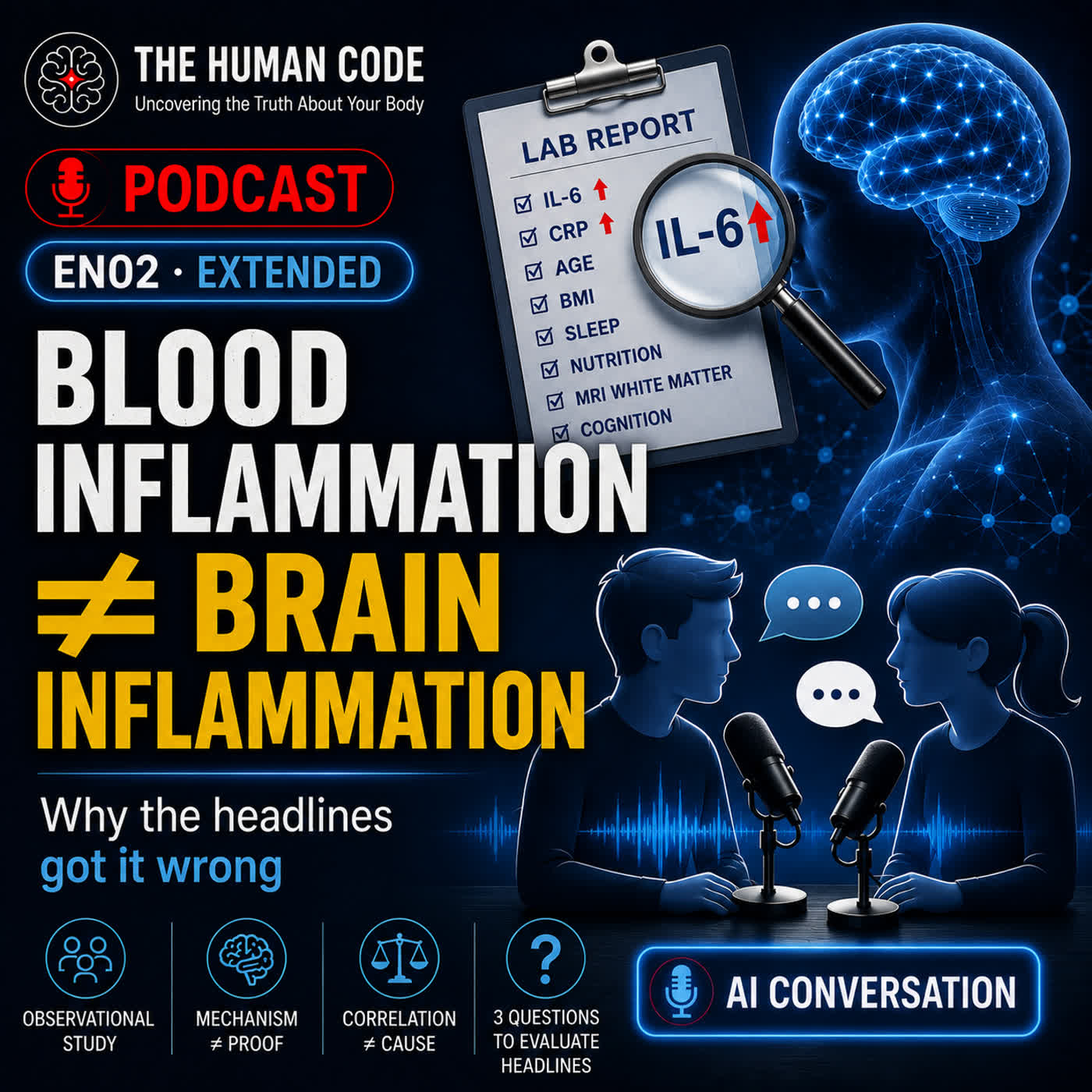
Health headlines often compress an association into a warning, a cause, or even an implied diagnosis. In this extended analysis, we examine a Canadian observational cohort of 514 older adults across the cognitive spectrum. The study measured the peripheral inflammatory markers IL-6 and high-sensitivity CRP—it did not directly measure inflammation inside the brain. Although 55% of participants in the mixed dementia group fell within the study’s highest IL-6 tertile, that tertile was a relative ranking within the dataset, not a clinical diagnosis. Across the full cohort, 8.7% exceeded the assay’s adult upper limit for IL-6.The findings also resist a single-cause explanation. Age and BMI showed the strongest overall relationships with peripheral inflammation, while MRI white-matter changes, sleep quality, nutrition status, sex, comorbidities, cognitive scores, and diagnostic group formed a more complex pattern. Because the study was observational, it cannot establish whether inflammation preceded cognitive impairment, followed changes associated with illness, or reflected shared influences affecting both.We then separate peripheral inflammation from neuroinflammation. Blood markers such as CRP and IL-6 reflect systemic immune activity but cannot identify where inflammation is occurring or establish what is happening inside the central nervous system. Research reviews describe several possible routes through which peripheral immune signals may interact with the brain, including changes involving the blood–brain barrier, vascular endothelium, neural signaling, and microglial responses. However, the Compass-ND cohort did not directly measure blood–brain barrier permeability, cerebrospinal fluid inflammation, microglial state, BDNF, synaptic plasticity, or hippocampal neurogenesis.Mechanistic and preclinical studies provide biological explanations that may connect neuroinflammatory environments with microglial changes, altered BDNF signaling, synaptic plasticity, and neurogenesis. These findings establish plausibility, not proof that the same mechanisms occurred in this cohort or in an individual experiencing memory changes. The episode closes with a practical framework for evaluating health claims: What was actually measured? What layer of evidence is being presented? And how many inferential steps separate the research result from the headline?References“Peripheral inflammation in a Canadian cohort of neurodegenerative conditions: Occurrence, determinants, and impact.” Journal of Alzheimer’s Disease. 2026;109(2):1020–1035. DOI: 10.1177/13872877251401611“Peripheral inflammation and blood–brain barrier disruption: effects and mechanisms.” CNS Neuroscience & Therapeutics. 2021;27(1):36–47. DOI: 10.1111/cns.13569“Microglial Priming in Infections and Its Risk to Neurodegenerative Diseases.” Frontiers in Cellular Neuroscience. 2022;16:878987. DOI: 10.3389/fncel.2022.878987Coverage note: This review centers on infection-associated microglial priming and the possibility that prior inflammatory or infectious exposures may alter responses to later immune challenges. The episode discusses microglial morphological and functional changes but does not fully cover prior infection as a priming trigger or the review’s broader infection-to-neurodegeneration framework.“Neuroinflammation, memory, and depression: new approaches to hippocampal neurogenesis.” Journal of Neuroinflammation. 2023;20:283. DOI: 10.1186/s12974-023-02964-xCoverage note: This review primarily concerns major depressive disorder, hippocampal neurogenesis, and evidence spanning human observations and animal or mechanistic studies. It supports biological plausibility involving BDNF, synaptic plasticity, microglia, and neurogenesis; it does not provide direct clinical proof for dementia or for the Compass-ND cohort.Medical DisclaimerThis episode is intended for educational and informational purposes only and does not constitute medical advice, diagnosis, or treatment. The research discussed includes observational human data as well as mechanistic and preclinical evidence. These evidence layers do not, by themselves, establish individual diagnosis, causation, or treatment effectiveness.If you have concerns about cognitive health, inflammation, or any symptoms discussed in this episode, consult a qualified healthcare professional. Do not start, stop, or change any medication, supplement, or treatment plan based on the content of this podcast.加入會員,支持節目: https://humancodebio.firstory.io/join留言告訴我你對這一集的想法: https://open.firstory.me/user/clexvr1v8000201vd1ddwbra8/comments Powered by Firstory Hosting
Embed this episode
NOW PLAYING
EN02 Extended Analysis | Inflammation, Dementia, and Where the Evidence Stops
No transcript for this episode yet
Similar Episodes
No similar episodes found.
Similar Podcasts
No similar podcasts found.