Life isn't fair, justice is blind and dysfunctional. This is who killed Teresa. For those of you coming fresh to this podcast, this is what we have so far. We've done 12 chapters, the stories are all interrelated, in some cases the stories are connected, and the narrative is focused on the region in the south eastern part of Quebec, known as the eastern townships, an area that I've referred to as Quebeczico.
It's a label given to Quebec by cops, not from the province, and it's meant to imply a sort of dark exoticism, though there are also insulting undertones to it, implying that the area is akin to a third world backwater, and some of the earlier chapters, in case you forgotten, where Folly had the chapter on Seco, the government crime commission, the bikers of Sherbrooke, the dirty Reich, the biker priest Jean-Salve, the long knives, etc. In the early episodes, we learned that the townships was once kind of an idyllic place, but that changed with the arrival of the biker gangs and organized crime in the late 1960s. The bikers fooled the local population establishment into thinking there were a bunch of country bumpkins who just wanted to be left alone and ride their choppers. They gained the support of police and clergy, and even persuaded some local politicians to provide them with government assistance in the form of funding, in some cases land, but once you leave the wooden horse through the gates of the city, it's hard to leave it back out again.
In 1968, the city of Sherbrooke, the townships anchor municipality, recorded only one murder by 1974, there was open gang warfare and murder in the downtown streets of the city. And for me, what is interesting is what quickly followed was the era of stranger homicide and sexual murders. This was not unique to Sherbrooke. And so we did a profile on the three cold cases from the late 70s, Louise Cameron, Case Manonzi Bay, and Theresa Allure, my sister.
And along the way, we talked about a different kind of murder, the assassination of 18-year-old cattle Fecto. And I've been really circumspect about the Fecto matter, but we're going to get right into that beginning in April. It's for me a really fascinating case because it appears to be a hybrid between gang-related activity in the early 70s and sexual murders and assaults that began to appear in the later part of the decade, kind of bringing the two worlds of this story together. And I was recently talking with police about the evolution of sexual murder, and they were explaining to me how early on open violence against women, like the 1973 gang rape by 11 members of the Jatans, that appeared to be the norm, certainly was the norm all across North America.
I'm not sure if you checked it, it's worldwide phenomena. But it appeared to dissipate, stop by the 1970s, qualify that by saying not entirely, and we'll pick up on that a little later. But it did appear to Eb. And we were saying that when offenders discovered that taking women back to club houses and subjecting them to mass sexual assault and humiliation just wasn't going to be tolerated anymore.
They adapted their behavior. And so began the era of killing victims to silence them, the stripping of identities such as persons and wallets and the disposal of bodies in remote locations. This last little bit has also been kind of a writing lab for me, a way to work out discoveries and ideas. You could make the case that, for instance, the chapter Kentucky Fried Murder that we did last time, really, if you like chronology belongs earlier on, you could really shuffle any of these stories, these chapters, into a different way of telling them.
I'm very much a William Faulkner guy, which is his ideas. You just write and you just get it down and you can worry later that it's crap fix it. But for God's sakes, just write. That appeared to, it's a different approach to me to write quickly, to write on the fly.
So there's not a, usually just in the rhythm of the last three months, if you really must know, there's a real machine to this. Usually write Sunday, Monday and Tuesday mornings early and then edit later in the week and then do this record and process and edit and add music and add visuals and get up on Sunday and do it all over again. It serves its purpose. Repetition doesn't always lead to better results, but in this case for me it has.
It's really helped to have a timeline, to force product. I don't always recommend that, but I do now. The interesting thing about that is I kind of took a slab of what I'm talking about right now and I sent it to my agent and sort of said, this could be a thesis that I would like to test in a project that we should pitch. What do you think?
And he came back immediately and said, I love it. That doesn't always happen when he thinks something is crud. He'll say that's crud. But it worked this time.
I've never done that before. I've never worked in the open. But I know that that is an approach that many others are doing. You have a podcast that becomes a book and all that.
This particular one is another proposal in play that is not that. That is ultra secret and I don't want anyone to know about. But this one isn't that type of thing. And also it is dovetailing into the American release of Wishy were here.
There's that alignment in that thinking that it's really, really important. Somebody commented to me, you're really obsessed with this. It seems to be all you're doing. Well, that's your perception of it.
That's what you know about me. I am happy to drop this at any time. I am going to ride my bike. If you said to me, hey, how would you like to go on a cycling tour of San Francisco or something?
I'd be there and drop of the hat. I wouldn't be doing this crap, that's for sure. And then my day job is very involving. So I pivot between the two because this gets absurd.
And at the end of the day, this is not very important. I mean, it's important and specific to a region and me saying, well, don't act like no one never told you so because I'm telling you so. And I'm losing listeners because I'm talking so specifically, not only, I mean, they didn't give a fuck about Quebec to begin with, but now I'm talking about not even Montreal, Sherbrooke. I'm losing engagement and I could be much more popular if I was talking about the tri-state area or something like that.
But for now, I'm willing to forgo all that because I want to tell this story. And what's, somebody has this, what's Quebec'sico? That story of a bunch of Montreal bikers salvaging a military plane that crashes into a lake doing in this narrative in the first place. I don't know.
One reader got really mad at me about it. It has nothing to do with anything. I guess I really liked the story because it was told to me by a local guy over a cup of coffee. So I had a real earthy tactile feel to it.
And I liked the idea of trying to land a plane before you even knew where the story was going, before you even learned how to fly the plane. And to be perfectly honest, there was a nod there to more Kyrichelor's novel, Solomon Gursky, he was here, which is about the brothman family and bootlegging and smuggling and a fatal plane crash. To hit the point home, this is a portion of the opening paragraph of Solomon Gursky's Solomon Gursky was here. One morning during the record Cold Spell of 1951, a big, menacing black bird, the likes of which had never been seen before, soared over the crude mill town of Meghog, hard by the Vermont border, swooping low again and again.
Luther Hollis brought down the bird with his Springfield. Then the men saw a team of 12 yapping dogs emerge out of the wind and swirling snows of the frozen lake meant for Meghog. Switch out the dogs for the boy, Riel, Bernay, and Snowmobile, and there you have the opening of Kalexico. I should say now that the same guy who told me that story gave me the one about the chicken guys, the murder of Roland Juger.
And like the Kalexico story, I barely believed it when he told it to me. Three guys that start a Kentucky Fried Chicken franchise in the townships, it sounded like a toltail. But like the salvaged biker plane story when I went back and I fact checked it, it was all just the way he had told it to me. So small towns really shouldn't keep their secrets.
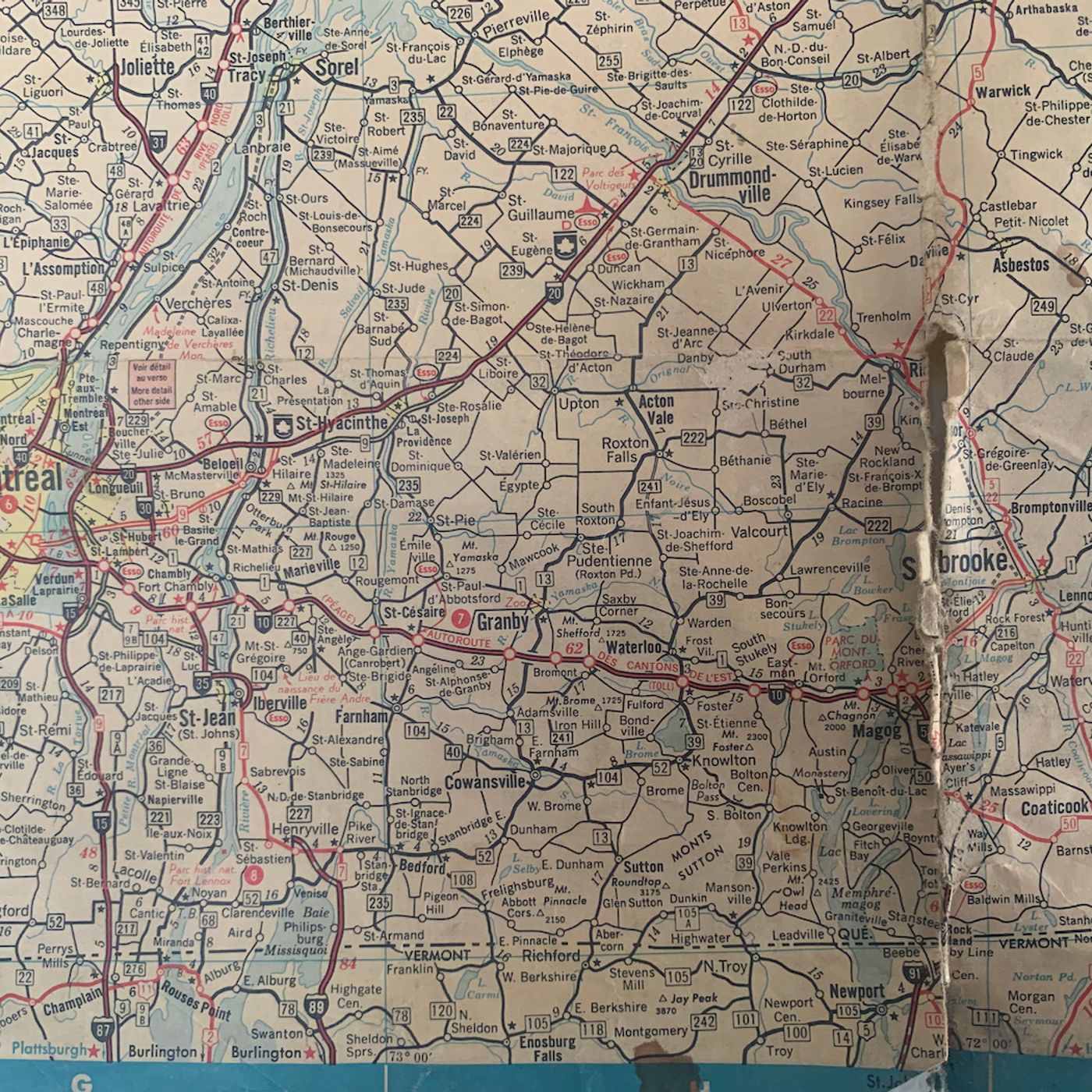
They got really rich stories. I like to visualize information using maps. The first map I ever used was an old SO road map of Southeastern Quebec and I had it on my wall at work and I'd use these stick pins to mark locations. And this became the basis of the first map developed by Kim Rosmo in geographically profiling a series of data points for the cases of Louise Kimara, Menon Tubei, and Trisilor.
And data, it's just numbers, it's all math. You know what I'm about to talk about next? It's really best demonstrated visually. And if you go to the website, Trisilor.com, T-H-E-R-E-S-A-A-L-L-O-R-E Point Com, I've got screenshots but even better just before recording this, I actually recorded like a little quick time movie of using Google Maps that I'll post on the YouTube version of this podcast to kind of really interactively walk you through that.
And it's not a gimmick. I just think I don't think people are aware of this map. So I think it would help people really kind of visualize what we're talking about. So there's this master geographic map I used with Google.
And I don't plot everything. I plot points of significance to me. And I am no mapping genius. There are people who are better at it and there are more sophisticated ways of representing information using tools like ArcGIS and this.
But this is what works for me. And the master Google map is just a more detailed interactive version of the Rosmo map. And as I've discovered information, I've added it to the map. So in the last 12 episodes we've done, I've added a layer of a lot of geographic content.
So beginning fresh, as I said, this year with the Sherbook stuff, these are some interesting things I've discovered while kind of taking this inventory. And you may have already, some of you probably, especially if you live in the area, you've connected these ideas. But it's always interesting to map them. And the first thing I'll reference is, last time we talked a lot about Pat's original canteen, which was on Speed Street, which evolved into a KFC on Queen Street, which is also Route 143, which evolved into Yevon Charlon's Charles restaurant with Shea Robert disco above it.
And what for me, the interesting thing about that is that location lies directly between the Georgian hotel and the lion pub. Teresa frequently the lion and Louise Cameron was known to hang out at the Georgian. And so right in the middle of that, we have this establishment that we know was frequently targeted for police raids and such. And the other thing to note is bear in mind where the lion is, at college and Queen Street, was the site in the late 70s, early 80s of many, many sexual assaults.
And then also because the Georgian is near Speed Street, remember that the original location of Patrick Douglas Douglas Patrick, he's got two first names, his canteen was on Speed. So all of this stuff is very concentrated and focused on Queen Street. That's another thing worth bearing in mind. Queen Street is also Route 143.
King Street is also Route 112. College Street turns into Rue Belvedere. So there's these dual names for things that you've got to keep in mind. So certainly when you're talking, Wellington is 143.
Wellington turns into Queen, and it's always Route 143, which helps to give you a sense of continuity. The second map marks the close proximity in the area where Luke Gregoire and Kedal Fekto were living. And we know, according to the Seco reports, that the Adams had a clubhouse on Wellington. We don't know the exact location, but we know it was on Wellington, according to Seco.
In fact, there's a lot at talk. I didn't put too many locations of biker places on the map because they're open to a lot of contradiction. People say different things about where they are. But a couple I did kind of anchor on here.
But visually, with Fekto on Rue Sanborn, which runs into Rue Brooks, where Gregoire lived, it's a less than one minute. They are four houses away. And the Adams clubhouse was one block from that. The third thing that is interesting, so for a long time, everybody knows where the Sherbrooke Hussars, you know, Garrison or whatever you want to call it, was located up on Belvedere on the Hill on Belvedere.
And if you weren't aware of it, and currently it's that, the Hussars location is subject to much discussion about what to do with the facility because it's falling down and it's millions of dollars of renovations. And of course, the town of Sherbrooke is turning the feds to pay for it and nobody really knows what to do with it. It seems to be that the investment is not worth the return, but some people are saying that it's historic. So, Sherbrooke Hussars is well known right now and in the news.
What I didn't know is that the Jitans, according to Seco, in the reports that they had a house at 584 Rue Mariel, and again, that's in walking distance of the Hussars. So that's interesting. And this is another thing, if we're turning to the Men on to Bay case that we discussed, and this is better showed on the YouTube video. Anyway, so we talked a lot about Dubey, the potential abduction, well it is an abduction, the abduction site, she's walking home from the case popular, gets in front of a school, that's the last time she's seen by her sister, she doesn't make it home.
And Latrivialn talked about this getaway route where she kind of does a jog onto Boulevard La Caddie and then the fender possibly then exited on Rue Wellington south, which again, as we said, turns into 143. Well, I also knew that in the early 80s, Luke Gregoir robbed a gas station on Wellington, and I was just curious where that gas station was located. So I plotted it and unknown to me, it popped up exactly, earlier when we did that episode, I drew a line of the getaway route, and when I plotted Gregoir, he popped up right at the end of the line where he robbed this gas station. And again, it's like, well, that's interesting that all these things are running into each other.
But the kicker for me, the last thing is where Gregoir's childhood home was in southeastern or southwestern Sherbrooke. So he lived on Rue de Lorme, 325 Rue de Lorm, and we discussed how he's camera on, lived a few blocks away from him. Well, we also learned that Roland Jaguerre was shot in his driveway and we're told it was at 1060 Rouge Janae. And when you plot Rouge Janae, we find that the Jaguerres lived in the same neighborhood as the Gregoirs and the cameras.
Now again, this is not to suggest a connection between those cases. Luke Gregoir would have been eight years old in 1968, the night of the shooting, and Luis Camarón would have been around 11. That's missing the larger point, and I believe more significant. As children, it would not be a stretch of the imagination to think that the camera on Gregoir knew the Gregoir, or the Jaguerre family, and that they may have played with the Jaguerre's six children.
Beyond that, they most certainly would have been aware of the 1968 murder of Roland Jaguerre, and they would have probably have been traumatized by the event. To note out, the entire generation in Sherbrooke were mentally impacted by this and other events of violence that were springing up in the area in the late 1960s. So again, with all of these things, I'm not implying an emotional connection. Case connection, no.
In a lot of these cases, I think what it points to it was that Sherbrooke is a very small place, or it is now. It was even smaller than population of 80,000 people. I've left things twice now on resolve with these cliffhangers about Jean-Charlain and Carol Ficto. I've stated that Ficto was an 18-year-old drug runner from the King and Wellington area, whose body was discovered naked in a stream in East Harford, Quebec in June 1978.
Charlain was a small-time hildlum, a jatain, in and out of trouble with the law, all his life who is chiefly remembered for his part in the July 1978 murders of Sherbrooke drug dealer Ramon Gromard and his 20-year-old mistress, Mennon Bergeron. And I'd say we've now reached the point where you have enough background information, and I can tell you this really good story about Jean-Charlain and Carol Ficto. Certainly those of you with comprehension of French and some librarian skills can jump ahead and learn these stories. And if you figure out exactly what's going on in the meaning of them, please let me know, because I've been studying them for years and years.
I still can't figure out what the hell was going on in 1978 and 1979 or something. I'm not regarding these murders. From a broader perspective, I can tell you that some of this work is being done to guide police in their investigations. This is not rocket science.
Regarding the 1968 murder of Roland Jaguerre, we know that a suspect in his 60s was interviewed in the 2000s. And we have also discussed in the Faliadu how an older offender may have mentored a younger offender or offenders in some of the cases in the 70s. And there is a family tie to two murders that span generations, the Charlaines. So you don't have to be sure a lot of combs or anything to realize that the Certa de Quebec might want to examine the file of Roland Jaguerre.
Never mind that it crosses agency, jurisdiction, the SQ and the Sherbrooke Police. Jaguerre is not your case, but there very well may be answers there to the cases you are trying to solve in the region. Get it? This is who killed Teresa.
If you like the podcast, please go to the website, TeresaLord.com, T-H-E-R-E-S-A-L-L-O-R-E Point Com, and support us by following us on social media, Instagram, Facebook, Twitter, YouTube. You can subscribe to the YouTube channel. You can subscribe to Substack account, monthly newsletter and all kinds of updates on things that we don't cover here. And then you can spread the word and support us that way.
It's always appreciated. Give us a review on iTunes. I think it's the best platform. I got a particularly nasty review last time.
I also got a really good one, but as you always focus on the bad, it's all relative and none of it really matters. But it does matter when you give a good review and like it, particularly right now, it would really help. I'm not going to still box that much longer. You know the spiel.
You know how it works. It helps out. And that's it. I'm going to book on out of here.
It's going to be a great day. And I'm John Allure. And this has been Who Killed Teresa. And you have yourselves a great, great day.