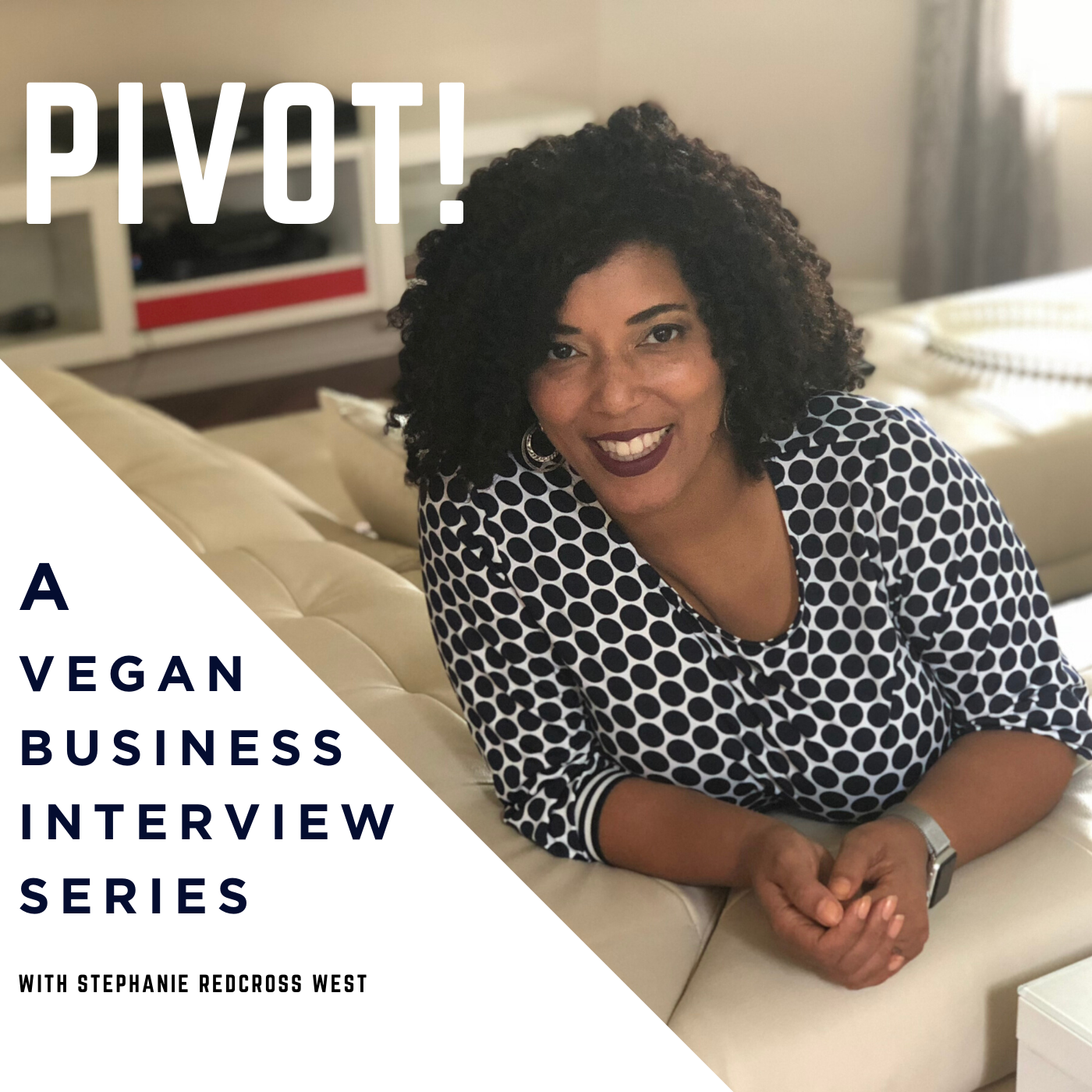
As vegan and plant-based business owners and entrepreneurs we're often adapting to a new reality. This new podcast series from Vegan Mainstream is an opportunity to help you when it's time to pivot. These interviews will come from inside and outside of our community, and I hope as your host Stephanie Red Cross West, I can inspire you and give you the tools that you need to move forward. As vegan and plant-based business owners and entrepreneurs we're often adapting to a new reality.
This new podcast series from Vegan Mainstream is an opportunity to help you when it's time to pivot. These interviews will come from inside and outside of our community, and I hope as your host Stephanie Red Cross West, I can inspire you and give you the tools that you need to move forward. Welcome to our next interview. I'm excited about our guest today, not only because of the opportunity for me to get to know Taylor, we haven't met before, but I always get excited when we get an opportunity to talk to someone who's not only in the vegan space, but someone who brings that knowledge, that expertise, because many of us become vegan for a lot of different reasons.
And as more and more people are starting to do it from a health perspective, it's always great to hear from individuals with the expertise and background like Taylor, and having someone like a vegan dietitian nutritionist available for this discussion, I think, is just amazing, and I'm really excited about diving in to a couple of different issues. Specifically where Taylor, and I don't want to take too much kind of a thunder from our discussion, but a lot of the work that Taylor does is not only helping people through the transition of going to veganism, but helping with some of the challenges that I think we're really plagued with in our vegan community around body shaming. Some of the issues that many of us struggle with is how do we fight multiple social injustice issues in the world, especially as vegans that we want to bring our compassion, as many of us want to drive change, how do we juggle all of these things that are happening in the world? And I'd love to be able to get an opportunity to not only have Taylor kind of help us, support us and give us recommendations, but also talk about some of the great work that Taylor has done as well.
So, Taylor, thank you so much, and welcome to our interview session today. Thanks so much, Stephanie. I'm so excited to be here. Perfect.
So just a ground everyone. Everyone loves it that we spend some time with vegans here, because it's a great opportunity to kind of show and highlight the diversity of the vegan community. So just give me a little bit of background. Let us know how long you've been vegan and maybe just a little piece of your vegan story.
Yeah, sure, no problem. So I hit 11 years vegan this year. I went vegan when I was in college. I was vegetarian for about six months before.
And then it wasn't until I got connected with my university's animal rights club and started learning a lot about cows and chickens and the dairy and egg industry and just more about our food system and food justice in general was like, okay, yep, I care about animals. I don't want to participate in this. I'm definitely going vegan. So I was really lucky to go to a school that had an animal rights group.
And it was in a city that had other animal rights, like activism organizations. And so it was a really great opportunity for me to get involved with people at lots of different levels. Perfect. I think that's great.
When we kind of find that sense of community, when we're making this transition, I think it's such a great way to do it. And I know a lot of people that did it, you know, it's part of their college experience. So that's very common. But it's a great place, I think, for many of us to start.
So let's fast forward and talk about where you are today. I think one thing that's very unique is that you have a private practice. You know, a lot of times we talk about vegan businesses on our interviews and for a lot of people, I'm not sure if they're familiar with the idea that, you know, there's dietitians have all types of roles out there. So maybe give people a little bit of background on what you do in your business.
Sure, yeah. So I'm actually just now coming up on one year, working for myself full time. Thank you. Yeah, thank you.
I had that kind of doing a side hustle of private practice, seeing some sample of clients on nights and weekends while I was working my day job, still the dietitian. I was doing research and communications. So it was more of a desktop, you know, no patient facing care of any kind. And I really missed that working in a desk job.
I love communications and research as well, but I really missed, you know, getting to know individual clients and helping them with their personal struggles. So I left and the best thing that I love about working for myself is being able to pick and choose, you know, all the different things that I like to do. So, you know, I do see private clients, but I also do some consulting. I also do freelance writing and some research work.
So it's been a really wonderful opportunity for me to be able to do all the things that I love related to my career. And it's certainly not an adventure. It's about a wild ride and lots of learning curves, but it was a looking back and like, yeah, that was definitely the right decision. And then I plan on sitting down and kind of doing a reflection of, you know, that first year in business and where I am and where I want to go moving forward.
So really cool opportunity. Oh, that's good. When you do the reflection, if you do an article, something we'd love to share it, because I think a lot of people, you know, think about, you know, starting a business. And when they can kind of hear what that experience is like, and to your point, the hard work it takes to get maybe where you are today, but being able to reflect on the fact that you're doing something you love, you're able to do a lot of variety of work.
And the fact that you're really kind of developing and charting your own career, which is one of the things that, you know, I dream of for people when I talk to them about potentially starting their own business. So it's really excited to hear that from you as well. Yeah. So let's dive into what you do day to day, how you help people.
And I bring that up because, you know, there's a lot of challenges in our world right now. There's a lot going on where, you know, we're faced with the pandemic, we're faced with the social injustice protesting. But at the same time, we're also seeing a lot of people get together, fight things together, get a sense of community and so forth. So it's kind of an interesting dynamic and interesting world right now.
We're living in. So I don't know if you want to give us some really perspective on what you do and how you've been helping people and how that reflects on some of the headlines and things that we're seeing going on in the world today. Yeah, definitely. I just want to start by saying, like, I am really grateful that I am able to incorporate social justice work in my job, in my career.
And that for me is so important to be able to like merge my passions like that and feel like, you know, what I do for a living is also, you know, helping causes that I am personally, you know, passionate about. So I'm like the one to one kind of client facing level, which you alluded to earlier, I do a lot of work with folks who experience disordered eating, have body image concerns, some folks who are in recovery from full blown eating disorders as well. And a lot of that work is grounded in what's called the body liberation movement or fat activism, you know, kind of based on this idea of, you know, we shouldn't be judged by our appearance and you can't tell anything about anyone's health just by looking at them. And, you know, there's a natural diversity of body shapes and sizes among humans and we should respect that.
And so, you know, obviously, that's easier said than done. We live in a culture where we're constantly being inundated with messages about dieting and weight loss and cosmetic surgeries and skincare and regal reduction. And there is so much emphasis on appearance, especially for people who are women or who identify as women. And so, I love being able to support people, you know, along their journey to help kind of bring it back to that core of self-compassion in terms of how they want to take care of themselves with food, exercise, sleep, stress management, all of that stuff.
So, it's intense work. I do, you know, extra training, I do extra supervision and mentorship to assist me along the way. I just learned so much from my clients and I'm amazed by them and just be really grateful to be able to do that work. So, that's what I do.
I'm the client, you know, kind of one to one facing aspect. And then I also have a blog on my website and I'm pretty active on social media, especially Instagram. So, I've been building those platforms slowly over the years to gain a little following and, you know, have the space to explain more like the philosophical side of, you know, things like racism and patriarchy and how they contribute to, you know, fatphobia and body shaming and healthism and things like that. And then as well talk about, you know, how can we bridge the gap between some of these social justice movements for a while?
I felt kind of, I don't want to say left out, but it was tough kind of having one foot in one area and one foot in another area in terms of the animal liberation space with ethical veganism and then the body liberation space with lots of fat, positive dieticians and therapists. And it's tough because a lot of professionals, health care professionals in the space of, you know, body liberation can see veganism as a diet, right? Or as a tool to change your body or as a tool to lose weight. And some of them, you know, just shut it out, right?
That's disorder. That's not healthy. You don't need to do that without really understanding like, no, this is about, you know, taking a stand against injustices, you know, against nonhuman animals. And if we just kind of widen our circle of compassion a little bit, we're talking about body liberation of humans to nonhuman animals, you know, then we can look at kind of, you know, how these oppressions and hierarchies are interconnected and how we can take, you know, kind of like a consistent anti-oppression stand against all of them.
And so that's kind of space that I've been feeling out kind of personally and professionally. Like how do I talk about certain topics in other spaces where they might not really understand them? And luckily it's been pretty well received, I would say, but it's also challenging because there are lots of folks who use, you know, veganism as a diet and as a tool for disorder to be in a weight loss. And so it's really complex, you know, it's really hard to explain and just, you know, like one little paragraph or one.
But I'm grateful to, you know, be able to be here and do the work and be involved in both communities and learn from people and also share my input on things. And I think that's what's important is the fact that we can participate in different communities. We can be active in different communities. And not only that, we can also create bridges.
I think a lot of times for many of us who put our activists hat on, for many of us, when we see injustice, we feel like, you know, how can we fight multiple, maybe if it's not the right word, but how do we drive change in multiple spaces? How do we be active in both of these communities? Sometimes when these communities don't see eye to eye. Sometimes when these discussions are hard discussions to have.
So do you have any advice for people who feel that there's a need for them to speak out, but they feel like they don't know what to say. They feel like they're not sure how to handle these discussions. They feel like they have to make these choices. Do you have some general advice when someone is trying to be as active as they can in private change?
Yeah, that's such a great question. And, you know, I'm only one person and I personally hold a lot of privileges myself. And so I just want to acknowledge that before I share my input. But I do think, you know, coming from a place of compassion, not coming out super defensive, you know, fist swinging, kind of, you know, attacking people about things, but more so, you know, gently presenting some information and asking people, you know, how do you think that fits in?
Or, you know, I've been wondering about the intersection of, you know, X and Y, or I'm wondering how that fits into this discussion of oppression or injustice. And you know, I think part of it too is just to never stop learning and growing. There's so many resources out there. There's so many books by fantastic authors and collections of essays from people who do have lived experience in different communities or with different, you know, identities.
And so I think it's so important to make sure that we're always learning from those folks and then also working to advocate among circles where, you know, a lot of us might have certain privileges and comment, right? And so we're trying to help open each other's eyes. But I do think coming out with a gentle, curious, compassionate approach from my experience tends to be more effective than coming out, you know, in an aggressive way where, you know, people's defenses are just going to fly up right away. So that was really cool.
Definitely a learning curve with that. Lots of patience and some, you know, unpaid labor, you know, figuring out insurance and everything that goes along with that system. But, you know, it's the best we have right now in terms of accessibility. So from a private practice standpoint, you know, I was able to do that and all my other work has been fine.
I've done a few virtual presentations for different conferences and things. And so, you know, people have been figuring it out. But I do think it's also really important, even though, you know, I am a registered dietitian, I'm not a therapist. I still think it's important to hold space for these topics in session with people because anything that's stressing anyone out, anything that is challenging someone's identity or body image is going to affect how they eat, how they take care of themselves.
And so it all does tie back to food and nutrition. But things like the pandemic and food accessibility or safety of going to the grocery store and, you know, the rebellion happening right now against racism and, you know, people participating in that or getting amped up about it, you know, or people who are black or who are people of color who want to share their experiences with me and session or who are married to people, you know, who are family members who are black or people of color. That's, it's really important, I think, to hold that space and, you know, help people remember, like, I'm a real person too, living in this world with you. I'm not just like a robot on the other end of the camera, you know, I don't want to just talk about nutrition.
If that's not what's going to serve you, it's definitely going to be helpful for you. And so that's important because sometimes what we're feeling is the barrier or the challenge that can prevent us from moving forward. So if we are feeling, you know, especially with these headlines, I mean, I've even been talking about it with my family, you know, every time I'm reading the news, I'm getting more and more upset. I'm, you know, I mean, it's bringing up things that I kind of suppressed.
I kind of said, but that's just the way it is, it's just the way you live. And now it's starting to kind of bottle up and I'm starting to be minded every day. And it's starting to put a different emotion in me that I always haven't had before because I felt like I had to, I had to just take it as an African American. And now I'm saying, maybe it will change.
Maybe it'll be different. Maybe I don't have to have like my husband and I have like protocol. And if we get pulled over by cop, we have a process that we do to make sure each of us are okay. And that's like, that's our standard.
And for a lot of people in America, I know that's not their standard. So things like that, it's really important. I think like you're saying to be able to talk about that because if someone's feeling that they may not be able to get to their other issues and not maybe able to resolve because they're feeling that anxiety, that pain, that hurt. Yeah, right.
Absolutely. And like what you said, like I had to live with this my whole life, right? Like I've had to skin color my whole life. Like this is standard procedure.
This is something that we've always had to think about or do. And now there's a lot of people who might just be realizing that for the first time. Like, oh yeah, like people who skin is darker. They have to think about these things.
And so, you know, I do notice there's a shift, you know, for folks who've always been, you know, involved in anti-racism, of course, they're, you know, up in arms right now. But I've seen a lot more people who I've never heard talk about that before. And I think that is awesome. But like you said, it is everywhere every day.
And so for some people, you know, especially African Americans, like you don't have to, you know, hear that all day, every day, like you know that it's going on, right? So, like setting boundaries sometimes is really important to protect yourself as well. And it's kind of like, okay, let the white allies like do their learning and growing and getting, you know, active. And, you know, I'm here to protect my own space.
And so I think that's challenging sometimes too, when that stuff is just everywhere all the time. Sometimes people don't think of, you know, how might this be affecting my followers of color who have already been dealing with this? And now that's all their Instagram feed is like maybe they don't want to have to think about it for seven. Yeah, they might need a break.
They might need a different reflection or they might need a different type of discussion because there's one thing of the outrage of it. And then there's another thing where we talk about what do we do? How do we change? What are we acting on?
So I think it's really, it's an interesting time right now. And I think it's so important that we're all willing to have these conversations even though they're difficult, even though they're hard, even though sometimes we're not sure even how to navigate them. I think it's just, it's really, really important that we do it. And I think it's really important that we do it as vegans as well.
I mean, with both of us, someone who just asked the both of us were vegan. And yes, we are. I just think it's really important that we acknowledge this. We have these discussions.
We don't shy away from it. We aren't afraid to engage in this because this is a part of our compassion. This is a part of what we believe in as ethical vegans. And I think it's important that we're part of these discussions.
Absolutely. And I just want to highlight, it doesn't take anything away from the animals to also fight for human injustices, right? Or a question of certain groups of humans. And I think it can really help us even be better in other forms of activism.
And I know for me, personally, veganism was kind of like a gateway to learning about different forms of injustices and getting involved in different areas of social activism, like social justice. And it hasn't taken away from, you know, still vegan. And I'm still, you know, an animal right there, because I still talk about it. And I think some people are afraid or see, like, oh, I dedicate so much energy to the animals.
I literally don't have anything else to help, you know, other people or other communities. And, you know, I think maybe that's something where having a mentor might come in handy, right? Or for more of us who are doing a lot of different work to show what it was it looked like, like how do you actually care and be active for lots of different marginalized groups at once? Because I do think some people are just afraid that it's going to take away somehow.
And I really think it's only a positive thing. Absolutely. I think it just becomes more and more and we can make a greater impact. We had Janet earlier.
She just wanted to say hello to you from Chicago suburbs. I guess you're getting a good Chicago shout out there. Oh, me Janet. And then we also had someone who was just asking a question about they wanted to go vegan.
They were saying they don't know how to cook. So I don't know if you want to give any quick recommendations for a jab Buddha. I think that's probably over for now to get. Yeah.
Yeah. This is a good question. And I think a lot of people, you know, whether they're trying to go vegan or not just anytime you're trying to change the way you eat, thinking of, oh, but I don't like to cook. I don't know what to do kind of feeling trapped.
And so I think one helpful thing. Well, I think there's kind of two strategies, right? It's like, you don't have to. You don't want to.
We're really lucky that in 2020, there's so many vegan convenience foods available, even at regular grocery stores in small towns, you no longer have to have access to specialty health food stores or live in a city, which is great. So maybe it's helpful for you who is asking this question, are there swaps, just like simple substitutions you can make for what you're already eating? Or if you do want to start learning a little bit more about cooking, just learning the basics and taking it one step of time. Like, okay, how do I make a pot of black beans, right?
Or how do I bake tofu or how do I roast veggies? And just starting with some basic components, how do I make rice, you know, and slowly building a meal. And remember that it doesn't have to be fancy, it doesn't have to be complicated. I personally make quick-using meals all the time.
And so just remember it doesn't have to look like the Instagram style food blogger pictures that it can be simple and nutritious and delicious and not totally stressy while it's just a matter of figuring out what you want to do and taking it one step of time at a time. And then, you know, if you did want someone on one help working with a vegan registered dietitian could be so helpful for learning more about you and your lifestyle and preferences and what you have accessible to help you come up with really tangible, specific little objectives and action items to help you along the way. Perfect. Now, if someone wants to get in touch with you, I know you said your practice is full with your blog and all the great information you have on the site.
I know you have a free download as well. Do you want to give everyone just maybe your website and your Instagram handle? So if they do want to get in touch with you or start following you, they can do that as well. Sure.
Yep. My website is just Tailorablefrom.com. Super easy. It's my name.
And so, yeah, I've got a couple of freebies. It's like an introduction to intuitive eating for vegans. And so it's basically, you know, how do I eat vegan, but not have all of these like food rules and dieting and, you know, how do I listen to my body and my hunger and honor all of that and still stay vegan? Because I think some people are like, oh, you know, veganism is, you know, just like rich people have not including animal products, it's restrictive.
So you can't do that and, you know, eat intuitively. And that's not the case. So there's a little intro for you be there for folks that are vegan and there's a non-vegan version too. So that's there.
And then Instagram is just TailorablefromRD. Perfect. Well, as we wrap up today, I know we try to keep people for about 20, 30 minutes. So we're coming up on that 30-minute mark.
Is there any final words or any advice that you have for people out there that are watching anyone who is either struggling with body shaming, anyone who's struggling, especially in our vegan community? Unfortunately, that is a big part of what happens for a lot of people that they have these, who put some time cease requirements on them that if you do make the transition over to vegan, you should be dead, you should look like this, you should act like this, you know, we start putting all those requirements on them, which is kind of insane if you think about it since we are supposed to be the group that fights for others and that we should be liberating everyone. So if you have any final kind of recommendations or any thoughts on that, if anyone is struggling with that, if anyone has any questions about it, or if anyone needs to have a little bit of a wake up call. Yeah.
Yeah. I think, you know, even before the pandemic, but definitely not, we're so much of our lives are online to kind of do a little audit of your social media feeds, your, the newsletters are getting in your inbox. Kind of what are the things that you're consuming online and what are the messages? What are the bodies?
What do they look like? Are they all thin white people? You know, is it all about oil free and low-fat and this and that? Or is it more celebrating diversity and empowering people, you know, showing lots of different options?
And so I think that's a really good place to start because a lot of people are really impacted by things online. And I do have a resource on my website. I think it's called like 150, you know, Body Positive Instagram accounts to follow. So if you're like, I don't know how to talk, that's a place to start.
And then the more people go, you follow, then the more algorithms, you know, going to serve up similar content and give you suggestions. And I think also becoming, you know, a part of different Facebook groups or listening to different podcasts, just finding different spaces online, especially vegan spaces where they do celebrate different bodies. Like the Vegan Chub Club is a really cool podcast and they have a Facebook group as well. I mean, I don't know about that.
I don't have to start. Yeah, yeah, it's really cool. And they talk about lots of different topics. And then there's a Facebook group called Fat Positive Vegans as well.
So there's spaces out there. Unfortunately, it's not the norm. And even just like your typical like cities vegan group is still going to contain like lots of problematic, you know, messaging and content, but just knowing that you do have those other groups that are, you know, safer spaces can be nice to go to. Yeah, that's wonderful to know that there are those other groups that are great places to start.
It's also great. Janet had asked how she can get in touch with you. So the fact that people can go to your website or your Instagram as a great way to not only follow the work that you're doing and be continued to be inspired there as well. So thank you so much for spending the time for us with us today.
Over with me, I probably should say we had a good amount of questions and people watching. So it's always fun when that happens. If anyone is watching this as a replay, please feel free to post your comments as well. I'll make sure they get over to Taylor or I will try to respond if I can.
They're directed towards me. But we really appreciate you not only taking the time, not only sharing kind of your experience or knowledge, but also helping us with a lot of the unrest and the easy and as many of us are feeling and anxiety over feeling these days. I think hearing your words and hearing that message is not only powerful, but I think it's also just impactful for many of the people who listen and even for people like me that are kind of struggling with and listening to all these headlines and trying to find a way to continue to make sense of it all. Yeah.
Oh, I'm so honored. It was my pleasure. Thank you so much. Perfect.
All right. Bye, everyone.