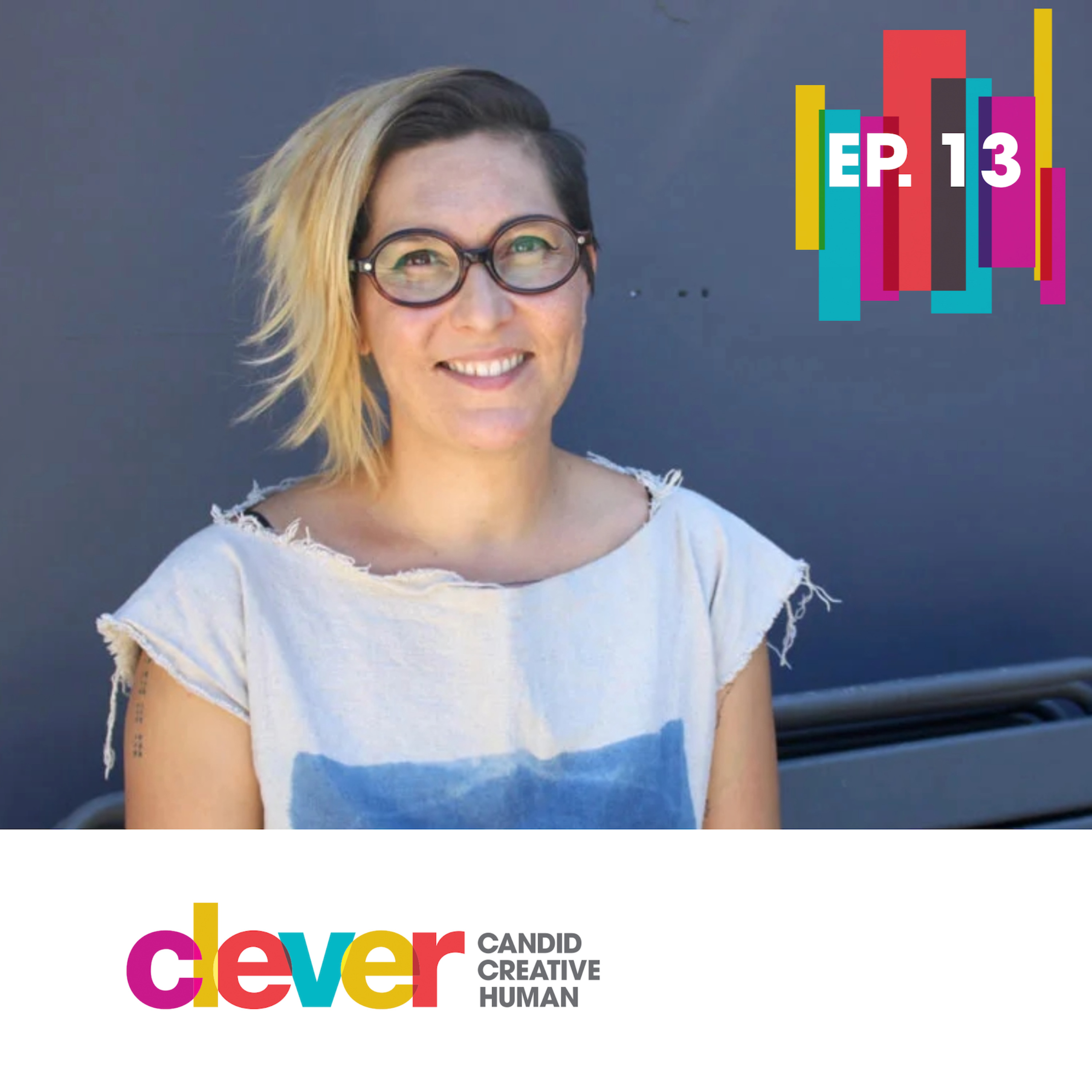
I just hope I gave enough, and there was still enough, like, like, like, entertainment. Yes, there's plenty of entertainment. Plenty of entertainment. So much that we're gonna have trouble editing out the good stuff. Hi everyone, I'm Jamie. And I'm Amy, and this is Clever. Today we're talking to Tanya Aguiniga. Tanya's an artist, craftsperson, designer, and activist. She grew up in Tijuana, Mexico, and spent her childhood crossing the U.S.-Mexico border every single day to attend school in the U.S. So this Mexican-American dual identity informs both her work and her personality. Her work is primarily textile-based and handcrafted.
And her design work includes furniture, wearable accessories, and home decor pieces. You may have seen some of her dip-dyed rope bracelets on chic celebrities, or maybe you just saw them on me and Amy, because we have some. Some of her felted folding chairs and other furniture in design magazines, and some of her more elaborate weavings and wall hangings in uber-trendy hotels like the Ace in LA or the American Trade Hotel in Panama. As a craft-based fine artist and activist, she creates compelling installations and activations using craft as a performative medium to foster community, as well as generate dialogues around identity, culture, and gender. She studied furniture design at San Diego State University and then got her Master's in Furniture Design from the Rhode Island School of Design.
She's a United States Artist Target Fellow, a Creative Capital 2016 Grant awardee, and has been featured in PBS's Craft in America series. More importantly, she's a very, very dear friend of mine, and I love her like a sister. She's super smart, super colorful, and super badass. Just wait till you hear her story. My name is Tanya Aguiniga, and I live in Los Angeles, and I am originally from Tijuana, Mexico, otherwise known as Tijuana in English by many folks. I guess I am a designer, maker, artist.
activist yeah and on the design end it would be textiles furniture and jewelry and accessories for the home and self and I'm also an art teacher and also an educator wow that's a lot and a mama and a mama yeah let's not forget that I was super cute okay so you're a dear friend of mine so I know a lot of these answers already but you have to tell our listeners all about you so let's start from the very very beginning where did you grow up and what was your childhood like so I grew up in Tijuana and I guess now I would be like third generation from Tijuana and I grew up living in Mexico but going to school in the U.S. So I would cross the border every day for 14 years to go to school in the U.S. Every single day. Every single day. And my parents did it for close to 40 years. And so that made me kind of an odd little babe. Yeah. Now, were you out in the open about living in Tijuana or did you have to have a fake address in the U.S. so you could go to school there? You have to be pretty like like on the down low about it. And so then I had to use my grandma's address.
And then when my grandma passed away, I had to use my aunt's address, my best friend's address, my best friend's grandmother's address and different aunts and stuff. Did you feel a little bit like... Because you had to keep your kind of life on the down low. Did you feel like a fugitive or what did you feel like? Not like a fugitive, but definitely there was like a massive stigma to like living in Mexico. It's kind of gone through like different iterations of like stigmatization. But when I was a little kid, everybody thought Mexico was like dirty place that was just full of like poverty and like little caves where people like lived in like cardboard shacks. And then when I got a little bit older than everybody was like, oh, that's where all the like bad drug stuff is going on. So like you can't go into Mexico or like, oh, you're going to get kidnapped. There's been like a bunch of different like ways that people have.
like hated where i come from and so then for the most part i didn't tell anybody that i lived in mexico my parents also kept it super hidden um one of the reasons was because we could like get kicked out i could get kicked out from school if anybody knew but then also it's just like i didn't have all the normal stuff that like american kids had so like i didn't have a phone until i was 11 like in our house like hardwired no landline no landline you know we didn't have a lot of like we had a lot of like issues with like running water and electricity when i was growing up there was all these things where you know like kids are like oh can i have your phone so we can like talk about like I don't know, babysitter's club or whatever, like at night. And I didn't have a phone and I didn't have like a home where somebody could like talk to me. So no sleepovers and playdates? No sleepovers, no playdates. So I had to kind of keep a distance from everybody, even though I was a super social kid. So it was really difficult. It was like a pretty rough.
that sounds like kind of a conflicted childhood and then crossing the bad but you're very happy now yes no i mean i was very happy at the time too because i didn't know any different it was just like what you do you know especially when you have no choice like your parents are never like would you like to not have hardships you know like we wake up at like 233 in the morning for me to go to school every day every day oh my gosh but i didn't really think about it until like recently when i started like writing grants for projects that were related to the border um and we'll talk to some people about it like people were like oh my god like you totally like your childhood is more reminiscent of like somebody who's like homeless and is constantly like moving from one place to another like doesn't have any um it was very itinerant yeah so it's like constantly like trying to navigate all these different households to like make sure that they liked me enough to like let me be drunk off there in the morning oh so you had to be a people pleaser because a mega people pleaser because if I did anything wrong, then they could just tell my parents, no, like she can't be dropped off here in the morning. And, you know, cause those families were like feeding me, like letting me take a shower there sometimes. Like I'd hang out there at night until my parents came to pick me up. So it was a, it was a pretty kind of difficult thing to navigate, but it also like, you know, let me like experience living in two really like.
different world you know there was like such a dichotomy to like the way that both cultures run yeah and it's like also um like it's such like a different way that both countries operate especially like on the border i mean like san diego tijuana that it's like it makes the difference is super apparent because one is very bright the other one and like crazy and chaotic and like noisy and smelly sometimes and there's like so much rawness to it and on the u.s side it's very like combed over you know one side's very like colorful and textural and gritty and like sensual and by sensual i mean like all the senses are activated And then the U.S. side is almost kind of gray and organized. Yeah, it's like very like concrete and flowing, you know, and other sides are just like bumpy as fuck.
But it's pretty awesome, you know, because like I said, like I get to like I know how to navigate like both worlds. And it doesn't mean that I belong to either, but I get to like navigate both and like take what I want from each to make like my own weirdness. But tell us about your family. So you're growing up crossing the border every day, experiencing both of these worlds. Like what's mom and dad like? And did you have siblings? And what's the whole dynamic? So my dad is a U.S. citizen. And so my dad's family, his mom grew up working the fields in Azusa, which is San Bernardino County, L.A. East area. And my mom's family is from.
They grew up in Tijuana, both sides of my, both parents. Yeah, they were both like kids in Tijuana. And my grandpa was super strict because he had seven daughters and two boys. So he didn't let anybody leave the block. So then all of my aunts and uncles on my dad's side all married someone from the same block. How big was this block? It's a small block. But everybody's like, all right, like, you know, you end up with the one across the street. You end up with the one next to that one. You end up with this one.
So my mom is from around the block from my dad. So the majority of my dad's side of the family has all known each other since they were like babies. So super tight knit. Super, super tight knit. And also, yeah, they grew up in like the neighborhood that's the closest to the border, the actual border crossing. It's called Liberty Colony. So they grew up in like La Libertad and which is a really rough part of town even still. Yes, they just grew up in like a rough ass part of Tijuana. And when I was born, my dad, I think, was like a playboy.
So supposedly at one point he was like a model for Levi's. Maybe that doesn't mean he put on some Levi's and someone took a picture of him. And he like had, I guess, a nice car, like some little Porsche, like, you know, Dylan Walsh or whatever his name is. Oh, from 90210. 90210. He had one of those like little like roadsters. I guess he was like super hot shit. And like my mom is really pretty. So I think she was just like super pretty Mexican girl with blue eyes. And so then they were like the Brenda and Dylan of your block. Yeah. So they were just like super cool.
And like, I don't think they were actually super cool, but I think that they were like, you know, they were like, yeah, they were like hot shit. They'd go to like the disco and like hot pants and stuff. But my dad used to be a hippie. So he used to have like long hair. So he wanted, I guess, to live in like the hippie part of town where like the surfers are at. And he's always been like, yeah, into like, oh, like the surfer lifestyle and like classic rock and like all of this stuff. I don't think he's ever surfed. Yeah. Anyway, so yeah. And he told me like at some point because he had long hair and he was a hippie, like in Mexico, they wouldn't allow hippies. So he would have to like cross illegally into Mexico.
So you'd have to jump the fence into Mexico because they wouldn't allow hippies, like no long-haired men. He would have to, oh my God, that's hilarious. Yeah. So he was like, yeah, but it was just like the small fence. You could just like jump it. So it wouldn't have to give a deal. Yeah. So I grew up in the like beach hippie community of Tijuana, which...
I was never that beachy or that hippie by comparison to the rest of the corner. Yes. So your parents both worked in the U.S. when you were going to school in the U.S., right? Did you guys all cross the border together? My dad worked for Pepsi. So he was the machine maintenance dude. So he would like fix all the machines. And then before that, he worked for NASCO, which is like a big ship manufacturer for the military in San Diego. So he used to be a ship grinder. So they would strap like a 40 pound grinder to his body and like hoist him over the edge of the battleships. And he'd grind all the welds down. Wow. So him and all my uncles worked at NASCO. And then my mom.
was a doctor in mexico but then my dad didn't like that she made more money than him so then i think by the time i was like three she had already like quit being a doctor and she started working at grocery stores in the u.s and like little like weirdo woolworthy stores like little whatever that's called like drug storage type of stuff but they also had like fish and stuff did i just understand it that your dad didn't like that your mom was a doctor and made more money so she quit to work in a grocery store yeah and so and i can see all the stuff with my parents i can't get online so but yeah no my mom was like an orphan who worked three jobs to raise the rest of her family put herself through medical school and yeah and then hooked up with this like good looking dude levi's model levi's model with like a little porsche and like a really shitty part of town you know so that's like a lot to have but my dad was like a total hustler you know so um So, yeah, I think she was just, like, dazzled by his, like, glitter. But still, you grew up with that message that you have to sort of defer to the breadwinner of the family, or you have to protect his ego, or you have to adhere to local custom. What was the message to you? It was, like, a very mixed message. I don't know. Like, in Mexican culture, I think, well, women always have, like, this very mixed message. That's, like, complete opposite. Like, dudes want their, like, their Virgin Mary, like, little saintly woman, but they also want their Malinche, which is the woman that sold out the Aztec Empire to the Spanish. So they always want their, like, little saintly pure woman that does everything, but then they also want, like, their, like, whore.
on the side you want both classic madonna whore yeah yeah exactly so i had the very like you know you have to go to school you need to like be better than you know you have to have a better life than we have and that was the main reason why they went to work in the u.s is because you can like make a lot more money in the u.s and then have a better life in mexico like with u.s dollars because it goes a lot further because it goes a lot further but at the same time yeah so they were like you have to go to school you have to do all the stuff but then you have to know when to like look the other way when your man does something wrong oh you know so it's like you have to learn how to like shut up but you have to like also be strong yeah you know so it's really weird just way to be but the way that I like saw everything and you know like I saw how stuff was different like on the U.S. I just kind of took it as like you have to be super strong and a badass and not let anybody get in your way like man or woman right still be nice you have to be nice to people you know but you also like can't let people step on you true that yeah so anyways yeah so I had like like a badass mom that stepped aside to let like love
rule her craziness so i have to ask you then did you get your creativity and your i guess you gravitated toward art and design did you see any of that in your either one of your parents were either one of them creatives they were not creatives but i didn't think about it until somebody told me they were like oh both of your parents did like trades that involve handwork and like being really meticulous with their hands you know because my mom went into like medicine and eventually like price changing at bonds at the grocery store but still you know like they both went into like doing meticulous tasks with um yeah with their hands and then my dad has this really amazing spatial understanding that not a lot of people that I know have. He can look at somebody's foot and know what size shoe they need. Oh. You know, he buys us all shoes, even though he doesn't know our sizes, like including my daughter. And it's always the perfect size, you know? And like, we both have this amazing like Tetris ability to pack a car. Yes, I've seen it. It's amazing. Yeah. So I think my dad has this really amazing like spatial understanding. And then my mom has always like been into like little handcrafts, you know, like decorating weird stuff around the house and like dried floral arrangements and like poofy curtain topper business with like, you know.
like dead birds on it and stuff. I guess you were kind of genetically predisposed to be doing something with your hands, but you didn't know. Yeah. Yeah. And I mean, yeah. And I mean, who knows? You know, it's like I come from like on both sides of my family, generations of people that work the field. So how did you become aware of art or design? Where was the exposure? There was no exposure. So my parents never.
Took me to an art museum. We never spoke about any art stuff. I like grew up going to like lowrider shows in the Chicano Park in San Diego. And that was like surrounded by murals. And I think my only kind of introduction to art stuff was, yeah, just like looking at murals. Because there's this like long, you know, history of like Mexican muralism and stuff. But yeah, no, I just grew up like going to car shows. But when did you start to understand your own creativity? When I was a little kid, I think probably starting at four, I would sell stuff door to door that I made.
So I was super into, well, like they can't like provide what I need or what I want. I can hustle and like get that money myself. So wait, what were you selling door to door? I used to sell, I think in the, in the beginning I was selling jewelry. So I would make necklace, earring and bracelet sets out of like palm fronds that I would shred and then string flowers into. So then I would put them on like a paper plate and wrap them in saran wrap and like go sell them door to door. And then eventually I started getting super into drawing. So then I started getting, I was like obsessed with clowns.
So I would do drawings of different clowns and, like, name them and have different personality traits. And then I'd sell those drawings door to door. What was the price? Like, how much could you get for a clown drawing? I was maybe selling for, like, a peso? Or, like, it was not much money, you know, but it was enough money to get candy. Okay. Like, you know, who got my candy fixed? Got a hustle for candy. Yeah. Yeah. But I also, like, had, like, a video store rental. I had a circus at some point. A circus? Yeah. I had a candy shop. Is this, like, a puppet show circus? No. I was, like, that would have been 1984, so I would have been six. You know, Mary Lou Retton was, like, massive. I was, like, super into gymnastics, but I was, like, too tall and, like, too.
not good to like actually do it. Yeah, they actually told my parents that I shouldn't be in gymnastics. I knew how to draw, so I drew the posters. Did advertising all over my street. I had a bunch of kids come, put up a sheet attached to a tree. My cousin had given me a hand-me-down pajama that kind of looked like a clown outfit. So then I wore that. And then I was really into jokes because my dad tells a lot of jokes. So wait, you were performing in the circus as well? I was the whole circus. You are the whole circus. So then all these kids would come to the backyard. Yeah, so then I would do jokes and acrobatic. I was really into magic tricks. I would do all this stuff. And you would charge them admission?
I was charging my mission. I remember after the first one, I bought myself a quesadilla. That's what I had money for. So I wasn't making that much money. I admire the hustle. That's your childhood. What about your teenage years? I can imagine that there might be a place in your life where you really struggled with identity, especially because at that point you were so Mexican and so American, both. Like, was there ever, how did that play out? Were there rebellious years? Were you lost? Were you always really confident of who you were? Or did you have to figure that out? I was like mega fucked up. Really? Yeah, I was like super fucked up. My cousin and I were both anorexic. So I went through like a lot of like weight issues because like the majority of my family is all.
overweight and like has like diabetes and stuff but then also i just got like super fucked up from like like dealing with my own like how i look so different than other people because i was always like taller than most mexicans i was always like lighter skinned and because i like grew up going to school in the u.s i always looked a little off you know because even like when i tried to look like super normal whatever that means like people could always spot me out and like talk to me in english which was kind of weird you know because i'm like dude i'm in mexico like i'm walking around by myself why are you speaking to me in english but i always looked a little bit different as a teenager it was really rough it was super super rough I was having, yeah, a lot of problems with my parents. And again, like when I was like, which of my family will listen to this, but they all know this. Yeah. And my dad's an alcoholic. So I had just a lot of issues having to do with body issues, like issues with being a child of an alcoholic and growing up on both sides of the border, like really different from everybody else. And yes, it was really rough. The like pinnacle of the roughness was when I shaved my head by accident. What? You're like, what? No, I just like didn't have money to get a haircut. And so then my friends were like, oh, I think we can do it with like one of these like.
razor things that like dudes use so then we were like in the backyard of a friend's grandma's house with the clippers and so then they were like cutting my hair but then they were like oh and so i was like what happened yeah and they were like you have two really big bald spots and uh you have a step and yeah it kind of looked really bad so i was like all right well what can we do to fix it and they're like i think we have to shave your head i was 15 we had to shave my head and then that was like the beginning of craziness wait so were you a girly girl who just lost your feminine identity with the head shaving or were you already like sort of a tough badass but that was still hard to go through i was already like a tough badass because i was already trying to like protect myself like for me to get home at that point like before i started driving like i'd have to take from my high school i'd have to take a bus to the charlie charlie to the border across walk across the border then take a bus to downtown and then take like a collective car from downtown to tijuana so that's like four different public transportation things and like walking through like the middle of like downtown tijuana so you guys are young girls i was already yourself up so you would not be a target yeah so i had like a size 19 inch waist but i would wear size 42 jeans and like just over
like dress to like yeah yeah but all i did was just like make myself look like more of a weirdo so then people would kind of like come after me more so they target you for ridicule but not for sexual aggression both yeah so then it was like yeah it was like a pretty a pretty shitty time but um anyways yeah so my mom kicked me out of the house so because of your head being shaved because of my head being shaved yeah so she like cut up all my clothes because i was like into just like thrift store stuff i was like super into the beastie boys i was like total little like skate rag girl and it didn't fit with her feminine ideal yes it didn't fit with like her feminine did she think that you shaved your head on purpose uh she did but also i didn't mind having a shave oh okay so you were like this is this is pretty cool yeah and i mean i had like a secret like pierced tongue and you know i was like alternative whatever that means now but so i was like this is the final straw yeah so she was like i've had enough like this is fucking bullshit like you can't like look like this like we've worked so hard to like give you what you have you're pretty much like like slapping all of our efforts like in the face by like choosing to be this weirdo so then um yeah so she cut up all my clothes yeah and i got kicked out of the house so then i stole her car you stole her car yeah so i stole her car
So then I just lived in the car for two weeks and I had a gym membership so I could take a shower. Nobody at school knew that I was like living on the street. So it was good because I was still like in high school and I was still working a full time job. And yeah, so I was just kind of had to like take care of myself. Sorry, starting to be a bummer. No, no, no. I think this is this explains a lot of how you got, you know, you're scrappy. Yeah, very scrappy individual. And I'm sure you were always nice to people. Yeah, but I also like didn't like let any of that shit get me down. You know, like it was kind of weird that I didn't tell anybody that I was like living in the car.
But I was like, that's my thing. And is that because you didn't want pity or you didn't want people to? No, I think I was just like them down. No, I think I was just like, I can handle it. Like I have a gym membership. I have a place to take a shower. I have a bunch of clothes in the back of the car. I have a blanket and I would just park around the corner from someone's house that I knew because I was like, well, if something happens, like I can like walk to their house and be like, this happened, you know, but I didn't want to bother people. Like I was just like, I can deal. So through all of this, you're still going to school and are you getting like, okay, great. So are you? Yeah. Was this high school?
This was high school, right? This was high school. Yeah, so it was actually like in majority AP classes, like all honors classes. Yeah, super smart kid. And your good grades weren't enough for your parents to say, well, she's still trying. She's still on track. Let's keep her engaged. No, because the way that a lot of stuff goes, even when I won, when I was 27, I won the United States Artist Fellowship. And when I announced to my family that I had won, everybody was just like, oh, you mean you're not pregnant? It's just different. It's just a different set of standards and things that garner accolades. So your mom was probably really concerned that you weren't going to attract a suitable husband with a shaved head. Totally. And you're like, I got this. I got a gym membership and straight A's. I'm going to figure this out.
Wow. I don't know. I just always felt like I was in charge of my destiny since I was like three and a half, you know? So it's like any other stuff that comes my way is just kind of like side things, you know, that I kind of have to learn to deal with, but it doesn't mean that it's like my main narrative. So you also became an activist at some point, which was that during college or before college? Describe to us how the activism started. Yeah. So crossing the border every day, especially in the 80s and early 90s, was really like super sad. It was during a time before Operation Gatekeeper. Operation Gatekeeper started in 95, which was a strategic reinforcement of the border between U.S. and Mexico. And so anyway, so before Operation Gatekeeper, the fence between the U.S. and Mexico was not as high. And it was also made out of jet landing mats from the first Gulf War.
which were ribbed, and instead of the U.S. placing them so that you couldn't use the ribs to climb on, they placed them so that you could use them as a ladder. There would be thousands of people just lined up against the fence, waiting for the Border Patrol to move away so that they could just jump over the fence and, like, run. So it was, like, thousands of people that we'd have to drive past every morning, you know, on our way to, like, work and school. And a lot of times all of these people would get, not all of these people, a lot of people would get run over. So we'd have to, like, pull over. One time my dad had to, like, close some guy's eyes that had just been, like, run over and killed. Oh, dear God. So then it was, like, visual, like, reinforcement of...
how hard it is to get to the U.S. for people that are not U.S. citizens, how much people sacrifice to like come to work in the U.S. And it was just this really strange thing to deal with, especially since I was a little kid. What makes me more valid of a human that I'm allowed to come and go without questioning or like having to do that much to just be able to go into the U.S.? And so then in community college at Southwestern College, I was 19 and I was taking a class with Michael Schnorr, who was one of the founding members of the Border Art Workshop. And so it was all like talking about activism and talking about.
like the Chicano art movement, it just really, really, like, resonated with me, like, to the core. Because I had asked him, like, do you need help on anything? And so he was like, yeah, we're doing this, like, migrant rights, like, billboard if you want to help with it. So then I had never touched a paintbrush. I had never done any art stuff because by the time I got to community college, I was a drama major. So I'm actually a thespian. I'm a trained theatrical. Did your clown training? Yes, it came in very handy in improv classes. But anyway, so I first, and it was just because, you know, I was dealing with so much weird trauma and psychological shit.
that being on stage and being somebody else let me get out all of this shit that nobody thought was me oh my god sometimes it's so nice to be somebody else for a while yes it was just like weird ass like therapy like on stage uh but i didn't actually want to be like an actress i was actually pretty bad Yeah. So Michael was like, yeah, do you want to help on this? And he like immediately saw something in me. And so he took me under his wing. I ended up becoming part of the Border Art Workshop and working for six years on art activism. So community activism, using only art in Mexico, in the U.S., a lot of stuff having to do with migrant rights, a lot of stuff having to do with human rights. But just like generally like using art as a vehicle for community empowerment. It was amazing training because like before I met Michael, like not only had I not done any art stuff, I also had never lifted a tool.
you know so I didn't know how to use a drill I didn't know you know like how to just like take care of shit because like as a young woman you're not you're like rarely given boy stuff to do you know one of the few times I had my dad come and work with me because I co-built and ran a community center in Mexico with Michael through the border art workshop and the first time my dad came to help he was like you should put on some gloves oh my god aren't you afraid of splinters I was like oh my god there's so many other things to be afraid of why would I be afraid of a splinter like you're fucking sissy like come on lift that shit you know No. Yeah, for six years, I was working with a border art workshop, ended up getting a job at the San Diego Museum of Art and then worked my way into the education department. Then at some point transferred to San Diego State to study furniture design. So I was like having this very multidimensional art education, which was doing community based art, but through like really hardcore, like hands on building and like solving really like insane problems through art. You know, like people being falsely imprisoned, assassinated, all this like crazy shit, like with art. And then working at like institution where we were like.
trying to bring, like, arts to, like, disenfranchised youth and also, like, a bunch of, you know, like, San Diego conservative people. Right, right. Still straddling two very different worlds. Yeah, and then, like, going to San Diego State. Yeah, and before that, I went to four different community colleges. What made you study furniture design at SDSU when you transferred over there? So I lived on top of this mid-century furniture store that was amazing. And so then every time I'd come home, I would just, like, look in the window and look at all this amazing furniture. And so I don't think I ever told David Skelly this, but one day they forgot to bring something in. Yeah, so they left these really beautiful, like,
uh plastic like 70s chairs that are called tango chairs outside and so I took them into my apartment and then I like lived with them and it kind of started my like love affair with furniture and so then I like walked into his store and I asked him if I could intern there and then he said young girl people don't intern at stores and I was like well I want to learn how to make furniture how do I learn and so he's like there's this young lady that's teaching at San Diego State I think her name is Wendy you should go there and it was like you know before internet stuff like I didn't look her up or anything I was just like okay I'm gonna like work towards transferring to San Diego State to study with this young girl who is not a young girl and she's also a national treasure yeah people come from like the world over to study with yeah so then i just got lucky that the dude in the one store i lived on top of told me to go somewhere good were you i guess empowered because you now knew how to use a drill and you were like yeah i could totally build this furniture like i can design it and i can make it no because i knew that the way that we were building in tijuana in the community center was not the way to build yeah no michael's like motto was pound to fit paint to match you know we built the majority of stuff out of like trash from the u.s and the community that i worked in
was a land squat run by women made out of trash from the U.S. So it was a very different aesthetic than what I was dealing with in San Diego State. And San Diego State was like fine woodworking, the epitome of craftsmanship and visual expression through furniture. Totally. But like the first day of school there since I transferred, like my first day of school, like they were like, oh, like you have to do hand cuts, lighting dovetails. And I was like, what the fuck? I was like, oh, no.
No, but it was like very much like based on like like a woodworking tradition and knowing how to, you know, use your tools well and, you know, have perfectly sharpened chisels and stuff. And yeah, I know in Tijuana, it was just like, oh, my God, somebody just threw away all this like shit that like used to be a telephone pole that was like hardwood from Sri Lanka. Like, let's try to figure out how we can use this. But those two skills like probably serve you really well. Yeah. To have the resourcefulness of being able to make something out of anything. Yeah. But then also like.
the the eye and the skill and the attention to detail in order to like upgrade that to something really fine totally and I mean and I think that um like they're both just like exercises and problem solving it's just like very very different like sets of circumstances but they're both just very much like this is what you have what can you make out of it I think it's helped me very much so you studied furniture design at SDSU with Wendy Maruyama and then you went to RISD yeah RISD was pretty amazing because I had always worked full-time and gone to school full-time. So I never had that quintessential college experience where you all are from a different place and you all bond because you're forced to bond. Because you're all living in a concrete box and sucking beer through funnels. Yeah, and stuck in the same space, the same studio. Although I did have some of that at San Diego State. But when I went there, I was just like, okay, for once in my life, I'm not going to go with what I can afford. I'm just going to go with what is the best that I can get into. And so then I was like, I owe it to myself to get as much education as I can and equip myself.
with as much badassery as possible, degree-wise and skill-wise, so that I can go back to Mexico to really make a difference that's more informed. And I also had never lived outside of San Diego or Tijuana, so it was pretty exciting to just get really far away. And part of the reason why I really wanted to get really far away, too, was because all of the work that I was doing in the community center had gotten really very overwhelming. The community, we were no longer empowering. We were enabling. And so I was just being...
It's a conversation to come to. Yeah, I counted on for way too much stuff and, like, wasn't being helped by the community anymore. Everybody was just like, she can do it, she can do it. So then I just really felt like I needed some space. So I wanted to go as far as possible to kind of, like, really have distance from my entire experience and kind of, I was really, like, thirsty for figuring out how I belonged in the world outside of, like, just being someone connected to the border. You know, just, like, find my own place. And so, yeah, so then Rhode Island was the best and the furthest away I could get.
from San Diego and Tijuana, and it was amazing. It was so amazing. Yeah, just made me super aware of everything I had and kind of gave me, like, enough space to have a lot of clarity. And you experienced your first blizzards, right? Your first, like, fall-on winters with snow. Yeah, and I thought I would never stop. I was like, oh, shit, what did I do? Yeah, because I thought once it started snowing, it just didn't stop. I don't know why. I think maybe because in movies, it just keeps coming, so I was like, oh, no. It's like all winter, it's just constant snow. I was like, shit. Yeah, so it was pretty crazy, but at the same time...
Yeah, it was amazing because since I no longer had like two different like outlets for my emotional work and my anal like perfectionist work, they both became one. So then my work started having a lot more context and yeah, just becoming a lot more like narrative driven and personal. So after RISD, I know you moved to Los Angeles because that's when I met you. I was doing a show on the DIY network called Freeform Furniture and you joined us behind the scenes. And that show was short lived, but your friendship and mine is everlasting. Okay. After you worked on that show, then you worked at a gallery and then you became independent designer maker.
artist yeah describe to our listeners what it was like getting traction as an independent artist and and how you did that so I started doing a bunch of accessories and like little stuff and then when I was at RISD I also like was making a bunch of random little stuff and so then when I came to LA same thing I was just like still making A bunch of little stuff until I had enough money or space to be able to, like, access tools. Because all my tools got stolen in Providence. Damn. Yeah. By a pirate. What? One-legged dude with a patch. What? Wait a minute. Like a, not a for real pirate. A land pirate? A land pirate that was my neighbor. Oh, no. He was very aggro and I think on PCP. Oh, no. PCP never turns out well. It's not a good idea. Yeah. But anyway, so I didn't have access to its tools because that dude took them. And so, um.
yeah so until i had like access to tools again then i was like okay now i can make furniture but there was a little while where i was just doing like home goods and like like jewelry and like bags and like stuff for handcrafted all of these yeah all handcrafted stuff and then um i ended up very shortly after being out of school winning a fifty thousand dollar grant not grant fellowship which means that it's not there's no strings attached to it so then i yeah quit my job bought a bunch of tools bought a truck so that was like your big break moment yeah that was my big break moment and before that My big break would have been back when blogs were like massive and there wasn't that many blogs. Design Sponge had featured one of my little felt birds. And so then I got like tons and insane amount of orders. And then Daily Candy had picked it up. I had like thousands of emails of people like wanting stuff. So then that kept me busy for a while. And so then from there, I started getting a bunch of like magazine interested in like my work. So then I started getting a bunch of press. And so then by the time I got my award, I already had like a bunch of orders, had like a bunch of press, had a bunch of like a big following. So I got this massive grant. And so that's how I was able to have like startup money.
Yeah, to quit my job, to buy a bunch of tools to be able to make again. And then also to take a bunch of trips to different parts of Mexico for the first time, really explored my like Mexican connection to traditional arts. Because growing up on the border, we didn't really have any of that. So then, yeah, I just spent a bunch of time getting like super steeped in Mexican, mainly like textile, like fiber art. Like weaving. Like weaving and dyeing. Okay, so more recently, you kind of define yourself as a craft-based fine artist. You've been pushing further away from functional art and into fine art. And this is a two-part question. What's the gravitational pull for you?
And what do you think you can say in the fine art world with your craft based message? I always kind of wanted to do stuff that wasn't functional. I just always was felt a little too like guilty. And so some of it was like, I know that feeling like now I understand, like as like you get older and like different like things shift in like society, people bring up names that like they put a name to something and you're like, oh, yeah, that's what that was. So now I understand. I had a lot of privileged guilt. So I had, you know, a lot of like guilt associated with like, how come I can.
come and go on the border when all these other people that I see as very deserving like cannot you know so I had a lot of well if I spend a bunch of time on something it really should be useful you know and so that usefulness sometimes or in order for it to be worthy to somebody else it should really have a function exactly and so then I think that that usefulness a lot of times at least myself like I didn't stop to think about things that make you think things that are provocative are very useful but I kept thinking about like more recently so Michael Schnorr my like mentor and the man who shaped my trajectory as an artist committed suicide in 2012. I had my daughter Io in 2013. So then those two things kind of like back to back had an insane impact on how I make art now. And so when Michael passed away, I just kind of kept thinking about how I had been trained for so much more. And I had been given so much information and handed down so much wisdom and strength, like from the work that I did with Michael. And I really felt like part of the legacy of the Border Art Workshop. And then I really...
Like needed to reevaluate what I was doing, the way that I was working and the type of work that I was making because I was trained and the way that my life story has shaped itself. Like I was made for more than just making pretty things for rich people. And so then I just really felt like a lot of momentum to like fuck shit up. And then that's kind of that's kind of momentum. Yeah. Because I was just like, no, I cannot continue this way. It's not feeding my soul. And it's not what I wanted in the end. And so is that when you started to plan for this interactive art project that you recently completed on the border? Yeah. So that's when I started writing a bunch of grants to try to do this project on the border. And so then it was like that, like Michael dying. And then.
After I had a daughter, then I was like, oh, fuck, I have a daughter. Then it's like a whole nother added set of pressure to like. make sure that there's enough space for her to be whatever she wants to be like as a woman or as a whatever you're still swinging the machete back and forth like clearing the path yeah because it's like your daughter you know what i mean like i see a lot of it like with my students like i see a lot of the stuff where their like infrastructure is lacking to like let them have a strong foundation to like fuck shit up on their own but i like think about io you know when she's like old enough like what is the world gonna be like then like how can i bring up a lot of like topics and like issues that i feel are really important to not be quiet about So that when she wants to speak up, she can be heard, you know? So then it's like, yeah, so it was like a one-two punch of like, my shit has been trained for like fucking battle. And so then you got a grant to do that border art piece. So I got two. So tell us about that work.
So just last week, I completed this project that I've been working towards for four years where, you know, I spend a lot of time traveling all over the world and either working with like craft based communities or looking at like how to work with craft based communities. And most of the times it's to like solve problems or to create like dialogues within that community that kind of like help empower more people. And so I had been thinking about that I hadn't done a craft based project in Tijuana and how I had not looked inward and tried to solve a problem that affected my own life. So then I ended up getting a creative capital grant and a NALAC grant, which is. National Association of Latinos and Arts and Culture. So I got two grants totaling in $55,000. IRS don't listen. So that I could do this really massive two-year project on the border. So in Tijuana, the border crossing in San Isidro, there's 300,000 people that cross the border each day. The majority of them are crossing to go to school or work in the U.S. And the majority of those people are U.S. citizens. So they have the ability to come and go as they please without being molested. And many of us are in a not sexual way, but in a, you know.
Emotional way? Searched and considered a criminal when you're not kind of thing. Yeah. So anyways, I thought about how shitty that experience was to go through every single day and how it's a very like dehumanizing way to start your day one, but also to enter another country. And for a lot of us, it's to enter your own country. And for the most part, it takes like around three hours, sometimes up to six hours to cross the border. So if you think about like starting your day, like think about like waiting at the DMV for three and a half hours every single day of your life before you start work or before you start kindergarten.
every single day you just feel like your life is squandered it is completely insane and the way that you get treated when you get to crossing the border um the way that we treat each other when we're in our cars like everybody's incredibly defensive everybody's like you know like trying not to let anybody cut in line in front of them like think about like tsa yeah you're like not your best person when you're like at the dmv or the tsa so it's the same thing you're like not your best person when you're like waiting to cross the border like you're just pissed and like over it and so i really wanted to do something to address that community like the community of border commuters but also to make it so that it's a more mindful place of transition into another country where we think about the fact that we are able to go between two different worlds where we think about that you're not going through this experience alone you're like not in isolation we're all dealing with this as a community even though none of us talk about it and none of us talk to each other about it and none of us are very community like when we're in that space you know and so it was about humanizing border crossing the market that's in the middle of the border crossing which has been there since 1986 is going to be demolished and so that market space which allows us to have like a physical
presence on the border but also gives us the only like real connection to other humans um that are friendly and smiling and talking to you and having a social interaction with you yeah so the vendors on the on the border they have stalls and they have all these colorful displays of figurines and weavings and crafts but then there are also vendors that like weave throughout the car selling churros and burritos and all kinds of stuff yeah so they're the only part that makes the experience kind of normal but it's also like through the years like all the stuff that they sell kind of gets like stuck in time because something might not get sold for 30 years You know, until then it's this really weird like time capsule, like encapsulates how we see ourselves being seen by the U.S., like how we experience our own identity, what we think our identity is to the U.S., how we think we're being looked at. So it's like this weird Mexican, Mexican-American and like Chicano identity like time capsule because that was going to be demolished. And because I really wanted to do something that addressed this this problem and this community, I decided to rent a stall.
at the crossing in the market space and then activate that space with art. So we had like a private radio station that was Cognate Collective. And so they were doing symposiums in their car where they invited people from LA, San Diego and Tijuana. to talk about the border and their border experience. And so then they were broadcasting the interviews as they crossed on pirate radio stations. We had a film series. It was different film curators, most of them filmmakers from Tijuana, selecting different films. First weekend was films about borders internationally. Second one was films about Tijuana and then films about the actual market and the border crossing. We also had a sound piece, which I commissioned, which was sound bites recorded through the cars, through the pedestrians at the different vendors. And then Moises Huerta.
hooked himself up to a brain scanner and recorded his brain waves as he was getting closer and closer to talking to the border patrol agent. And then his brain waves mixed the sounds to create a new music composition. Wow. Yeah. And then I also commissioned a documentary to be made about the whole project. So there's a bunch of children that actually live at the market that are homeless, the majority of which are indigenous. And so we ended up doing a collage workshop with the kids, intro to narrative and stop motion animation, film with the children. And then, oh yeah, and then photography project with Ingrid Hernandez.
So commuter source photographs of the border being turned into lithographs, which were then given away for free to people at the border. And then my project was called Border Kipu, which is Kipu is an Andean organizational system of knots with string that's pre-Columbian. And so I gave it ended up being over 3,500 commuters, a postcard with two pieces of string and asked them to tie it into a knot, which signified the U.S. and Mexico's relationship, their two selves on either side of the border and their emotional state while they were crossing. And then write about a reflection about.
what they thought about while they were crossing. And then we documented that and then tied every knot to the other knots made the same day to make eight sculptures that are all hung together of the daily knots, if that makes sense. Yeah, so the kipu is sort of like a topographical or an abacus type document of the border crossings of that day. Yeah, so it records like our daily migrations. Was it a success? It was a complete success. It was really amazing. I mean, I was there for the closing party.
It was so surreal and so amazing to be dancing to a DJ next to all the cars like we're waiting to cross into the border. And you could tell that they were disgruntled naturally. Right. But they were so curious and excited that there was something different going on. And it just it made me really cognizant of how despite even changing things up or just by by making an attempt, you can really.
you can really create a memory for people. You can really change the experience in a massive way. Yeah, definitely. And I think that, I mean, one of the really huge things for us too was you never get asked how you feel, you know, like going through things like that. It was just really, I think, empowering for a lot of people just to be asked and to be able to like have a place to like put their opinions. Some people got really, really deep into what they were thinking and like sharing with us a lot of like really deep things. But another really thing that I didn't think about before I did it was that like by doing this, like I was also giving like me and my family.
the opportunity to completely like flip our like way of relating to a very like negative space, you know? Yes. And I did see your mom and your dad dancing the hardest. Yeah. And so, and that was like the point where I was like, holy shit. And I started crying when I saw them because I closed the whole party by bringing mariachis to the border and then having them play like at the market and then in between like the cards and everybody was kind of like, what's going on? Oh my God, what is this? But I saw like that point, like my parents took ownership of the space. We all no longer felt it as.
like a strange, negative, traumatic place. Like I know this place. Like I know the kids that are asking for money. Like I know the vendors. I know like the ins and outs of this place now. And this space is mine. It's my weird living room. Yeah. We'd like took ownership of that space and we like turned it into something positive, you know? And I think we all just walked away thinking.
Like how easy it can be to like take the power away from negative things and like change it into something that like can give back to you. Yeah. Yeah. You know, because my dad used to carry like a baseball bat when we would cross the border because he'd constantly get into fights. Like he retired early from like working in the U.S. because he could no longer stand to cross the border. Like it was just such like a painful thing to him. Like he was just like, I can't do it anymore. People who don't do it have this false idea that you get used to it.
But you don't. And this isn't just border crossing. There are other things, too, that people are like, oh, I suppose you get used to it. And it's like, that's a really flip way of understanding my struggle here. Because, no, every time I do it, it adds to the time before. Yeah, it was just amazing to, like, at the end of it, like, see my parents, like, so joyous in that space. My dad singing with the mariachis. And sometimes it was hard for me to talk about crossing the border every day because I would start crying. Because it was just, like, so loaded. And, I mean, it still is loaded. But now it just, like, has... Now you have this beautiful memory. Yeah, but now it has, like, humanity to it. You know? Which was, like, the point of the project.
And now I have to research and see how many like border surveys have been done, but I might have like the biggest border survey that's been done. So now I have like data. That is huge. Yeah. That I can potentially like try to like institute policy change with. Wow. That is badassery at its finest. Yeah.
So now that this project is over in the sense of the live interactive part of it, where can people find out more information or see these documentaries or, you know, what can you share with the general public about this project? So it's called Ambos. It's art made between opposite sides. So it's AmbosProject.org. So Ambos. For us Americans, for us Gringos, it's AmbosProject.org. And we'll put all the information that you have available on the show notes. I love that. It was weird. I mean, it's one of those things where you're like, oh, like, well, how does like design relate to this? And it's like.
because all i'm asking people to do is to tie a knot and like there is design in that you know there's design in like how you like lay out graphics how you like do the branding like how you do all this other stuff but then also but it's it's design thinking to think how can i change the experience of this border and how can i document this experience and how can i activate this experience and then implementing all of that and it's also about solving a problem right so design is interwoven throughout the very dna of that whole project in the beginning when i was writing the grants i was like oh like i will teach like some people to knit some people to weave some people to this and we're going to do this big fiber piece and then i was like no like i need to like Problem solved so that this is actually like set up for success. And so then it's like, what's the lowest entry point? And like, everybody knows how to make a knot, you know, and some people were like, I don't know how to do it. I'm like, dude, your shoelaces are tied. You made a knot this morning. Like, don't tell me that. Yeah. How can you get to a point where people can like come in from all different ages and different like skill levels to participate in making art? So it's ultimately very democratic in that sense and that everyone can participate with there's no cost to them. Their only cost is participation. Right. And then by the very nature of having participated, they have some ownership.
which is really, really powerful when they can look at that sculpture of hibus. Yeah. And that's like the big part about it was like making our experience visible to like national, international audiences, because it's a massive community that doesn't usually speak up, you know, because we're all in isolation, stigmatized by our experience and like a really like massive part of like the American socioeconomic system on the border, you know, because everybody's going to like work, purchase, like contribute to U.S. society. But we're also like shy because we don't want to get in trouble.
Yeah. You are like this pioneer in the fiber art movement. Do you feel like a pioneer? Do you have any sense of that? No. I feel like when you came on the scene, nobody was really making textile art or textile design in the way that you have done it. And I feel like you've kind of paved this road for people. Or connected a distant road of the past to a very modern aesthetic. Yeah, like taking traditional materials and just, you know, working with your hands, traditional techniques.
And modernizing them in a way that feels contemporary and new and exciting. I don't and I would never want to think of myself that way because I like I really like to stay grounded and humble. Like and also I just know like all the amazing people that never stop making stuff in fiber. But I do think like one of the things that. kind of differentiate the way that i work from other people that maybe like in fiber that maybe other people like relate well to is at a certain point i decided to just do whatever i wanted with it but i mean like a like a super organic like anybody can make whatever they want and there's no wrong like anybody at any level can come in and like not mess anything up and you can just play have fun have good conversation and then we keep rotating so that whatever you know people that are helping make pieces did none of us have any sense of ownership to stuff we just keep rotating so then it kind of like teaches you to let go of ego but also the hand working and the community that you encourage through the creation of your work is is also part of its beauty yeah and i think that's what's that's what makes the pieces it makes it really approachable you know and you like no matter what you find like little like inroads into like connecting with the work and a big part of it i was also like working with super like blue collar materials you know like i for the most part work in like cotton and wool so there's nothing too precious about anything yeah you could like throw it off
you know, the freeway and like it could get run over and I like died and it would be awesome. Like it's like, Oh, whatever. This is so much like the core of who you are though. I mean, basically you just described your personality. Like you've been through all of these things that have been like difficult and challenging and obstacles and whatever. And in the end you've just made like total lemonade out of anything. It's incredible, but you've done it in a way that isn't like, you know, Hey, I'm Tanya and I'm hot shit. It's like you do it for yourself, but you're doing it for this, this community that surrounds you. And it's, it's just such a beautiful thing.
Yeah. I mean, it's like I totally like forgot about this, but it's like thinking about throwing it off the freeway not to make it like like morbid. So Michael Schnorr had painted. He did six really amazing murals in Chicano Park and he was not Mexican or Chicano. He was white. There was always like criticism behind like him doing murals in the park because he wasn't Mexican. But he did this really, really beautiful like Aztec God mural that was like a female deity in Chicano Park in San Diego. And these like white supremacists filled beer bottles with paint.
And went on the Coronado Bridge and threw them at the murals and messed up the mural with like all of these like paint bottles. And so then he told me that when the community saw or found out that this had happened, they went to scrub the mural to like get the paint off of it because they really love this mural. And because there was glass that had dried into the paint, it was like cutting up their hands and they were bleeding. And so he decided to rather than like erase this action to turn all of those murals, all of those paint splatters with glass in them into like design elements because like you can't just. Like, look over stuff. It becomes part of your history. This sort of reaction to that mural is part of its legacy. People from the community, like, trying to scrub it off and, like, getting, like, covered in blood. Like, that's, like, now part of this really strong, like, thing that that represents for the community now, too, you know? And, yes, I think a lot of the way that I am is also like that. Like, it's like, oh, okay, like, let's not try to erase a bunch of stuff. We'll just work with it. You seem like such an easygoing kind of person, but I want to know if there are things that just drive you completely crazy. I think the most things drive me crazy.
my default like my actual default is to be a total bitch uh but i work to not go there you're in a constant state of like restraining your bitchiness yeah i'm like shady ass yeah like i have like shady ass like innards um yeah like if anybody like steps to this like yeah well i do know because i've been your friend for so long that i've always had this quiet knowledge that if anybody were to fuck with me you would fuck them up so bad like so bad that i'm like a little scared of what you might do But you might have to go on the lam. Yeah. No, I just, I mean, you know, like, yeah, like you work towards like looking past stuff with some of those stuff, you know, you know, you can call on for power in rage form whenever it's needed. Yeah. That's a great way to supplement those feelings. Because it's like, you know, like there's a difference between being like a pacifist and a pushover. Yeah. Hey, that's true. Okay, so we've told us a lot. So bearing in mind that our listeners have this whole story, what would they be surprised to learn about you? Like, what's something that's sort of out of left field now?
I was in elementary school. I was little. And my little cousin is three years younger than me, so she was even more little. I used to constantly try to, like, bribe her to spend the night at my house. She never wanted to. But in Tijuana, we lived across the street from a rodeo. We lived, like, it was, like, our house, one more house, a trash dump, and then a rodeo. So between us and the rodeo was a trash dump. So they would have, like, rodeos with, like, midget clowns and, like, rodeo dudes, you know, because it's Mexico. Like, you know, whatever. It's not PC. It's not PC at all. So anyways, so one of the bulls escaped, and my little cousin was wearing, like, a red jumpsuit. So then...
Yeah. So when we were little kids, we got chased by a bull and we like went door to door, like knocking, trying to like get into different houses because a bull was chasing us. And finally, we just like went into a house. We just opened the door and went in. So that was one. But then also we owned, not owned, we housed Eagle for a while in my house. What? An Eagle. Because when we moved into the house that my parents live in now, it was like still under construction because it took them 15 years to build it. And so then we had no windows, no paint, no floor. It was just like cement and like blue tarps. We went outside and there was an Eagle like perched on my dad's truck.
And so then, and it was Father's Day. And so my dad's like, cool, like, I guess this is my Father's Day present. So we like took the eagle because it was hurt. And so then we just gave it the master bedroom because there was like nothing there but cement. So then we put a chair and then the eagle. And then my dad would put on a leather jacket and throw meat at it. That's what you cared for? Yeah. Until it got better. His name was Padre. Okay. Padre de Eagle. So then Padre de Eagle eventually got better and then we let it go. But so we lived, yeah, with an eagle. All right. Let's wrap it up. Is there anything else that we should tell our listeners to keep?
an eye out for? So right now I have a bunch of different exhibitions that are coming to a place near you. A lot of lectures and then some of those lectures are tied to exhibitions as well. Cool. Where is the best place for our listeners to find you on the web or social media? We actually keep the Instagram pretty updated. So if you search my name, Tanya Aguiniga, A-G-U-I-N-I-G-A, either Instagram, Facebook, Twitter, all that business. And yeah, my website has more content, obviously. Your website is TanyaAguiniga.com? Yes. Well, thank you so much for sharing everything with us. It was wonderful to talk to you. You're welcome. A pleasure.
I always love talking to Tanya. I feel like every single time I talk to her, I learn something completely new, but also equally, like, shocking and awesome. She is so colorful. She is just, I can't even explain, like, all the colors in the sun are, like, present in her personality whenever you see her. She's the light of my life. She's just amazing to me how deep her...
thoughts are and yet how fun and superficial she can be at the same time. Yeah, she's really down to earth, but she also does think on this like highly intellectual, but also philosophical level that's like astounding. I mean, I was not lying. That sense of community that she creates around her is so organic to who she is. She's kind of like a den mother. She just like pulls people in and she loves them up and then she gets to know them really, really well. But at the same time, she has them, you know, volunteer for her, help her out with her artwork. And it's a very healthy exchange of energy. And it's sort of just wonderful to be in her presence. She has a real...
warmth that emanates from her. I think my favorite part of this conversation was when she said that she didn't expect To get something personally out of this border project that she did. But in the end, there was like this whole healing or beautiful moment for her, but also for her whole family. I've always known the border was this really like charged space for her, this big part of her identity. To see her take it over like that and to see her parents dancing amongst the cars and to feel that positivity on this charged section of land where everybody's sort of marching through to get scrutinized as though they're a criminal or somehow shouldn't be entering the United States was so powerful.
I'm excited to see some of the documentation and the photography and everything that she's collected from the project. It's always really nice to be able to see generations of a family and kind of compare and contrast. What Tanya didn't mention is that she has two younger sisters and are both in the arts. Her younger sister is a product designer and her middle sister is an arts educator and administrator. So the Yaginiga family as a whole is doing enormous work within the arts.
And Tanya's largely the reason. Total badassery all around. Yes. All right. Well, thanks everybody for listening to another episode of Clever Podcast. You can find us at cleverpodcast.com where you can read our show notes about Tanya, see images of her work and sign up for our newsletter where you can get notified of all of our new episodes. Yeah. And be sure to follow us on social media on Twitter, Facebook and Instagram at Clever Podcast. And we just want to thank Chris Modell of your studio for editing this episode. And thanks to L1011 for our music.