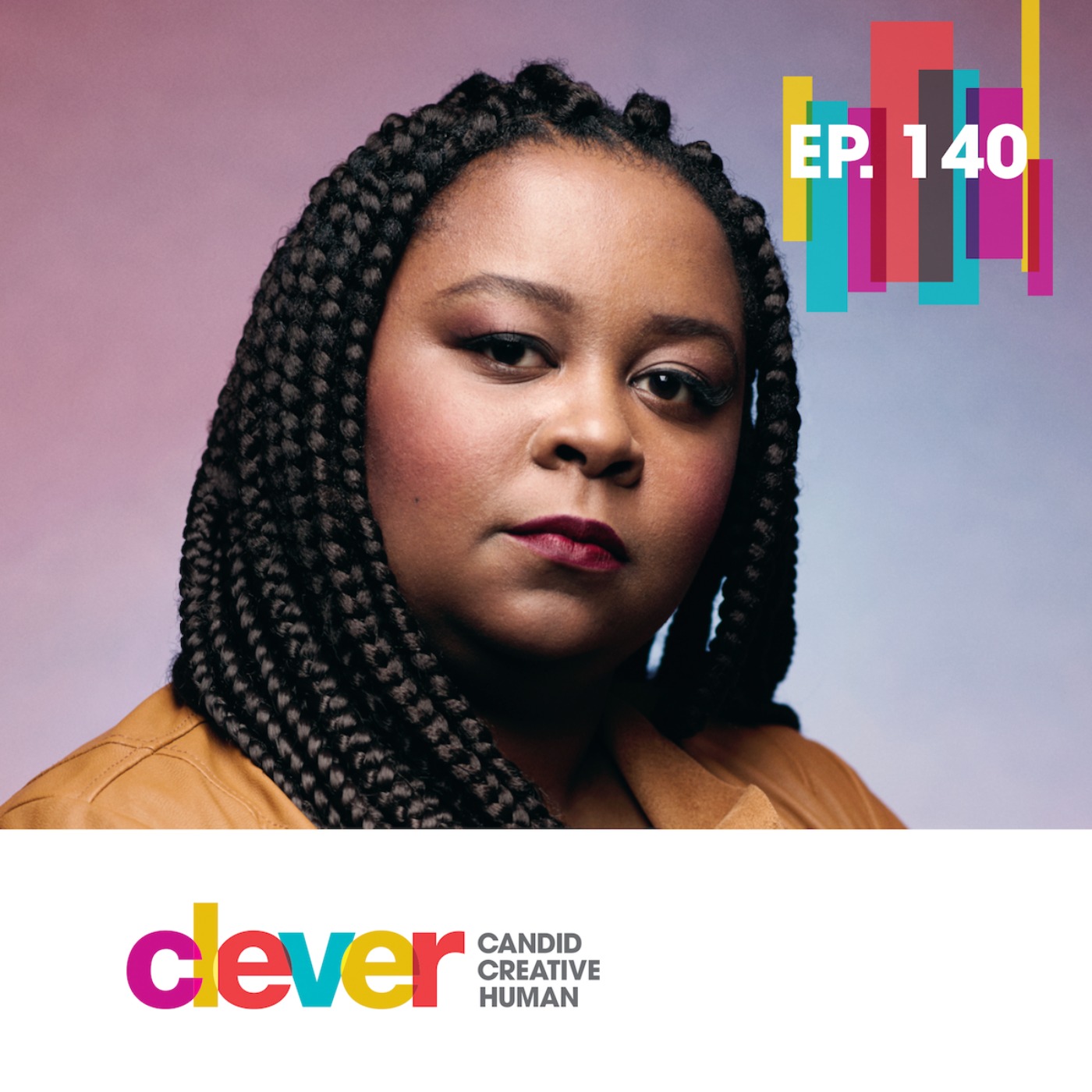
When you think about design, it really is thinking about possibility. It is looking at the reality that outcomes are everywhere and in every situation and scenario, I am a designer. Hi, everyone. I'm Amy Devers, and this is Clever. Today, I'm talking to Antoinette Carroll. Antoinette is the founder of Creative Reaction Lab, a nonprofit educating and deploying youth to challenge racial and health inequities impacting Black and Latinx populations. And within this role, Antoinette has co-pioneered an award-winning form of creative problem solving called Equity-Centered Community Design, and in doing so has received several recognitions and awards, including being named an ADL and Aspen Institute Civil Society Fellow, TED Fellow, South by Southwest Community Service Honoree, and Essence Magazine Woke 100, among many, many others.
Additionally, she's the founding chair of the Diversity and Inclusion Task Force of AIGA, the co-founder of the Design Plus Diversity Conference, and an active member of Adobe's Design Circle. She's also a Taurus, the mother of twins, a fan of Mexican food, and a proud granddaughter. Here's Antoinette. My name is Antoinette Curl, and I am based in St. Louis, Missouri. I was born here, and so I have yet to leave. I am the founder, president, and CEO of a nonprofit called Creative Reaction Lab. Our mission is to essentially build the new racial and health equity leaders of tomorrow today. We do this through a process I co-pioneered called Equity Centered Community Design, and also we're building a movement.
of these young leaders, as well as individuals that are more experienced, is how I like to put it, called Redesigners for Justice, and being very conscious of the reality that we need to be more than changemakers, we need to be more than designers, we need to be very conscious of the history that we're navigating, especially in the context of the United States, and especially as it relates to race and ethnicity, not just sit in this... place of awareness, but also bringing in design mindset. What are we going to do about it? How do we actually iterate, make, improve on interventions, be embedded in a community we're working to change and center our living expertise? And if we don't have a living expertise related to the issue, using our power and access on behalf of the folks that do. And so Creative Reaction Lab is my full-time job. I have two other businesses that I founded and currently leading. I have another business I co-founded that I'm no longer involved in. And ultimately, I don't sleep.
That is a lot. And that is a lot of very important work. And I want to talk to you all about that. But before we get into the mechanics and the purpose that you're so dedicated toward, I really want to understand you as a human. And to do that, I like to go back to the beginning. So you're born and raised in St. Louis, Missouri. Can you tell me a little bit about your childhood and what kind of kid you were and your family dynamic and all those things that sort of activated your young mind? You know, it was interesting. I was talking to my sister about this the other day, as well as some of my best friends. And growing up, I was known as the lazy kid.
That is a surprise to me. But you know what? My family has a little bit of bias, which we laugh about a lot now, but because they define laziness as cleaning. So they were like, you won't clean anything. My grandmother always used to say to me that I'm not trying to teach you how to clean homes. I'm trying to teach you on how to essentially pay for people to clean. And I know that sounds weird to say, but I grew up in poverty.
goal and my family goal was to make $10 an hour. In my family, if you make $10 an hour, you officially have made it when I was growing up. My family were either restaurant workers or they were housekeepers. My grandmother that told me this worked at Holiday Inn for almost 30 years. And as soon as she had to have surgery on her knee, they fired her. My great grandmother used to clean affluent white homes and did it up until she could no longer essentially care for herself. Not until she retired, but no longer until she could care for herself. And so when my grandmother was telling me this, it was essentially telling me that she wanted me to accomplish more than what my family had been able to do so far.
So her stress on chores was, this is the discipline you need in order to achieve more than we have been able to. Actually, my grandmother's anti-stress on chores, so it was everyone else telling me I was lazy. Oh, I misunderstood. Okay, so your grandmother was giving you freedom to let your mind do the heavy lifting, to do all that hard work. Yeah, okay, I got it. Because I was raised by my grandparents, even though my parents were and still are in my life, I was actually raised in the home of my grandparents. And I was essentially, and still now I'm still a combo of the oldest sibling, but also was raised as an only child. And that's a very interesting dynamic. While my external family,
My grandmother knew that I was actively involved in school. I started so many clubs in high school. It's not even funny. I've been working since I was 11 years old and I was a straight A student. So I was like the opposite of lazy for some people. But in my, most of my family, they viewed me as you need to do more. You need to do different because of what they essentially had only seen in front of them, essentially across the generations in my family.
So how did you as a young child or an adolescent connect those disparate narratives about yourself? It took me a long time for that. At one point, I mean, I'm a Taurus, so we're stubborn and we're... Oh, I feel you. I feel you. We move mountains, but we do it slow. Yeah. And we're very bullheaded and we're like anti-trusting and trusting at the same time.
And, you know, lo and behold, I ended up marrying a Taurus. So that's very interesting as well. But, you know, being a Taurus, I got to a certain point where I learned to hide how their opinion affected me for a very long time. And I remember being at a scholarship interview in my senior high school and they had asked me about my family's support and I actually started crying. And which was interesting because I view my family as very supportive, mainly my grandma. My grandma is my world. She is the pinnacle of woman for me. But it was hard when I felt like I was doing a lot. And yet it still seemed like.
Like I wasn't doing enough. I will say even now, and it might be why I'm such a workaholic, why I do so much, is that I still am kind of grappling with this, am I doing enough? And that has, and we may get to a little later when we, I may talk about my brother and losing him a few years ago. But every time like hard moments happen, I always question like, why didn't I do more? And am I actually being effective? I won't say I probably in a healthy way learned to deal with it. I just learned to navigate it and understand that what I am doing.
actually has a reason and a purpose. And when my sons tell me they believe in what I'm doing, then it starts to break down or chip that down a little bit more on maybe I am doing what I'm doing and I am doing enough. I mean, it sounds like you've always shown leadership capacity, but it wasn't always acknowledged or recognized by all aspects of your family. And so you, in an effort to try and be everything that everybody was expecting of you. really feel like you needed to do more all the time. But now as an adult with children, this is what I recently came to terms with is that I can't do everything. So I really need to be conscious of how I spend my energy and I need to spend that energy in the most effective ways.
Oh, absolutely. I'm in a fellowship program with the Aspen Institute and Anti-Defamation League. I was accepted in their inaugural cohort and their trainings is essentially around like literature-based leadership. Like you read different stories or articles or listen to different audio recordings and videos and really start to reflect on your leadership journey. And it was December 2019 when I first started the program. They had us read a poem called The Bell Stand. In that poem, the writer was talking about how he created this.
quote unquote, perfect bail stand. And the king came and asked him, like, how were you able to accomplish this amazing feat? And he said that I essentially learned to push everything out that wasn't the bail stand. And when I was reading that poem, it made me realize that the bail stand was representative of what is our purpose and what is our why. And it was in December 2019 that I really started to look at all of the things I was doing and really questioning, should I remain involved? Because while...
I may enjoy it or I may have originally was in this space, but it mattered to me. Was it actually my purpose or was it more of people thrusted me into this leadership role? Or I may have kind of organically went into the leadership role, but it wasn't actually working towards what I was looking to accomplish in my life. That was a pivotal moment for me. For some folks that may know me in a design space, that was the month that I actually resigned from AIGA. That was also the beginning timeframe in which I started to think about removing myself from one of the businesses that I co-founded called Design Plus Diversity.
and in which I'm no longer involved. It wasn't through this negative mindset. It was really a refinement of thinking through like, why me and why this? It was really crucial and key for me on my journey. That is so interesting because I think it also involves an incredible amount of self-awareness and a very clear understanding of what your purpose is and how your energy can be concentrated and more impactful if you don't, I guess, spread it as thinly as you were before, even though many of those things are worthy.
and could be helped by your energy, you actually now are the steward of the power of your energy. And if you funnel it and concentrate it like a laser beam, you know you can do so much more with it. Yeah, I would also add, it was prior to this, but I think I started to call it out more explicitly after that. I started to also think about the reality of me being a Black woman in the United States. How many times what we provide in spaces, we typically are not paid and or valued at the rate of others. And I also started to reflect on all of the numerous requests that I received to do things. And I tend to be a yes person because
My brain goes to how can I help? Particularly, it also goes to how do I challenge the status quo? And if you're helping me do that, let's go for it. But I had to also start to value my own time. It was like I was telling people, you know, you need to value what I'm bringing and value me. But I don't think I had spent the time to really think about how do you value yourself? And how do you tell people to be working towards liberation if you haven't spent the time to really define or reflect on what does liberation mean for you?
Man, can you elaborate on that? How did you define liberation for yourself? I think it's a continual definition. It's definitely where I am not only just looking at this idea of freedom. of choice, which a lot of times people just say liberation is freedom. But for me, it's also thinking about the reality of my history, the lack of knowledge and consciousness of my history. Also being free from these stigmatizations and generalizations of me as a black woman, because I have an intersectionality of two, quote unquote, minority identities. I don't like the term minority or targeted identities. I don't like that term either. But, you know, being black and being a woman, there's essentially very limited pathways of, quote unquote, power. When you look at most of the time, people equate power traditionally or centered power.
two white men. I am a woman and I am black, so I don't have that alignment. Now, there are other areas that I have privileged alignment, such as being a Christian woman. The United States, whether we want to explicitly say it or not, we are very much centering of Christianity and don't really value as many religions as we should, even though there's many religions, there's Sikhism, there's, you know, Buddhism, there's so many interspirituality, you know, and yet... Even the holidays that we celebrate are quote unquote Christian holidays, right? And jobs. And so there are some privileged identities that I have, but when I had to reflect on my idea of liberation, I started to look at the identities that most people would view as negatives, but I viewed them as superpowers. Being a black woman in the United States, I have learned to create something out of nothing every single day.
And if you look at the design profession, like the traditional design profession, design is about creating something out of nothing everywhere. Right. Well, and imagining something that could be and then reverse engineering it so that you can create a plot for execution. When you think about design, it really is thinking about possibility. It is thinking about, in a way that I define design as the intent and unintentional impact behind an outcome. It is looking at the reality that outcomes are everywhere. And in every situation and scenario, I am a designer. Even as a mom, I am designing outcomes for my children.
As a wife, I'm designing outcomes for my husband. As a CEO, I'm designing outcomes for my staff. And also just as a human being, I'm designing outcomes for myself and folks to see themselves aligning with some of my identities. And I understand the responsibility that I have with that. And that, to me, has been part of my liberatory journey of really reflecting on who I am and also who I possibly want to become in the future. Who do you want to become? More of you?
What I hear is a pretty amazing person. So I'm interested in just if you're designing outcomes for yourself, I understand that greater impact is important. Affecting change is important. But I'm really curious about how you think your identity is evolving. I think my consciousness of my identities are evolving. There's so much that we don't know about ourselves, about our culture, our history. Like, I don't know my ancestors. I have no idea. When folks can say, well, my family did this blank generations ago, I can only tell you maybe two generations of my family. That is it. And there's a struggle there. And when I think it's funny when you ask, like, who do I want to become? When most people ask me what's my theme song for my life, I always bring up Queen Bee, of course. But Beyonce's I Was Here is the song that I tend to align with.
Because it talks about making a footprint, in a sense, leaving a legacy while you are here. And when I think about legacy, it's not through this like egocentric, oh, I want to be known, put my name on all the buildings. That's not what I'm saying. Actually, there's a few parts for me. When I think about my ancestors I don't know, I sometimes sit and wonder if they are looking at us. And for us that don't know our ancestors, are they sitting there disappointed in the fact that we don't even remember them? That we don't know what they did for us to get to where we are. And then also, when I lost my...
14-year-old brother to gun violence in 2018, I had to look at the fact that he wasn't able to leave a legacy beyond the memories that the media family had of him. And how many black people, like anyone, how many people? have lost like their legacies, their memories are lost over time. And also that deepened connection is lost over time. And so when I think about legacy, it's not to put my name somewhere. It's looking at this reality that I will be an ancestor one day, that I am a part of history right now, just as being a human.
You know, I was talking to another artist about this, and the analogy that came to me as she was saying, and it's coming to me again now, is it's about sort of strengthening the fibers of connection back through your ancestry, but also keeping them strong forward as you become an ancestor in terms of legacy. And strengthening those fibers also strengthens the weave. And the weave is community, is society. That is powerful. And with all of this injustice and lives cut short, displacement, and it frays the weave.
I'm resonating with what you're saying about wanting to leave legacy. And, you know, legacy does have kind of an egocentric. If you're looking at it through the lens of like white male power, it can have an egocentric tinge to it. But the other thing that I've noticed in this podcast is we started asking men and women how they feel about legacy and women hadn't really formulated their opinions on it for the most part because it's socialized out of them. But men think about it all the time. Oh, absolutely. And I think that's one of the sort of frontiers of female power is really claiming what our legacy.
can be in the way you just framed it. I think it's just that. I think it's strengthening the fibers and strengthening the weave. Absolutely. And, you know, it's even when you think about men, especially the way we are socialized, unfortunately, even down to them creating children, and particularly men, that has been passed through generations, like continuing the last name. Like my father was extremely disappointed when I changed my last name. He was like, why? Why did you do this to me? And because I was essentially like, I'm in a sense, it's only it's his only child. It's kind of like he lost that.
legacy for him because of the removal of that last name. And let me be clear, my last name used to be Dickens. And I don't even want to talk about, you talk about childhood. I don't even want to talk about, I had some horrid ones, as you can imagine with children. And I also had some very silly ones where I had teachers like, are you related to Charles Dickens? And I'm like, yep, I surely am. You know, the kind of question is that. It's like, even when I think of black communities, I was making a joke with one of my friends that in the past, you would grow up and you would always see a picture of Martin Luther King or Malcolm X in someone's home.
Like literally have them framed up on the wall as if they were family. Now you, I would argue that it's showing up a lot for President Barack Obama to the point where I have an Obama picture on my wall. It was a gift. Don't get me wrong. I love President Barack Obama, even though I'm more of a Michelle girl. I love them both. I love the whole package. I love them both. Michelle is like queen, you know. But like I was at my friend's grandmother's house and she had a picture of him in a picture frame with the family photos as if he was a cousin.
And I think it's to the point of like, these are the public images we have of legacy because we've had so many in our history, like erased. Growing up, and I had to talk to my grandmother about this, like the neighborhood my family actually grew up in no longer exists. It was a product of displacement and gentrification. Boeing, actually the company Boeing, Boeing had acquired the company that originally was on that site. My grandmother, like it was called Robison. Most people have never heard of Robison now. It's become one of those black neighborhoods that were...
acquired for growth of society. And the history is lost. And then my grandfather grew up in Kinloch, which was one of the first all black communities in St. Louis and partly also in Missouri. And that neighborhood now has been so divested. And just honestly, I would argue lack of investment. It's become a ghost town. And again, the history and the legacy is lost. And then as my kids grow older, they're not going to know about Robinson unless I mention it. They're not going to know about Kinloch unless I mention it. When you think about the telephone game as generation goes on more and more.
We are disconnected from our own heritage, which is, in a sense, kind of a continual walking around, at least for me, of loss that I'm constantly grappling with. Yeah, it's a little bit like society is erasing that that tethers you to your own heritage. And telling folks to assimilate to someone else's. Assimilate to what, though? White supremacy. Yeah, of course. White supremacy. First of all, I don't want to live with all white people. Like, that would be terrible. Tell me more about this.
That would just be awful. But I understand that white supremacy is this sort of continual erasure, devaluing and gaslighting of several groups of America that make up America. And economic as well. And economic, yeah, for sure. Yeah, because I know we talk about white supremacy a lot, especially in my work. I'm always talking about white supremacy. But we've done work with global clients and they're like, well, we don't have white supremacy. I'm like, what do you do? It also shows up in other ways, such as caste systems when we think about economic status.
How many times have we heard now even the problematic language of developing nations as if people weren't already there? Or in the United States when we say when this country was founded, let's be clear, there was already people here. It was stolen. And so even the language we use is showing the erasure and devaluing of communities. And we are being told that we need to adhere to whiteness and adhere to affluent natures, even to the point where most of our aspirations are tied to financial stability or white privilege when it should be tied to our own.
heritage and culture and like our own traditions. But most of us don't even know what those traditions are. You're doing really interesting and powerful work with Creative Reaction Lab. And you are empowering the legacy. makers of tomorrow. Can you talk to me about your work in Redesigners for Justice and the equity-centered community design framework for problem solving that you co-pioneered? And let's be clear, most people call me the pioneer. The reason I very intentionally say co-pioneer is because it was actually me and a group of students that created that framework. But because my name was more known, which is typically what happens in most spaces, we like to focus on the singular person and not pay attention to the other folks. Like Eve was an individual that supported that. Amy was a person that supported that. Abby was a person that supported that. So we, you know, it was a few of us that created it.
Most people tend to put me as the forefront of it. And when I first started equity-centered community design, equity-centered community design is a new form of creative problem solving that essentially merges the great things about the design framework, which is around action and testing and learning, and honestly, the implementation component to the great things in the equity movement, which is around consciousness raising, cultural healing, and centering living expertise and tying those together. And so when we think about equity-centered community design, we are looking at the reality that no matter what part of the problem-solving process you're on, whether it's you building your team or you developing evaluation methods, or you're funding it, you need to think about history and healing. You also need to be very conscious of the power dynamics that are across every single step of the process. Like power is always there. And for some reason, we never talk about it. Like we just pretend it's an invisible thing that doesn't affect us in this bubble. But power, and I would argue sometimes white supremacy, is the bubble that we are trying to navigate. We are very conscious that both of those things, history, healing and power constructs, are embedded throughout the entire process. But then also...
How do we invite diverse co-creators? How do we make sure that we are building our humility to actually become empathetic, opposed to thinking empathy is enough? And it amazes me when people talk about empathy and don't really understand that reflection and calling out of themselves is a part of actually empathy building, being conscious of their biases. Also iterating, making, improving our inventions, prototyping, refining and understanding the topic. Like it's creative problem solving, but having that social justice and equity lens, being conscious that equity is something we've never actually accomplished in our lives. Like we've never had it in the history of humanity.
humankind, I would argue, at least from my knowledge, let me not say that from my knowledge, we've never had it. We may have had it in our different tribes that have been erased over time, but we don't have it now. I'm just going to say that now. And equity, equity for folks that are like, well, what does equity mean? It is when outcomes are not predictable based on someone's identity. So when we talk about racial equity, outcomes are not predictable based on my race. When we talk about gender equity, outcomes are not predictable based on my gender. And of course, there's an intersectionality of that. Like if I am a black trans woman,
There's a lot of things that I need to be navigating and hoping that I don't become a data or stat. Like in St. Louis, there's an 18-year life expectancy gap between black and white residents. That's a data point that we shouldn't have if we actually had an equitable, and I would argue, liberatory society. So equity-centered community design is giving people essentially a framework and tool to design towards equity while also evaluating our history and also our personal healing at the same time. I've heard you talk about the difference between equity and equality, and I think it's...
valuable to our listeners, if you just spell that out really quickly here, if you don't mind. Absolutely. So equality is essentially sameness, whereas equity is fairness. And a way to think about it is that equality is providing equal access, whereas equity is providing equal outcomes. So most folks are speaking through the lens of equality. Let's go with the All Lives Matter versus the Black Lives Matter discussion, right? You know, like when people say, well, all lives should matter, that is them saying everything should be the same. But Black Lives Matter, most of the time specifically, is calling out the reality that we do not have equity due to our skin color.
It's being also very conscious of content and context. Like as a black woman, I am automatically being born into today's society behind a white woman or a white man. They automatically have associated privileges that I don't have. Even the basics of, I remember growing up, nude was not what you all are seeing now with nude, okay? Now people are trying to be more inclusive and show more colors with nude. Nude was white skin.
Right. Nude pantyhose. I remember nude pantyhose. They're always this weird ass tan color. Weird. I don't know what skin they were looking at. It's not even really white people either, honestly, but it's definitely not brown and black people. Definitely not brown and black people, right? And this is across the board. Even when we look at ability status, right? And I've been at places where there's only steps. My grandmother, she couldn't even get in if she wanted to. We would have to carry her. I think about like equal access, meaning like, well, anybody can get this job or anybody can apply to this school and get in. But it's like, yeah, but not everybody had the opportunities to get their grades in a...
or get the kind of education that they would need to even apply to that school, or had the representation in their community that made them even think that would be an option for them. I might not even know what applying means. Like, I don't even, I may not even know that this is an opportunity for me. I remember the only reason I learned about Yale growing up was because I took the PSAT, I think it was, I think it was the PSAT, and apparently I had a good enough score, but they sent me a postcard in my sophomore year of high school, like, hey, you may want to consider us. And I'm like, you are who?
I don't know you. Like, who are you? Because that's like, again, both my parents and the one that graduated from high school. I didn't have that knowledge of what could be. And so I had to...
navigate that world alone. And even when I think about the fact that I did get into college, that I did have full scholarships, what if I didn't have full scholarships? I couldn't afford to go there. I would be on a similar path as most of my family members. And the education system, in my opinion, actually spoke to my learning style because most education systems do not accommodate the different learning styles that we have in society. And not just around neurodiversity because most people go to like, oh, if they have ADHD, like yes. And some people are visual learners.
Or kinesthetic learners? Exactly. So I also wanted to ask you, acknowledging that history and healing and power needs to be part of the framework for everything. Have you developed like some language or techniques around addressing those things or bringing them out into the sort of transparency that they need to be? You mean the history and healing component?
History and Healing and Power Dynamics. At our organization, so we didn't just come up with the framework and then send out a field guide and say, live your best life. I wish you the best. We, every single day, we were coming up with new activities, prompts, like processes for folks to bring this into implementation or into action. So when we think about power, we have an activity called Power Spectrum, where people are reflecting on things that give them power and things that take power from them. And how does that show up in their lives? We have all that power analysis where people are analyzing their power within the environment or the team they're working, as well as analyzing their power again in life.
When we think about history and healing, some of it is more activity. Some of it is more intentional design. Like one, asking people what they need in the planning is a form of actual healing because they many times are not asked to be involved. Like even a basis of asking, it seems to not happen. When we think about history, we are many times looking at like old stories of videos of things that in my case that happened in black history that I was not aware of and am very ignorant about, but then also have a reflection on what has that learning actually meant for me? You know, has learning about this.
led to more trauma. And also being conscious that there's times in which we've gotten it wrong. You know, there's times in which we've had groups come together where it was youth and adults intergenerational working together. And what we found is that particularly white individuals would then look to the younger people of color and say, give me the answers. Not realizing that they are creating harm. That started to become times where I would actually explicitly say to folks, do not look for people to educate you. That is your job. Google is free.
If people want to educate you, that is their choice, but you first have to build at the speed of trust before you can even get to that point. And so it's being very self-aware, as you mentioned earlier, on what you need yourself and also what you are willing to provide. I made a choice years ago that I would be fine with educating. And sometimes I just don't be in the mood. Right, right. Sometimes I just don't want to be in the mood. It is exhausting. But then there's times in which I will take the time to educate. Like I remember being in, I think it was a Lyft. I remember, I don't remember what city, but I was in a Lyft. And for some reason, this Lyft driver decided to start speaking about, he was a white man, that he was married to a black woman and that he cares about safety and gun rights is important. And you know, yada, yada, yada. And I'm sitting here thinking in my head, why are you talking to me? Like, why are we talking about this at all?
And then my head went to, I can either not talk to you and let that mindset continue and perpetuate, or we can have a dialogue. And this was a hard moment for me because I had literally just lost my brother to gun violence. And so he's talking to me around the importance of gun rights. And I'm like, I just lost my brother to this. I think it was maybe a few months, a year after it. So it's still, because when you lose someone to a violent act like that, it never goes away. Instead of getting angry, I...
Actually had a conversation with him. I told him, talked to him about my brother. I asked him why was gun rights so important to him. That's when he talked about like protection and safety. And I'm like, well, what does safety mean for you? And we actually had a dialogue to at the point when he dropped me off at the airport, we were able to shake hands, even hugs and wish each other the best in each other's life. I'm glad that it played out like that, that you had a meaningful conversation. Do you feel like your spidey sense is attuned to whether those conversations are going to be productive or you're just dealing with somebody who needs to offload some of their own shame and are going to be really resistant to having a dialogue?
I tend to be a facilitator or a moderator. I ask questions and opposed to making assumptions. And sometimes even my questions, and this is just all parts of my life, personal, professional. Sometimes my questions, people assume are like me giving an answer, my thoughts on it when I ask a question. Like for instance, my staff had to learn this. I would ask the staff sometimes, staff members, what have you been working on? Because of the past traumas and experiences they had at other organizations, there was this underlying tone of you're not doing what you're supposed to be doing.
When in reality, I was asking, no, what have you been working on? I actually travel a lot. So I have no idea what you're working on. No, I've definitely had that feeling too as somebody who asks questions where people are assuming they know what I'm getting at with a question or that I have like an agenda I'm furthering when I really just want to know the answer to the question. Exactly. And so I started at times even asking questions. And if I, from my experience, can assume that someone may interpret it in a different way, I may ask, like let them know, no, I'm seriously asking this question because I don't know.
And so I'm very open to telling people I don't know. Or I'm very open of like, because I remember there was a woman also on another trip, Lyft drivers, but she was proceeding to tell me that Asian folks, and this was a white woman, Asian folks have more health issues because they eat spicy foods or something like that. Oh, I'm sure she's the expert on Asian people. Yeah. And I was like, hmm, tell me more.
You must have such patience. Oh, yeah. I'm like, tell me more. What is this resource that you pulled that has told you this? How did you learn this? Interesting. And I even tweeted about it. And people were like, are you freaking kidding me? And I've learned. And like I said, I made choices years ago to be fine with educating. And so that for me is also being conscious of being OK with positive and negative consequences of things. That a negative consequence for me could be I'm tired or I'm exhausted. There might be moments where there may be some harm, like when that individual was talking about gun rights. There was a little bit of harm for me when I first started. But instead of.
coming in with this mindset of anger, I was like, no, I genuinely want to know. I don't live your life. You have your living expertise. You're the day-to-day expert of your life, just like I'm the day-to-day expert of mine. So let's talk about what our day-to-days look like and see if there's actually some similarities and also what the differences are. And that has helped me significantly. It's not to the point where I'm like, oh, these conversations has led to me like trusting them with my children. That's not what I'm saying. But it's broken down barriers. Yeah. And I think genuine curiosity opens people up to...
being more willing to have that dialogue with you. It sort of helps them let their guard down a little. And don't go wrong, there's been times where I've been upset, that I've been harmed, that I've actually cried about some things. That fellowship is powerful to me because civil society, they intentionally brought people together there from different viewpoints. Like I'm in the space where one of my cohort members or fellow fellows, he actually was paralyzed due to a police officer shooting him in the back, a black man. Oh my God. Also in our cohort is a police chief.
Oh, wow. Oh, this is good. Yeah. And I remember the first session we had with each other. They genuinely was able to have conversations with one another. And to the point where whenever the young man that were penalized needed to be moved, the police chief would actually be the first one alive to help him and to support him. And vice versa. Yeah. Because too many times we're so focused on we're so different that we don't actually try to have conversations beyond that. Because to be honest, my husband and I are very different. We call each other yin and yang. Like if I say yes, he says no.
If I say the sky is purple, he says, no, it's red. Literally everything is, I love Mexican food. He doesn't like Mexican food. He loves hamburgers. Thank you. Thank you. You know, he loves hamburgers. I don't like hamburgers. You know, we are literally the polar opposite of one another. And yet we've been together this year. It'll be 17 years that we've been together. Oh, that's beautiful. Because we, it drives him nuts. But I sit there and I'm like, tell me more about this insight. Tell me more about this belief. It's been a great journey for me.
So I'm really actually want to hear a little bit more about that. As parents, yin and yang, how do you both work together to encourage that equity mindset in your children as they're growing and probably being educated in systems that don't always align with your values? I am convinced that my children look at my husband and I and just go, oh, goodness gracious. Well, don't all kids? Like, that's just part of growing up. Exactly. I think they're just like, okay. We've learned to, at least for us, we will give them both perspectives. And I tend to tell them.
These are our perspectives, but you are going to cultivate your own over time through your own experiences. I would rather you learn how to be inquisitive opposed to just taking things at face value. That to me is the biggest lesson, period, that I want to give my children. Don't get me wrong. I do have a foundational thing. It might not be the best way I will say this, but again, I'm a Taurus, so we just got to say things. But I've told my kids since they were...
toddlers. I told them you could be literally the dumbest person ever. The only thing that matters to me is if you're a good person. That is the only thing that matters to me. And I know that sounds weird, but again, growing up academically like I did, and even the spaces I'm in that put academic pedigree over lived experiences. I'm like, you can have all the money in the world. You can have all the smarts or, you know, I would say intellectual support because I think everyone's smart. Intellectual support. You can have all of those things, but if you're not a good person, none of that matters. Period.
I think that's really important that your message is so clear. I know growing up, it was really confusing between is my character being approved of here? Or is it just the good grades I got? Or, you know, when I did something that was potentially breaking a rule at school, but it was for the right, you know, for the cause of being a good and just person. You know, I'm not sure I always got the validation or the reinforcement on my character. And your kids are probably really...
feel valued. And I think that's beautiful. And they also probably feel like they have the freedom. You talked about freedom in the beginning, the liberation to unfold, like have their lives and their identities unfold and blossom as they will. And that's all I want as a mom. Like, honestly, and I mentioned my grandmother at the beginning of this conversation, but I learned that from her. She allowed me.
a space of exploration. She allowed me to be me, to change majors, to not do something, to do something. She allowed me all of that. And I want to say that turned me into the person I am today. And it's hard, especially in the work that I do, when you have twin sons, or I would say when you just have children, but I have twin sons. That's why I say it that way. I call all other kids like singles.
But when you have children... Individually wrapped. Yeah, individually wrapped. I got a good, nice package. But when you are doing this work, it is hard at times to really decide on how much do I give you? How much do I tell you? What do we converse about? What do we dive deeper on? Because I remember when the uprising of Ferguson began in 2014, they had just announced that Darren Wilson was not going to be indicted. And I started crying because I was watching it on my computer. And my son came up to me and he said...
you know, mom was wrong. And I was like, well, you know, a young boy was killed. And then he said, well, mom, why didn't they just call the police? When he said that, that was so hard for me because I didn't know how to tell him that as a black boy. he is automatically devalued and at risk. And also because in some communities we have what we call the talk, the talk of safety, essentially. And my brain also went to how do I give him the talk of safety without limiting his freedom? Yeah. And without taking away his liberation just by trying to make him survive. I think it's something I'm still trying to figure out. I remember when I was traveling a lot, like prior to COVID-19, I think my record was I was out of town 124 days a year.
A lot. I remember going to my sons and asking, you know, like, how is this affecting you? I know it's hard because mom's gone a lot. And same son said to me, he's more the emotional one. He said to me, he was like, you know, mom, it's okay because I know you're trying to save the world. Oh.
And then I kid you not, this goes full. It's still happening this Christmas because we celebrate Christmas. He created a piece of art for me. He's a budding artist. I'm convinced he's going to be like the best designer ever. But he created a piece of art for me that was a hand letter piece. And it said, in a world we live on called Earth, full of racism, there is a person called Antoinette Curl. But in my eyes, mom, she fights and protects the world and stops racism.
Oh my God. And that to me showed that I was doing something. You're doing something right. And that is, you had mentioned earlier on, like when me figuring out, am I enough? Things of that nature, those small moments like that have started to chip away more and more and help me find my liberation. We're going to end there because that was just a very powerful soundbite. But in the spirit of legacy, can we give a formal thank you to your grandmother? Absolutely. Now, her name is Gertrude Priscilla Jackson. Main name was Helms, even though she don't like claiming that one.
And she don't like claiming Priscilla either. But she was and still is a powerhouse. We view her as the matriarch of our family. And unfortunately, she has survived a lot. My grandfather, that was her husband and also helped raise me, passed when I was 16 years old at the age of 55. Their son, my uncle, my only uncle on my grandmother's side, passed, I think it's now seven years ago, six or seven years ago, at the age of 44. And then her grandson passed due to gun violence.
Three years ago. And so majority of the men in her life have passed. And yet she still finds the space to tell us that we are enough. She still finds the space to support our aspiration and dreams. Like we all like to say that she educated everyone in this family. And when I think of liberation for me.
For some reason, it just goes to how do I be more like her? It's literally what it is because out of all the things I've accomplished, I've been in magazines, I've won awards, all things that my grandmother didn't have. She wasn't in magazines. She wasn't in awards. She's not on podcasts. She's not doing any of those things. I was a generational difference. She wouldn't have been. Most people don't know her name. They don't know who she is. And yet to me, she has accomplished more in her life than I have so far. And I'm just hopeful that I can get a piece of that in the time I have left in my life and in creating my legacy.
I'm hopeful for that too. And I am honored and grateful for the time that you've given to this conversation, for everything that you've shared and for the work that you're doing in the world. And so I just want to thank you so, so heartily. Thank you. Thank you for having me. This was a great conversation. You care about the people and it's not about just the work. And I wish we had more of that in society. Hey, thanks for listening. For more information on Antoinette and Creative Reaction Lab, read the show notes. Just click the link in the details of this episode on your podcast app or go to cleverpodcast.com where you can also sign up for our newsletter.
Subscribe to Clevver on Apple Podcasts, Spotify, or wherever you get your podcasts. And if you'd please do us a favor and rate and review, it really does help us out. We also love chatting with you on Twitter, Instagram, and Facebook. You can find us at Clevver Podcast, and you can find me at Amy Devers. Clevver is produced by 2VDE Media, with editing by Rich Straffolino, production assistance from Laura Jaramillo and Anoushka Stefan, and music by L1011. Clevver is proudly distributed by Design Milk.