
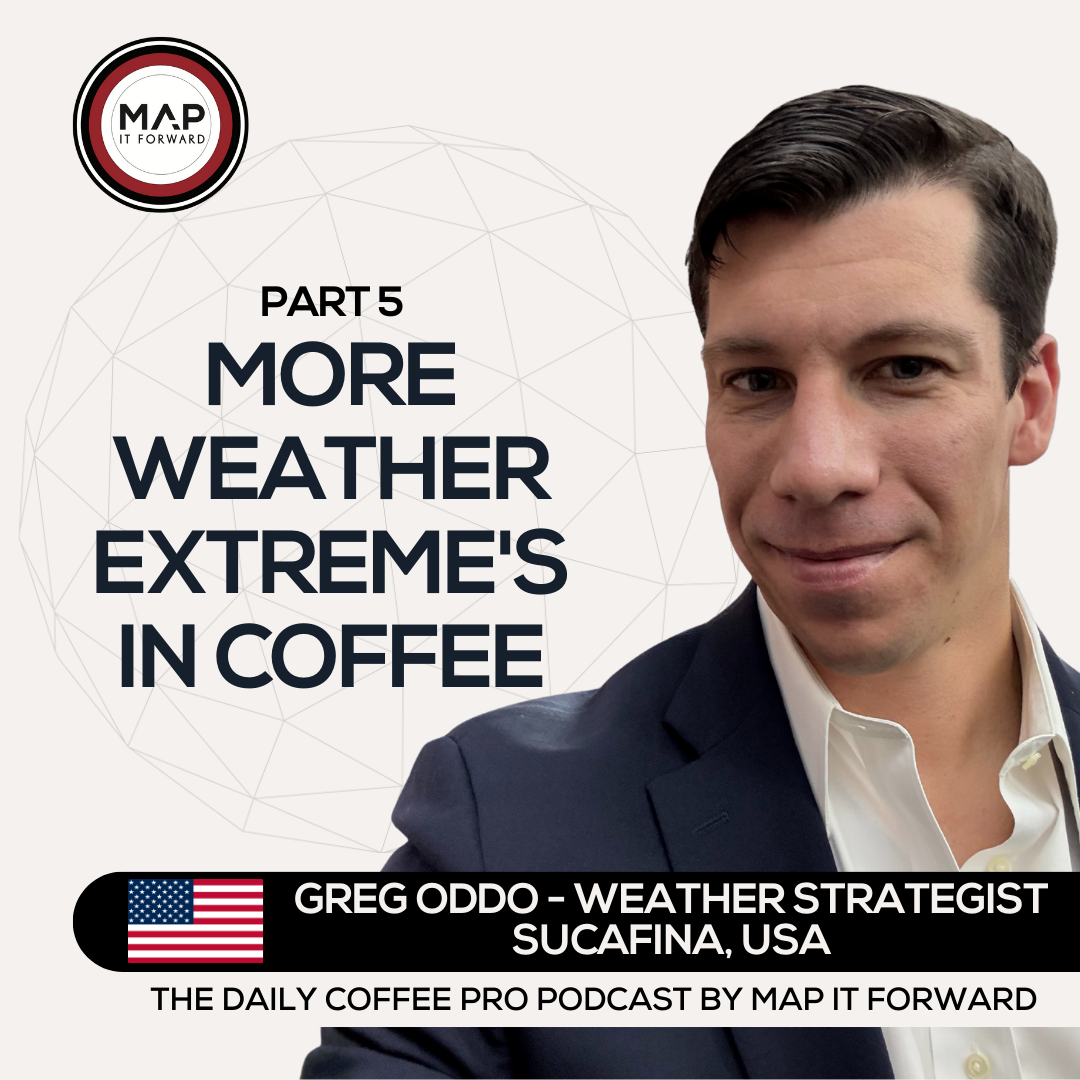
I think from the weather perspective, the challenge that we're going to have to deal with is extrema, extreme weather, extremely wet, extremely dry, rainy seasons that start earlier, rainy seasons that don't start on time, you know, dealing with heat, all of these sorts of things create stresses to production moving forward. And there's ways to smooth that out, which is that you either have people drinking less coffee or you produce more coffee. One or two things has to happen to create less volatility and to generate supply. You need to have more supply of coffee to have a little bit less volatility because you can stomach a loss of 500,000 bags from origin in those type of markets.
But I think, you know, the challenge I will again point to, which we talked about earlier in our prior episodes, is, you know, what do you do in a warming climate with a crop that doesn't love heat? How do you solve that problem? And I think that, to me, is the biggest question that we have in the next 15-20 years is what do we do? How do we find a solution?
How do we fix it? I think that while we're always worried about the short-term volatility and the trees, like we talked about earlier in our prior episodes, is, you know, what do you do in a warming climate with a crop that doesn't love heat? How do you solve that problem? And I think that, to me, is the biggest question that we have in the next 15-20 years is what do we do?
How do we find a solution? How do we fix it? I think that while we're always worried about the short-term volatility in the trees, like we talked about, right, you see the trees of this little landmine, this landmine here, this thing. You still need to see the forest, and the forest is how do we solve that challenge, in my opinion.
Who is leading the charge to solve that problem? I think it's multiple stakeholders. I really do. I think, you know, if you look at roasters are looking for sustainable, sustainability is huge.
Trade houses have responded to that with sustainability programs, regen ag programs, all these sorts of things. If they're not doing a regen certification, they're incorporating portions of regen into their sustainability. Living income, obviously something that we have to really, really focus on for farmers because as we kind of talked about before, if farmers aren't getting paid, it's really, really hard to get them to invest in these sorts of things. There's so many different levels of the supply chain that we need to, I think, really, really answer questions.
I think if you were to ask me, I think it's a combination of the trade, like the trade themselves. And I would think it's a combination of producer co-ops themselves. I think they understand above all else that they need to figure out how to make this work in order for this business to continue. The roasters are starting to catch on, but roasters are still really price sensitive, really price sensitive.
You know, I think there are certain ones who have built sustainability into their business model, and they've decided that this is a standard portion of their business model. There are others who talk about sustainability and, you know, Dave talks about this a lot. You can do sustainability one of two ways. You can make it part of your business model and it's a non-negotiable, or it's something to make you look good.
And we need a lot more of the number one versus number two in order for this challenge to be kind of addressed. So I think you need all stakeholders, including the end user. You and me drinking coffee, we need to probably have more of an understanding of how that coffee is being produced, where it comes from, and what methodology is being used to produce it. But it's really hard to do when it's really, really expensive when people are getting squeezed everywhere.
Oh, a thousand percent. And we are in an incredibly tension-filled time to be trying to solve these problems because everyone's operating on razor-thin margins. And we're asking people to have some patience at the farm level. What we're saying to them is you've got to adapt.
And at the farm level, we're talking about everybody, the farmer, the co-op, everybody in between. We're asking them to adapt to regenerative agriculture in a year where they're just starting to get ahead. Many, many farmers use the money that they earned this year to pay off debts from previous generations. Absolutely.
Absolutely. And so now what we're saying to them is, oh, and by the way, we need you to adapt and change the way that you're doing things, which will, by the way, nobody knows if it's actually really going to pay off. We think agroforestry is the way. We think resilient coffee farming is the way.
But by the way, it's going to cost you some money and you're going to have to go and get educated on it. And we don't know if it's going to work. Yeah, I think that's where a lot of the trade and the merchants are starting to really step in. Like, I know, for example, our impact program, we do a ton of microfinancing.
We do. There's a premium paid for a specific, you know, practices that are followed. But a lot of guys, I think also you would you would agree with me on this, that the certifications are creating such a paperwork, you know, headache for a lot of these folks as well. It's there's time invested in these sorts of things as well.
If there are any farmers out there listening to this, I want you to please hear me now. These certifications, I want you to walk away from them, walk, walk away from these people who are trying to sell you these regenerative ag certifications. You don't need any more headaches. There's one that is trying to get farmers to pay five thousand dollars a year for a generative certification.
We don't even know what the regenerative agriculture means as a definition yet. Yeah. And people selling farmers certification. There's two ways to look at it.
You want to have a standard to make sure that you have people actually doing the things that they're saying that they're doing. But I also think I also because you can bullshit people about what you're actually doing when you go to a farm. I know. And that's not really what's happening.
Right. Organic is not organic is the one that we always talk about. So I think that I hear the reasoning for it. I'm trying not to like get on my soapbox too much, but I do think the principles of soil health, living income, water management, big one, like managing the water, being able to be educated on new methodologies so you can yield more.
All of these sorts of things are very basic principles that we will need to help meet this challenge. That's not to say regen ag is a silver bullet. It's a way for us to mitigate some of the impacts. We still need to figure out where we can grow coffee in a new climate.
We still need to figure out, you know, what type of coffee that we're going to grow, what people are going to like, what are they going to drink? You know, we still need to figure out all these different challenges and we still need to make sure that all the stakeholders have a hand in this. Like, I don't think you can have one person solve this problem. I don't think you can have one part of the industry solve this problem.
You need everyone from end user, roaster and drinker to trade merchant who gets it from point A to point B to the guys who produce it to all have to figure this out as an industry. And that requires an element of leadership and consolidation too, which I don't think we're there yet. So I kind of think that all things being equal, it's an industry-wide challenge. It's going to require industry-wide solutions from multiple places rather than one silver bullet.
We got it. It's not going to look beautiful. It's not going to be this one, yes, this is the answer. I think it's going to require a lot of different answers from a lot of different places to make everything work.
Do people accept now that in the industry, in the trade, are people accepting that climate change is playing a major role in the volatility of coffee production and coffee trade? I don't see much resistance to it. I see less resistance to it in the coffee industry than I do anywhere else. Certainly in the news and the politics, I'll shy away from that.
You guys know where certain people stand on certain subjects. But I think if you're in it, I think you know. Like, you know what things are changing. You know volatility is impacting you, and you know it because you see it in the price.
One of the beautiful things about coffee and one of the beautiful things about an exchange-traded commodity in general is that a lot of times price answers the question for you. Like, it tells you what's going on. A lot of times through the amount of production from a place that is producing X number of bags 10 years ago and Y number of bags now, and the only reason that you can point to is that the weather has gotten hotter or the weather is changing or farmers are getting out because they can't deal with the volatility of what is happening with the weather patterns is telling you that things are changing. So I see a lot less of it in this industry, honestly.
And in fact, most of the places I go to and most of the people I talk to. Be it a roaster, be it a producer, be it just a random Joe Schmoe who knows I'm a meteorologist and a weather strategist and just wants to shoot the shit about weather. The number one thing is like, you know, what's up with this climate? Like what's going on?
This seems weird. You know, and I think that Thankfully in this industry, I do see a lot less of that. I do see a lot less of that. There are questions about how to handle it.
There are very deeply rooted differences in how you need to approach it. Hello, EDR. But there are very. Another, another fun delay there.
But Uh It's the worst on again, off again relationship that ever did exist. Another thing for people to deal with. Another thing for people to deal with. Like merchants sometimes invest so much money in this, but anyway.
Um and producers invest so much money in this sector. Um but in terms of the underlying, the weather is changing. I, I think you would agree with me and the people that you speak to, you struggle to find people who are like, yeah, this is just normal. This is what coffee does uh with the weather.
I, I don't find many people who push back on me with that anymore. Ten years ago, I would have, but I don't now. Yeah, right. What a lot of them say is this is challenging, but we are going to find a way.
And I'm like, okay, so what's that way? And they're like, no idea. No idea, but humans will adapt. The humans will figure it out.
They'll stop drinking coffee. They'll drink matcha. Whatever it is, we're gonna figure it out. But this brings me to a very interesting thing that we, um, I should have spoken, asked you about during the price episode, episode two, but uh this is as good enough a time to ask about it.
You mentioned it then, and um you talked about the way that computers are trading on the same market now. And tell me more about how computers are able to access where their information, process that data, and then learn and then figure out how to trade. Well, I'm not an, I'll, I'll spread this with, I'm not an AI specialist and machine learning specialist or any of that, but uh you can buy weather data. You can buy us correct weather data.
You can look at historicals and try to make an assessment and model and create a model off of it. You can look at price reactions to certain weather observations that have happened. You can look at the inertia of the amount of people talking about the weather and trade it. There are a lot of different ways you can look at it and find an edge or find a statistically significant correlation into figuring out, oh, this weather now means this.
I'd be lying to you if I said I haven't done some of it myself. But at the same time, you know, you will also have 8 million, 8000, 8, pick a number, other different strategies and micro strategies that have nothing to do with the weather. So I think that, you know, there's a lot of ways and a lot of different correlations and a lot of math to figure out a way to make money. And I think, you know, a lot of these guys that they're right 51%, 52% of the time, but they're really right, they're happy.
They can be wrong 48% of the time as long as they're not really, really wrong. And when they're right, they're really, really right. They're cool. Um but it just adds another layer of, of different things people are looking at that if you're a producer, you're like, or if you're a roaster, like, what?
Like, what are they, what are they doing? Fucking this, really? If I can give advice. Another thing?
Yeah, if I can give advice. Yeah, please. To anybody. It's, you're not going to understand everything.
I don't understand everything. I've been doing it for 15 years. There are people in this industry who are 30, 40, 50 years who don't understand everything. You're not going to understand every trade and why every trade is made and why people are doing this now at this specific time.
Because if you ask 10 different people, they may have 10 different answers. So I would focus less on necessarily understanding every little micro move and every good thing that's going on and more just trying to figure out what is the general trend and how we see things going. Is the weather good? Is the weather bad?
Is the, or is it in between? Is it a normal year? And if the weather is a normal year, maybe it's not the most, the number one thing that gets traded at any given time. Um, you know, I think that it's, you're never going to understand every strategy.
You're never going to understand why every person thinks a certain way. You're never going to understand why every market participant is doing something that may not make sense to you. But I do think you can have a pretty good idea of what the general consensus is that's forming and what that could mean over time if this happens. If this happens, if this scenario happens, right?
You can get a pretty good understanding of things that way. And I think just for me, because I'm not the smartest person in the world by any stretch of the imagination, I'm pretty dumb on a lot of stuff. I feel dumb in this industry a lot of the time. You can figure out and have a general idea of, let me compartmentalize things in a way that makes sense to me and that can help you wrap your head around the, your mind around things that are going on.
Um, don't overcomplicate something that's already super, super complicated and try to make sense in, in areas that you know you have an edge. You can make sense of that and you can try to put it in context of other things that are going on rather than trying to figure out which micro trading strategy is trading the next 15 minutes. I don't think for the lay person doing this, that's where you're gonna get much of an insight. You get much more of an insight of how you see things evolve over time.
Greg, this has been an absolute delight. I'm glad. This is the first time. My first podcast.
I, I think that you should do more of them, um, a hundred percent. And I hope that you'll come back every year on this podcast and help us understand this, uh, as we move through the years. Uh, we recently hit episode 1500 on the podcast. Congratulations.
It only took us, thank you. It took us uh eight years to get that done. Um, I hope that you'll be coming on the podcast for the next eight years as we do the next eight 1500 episodes. I hope I have, I hope I have the longevity of this industry to do that.
So thank you. Yeah, doing what you do, I can understand why you question that. You never know. Yeah, you never know.
Will you tell people um where they can find out more about you and about Sucafi. Yeah, super easy. Um, you can find us, uh, Sucafi and Sucafi Specialty on Instagram. Um, we do have, uh, if you haven't signed up for our email list, uh, if you're a client of ours or if you're looking to be a client, please do.
Uh, we have a specialty newsletter that goes out. We have market reports that go out. Uh, I, I have videos that are seen on places like Vimeo, LinkedIn, uh, and Instagram that are available uh to the public. Um, try to do business with us, though.
If you like what we're doing, if you want more content, Hey, come do business with Sucafi. But I think overall what I would just uh leave you with is that I think we're probably one of the more, if not the most transparent with our information and data of the multinationals and I'm proud of that. I'm proud of being a part of that. Um, so yeah, we put the content out for people to look at, so look at it.
Yeah. We will include links in the show notes, folks. So check the show notes for links. Um, our last question for you, Greg, is when the future version of you comes back and watches this, what do you hope for him?
Yeah, um, I hope a couple of things. I hope the future version of me looks at the prior version of me as an unfinished product, a little naive and a little dumb. Because that means I will have hopefully progressed in my knowledge and my evolution as a, as a person in this industry. Um, but I do hope he thinks, he looks back at me as like, you know, at the very least he was giving people like something that they could use.
Because I like to be useful. I like to be uh someone who's viewed as, as a subject matter expert. I like to be viewed as someone who's, you know, telling things in a way that makes sense and, and that, that help people. Uh and that maybe help the industry progress forward on certain things, like the data transparency that we talk about.
Uh and I hope that the industry has evolved, you know, uh to beyond a few of the things that we're talking about mattering anymore. I hope some of this stuff is obsolete. Um, but yeah, I hope he also thinks that uh when he looks in the mirror, he hasn't aged too badly. So I hope, I hope that's also true.
I think you'll be fine. We'll see. You're already useful to the industry. You're already really doing great stuff.
I'm very grateful that we crossed each other's paths and I'm really looking forward to having you back on the podcast.