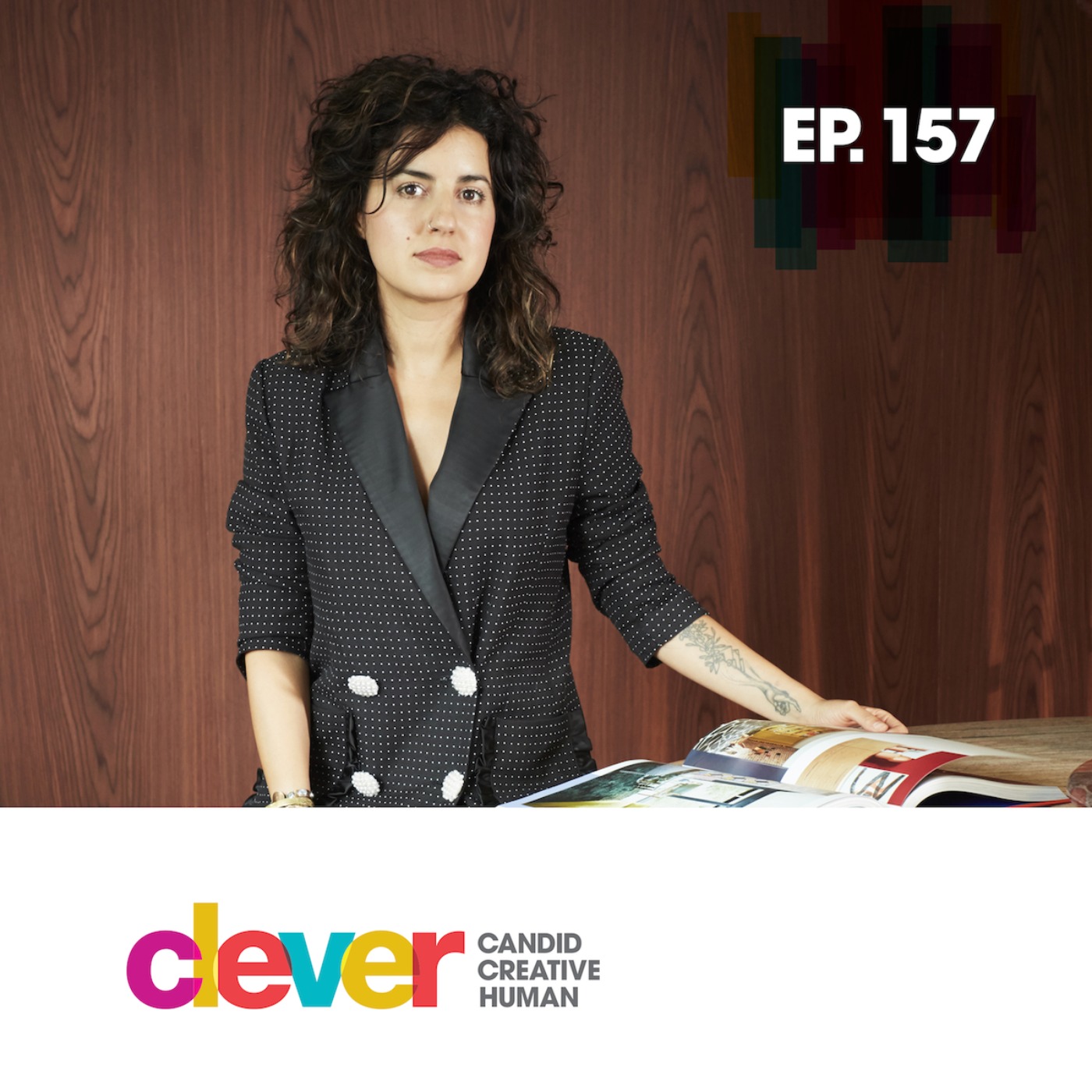
You're listening to an Airwave Media Podcast. I'm picking up stuff continually from different times and melding them into something that I thought was the now. Hi, everyone. I'm Amy Devers, and this is Clever. Today, I'm talking to Yasmeen Janine. Yasmeen is founder and principal of YSG Studio, an interior design studio that focuses mainly on residential and hospitality. Born in Kuwait, she's lived in Egypt, Saudi Arabia, Dubai, Australia, United States to attend Savannah College of Art and Design, or SCAD, and also spent a stint living in her car before settling back in Sydney. Having always been a musician and performed in bands, initially she wanted to be an entertainer. But after falling in love with interior design, she now harnesses that innate sense of staging and storytelling to dramatic effect in her design work.
In 2013, she co-founded Amber Road, a multidisciplinary design studio with her sister, and this past year has gone on to open her own YSG studio, which within its inaugural year has made quite an entrance and earned a lot of attention and accolades in Australia and beyond. With her blended heritage, she describes herself as a cocktail, and she is indeed intoxicating. Here's Yasmeen. My name is Yasmeen Janine. I live and work in Sydney, New South Wales, Australia, and I am an interior designer by trade. I do it because...
I actually feed off of my environments a lot. And I think there's a way to teach people how to live the best self possible. And I like to think that I can help people achieve that. I feed off my environment too, so I relate. Let's go all the way back to zero though. I understand you had quite a nomadic and dramatic upbringing. So can you tell me the story of your childhood? Yeah, I've got my parents to thank for that. My mother is Australian and my dad's Egyptian and they met in Libya of all places. And I was born in Kuwait. So I do feel since the get-go, I've always been thrown into situations that seem quite out of place or disjunct or just quite unusual. I'm not Kuwaiti at all, but my parents happened to have been there when mom gave birth to me, I suppose. So we lived there for a short while and then we moved to Saudi Arabia for a bit and then returned back to Sydney when I was quite small for about three and a half years.
That was really my first, I guess, taste of being out of the Middle East, I guess, when I was about seven. Dad, he's in the oil industry, so obviously working in Australia was almost non-existent, essentially. So, you know, these were the days where he'd sit by a phone and wait for a telephone call for work. And one day he got a call and it was a job offering in Kuwait. And so he jumped at the opportunity, got on a plane and started working on an oil rig. But unfortunately, the day that he arrived in Kuwait, the Iraqis invaded. That was a desert storm, essentially. And he disappeared for seven months. We didn't know where he was. And then one day he just turned up magically.
What? And said, we're moving back to Kuwait. He'd been putting the fires out for seven months and he was smuggled through Syria. Arrived back on, you know, our Sydney townhouse in the 80s, just going, yeah, we're packing up and we're leaving and moving to Kuwait. Wait, wait, wait, wait, wait, wait, wait. So for seven months, you had no idea who your dad was. Yeah. And what does that do to your psyche? I mean, does it test your sense of hope of like whether you'll ever see him again?
I guess I was young, but I think I was more upset for my mum because she was just beside herself. And I remember, you know, visions of her on the telephone calling into radio stations with family members in similar situations who'd lost family overseas and was just, you know, crying out and seeing if there was a response. And so I did feel super sad for her. But, you know, I had a half-brother and half-sister, so my mum was married before, and they lived with us, my brother and sister, at the same time while we were living in Australia. So the household was always a bit of a – definitely there was always some drama.
So for me, it was a normal, I don't know, it sounds terrible and not particularly supportive or anything, but it just felt like another thing that our family was just dealing with. So dad appeared, he said we're leaving. So we left Australia. I'm sorry, I need a little more. So dad appeared and he said we're leaving. Was there like some... No, it was very fast. Yes, absolutely. Some questions about like, where have you been? Why haven't you called? Yeah, obviously, naturally he arrived and we were absolutely dumbfounded and beside ourselves with joy and happiness, but it was a very swift...
packing up situation. I'd say we would have packed up our entire house in, say, a week and we were gone. And you were like seven years old at this point. So also ripped away from any friends you had made. Yeah, that was tough. You know, I've moved around a lot and I've gone to different schools and had loads of different friend groups. This one in particular, I felt it had taken me a long time to get.
This friend group, I had always felt a little bit of just an outsider. I wasn't fully Aussie and I wasn't fully Arabic and I never felt like a truly 100% fit in, especially in a very white Australia in the 80s. I went to an all-girls school and felt very isolated, essentially. I finally had found that space where I felt comfortable and being told that we were leaving was, yeah, it was very upsetting. But then when I moved, again, it took a long time, but at the same time, there were so many people like myself who were cocktails who had Arabic fathers and they married outside of the Middle East and it was such a great environment, melting pot of incredibly...
interesting mixes like half Russian, half Egyptian, half Somalian, half Australian, half Brazilian, half Kuwaiti. Just really beautiful, incredible mixes. We always laughed and called Kuwait a train platform. It was this transitory space where people would come and go and you knew if somebody left, someone amazing would replace or... step into their space. And I got a lot out of my relationships. And I'm still in such close contact with everybody there that I went to high school with. Funnily enough, I'm actually designing one of my girlfriend's house back in Kuwait. I haven't been there since I left. So we're connecting in crazy ways, even as I step into my 40s. So this is very cool. So you spent the rest of your youth and your teenage years in Kuwait? Yeah, I did. I graduated high school. And then I actually worked at my mom's school. She was an English teacher. And I worked as an art teacher for a year as a gap year before I went to uni. And I had my heart set on going to the States. So I did my first year of college in Dubai, actually, in visual communications.
And then I got a scholarship to Savannah College of Art and Design in Savannah, Georgia. And it was funny because we had recruitment, you know, people from all sorts of different universities visit high schools in Kuwait. And one of them was from SCAD. And I remember flicking through the book, just going, oh my God, it would be just such a dream to go to this school. I remember feeling I would just love to be in that book one day at some point. If I ever went to that college, I wanted to be in that book and I wanted to influence, you know, someone's decision in going to the uni because it looked so great.
You said you had your heart set on going to the United States, but had you already started developing your creativity? And how were you expressing yourself in Kuwait in the teenage years that would have informed this decision? Kuwait, I was surrounded by some really incredible people. And everybody was really different and very theatrical. And I don't have a single friend that went into science or anything like that. They're all very creative people. And I do feel that living in an environment like Kuwait, where you don't have everything at your fingertips, and it is a bit of a struggle to find.
the goodness in things. And you don't have access to the same things in Kuwait as you would if you grew up in the States or Australia or the UK. Watching MTV for me was like an absolute highlight of my week. I would creep into my living room at like midnight because I forget MTV when no one was watching. I would really resonate with the videos. I love music. I've played music since I was like six. It's always been a really huge part of my life as has dance. That was my true calling. I thought I wanted to be an entertainer. I wanted to be a performer. I wanted to be on the stage. What kind of band were you in?
In Kuwait, I was actually in a band called The Expat Story. Okay. Built with expats. And actually, the girl that I mentioned, Summer, whose house I'm designing, she was in the band with me. She has an amazing voice. And we would play out in shopping malls or just the weirdest of places. And to be doing that as a female in the 90s was really not a common thing. I didn't see anything wrong with it, but I was...
I guess, at heart, a little bit more rebellious than some. Is this the kind of thing that was supported by your family? Or were they like, go ahead, but just be careful? Yeah, my parents were always really supportive of my passions. But at the same time, my dad's a realist. And he, like so many dads, wants you to be successful and happy. But he's also really mindful that entertainment's a hard gig. You might not achieve what you want. It's really taxing. It's really competitive. You don't make that much money. It's all these kind of things that as a dad.
Dream killer. I'm kidding. He was a little bit of a, you know, get a stable job. And, you know, even stepping into interiors wasn't something that he was that keen on either, you know, but that was my second choice. So that's kind of how I fell into design, really.
Ah, the old compromise. I know that one. It's creative, but it's also kind of businessy. I think I was always destined to do a bit of both. I definitely have always felt very affected. You know, I think with my intro, I was like, I feed off of my environment and I do. It either gives me so much or it takes away from me. I just get so affected by a space. It makes me feel either really incredible or just soul destroyingly sad and not uplifting.
and depressed. I've always felt a draw to creating spaces that truly can enhance your everyday and just make you feel unstoppable, like that you can do anything. So that's what I'm trying to do. I like it. I said I was in visual communications before doing interiors. I had that moment where I was walking past one of the uni halls and I just saw a barrage of like 100 people in this one room looking at computer screens. And I knew that that would be my life. That would be my future if I had pursued a career in graphic design. And I have a passion for that too. And I said, no, and I went straight to the.
to a counselor. And I said, I don't think this is for me. Like, what can I do? And this is where we sat down and I ticked every single box that had to do with spaces, architecture, design. So that went from furniture design to textile design, to lighting, to spatial, to architecture, everything. That's when I knew kind of interiors would fully encompass everything I loved. Doesn't that feel good when you kind of figure it out and you're like, hey, it started off as a compromise, but now it's looking pretty good. Yeah. There is definitely a moment in my life where these two worlds will collide in the perfect marrying of what I'm actually really supposed to do. My true calling, I feel like, is still on the horizon. I'm not sure when it's appearing, but I feel like it's really close.
Ooh, stay tuned. Don't you feel like that? Don't you feel like there is something that everyone's supposed to do and they're spending their entire lives unraveling what it is? Yeah, absolutely. I feel like something's around the corner for me too. Not like it's just going to magically arrive, but that I'm actually sort of weaving a new chapter of my life. And I'm not exactly sure how it's going to turn out, but I'm pretty excited about what I'm doing with it. These are all just stepping stones. And it's so exciting being able to actually see into the future a little bit and know that you've still got a few stones that you've got to jump to.
Not only that, but I've got all these tools I picked up along the way. You can build a pretty sweet space on any stone you jump to. Yeah, no, it is. It's exciting. Okay, so we're back to SCAD. You ticked off all the boxes. You're studying interior design. Are you in Savannah at this point? I did my first year at the American University in Dubai, and then I transferred and absolutely loved that experience. The college was incredible. I think it actually just got listed as one of the best interior courses in America, actually worldwide, I think. It was a really fantastic, supportive space. And Savannah itself is just an absolute beautiful little city.
It's a very complicated little city. Yes, very complicated. It does have some very dark history attached to that place, but it's so beautiful. I loved Savannah. And then I jumped in a car and drove across your incredibly large country and landed in Portland, Oregon, where I remained for a further three years and jumped around some architectural practices. Portland was great. And Pacific Northwest is just an absolute joy to be surrounded within daily. It's so beautiful. Lived in my car for like six months because I didn't have a job. It took a long time to get work over in Portland when I graduated. Was it at least a cargo van? It was a very dingy red Azuzu truck.
And I had moved across with a uni friend of mine, Monique, who was a fashion designer. And she was struggling. It was a tough time. This was 2004. I think I had done some drawings for a theme park, some entry gates. And I got paid $600 cash to draw these gates. And that was what paid my way across the country to Poland. I lived in my car for a little while. And then I went to the carpet showroom. I couldn't believe I got a job. I was just amazed that somebody was giving me a job. So before that, painted an Agnes Martin painting in this guy's architecture office for free. Because he thought I really needed to know or learn about color.
So I did that for a bit. Life is so random. You know, I said earlier, I do find myself in these very precarious, strange situations. This was definitely one of them. So living in your car, is that the kind of thing that would have scared your parents? Or is that the kind of thing where you had already proved yourself so self-sufficient? They would be like, oh, Yasmeen, that's just so her. I don't know. I don't even know if my parents really know that part about me. Oh, no, sorry. My parents are very well aware of my absolute stubbornness, but willingness to just be me. And they get that.
And they appreciate it. I think they thought it might go away, but it only got stronger. Isn't that funny how that is? Because, you know, if you try and push it down, it really doesn't go away. No, it actually makes it come out even more. So I feel like my 40s, because I literally just turned 40 a couple weeks ago. Happy birthday. Thank you. I was not where I wanted to be spending my 40th in lockdown, but some people are spending their second birthday in lockdown, like second year in a row, which is just madness. So I should be lucky that I got to spend my 30 nights somewhere else other than my living room.
Yes. And I'm also hoping that being the designer you are, your living room is a pretty special place to spend for you. It was super fun. I actually had a really great day. But I feel like as I'm stepping into this new decade, which I was really fearful of, there's nothing actually scary about it. I felt really empowered on that day that there's so much goodness to come. Like your optimism.
Yeah, it's gonna be good. Let's get to that goodness. But I need to figure out how you got out of your car. Like, are you still doing music at this point? I've been doing music all through uni. And then my boyfriend at the time, he came over. He's a mad musician and climber and painter, incredible person. We were still making music in his garage and basement and throwing stuff around, but we weren't doing any performing or anything like that. What happened after the car gig? I did the carpet showroom and then I got offered my true first.
interior design position at an architectural practice so it was 150 person firm my group architects in portland oregon in downtown and it was great it was i made so many friends it was my real taste of what life um as an interior designer looks like and i remember i got the call that i got the job because i've been looking for so long i really didn't think it was going to happen ever happen i remember jumping up and down and squealing so hard My roommate and I could finally get an apartment. I remember going to Ikea and buying a bunch of stuff and then setting it all up and then stepping back in the living room going, oh, shit, it looks like an Ikea showroom. What have I done? But it was still home. We've all experienced that at some point. So, yeah, that was a really, oh, my God, I've made it kind of moment. I kind of switched around and went to another practice. And then just before I left, I got headhunted and started working at a really fantastic practice. It was boutique. It was small. It did celebrity residences and boutique hotels and things. That was really amazing. But at that point, I think I'd already made the decision that I wanted to leave.
and move on and do something different. I wanted to see some of the world and I had always been really interested in aid work. So I saved up for about a year and then applied for an NGO. placement in Kenya and Vietnam and did that for about a year. Worked at orphanages and built schools. It was really the most incredible experience. I dare to say that I got more out of it probably than the kids did. And that pains me because I'd love to be doing so much more, but I just got so much out of it and felt so happy. How did it shape you? Another big part of wanting to do interiors was being able to really create a home for someone who wasn't fortunate enough to have one of their own. That urge has come back really quite strongly to build, this might sound so incredibly lame, but I'd love to build an orphanage and I'd love to build.
this magical place for people to feel their future is bright and that they can do whatever they put their mind to. They just need an environment that is supportive. I want you to do that. Yeah. I'll totally come to help. I think you absolutely can foster a kind of hope and optimism and comfort. If people feel comforted, supported, nurtured in their environment, that sets them up. Right. It has to. Like, how could you, how could it not?
I feel like some of the interiors we create, especially we did installations. I love installations. And there's always this magical Peter Pan offering that I don't even see it until it's fully finished. I don't go into it designing it going, well, this is how I want it to feel. But it always ends up feeling magical. It's a place that I've never seen before. And I've dreamt it and realized it and lived it. If I can do that over and over again in multiple scenarios, I'd just be over the moon. I feel like I would then be offering something within the interior space that hasn't been offered before. Because it's such a saturated industry. How can you be different?
How can you offer something different? I don't know if it's for like a private residential client. I want it to be more than that. I want it to be a stepping stone for somebody's like big first step. I'm looking for the connection to your childhood. Is there a space you remember from your youth that imprinted on your memory? I think the Middle East is a world of glitz, but it's also a world that's so opposite to that too. There is opulence, but there is complete desolation. I saw both of those things and I saw what they made me feel. And it's not like the glitz made me feel any better than the non-glitz. They made me feel the same almost, but in a different way. I still felt empty and sad and depressed and depleted. So I feel like I have more places.
of things that I don't like that have made me go into create places that make me feel good. But I've seen more of the bad in order to make me feel like I know what I don't want. And I think that's just as important. I agree. You painted such a vivid picture because I'm contrasting this sort of drab, dehydrated landscape of the desert with this sort of artificial application of sparkle and glitz that almost just makes you feel just as lonely. It's not actually of the earth. It feels like a sad attempt at making the desert bedazzled.
Definitely, it is like that in the UAE and Dubai, especially. But, you know, where I come from, like in Egypt, Egypt's got such immense, incredible history. Well, and texture and depth and layers and colors and heritage and craft. And I can almost feel it. They do weave into my interiors and you can definitely see that ethnicity, for lack of a better word. It definitely kind of comes through. But there is, especially when I was growing up in Kuwait, because it was still such a new, I guess, country. There was so little there. There was a desert. My high school was a block in a field.
essentially. There was no trees. It was a very empty environment. And it was all the one color. It was a very not super uplifting environment. And my people were the people made everything. And that's why the relationships were so important. All the cocktails. All the cocktails. That's what I really truly want to do is make people's lives feel like they have a little bit more meaning. Obviously, you can do that for your clients. Is there some other kind of direction you're pointing yourself in to expand how you can do that for people? Yeah, I want to continue doing some type of charity work or...
be able to invite my world into a different world that's really has never had that type of touch. Do you see yourself as being a mentor or a teacher at all? I have done some of that in the past and I enjoy it, but that's not my calling. I don't think my mom's a wonderful teacher. You have to have incredible patience to be a teacher. And I just don't think my Middle Eastern temperament is made up for that. I only ask because I see you wanting to sort of gift people who don't.
bring your world into their world in a way that supports them. And one of the ways to do that is to also teach them your tools of your trade. It's a scale issue. Yeah, I think I would like to just have the spaces be my gift. Yes, not really teachings. And let them kind of make themselves be anything that they can, you know, I don't want to mold them in that way. So this aid work sounds really incredible and pivotal for you. But at some point, you started Amber Road with one of your siblings, which was your first design firm. Yeah, so after the aid work, I came back to Australia. I hadn't been in Australia since I left.
you know, when my dad came back and said we were moving to Kuwait. So for me, it was like a really coming home experience. I didn't know if I wanted to return to interiors, to be honest. And I actually applied for some work with Amnesty International and other NGOs and no one would have a bar with me because I didn't really have any experience. I didn't go to college for that. I went to college for interiors. So I begrudgingly went and got a job at an interiors practice, a small boutique firm in town. And I lasted there for about 18 months and I got fired because at that time I was heavily back into music and we were creating a band, my brother and I, and we were just spending a lot of time doing that. And I was...
writing at work. And my boss kind of saw me do that. And he said, yeah, I think it's time to kind of cut the ties. And I was like, sweet, amazing. I'm so excited. I've been wanting to do this for so long. So, you know, I was like, right, I'll start my own practice so that I can do the gigs on the side and still be making an income. And so that's essentially why I set my own business up. It wasn't because I wanted to change the world. It wasn't that I thought I had anything particularly interesting to give someone. I wanted to play music. I need to know what kind of music were you playing? Are we talking show tunes, indie rock?
I guess indie rock. It was a little bit of everything. It was an all-girls band, except my brother was the only non-girl in the band. But it was the five of us, and it was super fun. It was with my cousin, my brother, and my best mates. It was a violin, a pianist, bass. It was a lot of really good, interesting stuff. That sounds awesome. And were you playing like...
dive bars yeah we were playing bars and we slowly were working our way up because we did it for about a decade we did heaps of recordings released dps and it was really fun and i really wanted it to go somewhere and i think we were almost at that point where i feel like it was either going to go in that direction or it was going to kind of fizzle out and my drummer had a baby my aunt died suddenly from a brain tumor and it was my pianist is also an actress and she got a gig overseas so it just seemed like the natural fizzing component to a band was kind of at play and that really crushed me. And I was like, okay, well then I guess this is where I'm at again. You know, I was at that crossroads of the whole, I want to do the music, I want to do the performance, but it just, the world was not having it. So I went back to interiors and it's always been this thing that I fall back to and it's always been there for me. It is the supportive part to my story. I started Amber Road. My sister was living in Spain at the time and we got this amazing brief to design a hospitality venue on a barge in Shanghai on the Riverbund.
And I called up Katie. She was in Madrid. That sounds amazing. And I called up Katie because she's a landscape architect. And I said, do you want to come back home and design this venue with me? Because we'd always talked about starting a practice together and actually made a vow on top of this fort in Savannah that we would one day do it if we ever lived in the same country because we never lived in the same continent for like decades. She was in the midst of a divorce over in Spain. And she, I think at that point when I called her was I was that thing that made her come home. So she came home and we started Amber Road. We did that for seven years and it was incredible.
I think when you get older and you've got kids involved and you've got to be flexible, you've got to change, you've got to... pivot and move. And I think at that point, I wanted to really push the business. And I think Katie was really in a space where she wanted to create a family and step back a little bit. So that's kind of, I think, why we ended up separating. And that took a long time to decide. It was great. And we were finally getting the work we wanted. And there was great synergy in what we were producing. But I also think we were a bit naive in thinking that clients wanted both of our disciplines every time. Landscape's really hard to procure. It's a living beast. And it always got cut. It was always one of the first things to get removed. Or it took 100 years to grow. So you could never properly photograph it to show what your capabilities are.
I have a lot of respect for landscape architects. It's a very tough industry to promote yourself within because it's not like every other industry. You're actually working with living, breathing things that have a life of their own as well. We went our separate ways in 2020. And the first post went out about YSG on the 20th of the 2nd of 2020. So it was a very auspicious date to start the business. And then shortly thereafter, a pandemic came crashing down. Yes, the pandemic came rolling in. And I remember thinking, wow, is it the pandemic? I'm not getting any telephone calls? Or is it the fact that I've got for seekers of the unconventional on my website landing page over and over and over again?
So I definitely was a little bit wearisome that I had gone down too much of a niche path with my branding, but I later realized that's exactly what I wanted. That was the reasoning behind that. I wanted to service a specific market, people who really got me and wanted to do something different. Yeah, I've heard that from other designers. It can be a hard decision to make because there is an instinct to want to cast a wide net so that you can try new things and meet all kinds of people and secure your future with lots of jobs. But when you are so specific in your branding that you weed out the clients who aren't going to get you or don't want what you have to offer, then you just...
end up with projects that are just way more dreamy. Totally. They're such a better fit. Absolutely. I'd rather have a handful of amazing things that I want to be doing than like a list that'll last me a lifetime of really things that don't excite me. That's been working out great. I love it. It's been awesome.
Pretty fantastic projects with YSG. Let's talk about your creative process. And maybe through illustrating one of your projects, you can also talk about your process. Because you've said that your vision, which makes perfect sense talking to you, is informed by staging, storytelling, and performance. Now that I know about your history, of course it does. So how does this play out in your projects? And also the Peter Pan syndrome. We always start our projects with a concept. I know every studio does, but I'm really struggling to figure out how to rename that stage for us because it's not a concept. It's the first stage of the project.
I already have in that first stage a complete vision for the space or for the entire venue. So my concepts are really detailed and they have visual representation of what that shell is going to look like by the time we're done with it in 18 months time. I don't walk into a space and naturally go, oh my God, this is going to be this and that. It is a very emotive response that I provide to the brief and it is very client driven. So none of my outcomes really look the same and they shouldn't because every brief is different. It sounds terrible, but I don't look at magazines. I don't really look at references that much. I don't either because it just seems so incestuous. It really does. I don't.
I want to look at other chairs to design a new chair. That doesn't make any sense to me. I want my chair to be influenced by a smell or a dream or a thought. Exactly. And so that's where our concepts essentially are derived from a moment or a feeling or an emotion. Like you said, a dream, a movie scene. So many times I watch something and that evocative scene or the way the light hits somebody's face. These kind of things sound so trivial, but they really create such a wealth of inspiration for me, especially movies. I love movies so much.
The concept stage is just the most exciting. It's absolutely incredible. And it does happen really quickly. I feel like these things kind of aren't a long drawn out process for us. I really enjoy getting it out really quite quickly. And then we'll move to sort of like a tendering process. Because the vision is really strong in the beginning, there's very little changes to the design. There is not really a design development stage because everything's really been thought out and considered up front. I'm not to say that, you know, there's not things that change down the track. There, of course, are. But the main stage is really set for the rest of the project. We kind of go through the tendering process and draw it all up for some costings.
I'm really lucky and I work with the same builder pretty much on every single project, which is a really beautiful place to be. Those repeat relationships, you start to develop a shorthand. It's just, you know, I've got him on speed dial and, you know, I go on holidays with him and his wife and I have a really great relationship with my builder. So I'm very lucky in that way. And so we'll price it up and we'll work to a budget and we'll push and pull and we'll value engineer and then we'll do a construction set. And then it's on to site work, seeing the baby come to life, which is just so exciting. So that's kind of the process from start to finish. And we do a multitude of resi and commercial spaces.
I've just started doing offices, which I said I would never do again because I find them quite boring. But I have done one office for a repeat client whose houses I've done. And I had to do his office because he's just got a very different approach to everything. And I knew that we could create something really special. And that is really an incredible office space. I can't believe somebody actually gets to work there. They're so lucky. Can I back you up to the very first stage where it's all considered that initial inspiration then comes out in that initial stage and informs?
what the space is going to be. What is the process of getting that initial inspiration out of your body and onto the page? 3D modeling for us is a really good tool. I know a lot of people don't bother, but because so much of our work is really sculptural, I find it difficult to draw in 2D, to be honest. I need to be able to see if it works around the entire shape, the entire built form. I need to know if it works from this angle, that side.
So I literally jump in and use SketchUp as a tool to quickly kind of mass model, figure out proportions, scale. And I do my space planning in there. I don't really use a pen and paper, which is terrible. Sometimes when you create something on a paper, it just is never realized the same when you extrude it, when it becomes 3D. So I like to skip that stage and jump into a 3D setting where I can appreciate what these things look like in real life.
Thank you for sharing that. I'm thinking of a hospitality project you did called Hotel Collectionist. When you said you're inspired by movies, I took a stroll through some of the different rooms because all the rooms are different and they all very much feel like you're setting the stage for whoever's spending the night there to sort of live out their own movie. Well, we gave each of the rooms, we actually nicknamed it after a studio character. I was going to ask you about some of them because I was reading some of your descriptions and I was like, oh, I like this. It's soft porn with pops of grandma or Major Tom meets Popeye. And I was like, yes, I can feel the story that's supposed to be happening right now in this room. And I want to be a part of it. There's something so, I think, intriguing and exciting when you do that deliberate contrast with soft porn and laurels for pops of grandma. It's unexpected. And yet.
It makes you feel like you're creating your own story within this space that isn't a cookie cutter of a space you've been in before. I think it's wonderful. The fact that you don't recognize trends or style things that are popular also makes it feel like, where am I? I have stumbled into my own subconscious. And now what am I going to do here? It's going to be so different than what I would do on a normal day in a regular hotel. Yeah. You asked me earlier what spaces kind of as a kid made you want to create this kind of type of interior. And I think it was literally because it was so lacking of.
All of those things that were super tangible to someone living, like I said, somewhere else like the States and where these things were accessible. I had to create these things from scratch in order to enjoy these things. I would see a movie or I would see something in a magazine, but it was probably 10 years behind. I didn't get things that were off the shelf, immediately written and delivered to a newsstand. I was looking at a magazine from a decade ago. I'm picking up stuff continually from different times and melding them into something that I thought was the now.
So I didn't have, I think the flavors, the eclecticness, the mixes is literally because I was grabbing at so many different things when I was a kid. And now I have this really innate ability to mash things together that sometimes really don't or shouldn't go together. But they end up coming together really quite beautifully because of their complete kookiness. They shouldn't go together, but they do. And that's what I love. And I think the whole mixture, I feel like I've always been split. I love interiors, but I love music and dance. I am half Australian. I'm half Egyptian. There's this constant dark and light thing at play with my personality. Even, you know, I sound like a crazy person, but I do feel very split. I'm always one foot somewhere else. Like I'm half in, half out always with whatever I do. And I do think that makes for an interesting mix at the end of the day that never feels straight one thing. I don't think I can ever be straight one thing.
I'm thinking about your childhood and the fact that Kuwait was so new. Growing up, I remember being fascinated with houses that were old enough to have been sort of renovated a few times, but not completely renovated. So they'd always have this like mix of eras, you know, like the tile was from the original, but the wallpaper was updated in the 70s. And they start to like take on these layers of history that start to tell a story. And sometimes it feels really asynchronous or incongruous, but in a beautiful way, it starts to create a really sort of surreal environment where you can feel the history of the house and the people who lived there before. And then you can also feel the choices during each of the renovations. And it imprints on your psyche in a way.
that I think is important in the way that it has layers of time. But in a place that's so new, your time is coming in through the asynchronous delivery of like media, MTV plus a magazine that's like 10 years old. And you're layering it up that way because everything is so new in your built environment. I can see how this manifests in your work and why your work is so exciting. That's amazing. Okay, thank you for spelling that out for me. I honestly, it's so nice being able to talk about it because I think being asked questions makes you figure out what it is you do. And I don't think unless you ask that question that I would ever be able to actually remember that that's...
what I did, or that's how it influences my work. So thank you for giving me the opportunity to figure it out too. My pleasure. I love questions. That's my, that's my medium. I want to ask you a couple of personal questions. You've already kind of touched on some of this, but one foot in one foot out, you're really drawn to space and how it can be supportive. And I'm hearing from you. That's not just, you know, functionally supportive. That's not just like aesthetically supportive. It's almost like enriching the person's imagination. Yeah, that's exactly what it is. It's imagination. And I feel it. I feel it in your work. I think you're doing an excellent job, by the way.
I guess I'm wondering, how does living such a nomadic life in your formative years, how does that inform your concept of what home is and what home means? That's why I think it is such an emotive-based, like home is a feeling. I don't honestly know if it's a physical form. It's a feeling because I've had so many different homes. When I was in Kenya and I arrived, I remember being in my placement and it was quite far away. It was in Maasai land and I was living in a maniata hut with a family I'd never known before, never met before that day. I was in the middle of fucking nowhere. I had no idea what I was doing.
I had no contact with anybody. Anything could have happened. But I remember talking to my mom and she was like, how are you finding it? I was like, I was a little bit unresponsive, to be honest. I didn't know what to think. There was no running water. There was no electricity. I was really thrown into the deep end. And I did it to myself. And then literally she called me back like two days later and she said, you sound like a totally different person. I was like, I'm fucking loving it. This is where I'm supposed to be. This is in the best experience I could have ever asked for. My home was created within two days of being there because of my feelings for it, the way it made me feel.
And that essentially is how I take the idea of home. It's happiness. It's calmness. It's being okay and happy with where you are. I think that's all you can ask for. I think you're right. But I'm also really interested in, was that feeling informed by your physical structure? Or was that feeling something that was in you that you then projected? I think it was a combination. I love really understated. It's almost tatty. Like really, there is such beauty in nothing, in places that are not adorned, that are just being a room.
There is something so beautiful the way a light hits the wall or a shadow or a single. flower out of a degrading vase. There is such beauty in so many of these beautiful, precious moments that someone might not even ever really truly appreciate unless you love interiors like I do. And I think in that very moment of my life, I wanted that. I was seeking that type of appreciation to be really lucky. I'm so lucky. And I think I needed a reminding of that luckiness. And so when I was there and I had nothing and the family I was living with had nothing, it really made me feel human again. Oh my gosh, that's so...
Beautiful. The feeling of recapturing humanity in a really like essential way. And I think that's why I want to go back and I always try to remember why I'm doing this. It's not to make a beautiful house for a really wealthy family, even though that's great and I love it. I want to do that for people who don't even know how they would feel if they ever got given that gift. Yeah. I feel like it's on the horizon when I say something is out there that's happening, like in the ether, it's happening. I feel it and it's going to be great and I can't wait.
Do you sing into the walls before you close them up so they always have your resonance? I really like that idea. I don't. I used to sing out my bedroom window when I was a kid. I used to take a nursery book. It wasn't even like a rhyme book. And I would sing it to make it sound like a song. And my neighbors used to listen a lot. And I didn't even know they were ever listening. And then one day she came over and she's like, your daughter didn't sing today. And mom didn't even know I was doing it. She was like, oh, I didn't even know my daughter sang. It's funny. I always do things that I don't think people are listening or watching. And everyone's always listening and watching. Everyone.
Well, I think on your next design project, when the walls are open before they're sheetrocked. I should do it. I love that idea. That is such a great idea. I love it. I can actually see it. Yeah, it's so great. Thanks for that. I love it. That'd be a great painting, wouldn't it? That'd be such a great painting. It would be. It'd also be a beautiful documentary. Oh my God. Get it going, Amy. Come on. Let's do it. Let's do it. You've said that moving around so much has helped you develop a speedy adaptability mechanism. Yeah. It sounds like even when you were dropped in the middle of nowhere with no running water, you adapted really, really fast.
practically speaking, what does that mean in your body? Is that a mental thing? Is that a sort of global street smarts? How would you describe that? I don't know. I've had people tell me before, you can talk to anybody. And I do. I find it really easy to talk to absolutely any type of person, no matter who you are, what you do, what profession, where you've come from, your background, your ethnicity, your religion. And it does come down from my experience in Kuwait and having been around so many different types of people. And so when I was dropped in Kenya, that was another scenario. That was another life. And I feel like I could live a million lives.
It's almost like you pretend like you're in a movie. I remember I hadn't showered in like a week and it was my first bucket shower. You had to go into this little room and it was all mud. But outside this very tiny window was out to these gorgeous green luscious fields. Out this little peephole window, I saw this bed sheet.
blowing in the wind, drying in the sun, just catching the breeze really softly. And it was dancing as I was having my shower. It sounds so stupid, but like, I felt like I was in a movie. Like I was in this crazy situation. I hadn't showered and I actually really enjoyed being dirty for once. Like instead of having to have a shower for the sake of having a shower, I was filthy. And I just remember like all this stuff coming off of me feeling just so thankful for the water. You get so conditioned into certain feelings and what you should do in a day. And I didn't shower. That wasn't part of my makeup that day. And so when I got to do it and it was fresh.
It was exciting. It made that mundane activity amazingly fresh on so many levels. There's so much opportunity to change up your everyday and not be taking things for granted. And I think that makes a big difference is being able to step in someone else's shoes for a minute, be appreciative of what you have, and then experience their life in their way. And it is like being in a whole new world. Whether it's good or bad, it's new. I think people should try and do it more often. You've always got one foot in and one foot out, which makes you kind of an insider and an outsider in any given moment. And so you always have that opportunity to...
get a fresh perspective just by flipping the switch from being an insider to an outsider. Yeah, I feel like I'm pretty voyeuristic, but then I'm not at the same time. There's a term that needs to exist for that very person that kind of bridges both worlds. I feel like I'm that kind of thing. Well, you're a magical creature. I don't know what the term is for that. We need to figure out what that is. No, I'm a very visual person. And I think I'm a very movie-based, a still cinematography is like incredible. And I just, I always get locked into moments. I remember when I was a kid, I would be washing dishes.
And I would be having a monologue with myself, like I'm the poor girl, washing dishes at the sink, looking lovingly through the window out to my future. Like all of these things I did, I was reenacting moments of film sets that I loved. Or again, again, because of, you know, there was that one English movie during the day that I'd get to watch when I lived in Cairo. You know, I was really small and mom didn't speak Arabic. So that was the one thing we did that day was be able to watch like Arnold Schwarzenegger on the television as it was the one movie that was in English. I think I had such attraction to movies for that reason, because they were special. They were like, it's a moment, you know?
So I get stuck on things. I get stuck on movie scenes, for sure. I know the words to a lot of movies because I've seen them so many times. I watch Woody Allen movies in the background. If I have a deadline, I have that in the background. My husband hates Woody Allen, but I fucking love it. What are you looking forward to right now, other than your life unfolding in really wonderful ways? My business is growing exponentially quickly.
My team, we've grown from like four people to 12 in the last six months. And the project types that we're getting are just really exciting. And I'm working in the Middle East, which is so great. I got my first job in LA the other day. And I think I'm really just enjoying the idea that maybe some of my ideas and passions might make it across the oceans to other parts of the world and expand our office into some new territory. Well, it sounds like you're well on your way and one foot inside your 40s.
I'm dreading 49. I'll be half in and half out. No, it just keeps getting better. That's it. I've heard a lot of people say yes, because the sort of freedom that you start to enjoy in your 40s just continues because you give fewer fucks and you're less apologetic for any of that. Who knows what's going to happen with the world? I can't promise you that that gets better. But I do think that life gets a lot more interesting with the more wisdom and experience you have. As long as you position yourself so that you're still...
able to like capitalize on all of this like fresh perspective that is so crucial to your love of life. I don't think I could be one of those people that just sort of parks myself somewhere. And I don't have any children. So I'm teaching now at the university level. And teaching is like getting fresh access to all of this like really, really exciting, youthful inspiration. Yeah. And I'm really, really enjoying that. I'm super excited for everything that is coming down the road for you. And I know that you'll be seeing the world with fresh perspective, as you always do. I'm very excited for that. And thank you so much for having me, Amy.
As I said earlier, this is, you know, like the third month lockdown and I'm always up for a good conversation. And this was just what I needed. So thank you so much. Hey, thanks for listening. To see images of Yasmeen and her work, read the show notes, click the link in the details of this episode on your podcast app, or go to cleverpodcast.com where you can also sign up for our newsletter. If you like what we do here at Clever, you can support us by subscribing on Spotify, Stitcher, Apple, or wherever you're listening right now. By telling your friends about us, we would really love to share these stories far and wide, and by clicking our sponsor links in the episode description. Helping our sponsors helps us keep creating this show. We also love when you share your thoughts with us on Twitter, Instagram, and Facebook. You can find us at Clever Podcast, and you can find me at Amy Devers.
Clever is produced by 2VDE Media, with editing by Rich Straffolino, production assistance from Ilana Nevins and Anoushka Stefan, and music by L1011. Clever is part of the Airwave Media Podcast Network. Visit airwavemedia.com to discover more great shows. They curate the best of them so you don't have to. Clever is proudly distributed by Design Milk.