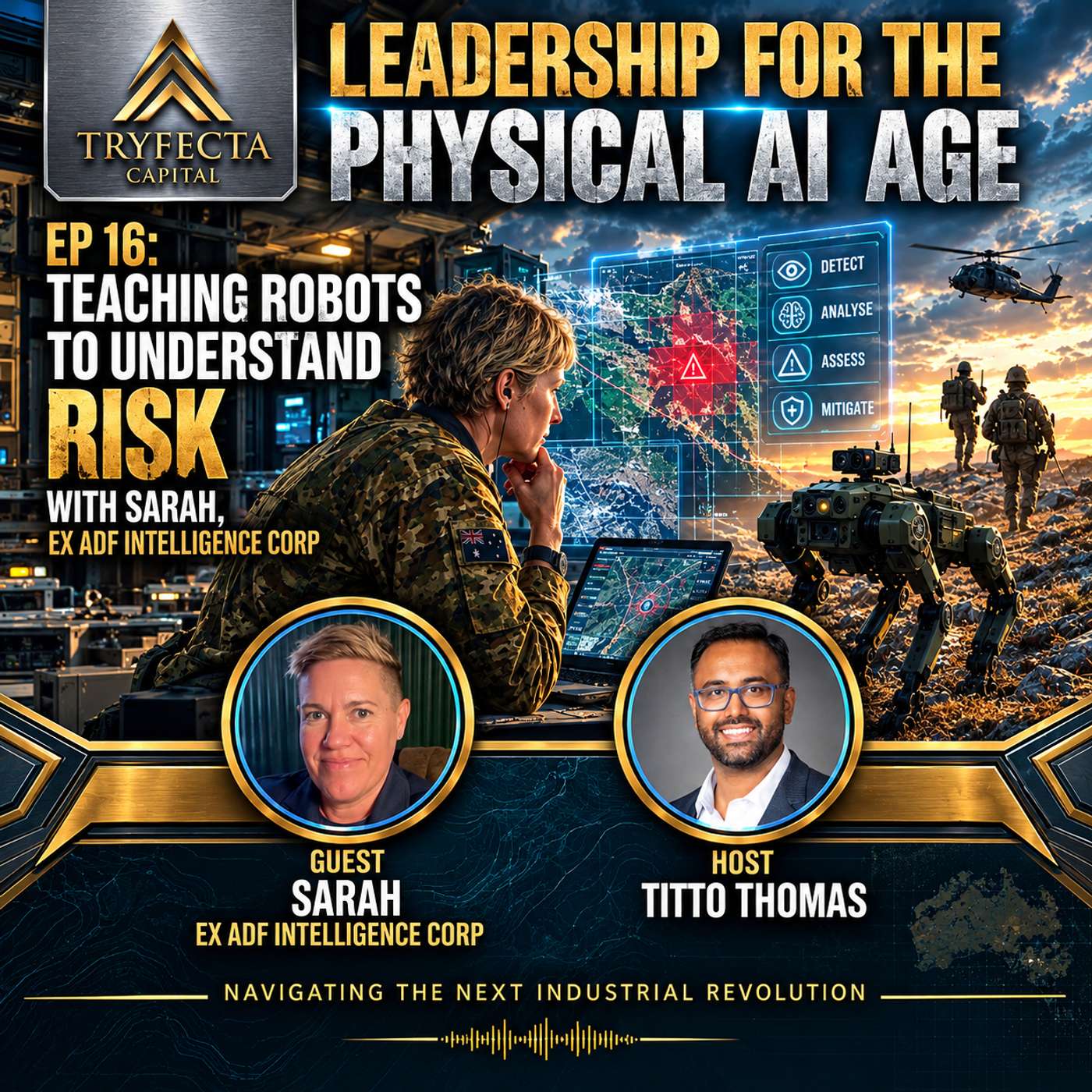
EP 16: Teaching Robots to Understand Risk
from Leadership for the Physical AI Age Hosted by Titto Thomas
What does it take to teach autonomous physical systems how to quantify and respect human risk? In this episode of Leadership for the Physical AI Age, host Titto Thomas sits down with Sarah Huth—former Australian Defence Force (ADF) intelligence specialist turned heavy-industry safety and risk practitioner. Drawing from her background in defense intelligence and frontline experience across Australian mining, oil, and gas, Sarah breaks down why workplace safety has remained largely reactive and weighed down by administrative overhead. Together, Titto and Sarah explore the shift from static checklists to proactive risk intelligence: how to train AI agents to bridge the "say-do gap," unify isolated data across operations and maintenance (CAMS), mitigate human cognitive bias and normalization of deviance, and apply Vision Language Models (VLMs) directly to field safety without crossing into invasive surveillance. Key Discussion Highlights Threats vs. Hazards: Applying enterprise risk management principles and battle-space environmental control from the military to heavy industrial worksites. The "Say-Do Gap": Why written safety procedures fail on the ground due to human fatigue, distraction, peer pressure, and procedural drift. Unifying Siloed Systems: Connecting computerized asset management systems (CAMS), daily operations logs, and safety reports into a single, cohesive organism. Stabilizing Risk Tolerance: How AI can standardize Risk Analysis Matrices (RAM), calibrate frontline hazard inputs, and surface weak signals before incidents happen. Industry 5.0 vs. 6.0: The practical realities of keeping humans in the loop alongside autonomous mobile machinery and clustered worksites. Vision Language Models (VLMs) & Governance: Using computer vision for sentiment mapping, situational awareness, and automated compliance tasks—such as performing chemical inventory stocktakes directly from a photo. Safety vs. Privacy: Balancing on-site monitoring and vehicle cameras with worker trust while maintaining the ultimate mission: ensuring everyone returns home safe. Timestamps – Introduction: Welcome Sarah Huth – Transitioning from ADF intelligence into heavy-industry WHS – Security threats vs. safety hazards: The shared foundation of risk – Lessons from overseas tours: Operational perspective and defense trickle-down – The human factor: Cognitive bias and safety rules "written in blood" – Moving from reactive reporting to actionable intelligence across CAMS and operations – Inductive vs. deductive analysis in fast-moving environments – Normalization of deviance and procedural compliance on site – Augmenting the Risk Analysis Matrix (RAM) using AI – Viewing the enterprise as a single data organism – Practical AI: Uncovering low-cost solutions to high-cost problems – Why operational risk is the foundation of physical AI – Closing the "say-do gap" and streamlining the hierarchy of controls – Industry 5.0 vs. 6.0: Collaborative robotics vs. remote autonomy – Worksite command-and-control: Structuring uncontrolled environments – Alleviating administrative double-handling for safety professionals – Visual intelligence: VLMs, fatigue detection, and situational mapping – Navigating the privacy friction of on-site monitoring systems – The vision: Shifting safety leaders from paperwork to frontline coaching – Automating governance: Instant chemical stocktakes via photos and dynamic SDS - Closing thoughts and wrap-up Connect & Resources Host: Connect with Titto Thomas on LinkedIn Explore Deep Tech & Physical AI: Tryfecta Capital Subscribe: Follow Leadership for the Physical AI Age on Apple Podcasts, Spotify, and your favorite listening platform so you never miss an episode.
Embed this episode
No transcript yet.