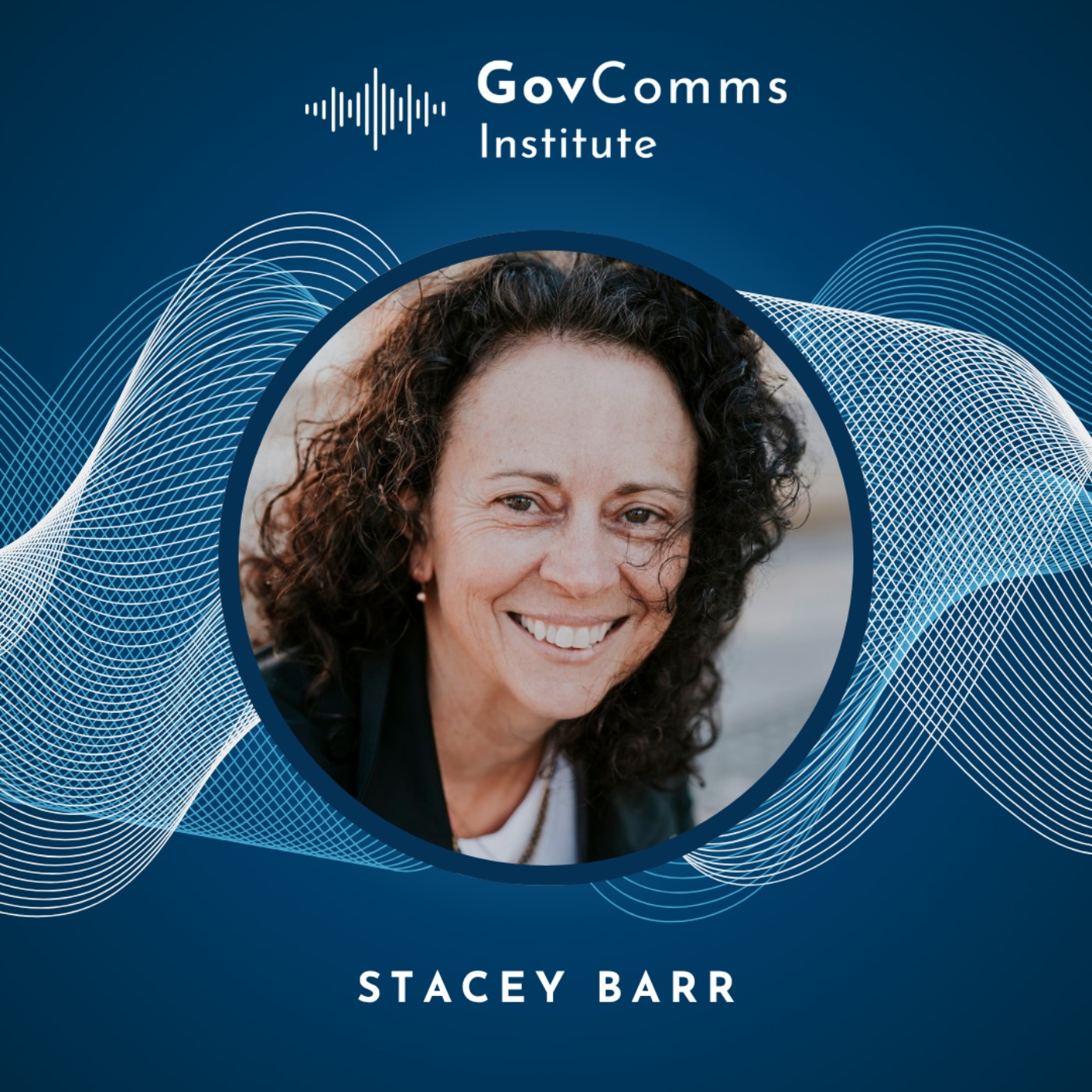
EP#193: Building KPIs leaders can trust with Stacey Barr episode artwork

EPISODE · Jul 3, 2026 · 58 MIN

EP#193: Building KPIs leaders can trust with Stacey Barr

from GovComms: The Future of Government Communication

Measurement should make our work clearer, not harder. Host David Pembroke is joined by Stacey Barr, a specialist in organisational performance, measurement and evidence-based leadership, to unpack why evaluation still feels elusive in government, even when toolkits and frameworks are readily available. They discuss the hidden “missing pieces” that undermine many measurement approaches, how to strip out vague “weasel words” from strategy, and how Stacey’s PuMP methodology helps teams define results, identify credible evidence, and report performance in a way that supports better decisions. The conversation also explores the role of leadership, the reality of public accountability pressures, and where AI can (and cannot) help.KEY POINTS- Start with results, not activity: Be clear about the outcome you want to improve before you decide what to measure, otherwise you end up tracking busywork instead of impact.- De-weasel your strategy language: Replace vague terms such as “quality”, “transparency” or “diversity” with plain, specific wording that everyone can interpret the same way.- Define evidence before choosing measures: Ask what you would see, hear or observe that proves progress, then work out how to quantify that evidence.- Report performance to reveal real signals: Move beyond traffic-light reporting and focus on patterns that show meaningful change, so you don’t overreact to noise or miss early warnings.- Tie initiatives directly to the KPI they shift: Keep actions and results connected, so you can prove whether an initiative actually closed a performance gap.SHOW NOTES:●     PuMP® (Performance Measurement Process): Stacey Barr’s practical methodology for performance measurement mentioned in the episodehttps://www.pump.academy/●     Practical Performance Measurement (book): Book by Stacey Barr mentioned in the episodehttps://www.amazon.com/s?k=Practical+Performance+Measurement+Stacey+Barr●     Prove It! (book): Book by Stacey Barr mentioned in the episodehttps://www.amazon.com/s?k=Prove+It%21+Stacey+Barr●     Australia Centre for Evaluation (ACE): Australian Government evaluation initiative mentioned (including toolkit/library resources)https://www.pmc.gov.au/resources/australia-centre-evaluation●     Harvard Business Review (website): Stacey notes her content has appeared on HBR’s websitehttps://hbr.org/●     ManageMentor (platform): Program Stacey describes as featuring her contenthttps://www.managementmentor.com/●     OKR Institute: Organisation mentioned in relation to the OKR Institute World Summithttps://okrinstitute.org/●     Objectives and Key Results (OKR) framework: Framework explicitly referenced (“OKRs, objectives and key results”)https://www.whatmatters.com/faqs/okr-meaning-definition-example/●     State Library of South Australia: Organisation cited in Stacey’s case examplehttps://www.slsa.sa.gov.au/●     Federal Aviation Administration (FAA): Organisation cited in Stacey’s case examplehttps://www.faa.gov/●    [email protected]: Email Stacey provides for arranging a “discovery discussion”mailto:[email protected] you enjoyed this podcast then please:  ●     Follow, rate, and review on Apple Podcasts●     Follow and rate on Spotify●     Watch our videos on the GovComms YouTube page●     Connect with us on Facebook, LinkedIn and Instagram!The GovComms Institute podcast is produced by contentgroup. Hosted on Acast. See acast.com/privacy for more information.

Measurement should make our work clearer, not harder. Host David Pembroke is joined by Stacey Barr, a specialist in organisational performance, measurement and evidence-based leadership, to unpack why evaluation still feels elusive in government, even when toolkits and frameworks are readily available. They discuss the hidden “missing pieces” that undermine many measurement approaches, how to strip out vague “weasel words” from strategy, and how Stacey’s PuMP methodology helps teams define results, identify credible evidence, and report performance in a way that supports better decisions. The conversation also explores the role of leadership, the reality of public accountability pressures, and where AI can (and cannot) help.KEY POINTS- Start with results, not activity: Be clear about the outcome you want to improve before you decide what to measure, otherwise you end up tracking busywork instead of impact.- De-weasel your strategy language: Replace vague terms such as “quality”, “transparency” or “diversity” with plain, specific wording that everyone can interpret the same way.- Define evidence before choosing measures: Ask what you would see, hear or observe that proves progress, then work out how to quantify that evidence.- Report performance to reveal real signals: Move beyond traffic-light reporting and focus on patterns that show meaningful change, so you don’t overreact to noise or miss early warnings.- Tie initiatives directly to the KPI they shift: Keep actions and results connected, so you can prove whether an initiative actually closed a performance gap.SHOW NOTES:●     PuMP® (Performance Measurement Process): Stacey Barr’s practical methodology for performance measurement mentioned in the episodehttps://www.pump.academy/●     Practical Performance Measurement (book): Book by Stacey Barr mentioned in the episodehttps://www.amazon.com/s?k=Practical+Performance+Measurement+Stacey+Barr●     Prove It! (book): Book by Stacey Barr mentioned in the episodehttps://www.amazon.com/s?k=Prove+It%21+Stacey+Barr●     Australia Centre for Evaluation (ACE): Australian Government evaluation initiative mentioned (including toolkit/library resources)https://www.pmc.gov.au/resources/australia-centre-evaluation●     Harvard Business Review (website): Stacey notes her content has appeared on HBR’s websitehttps://hbr.org/●     ManageMentor (platform): Program Stacey describes as featuring her contenthttps://www.managementmentor.com/●     OKR Institute: Organisation mentioned in relation to the OKR Institute World Summithttps://okrinstitute.org/●     Objectives and Key Results (OKR) framework: Framework explicitly referenced (“OKRs, objectives and key results”)https://www.whatmatters.com/faqs/okr-meaning-definition-example/●     State Library of South Australia: Organisation cited in Stacey’s case examplehttps://www.slsa.sa.gov.au/●     Federal Aviation Administration (FAA): Organisation cited in Stacey’s case examplehttps://www.faa.gov/●    [email protected]: Email Stacey provides for arranging a “discovery discussion”mailto:[email protected] you enjoyed this podcast then please:  ●     Follow, rate, and review on Apple Podcasts●     Follow and rate on Spotify●     Watch our videos on the GovComms YouTube page●     Connect with us on Facebook, LinkedIn and Instagram!The GovComms Institute podcast is produced by contentgroup. Hosted on Acast. See acast.com/privacy for more information.

NOW PLAYING

EP#193: Building KPIs leaders can trust with Stacey Barr

0:00 58:36

No transcript for this episode yet

We transcribe on demand. Request one and we'll notify you when it's ready — usually under 10 minutes.

Frequently Asked Questions

How long is this episode of GovComms: The Future of Government Communication?

This episode is 58 minutes long.

When was this GovComms: The Future of Government Communication episode published?

This episode was published on July 3, 2026.

What is this episode about?

Measurement should make our work clearer, not harder. Host David Pembroke is joined by Stacey Barr, a specialist in organisational performance, measurement and evidence-based leadership, to unpack why evaluation still feels elusive in government,...

Can I download this GovComms: The Future of Government Communication episode?

Yes, you can download this episode by clicking the download button on the episode player, or subscribe to the podcast in your preferred podcast app for automatic downloads.
URL copied to clipboard!