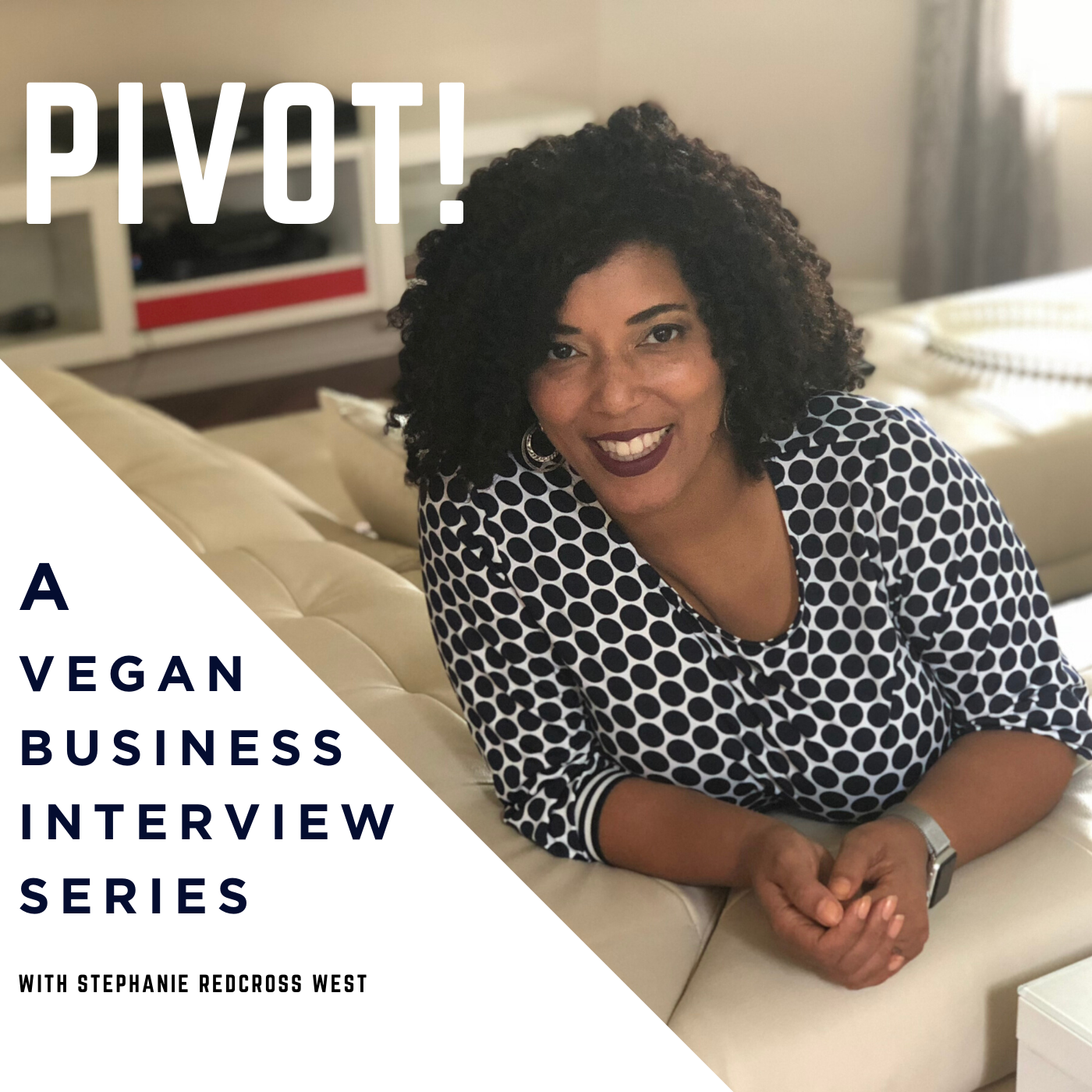
As vegan and plant-based business owners and entrepreneurs, we're often adapting to a new reality. This new podcast series from Vegan Mainstream is an opportunity to help you when it's time to pivot. These interviews will come from inside and outside of our community. And I hope as your host, Stephanie Redcross West, I can inspire you and give you the tools that you need to move forward.
Hello everyone and welcome to our next interview. I'm really excited today because we have JL Fields in the house. I'm excited about this because not only have I known JL for years, we've been able to do projects together. We actually did a vegan professional bootcamp years ago.
It almost feels like eons ago in Colorado. We've also done a myriad of things together. And we've just been trying to stay in touch all these years, but we were just realizing during the catch-up session that it's almost been three years since we've seen each other. So I hope everyone indulges me a little bit.
I'm going to use this session as a way to even catch up with JL, allow everyone else to make sure you're catching up with all the action because JL is not only just an amazing pillar in our community. Really what just blows me away from what JL is doing is she just has so many ways that she's driving impact, you know, whether it's through consulting, whether it's being a health coach, whether it's writing books, cookbooks. Oh my goodness. How many do you have now, JL?
The seventh came out last month. The seventh cookbook. And with her last cookbook coming out last month, we will cover that as well. So many of you that are maybe cookbook buyers like myself, we will talk about that so you can get your hands on it as well.
And I'm really just excited to not only catch up with JL, but talk about pivoting. JL has been doing this for a while, like myself, so has a good amount of experience around what it takes to kind of ebb and flow, what it takes to fulfill your passion and also what it takes to know when to keep working on something and when that passion has been fulfilled and it's time to pivot to something new. So we're going to cover a ton of topics today. I hope everyone is buckled in and ready to go.
And let me just say a warm welcome to JL. Thank you so much for being here with me today. Thanks for having me, Stephanie. I miss you so much.
I can't believe you just took me back to that Colorado workshop. That was amazing. Proof of what vegan mainstream does, by the way, because that brought together a group of people that weren't getting in the room together. And it really demonstrated that we have more in common than not.
And it was a perfect example of collaboration. And so I'm so glad you took me back down that memory lane. It's good to see you. Oh, it's great to see you as well.
And yes, I think collaboration is really the key, even as we think about moving forward with many of us kind of running our businesses differently. Many of us trying different things. I think we really should be looking at kind of the collaborative future in 2020 and maybe even 2021 as not only a great way to grow, but a great way to kind of work together to move kind of veganism forward to make those bigger impacts. But before I get all excited and start talking about 2020 and beyond, let's anchor ourselves.
Maybe give everyone a little bit of background in case there's like two people in the world that haven't met JL yet. Let's just give them a little bit of background. How long have you been vegan? And maybe give us a little bit of background on your original vegan journey.
Okay, I'll do the short version. I love that we all have our story, you know, and some of them can be more dramatic than others. So I'm going to tell you, I've been vegan for 10 years and that wasn't a dramatic transformation. It was the vegetarian transformation 18 years ago when I was in Africa opening a safe house for girls.
I was running a nonprofit organization. That was my life before I became a crazy vegan pro. And there was a wonderful celebration. We were in the Rift Valley in Kenya.
And part of that celebration included a male elder bringing a goat into the celebration and the goat was slaughtered and ensued and served for dinner. And at that point, I was a meat and potatoes gal from the Midwest, living in New York, traveling to Africa, and I ate the goat and I became vegetarian after dinner. And luckily for me, my husband did all the cooking back then. So I rang him up from the airport on my way to South Africa.
I said, honey, I'm a vegetarian. And by the time I got home, Dave was taking care of everything. But eight years after that, you know what? I just, you know, kind of, I guess, had that evolution that people have.
Although truthfully, I was doing a nutritional cleanse. It was back when I dieted all the time and I was doing this cleanse where I did no dairy, no alcohol, no sugar, no, I don't know, other things that I loved, wheat. I did things up for like 16 days and realized I've been vegan for 16 days. So I was like, okay, I guess I'm a vegan.
So it was a little less dramatic, but that's the key. And also I think the key is you got on the path. I think for a lot of people, you don't have to have this crazy over-the-top story. The idea is that you're here and not even just that, what you've done with being here, with being a part of the community.
And I think the dramatics and the excitement is also around just the great work you do. So let's give everyone a little bit of background. Let's just break it down a little bit of where you kind of have your, as I like to say, irons in the fire. Just give them a little bit of breakdown on the type of work you do and maybe what an average week or day in JL's life is like.
Okay, so for perspective, when I became a vegan, I was working in my, what I call my other life, that I've been doing for years and years, which is I have a master's degree in college student personnel administration. I'd worked in the nonprofit sector and in the higher education space for 25, 30 years. And then I became a vegan and I started a blog as people did back then. And I was kind of just writing this blog as a 45-year-old woman who has gone vegan.
Suddenly is cooking again because spoiler alert, my husband quit cooking as soon as I went vegan because he's like, I don't know what to do with that. So this is all significant because it was what led up to what my business became and how it's evolved over the years, which was essentially, I was far more into the veganism than I was with the work that I was doing on a day-to-day basis. At my last position in my old life, I was a senior fundraiser at the college level. And that's not what was sparking joy for me.
And that was not what was my passion. My passion was grabbing my laptop, walking into the faculty and staff lounge and writing my blog posts. And so I started tapping into what was interesting to me. So I started going to conferences, which I believe the first time you and I met was at VeggieCon.
So yeah, so I went to a vegan blogging conference and there I met Jenny Messina, who at the time was the author, coauthor of Vegan for Life with Jack Norris. And I just admired her so much because her website, The Vegan RD, helped me go vegan and like figure out how to eat healthfully. And by doing these networking things and going to conferences, because I wanted to be a better food writer, taking cooking classes because I wanted to learn how to be a better cook and then write about that on my website. Those networking, almost anything that's happened in my career ever is directly related to networking and to being vulnerable and being open and taking a risk and shaking the hands of a stranger.
And I say that because Jenny Messina wrote to me several months after we met at VeggieCon. That was in 2011. And she invited me to co-author a book with her called Vegan for Her. And I said yes.
And then I was so into that process that I decided to take a huge risk and I quit my job. And I decided I was gonna try to make a go at being, I guess, a solopreneur, I believe I remember you calling it that, where I didn't know what I was going to do. I just knew it was going to be services. I didn't want to be a company.
I wasn't selling a product. I just wanted to take my vegan passion and turn it into what I do on a daily basis. And my hope was that every day I would either be doing something to pay my mortgage or I would be doing something as a volunteer, but that it would always be vegan. It would always be my soul.
And I wouldn't know when I was making money and when I was being a volunteer, but it would be irrelevant because it would work out. And that's kind of how my business started. Perfect. I love that because not only did it show that, you know, sometimes these things take time.
You know, everyone thinks I meet someone, you know, you start the process from networking and two days later, it blooms. Sometimes it's like seeds. They have to grow over time. So I really love the fact that, you know, it took a little bit of time for you guys to get together and write the book.
But I love that the book became something that allowed you to make that leap, to make that kind of jump into, okay, I'm going to make sure I'm dedicating We try to avoid sometimes the pain. We try to avoid the bad, you know, if I get the bad in quotes. And I think sometimes we forget that that's a part of the process that allows us to be stronger when we're hit with that next adversity, when we're hit with that next disappointment or challenge. So I'm really glad that you shared that story.
So if anybody's watching and even now you're still struggling, even with some states opening, states closing, things are going back and forth for many people in their states, that you kind of move through that emotion, allow yourself to feel it, but also know that this prepares you for that next moment. It makes you stronger and really makes you kind of hit that resilience stage that I think is just amazing for all, all entrepreneurs to be able to achieve. So as we talk about pivoting, let's talk about what you did. I mean, for many of us, we were probably on your email list, so we might be familiar with just the wonderful gift you gave to the world during the time that we were all shut down and shut in.
So maybe give everyone a little bit of insight on what you did kind of as your immediate reaction and then what you did as you moved forward and maybe moved out of that immediate reaction to something that was a little more sustainable. So I did something very impulsively, which is, you know, I talked about how I just felt like I'm losing what feeds my soul being around other people and getting them excited about vegan cooking and vegan living. And so our governor made an announcement. I believe it was on a Friday that the state was going to shut down on that Monday, vegan pantry basics.
So if we're all stuck at home, we're cooking out of a freezer or a pantry. And I threw up a zoom link, said the class is free. And it was on a Sunday at one o'clock, my time, mountain time. And Stephanie, 300 people tried to come to my class, but I didn't know anything about zoom and did not realize that I was paying for like the cheap version.
So I only could handle a hundred people. So 200 people couldn't get into my class. A hundred people were there and it was so much fun. I had no idea what I was doing.
I don't have a fancy camera. I don't have fancy lighting. I do not have a fancy kitchen. And I just did it.
And I realized that I was doing what my books do and what I do in my cooking classes, which is just, maybe I'm an elevated home cook because I've spent some time on this, but it worked. It was fun. And I knew I was on to something. And I just asked at the end of the class, do we want to do this again next week?
And everyone was like, yeah, let's do it. And so I knew I was on to something. I had some obstacles to overcome after that, of course, but I knew that there was a need and I knew that it also fed my soul. Yes.
And what you also showed, at least in my mind, is you showed that your audience could do it. You know, I think sometimes when you make it too glitzy and glamour and it looks like it's super polished, sometimes we feel like our audience feels like we're too far away from it. Like we're not obtainable what we're teaching them. So when you can show that, Hey, this is my kitchen.
I got the camera. Even when you, you know, bump the camera and it shakes and you're like, Oh yeah, sorry about that. You know, those kinds of experiences help us feel not only relatable, but I really think that helps the people that we teach. I think so too.
Yeah. So you did the free classes. You did that for what, about 16 weeks? I ended up doing it for 16 weeks.
Um, but I will say that, you know, I realized I needed a bigger zoom room and that was going to be an expense. So now I'm offering free classes. I don't have my cooking academy, but this is going to cost me money. So I chose to be vulnerable.
Although I'm lucky that some of my friends, uh, pushed me to that place. So I was on Facebook, on my personal Facebook, and it wasn't a public announcement. I just said, um, you guys, I did this class today and I'm heartbroken. 200 people couldn't get in.
And someone said, well, you should like try to have people give you tips. And at first I was like, that's ridiculous. And I was like, Oh, well, maybe I could do that, but wait, how do I do that? And then I thought, okay, well maybe I'll try that.
So I just started doing some Googling and found some way to do a PayPal thing or whatever. I won't get into the details. Figured it out. So I put something on my Facebook, on my professional ones.
And I said, so I'm going to keep doing this. And I decided if you want to give me a tip, you can. And maybe I'll start asking for that, but these classes are going to be free. And people started tipping me for the class that I'd done on Sunday.
And there was a person in Boulder who messaged me and she's like, I'd like to, you know, do you take Venmo? She asked if she could go a different way. And I said, yes. And I just say this because we're talking about business.
And when people don't talk about money, I think that's so freaking weird. We're talking about business. She Venmoed me $1,200. Wow.
And I was like, I didn't see that one coming. I have goosebumps every time I say it. Me neither. Like I was like, what?
And she had taken my class and she Venmoed me. She's like, so you can get a bigger zoom room. And I did. And so then every Sunday I kept doing, I said, I'm going to keep doing these until we're all like, you know, we're all locked in.
So let's just keep doing this for a while. So every Sunday at one o'clock mountain time, I did a free class and I recorded it, all but one. I forgot to do one. And so then I would have the videos after and then I would ask for tips and people gave me enough tips to like make it worth my while and also make it so that people could take the class for free.
And so I ended up doing 16 pandemic cooking classes is what I call them. I love that because to your point, when we're talking about business, we have to pay attention to the financials. Yes. I'm going to give things away.
Yes. We want to support our community, but we still have to be able to afford these things. We all were in totally different situations. Like you said, you're cooking classes.
You weren't able to do that. Revenue was gone. So what people forget Stephanie is like the cooking class because it's a mess, right? It's a hot mess in my kitchen.
And I think that's why people keep showing up. It looks like they were in class for an hour, sometimes two hours because I'm chatty, but I was in my kitchen for three hours before we started. Um, and two days before that I was working on the recipes and I was getting stuff from the grocery store delivered because I wasn't going to grocery stores. And then I was in my kitchen for an hour and a half afterwards cleaning.
And so I was spending a day to do a one hour or two hour class when it comes down to it. And so it felt like my time was valued, which I really appreciated. And then the other thing is I still pay for the rent for my cooking academy. Like none of my expenses as an entrepreneur stopped.
I still, I had more money to pay for zoom. I'm still paying for Canva. I'm still paying for Adobe. I'm still paying my monthly website fee.
I'm paying for my web guy. And so I think that's what people forget too. Like, Oh, well you're not doing your cooking classes. So you also don't have expenses.
Nope. The only expense that I didn't have was paying my assistant or buying the ingredients for my cooking classes. And so, yeah, it was like, I think we forget that, um, when business is closed, that doesn't mean that the financial side of things just stopped and we're just sitting around eating bonbons and you know, hanging out. Absolutely.
We still have to figure out how to make, as they say, make ends meet. So once you moved from the pandemic classes at the end of those 16 weeks, where did you go next and how did you find your way to that? This, I love this because it didn't happen quite that in that linear fashion. I feel like something started to reveal itself during the online classes.
One was that there was a core group of people who kept coming every Sunday and they were my people. Like, like we would talk to one another, you know, like in the chat with zoom, whatever. But um, so I would ask questions like, I'd be like, okay, guys, do we want to have a class 4th of July weekend or, you know, just like think out loud. And I was like, can I have a weekend off?
Because I realized I hadn't had a weekend off since March. And they were like, take a weekend off. We're fine. So it's like, it was like, we had a team decided that we wouldn't have a class 4th of July weekend.
And that was just like so heartening to me. And then, um, when we resumed, I said, you guys, I've been thinking about this. So before with my cooking classes in Colorado Springs, people on my social media platforms would leave messages. Like I saw your announcement New book.
And then I don't know if we're giving out spoilers about maybe a next book in the works. I don't know if you, can you physically grab your book? Is it too far away from you? Are you kidding?
I have my baby next to me all the time. Let's just show everyone the new cookbook and maybe give a little bit of a background on why this one. Why buy this one? So, well, don't you think it's kind of crazy that all winter long before the pandemic hit, I was writing a vegan baking book and then suddenly the pandemic happens and everyone is growing a sourdough starter and like making bread from scratch.
And so, like, I don't know, the universe. But the reason I wrote vegan baking for beginners is because I'm not a trained baker or pastry chef and actually a bit of a hack and was really scared of it, which I think a lot of people are. And so there were two audiences for this book. This book was designed for people who are brand new vegans or thinking about vegan and they have no idea how to bake without eggs and milk and all kinds of dairy and animal products.
But also for people who have been vegan for a very long time and know how to do all of those things, but they don't think they know how to bake. So it's very basic. It is not a health book. It's not a diet book.
It's not a gluten free book. It's got sugar and flour and vegan butter and yummy, delicious treats to help people who are trying to learn to bake or learn to bake as a beginner. So that was, yeah, the timing was crazy that it came out. So if you're still home trying to bake because you're like stuck in your house, that would be a good reason to get it.
Absolutely. I love baked goodies. That is just such my weakness. So as we think about moving forward, as we think about where you may be going next, do you want to give everyone a little bit of idea of what you think the rest of 2020 will look like for JL?
Or if they have to stay tuned, let's make sure they have your website and your social media so that they can stay in touch. Well, for sure, 2020 is going to be for me. The rest of the year is the year of online cooking classes. I would rather have far reach, continue to do what I love to do and make sure that people have that kind of resource.
The next book that's coming out this fall that I got to work on a book during the pandemic is around plant-based eating. And that's gonna be surprising for people who've been following me, but it's also because plant-based is pretty specific and not really a diet. And I like that I'm going to get to reframe that a little bit for people. And so I am excited about focusing on that.
That book will come out in the fall. And you know, what I think for 2021 is the one thing that has not changed over eight years when I started my business. I'm vegan for the animals. I am vegan for people.
I am vegan because I believe in justice for all. And I don't know what 2021 will bring, but I know that whatever I'm doing will be working on behalf of justice for all beings. That is wonderful. So if people want to get in touch with you, where should they go?
My website is JLgoesvegan.com. You can find all my classes and information there. You can message me on the website and you can watch the pandemic cooking series. So go to JLGoesVegan.com slash classes, scroll down and you'll see 15 of the 16 classes.
Perfect. Well, thank you so much for your time today. Thank you for everyone who watched us live. If you're watching this as a replay, you can always still put comments in there.
We're monitoring it, checking it out. We love for this to be interactive, even if you couldn't join us exactly at the time you were going live, as well as we love likes and hearts and appreciate any time that you can support us and show us that you're enjoying these interview series and obviously enjoying this interview and opportunity for me and hopefully for many of you to get caught up on everything that JL is doing and how she's making such an amazing impact in the movement and the world. So thank you everyone. Thank you, JL one more time, and we will get to today's interview.
Bye everyone.