
EPISODE · Jan 5, 2026 · 37 MIN
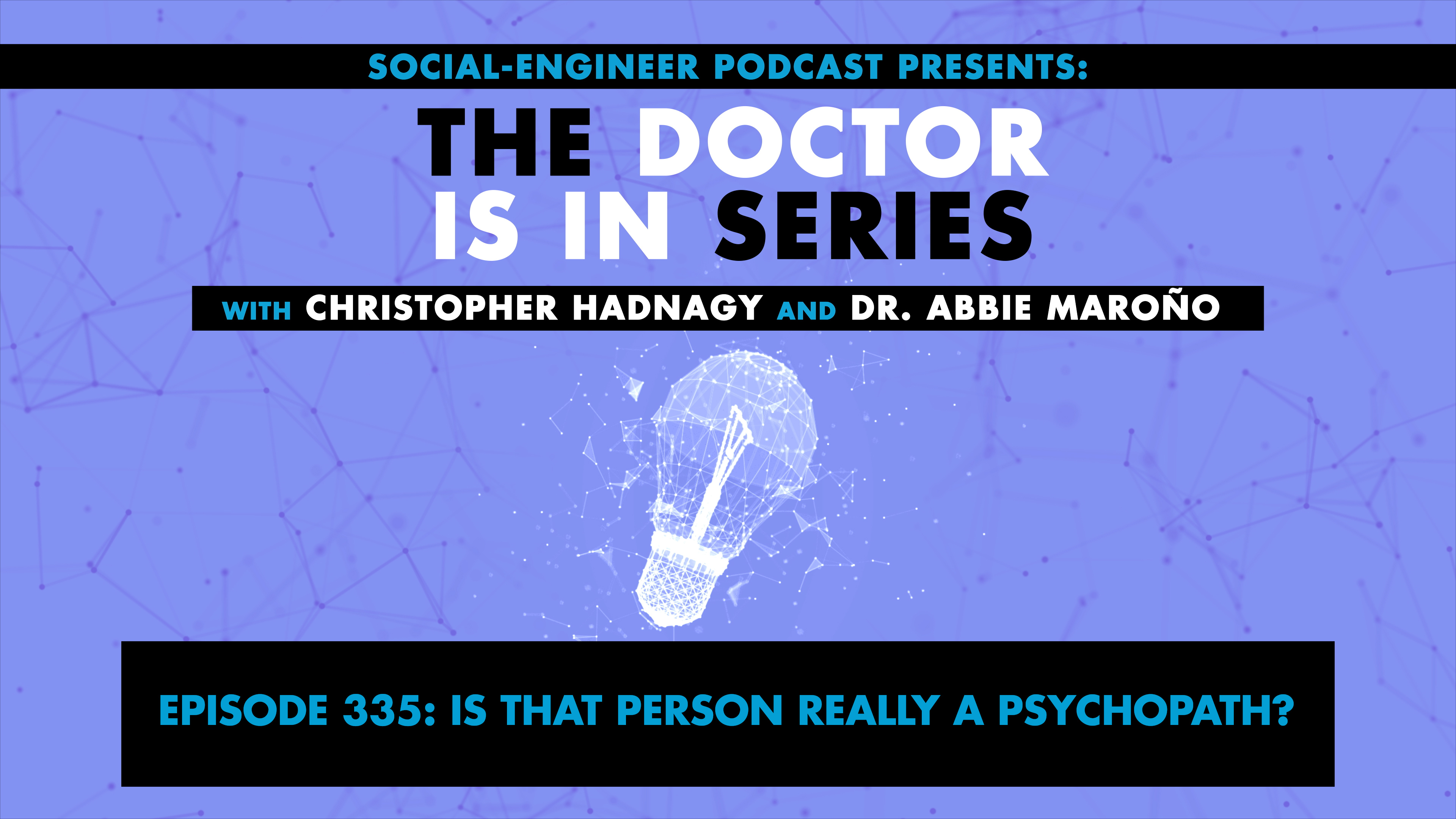
Ep. 335 - The Doctor Is In Series - Is That Person Really a Psychopath?
from The Social-Engineer Podcast · host Social-Engineer
Welcome to the Social-Engineer Podcast: The Doctor Is In Series – where we will discuss understandings and developments in the field of psychology. In today's episode, Chris and Dr. Abbie explore psychopathy, focusing on its clinical definition and common misconceptions. They discuss how the term is often misapplied to various behaviors, stressing the importance of understanding its roots in empathy and fear. By highlighting the need for accurate knowledge, they aim to prevent stigmatization and promote a deeper understanding of mental health. [Jan 5, 2026] 00:00 - Intro 00:24 - Dr. Abbie Maroño Intro 00:42 - Intro Links - Social-Engineer.com - http://www.social-engineer.com/ - Offensive Security Vishing Services - https://www.social-engineer.com/offensive-security/vishing/ - Offensive Security SMiShing Services - https://www.social-engineer.com/offensive-security/smishing/ - Offensive Security Phishing Services - https://www.social-engineer.com/offensive-security/smishing/ - Call Back Phishing - https://www.social-engineer.com/offensive-security/call-back-phishing/ - Adversarial Simulation Services - https://www.social-engineer.com/offensive-security/adversarial-simulation/ - Social Engineering Risk Assessments - https://www.social-engineer.com/offensive-security/social-engineering-risk-assessment/ - Social-Engineer channel on SLACK - https://social-engineering-hq.slack.com/ssb - CLUTCH - http://www.pro-rock.com/ - innocentlivesfoundation.org - http://www.innocentlivesfoundation.org/ 03:47 - The Topic of the Day: Psychopathy 04:28 - A Proper Definition 06:13 - Key Indicators 07:46 - Lack of Empathy 09:36 - The Influence of Social Media 11:51 - Evil ≠ Psychopathy 12:40 - Environment Matters 14:17 - Size Matters 16:02 - MasterClass Ad 17:28 - Work Advantage 18:46 - Gender Differences 20:54 - Big Red Flag! 26:00 - Teaching Emotional Regulation 27:27 - Label Hoarding 32:33 - It's Not Exclusive 36:04 - Wrap Up 36:58 - Next Month's Topic: Imposter Syndrome 37:23 - Outro - www.social-engineer.com - www.innocentlivesfoundation.org Find us online: - LinkedIn: linkedin.com/in/dr-abbie-maroño-phd - Instagram: @DoctorAbbieofficial - LinkedIn: linkedin.com/in/christopherhadnagy References: Blair, R. J. R. (2007). The amygdala and ventromedial prefrontal cortex in morality and psychopathy. Trends in Cognitive Sciences, 11(9), 387–392. https://doi.org/10.1016/j.tics.2007.07.003 Blair, R. J. R. (2013). The neurobiology of psychopathic traits in youths. Nature Reviews Neuroscience, 14(11), 786–799. https://doi.org/10.1038/nrn3577 Frick, P. J., & White, S. F. (2008). Research review: The importance of callous-unemotional traits for developmental models of aggressive and antisocial behavior. Journal of Child Psychology and Psychiatry, 49(4), 359–375. https://doi.org/10.1111/j.1469-7610.2007.01862.x Glenn, A. L., & Raine, A. (2014). Neurocriminology: Implications for the punishment, prediction and prevention of criminal behaviour. Nature Reviews Neuroscience, 15(1), 54–63. https://doi.org/10.1038/nrn3640 Hare, R. D. (2003). Manual for the Hare Psychopathy Checklist–Revised (2nd ed.). Toronto, ON: Multi-Health Systems. Hare, R. D., & Neumann, C. S. (2008). Psychopathy as a clinical and empirical construct. Annual Review of Clinical Psychology, 4, 217–246. https://doi.org/10.1146/annurev.clinpsy.3.022806.091452 Patrick, C. J. (Ed.). (2018). Handbook of psychopathy (2nd ed.). New York, NY: Guilford Press. Pemment, J. (2013). Psychopathy versus sociopathy: Why the distinction has become crucial. Aggression and Violent Behavior, 18(5), 458–461. https://doi.org/10.1016/j.avb.2013.07.001 Severson, H., & Lynam, D. R. (2020). Psychopathy and antisocial personality disorder: Distinctions and implications for treatment. Current Opinion in Psychology, 37, 27–32. https://doi.org/10.1016/j.copsyc.2020.07.006 Skeem, J. L., Polaschek, D. L. L., Patrick, C. J., & Lilienfeld, S. O. (2011). Psychopathic personality: Bridging the gap between scientific evidence and public policy. Psychological Science in the Public Interest, 12(3), 95–162. https://doi.org/10.1177/1529100611426706 Viding, E., Blair, R. J. R., Moffitt, T. E., & Plomin, R. (2005). Evidence for substantial genetic risk for psychopathy in 7-year-olds. Journal of Child Psychology and Psychiatry, 46(6), 592–597. https://doi.org/10.1111/j.1469-7610.2004.00393.x Walsh, Z., & Kosson, D. S. (2008). Psychopathy and violent crime: A prospective study of the influence of psychopathic traits on violence among offenders. Psychiatry, Psychology and Law, 15(2), 181–194. https://doi.org/10.1080/13218710802014489
Embed this episode
NOW PLAYING
Ep. 335 - The Doctor Is In Series - Is That Person Really a Psychopath?
No transcript for this episode yet
Similar Episodes
No similar episodes found.
Similar Podcasts
No similar podcasts found.