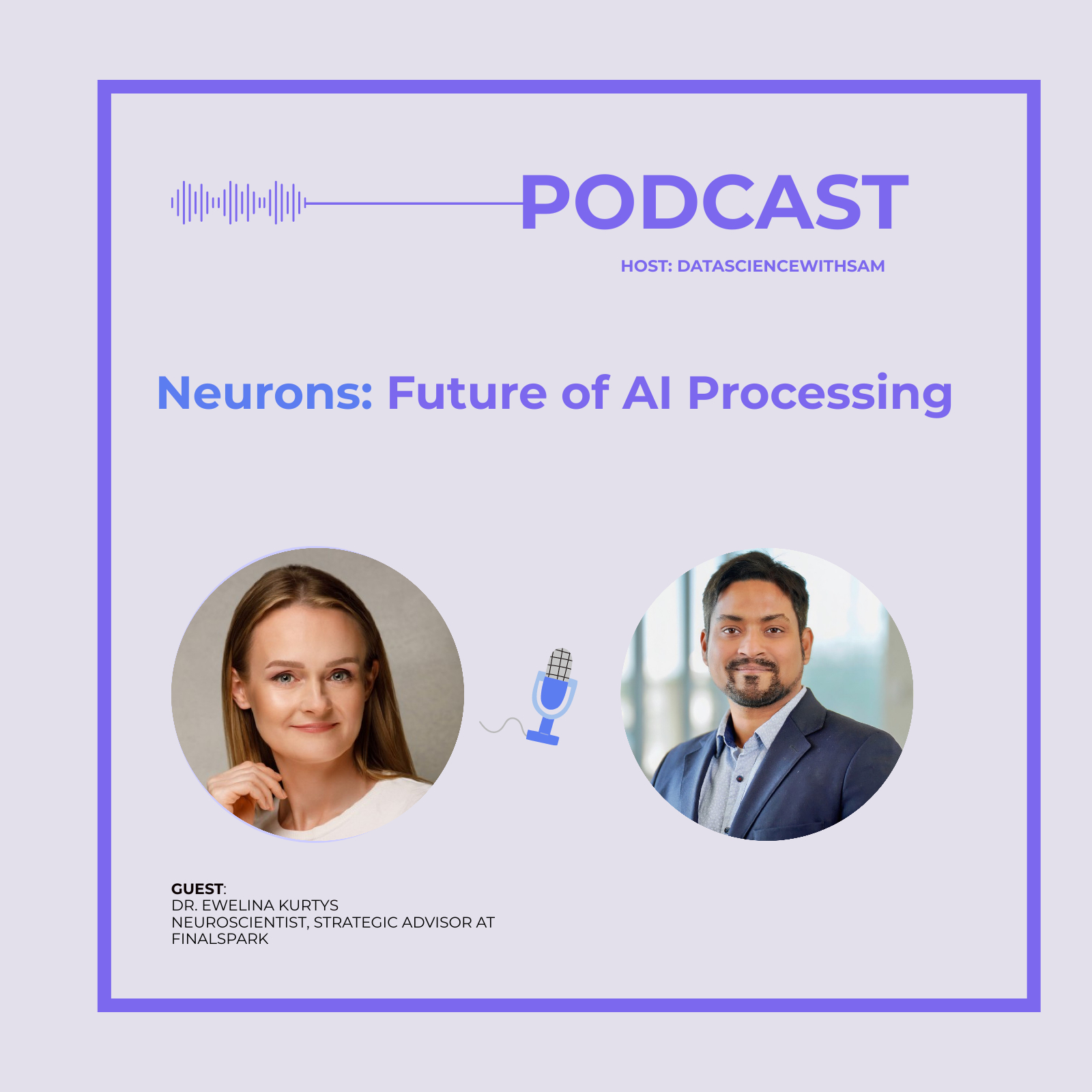
EP 37: Neurons: Future of AI Processing episode artwork

EPISODE · Apr 19, 2026 · 29 MIN

EP 37: Neurons: Future of AI Processing

from Data Science With Sam · host Soumava ’Sam’ Dey

What if the next generation of computers wasn't made of silicon — but of living human neurons? Not simulated neurons, not artificial neural networks inspired by biology, but actual brain cells grown in a lab, connected to electrodes, and used to process information. That's not science fiction anymore. It's happening right now at FinalSpark, a Swiss startup building the world's first remotely accessible biocomputing platform. In this episode, Sam talks with Dr. Ewelina Kurtys, a neuroscientist with a PhD in brain imaging and a postdoctoral researcher at King's College London, about how living neurons could revolutionise computing — and why they use one million times less energy than silicon-based AI hardware.   ▸  WHAT YOU'LL LEARN ▪  How FinalSpark was founded in 2014 by Fred Jordan and Martin Kutter — and why they pivoted from digital AI to biological computing when they realised the energy and cost problem was unsolvable with silicon ▪  Why 20 watts powers the human brain while silicon-based AI requires megawatts — and what that means for AI's sustainability crisis ▪  The difference between neurons as processors (not power sources) — a crucial distinction most people get wrong ▪  Why biological neural networks learn continuously while digital systems require full model updates — and what that means for energy efficiency ▪  The honest challenge: nobody yet knows exactly how neurons encode information — the biggest scientific hurdle in biocomputing right now ▪  How the I/O interface works: electrodes measuring neural spikes, analog-to-digital converters, researchers writing Python code to control neurons remotely ▪  The remote access breakthrough: researchers in Tokyo or Bristol can log in and control living neurons in Switzerland in real time via browser ▪  Why neurons won't outperform GPUs on speed: biocomputing specialises in efficiency and adaptability, not clock cycles ▪  FinalSpark's current stage: they've stored 1 bit of information and are collaborating with 9 universities on fundamental research ▪  The cost argument: even at 10× lower price than NVIDIA, biocomputers would still generate billions in profit due to energy and infrastructure savings ▪  Bioethics, consent, and regulation: how FinalSpark is working with philosophers now to establish ethical frameworks before biocomputing scales ▪  Why human-machine integration is not new: prosthetics, pacemakers, and smartphones are already blending biology and technology ▪  The hybrid computing future: silicon, quantum, and biocomputing will coexist, each doing what they do best ▪  The real game-changer: cheap, accessible AI for everyone — Ewelina's vision for what biocomputing means for society in 10–20 years.   ▸  LINKS MENTIONED IN THIS EPISODE →  Dr. Ewelina Kurtys on LinkedIn →  Ewelina's Personal Blog & Articles →  FinalSpark (official website) →  FinalSpark Neuroplatform (with live neuron view) →  FinalSpark Team →  Psync (Ewelina's mental wellness startup) →  FinalSpark Contact Form

What if the next generation of computers wasn't made of silicon — but of living human neurons? Not simulated neurons, not artificial neural networks inspired by biology, but actual brain cells grown in a lab, connected to electrodes, and used to process information. That's not science fiction anymore. It's happening right now at FinalSpark, a Swiss startup building the world's first remotely accessible biocomputing platform. In this episode, Sam talks with Dr. Ewelina Kurtys, a neuroscientist with a PhD in brain imaging and a postdoctoral researcher at King's College London, about how living neurons could revolutionise computing — and why they use one million times less energy than silicon-based AI hardware.   ▸  WHAT YOU'LL LEARN ▪  How FinalSpark was founded in 2014 by Fred Jordan and Martin Kutter — and why they pivoted from digital AI to biological computing when they realised the energy and cost problem was unsolvable with silicon ▪  Why 20 watts powers the human brain while silicon-based AI requires megawatts — and what that means for AI's sustainability crisis ▪  The difference between neurons as processors (not power sources) — a crucial distinction most people get wrong ▪  Why biological neural networks learn continuously while digital systems require full model updates — and what that means for energy efficiency ▪  The honest challenge: nobody yet knows exactly how neurons encode information — the biggest scientific hurdle in biocomputing right now ▪  How the I/O interface works: electrodes measuring neural spikes, analog-to-digital converters, researchers writing Python code to control neurons remotely ▪  The remote access breakthrough: researchers in Tokyo or Bristol can log in and control living neurons in Switzerland in real time via browser ▪  Why neurons won't outperform GPUs on speed: biocomputing specialises in efficiency and adaptability, not clock cycles ▪  FinalSpark's current stage: they've stored 1 bit of information and are collaborating with 9 universities on fundamental research ▪  The cost argument: even at 10× lower price than NVIDIA, biocomputers would still generate billions in profit due to energy and infrastructure savings ▪  Bioethics, consent, and regulation: how FinalSpark is working with philosophers now to establish ethical frameworks before biocomputing scales ▪  Why human-machine integration is not new: prosthetics, pacemakers, and smartphones are already blending biology and technology ▪  The hybrid computing future: silicon, quantum, and biocomputing will coexist, each doing what they do best ▪  The real game-changer: cheap, accessible AI for everyone — Ewelina's vision for what biocomputing means for society in 10–20 years.   ▸  LINKS MENTIONED IN THIS EPISODE →  Dr. Ewelina Kurtys on LinkedIn →  Ewelina's Personal Blog & Articles →  FinalSpark (official website) →  FinalSpark Neuroplatform (with live neuron view) →  FinalSpark Team →  Psync (Ewelina's mental wellness startup) →  FinalSpark Contact Form

NOW PLAYING

EP 37: Neurons: Future of AI Processing

0:00 29:37

No transcript for this episode yet

We transcribe on demand. Request one and we'll notify you when it's ready — usually under 10 minutes.

MG Show MG Show The MG Show, hosted by Jeffrey Pedersen and Shannon Townsend, is a leading alternative media platform dedicated to uncovering the truth behind today’s most pressing political issues. Launched in 2019, the show has grown exponentially, offering unfiltered insights, comprehensive research, and real-time analysis. With a commitment to independent journalism and factual integrity, the MG Show empowers its audience with knowledge and encourages active participation in the political discourse. French Your Way Jessica: Native French teacher founder of French Your Way Boost your French listening skills and test your comprehension with this one of a kind series of podcasts. Get the chance to listen to a real conversation between native speakers talking at normal speed AND customise your learning experience through carefully designed sets of questions (2 levels of difficulty) available for download at www.frenchvoicespodcast.com. All interviews also come with the transcript. French teacher Jessica interviews native speakers of French from around the world who share a bit of their life and passion. Where else would you meet in one same place a French yoga teacher based in Melbourne, a soap manufacturer from Provence, or a couple cycling around the world? That Hoarder: Overcome Compulsive Hoarding That Hoarder Hoarding disorder is stigmatised and people who hoard feel vast amounts of shame. This podcast began life as an audio diary, an anonymous outlet for somebody with this weird condition. That Hoarder speaks about her experiences living with compulsive hoarding, she interviews therapists, academics, researchers, children of hoarders, professional organisers and influencers, and she shares insight and tips for others with the problem. Listened to by people who hoard as well as those who love them and those who work with them, Overcome Compulsive Hoarding with That Hoarder aims to shatter the stigma, share the truth and speak openly and honestly to improve lives. The Small Business Startup School – Business Notes | Financial Literacy | Retail Psychology – For Professionals & Entrepreneurs The Small Business Startup School Inc. Starting or buying a small business? While personal circumstances may vary, business patterns remain timeless. On The Small Business Startup School, we explore strategies, insights, and practical solutions to help entrepreneurs confidently navigate their journey.Hosted by Ola Williams—a retail entrepreneur, fintech founder, and financial coach with over two decades of experience—this podcast marries financial awareness and retail psychology with optimism to deliver actionable takeaways.Join us to learn, grow, and connect as we uncover the keys to business success.Let’s continue to learn together and be encouraged to keep on connecting!

Frequently Asked Questions

How long is this episode of Data Science With Sam?

This episode is 29 minutes long.

When was this Data Science With Sam episode published?

This episode was published on April 19, 2026.

What is this episode about?

What if the next generation of computers wasn't made of silicon — but of living human neurons? Not simulated neurons, not artificial neural networks inspired by biology, but actual brain cells grown in a lab, connected to electrodes, and used to...

Can I download this Data Science With Sam episode?

Yes, you can download this episode by clicking the download button on the episode player, or subscribe to the podcast in your preferred podcast app for automatic downloads.
URL copied to clipboard!