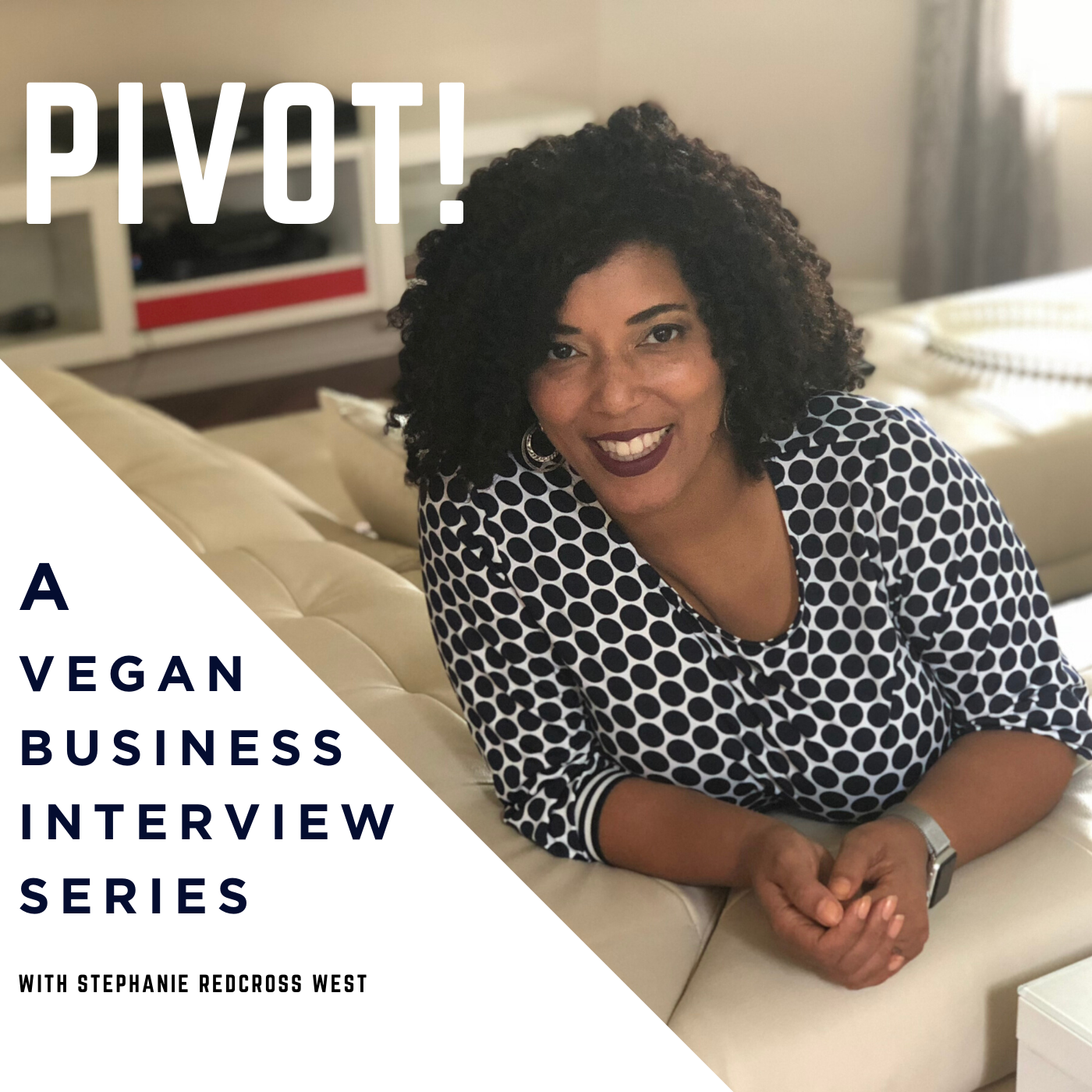
As vegan and plant-based business owners and entrepreneurs, we're often adapting to a new reality. This new podcast series from Vegan Mainstream is an opportunity to help you when it's time to pivot. These interviews will come from inside and outside of our community, and I hope as your host, Stephanie Redcross-West, I can inspire you and give you the tools that you need to move forward. Hello everyone, and welcome to our next interview.
Today, we have a special guest, and I say special because we're going to spend a good amount of time talking about the marketing. We're going to be talking about really some of the things for many of you out there that you can apply to your business. I know sometimes when we do these segments, we talk about perspective, we talk about ideas, we talk about learning, but really what I'm excited about today is having kind of a fellow, I guess, entrepreneur on the line that really understands what it takes to run a business, what it takes to work with the business and brands, and also what it takes to really get that message out and specifically how to do that in a video format. Video, as many of you know, and I talk about often, is really an amazing tool to help people understand who you are, what you offer, and differentiate yourself.
So I'm excited today to hopefully pull back some of those layers and talk about from Darren's perspective, how he does what he does and how he helps brands, and ultimately how some of his advice today may be able to help many of you. So first, let me welcome my guest, Darren, thank you so much for joining me here today. And effectively, that was making movie trailers, creating TV campaigns, radio campaigns. We didn't do the posters.
And eventually later on, we got into the digital assets. But in that entire career, the most fascinating thing about it was it went from analog to digital. So that was a period of time where, you know, the internet wasn't even happening then at that point, like in the early 90s. Like this was from 95 to 2005.
And so within that time period, the digital revolution happened, the internet took off, and this, you know, affected people I worked with, particularly brands who traditionally were using print, radio advertising, TV advertising. There was no online platforms like Netflix or digital outdoor like there is now. But that did happen in that transformation of my career. So it was a fascinating journey.
I got to work on two and a half thousand movies. I worked on the original Lion King, and I actually edited those TV commercials on an SVHS player that we hand logged the edits and then took them to an editor in London who then would produce the TV commercials for television. And fast forward 10 years, then we had our own digital online system in the office where we would edit Pixar movies ourselves without an editor. So that was the transformation.
And what happened towards the end was a lot of these digital agencies started to spring up and a lot more people marketing, a lot more people working within the market. But what a lot of them didn't bring with them was that strong storytelling elements was the expertise of knowing what to do with the visual medium. So that's something that I basically got in my bones and it's something that I love. And I'll talk a bit more about that today.
Now help me understand how you brought those things together, how you took all of these great years of experience and decided to bring it to the vegan business space. What was your maybe aha moment or what happened that made you realize that this is really one of the kind of playgrounds that you wanted to play at? Well, I left that job six years ago and I still wanted to help vegan businesses with the expertise that I had. But I also at that point in time, I was working on a feature film.
My father was quite sick for a number of years. That's why I left that job to spend some time with him. And I realized that, you know, my expertise could be used to help vegan business owners. And I've been vegan now for coming up to five years.
I was a vegetarian on and off leading up to that. Always very conscious about animals, the environment. I mostly went vegan for the animals, health second, planet third. And Cowspiracy, again, being a filmmaker, I know the strength of documentary that kind of underlined it for me.
And I know that's a similar story to a lot of people. And at that point, then I realized how could I then still serve the vegan community better? And so I realized, well, you know, there's not a lot of people like me that have that marketing or video expertise and I could bring that into this market. Absolutely.
There really, there aren't a lot of people with that skill set. And like you mentioned before, with the demand and also the access now, the ability for many of us to, you know, essentially record something with the devices in our hands and, you know, in some cases, even on our computers and so forth. The idea is how to get started. How do we make this work?
So maybe do you want to give people maybe a little bit of background on what you do day to day? Like how would you help businesses? What is your kind of strategy or approach, especially when it comes to being a filmmaker and how you help businesses kind of tell that story, like you mentioned earlier? Yeah, any business that I work with, again, that connection, they come to me if we've known, like, and trust for a recommendation or through the fact that they need some content that they can't produce themselves or they've got a vague idea.
And I'll just, I mean, I'll use an example with even somebody like Disney. You know, a lot of people don't know that a company like Disney uses external creative agencies to create the video assets because they're so involved in the day-to-day running of the business with the filmmakers. They don't have the time or the money to basically create those assets themselves. So they would hire creative agencies like I used to be to take a film like Up or The Lion King or Pirates of the Caribbean and create video assets that market that film.
It's almost like they're too close to it as well. And also there's a huge expense in that. So, to create a microcosm of that. Now, if you're a vegan business and you're thinking, well, I need some video content to market my business.
How am I going to do that? Then I've got to speak to them about the brand and know that they've got something that has got a story behind it. What's the USP? You know, how can you make it stand out?
And then there's a variety of formats that you can do with that within terms of platform. But again, people, if they're stressing about what camera to use rather than getting stuck into the filming, they're missing the point. Nowadays, video is so prevalent in terms of what we're used to seeing that the main thing is just really speaking to them in terms of the strategy and just getting to the core of that story and making it stand out. And it could be something really basic.
It could be a skincare product. It could be something that doesn't seem that fantastic or sexy in a word, you know, in terms of marketing. But that's where video can come into its own. And people, you know, people just engage with the visual medium a lot more.
And clearly a lot of people watch video online and they don't even have the sound on. So it's imperative to have captions on screen. And it's amazing what you can do with visuals and music. So from a day-to-day perspective, it really, every client's different with the needs and there has to be that initial discussion.
And I'll be very open with them and say, well, I think you're at this point in your journey. You know, it's all about where they are and where they want to go and how can I bridge that gap? If I can bridge it at all, you know, I'll be very frank with them and say, well, actually, I still think you need to do a bit of work on your product and your brand for you to invest this in a video. And that might be part of the story as well.
And that's the thing I was even thinking about is like, when is it time or how do you nudge people along even into video? Because even in a lot of what I do and I'm teaching people to even just use social media and just go live at times just to start to get used to telling your story and to get used to interacting with your customers and so forth. I tend to get a lot of resistance because people are like, oh, I don't know what to say, how to do it. And then you kind of get that concern of being perfect on video or being perfect that a lot of people will shy away from it.
Have you found ways to either, number one, I probably say help people through that process or help people understand when it's time to go into this format. I think there are levels of content. I think it's really important to have a high level trailer promo video that really shows your brand at its highest level, what it can do. And it depends whether you're at that stage.
The other videos of you just talking about your business or what you're doing. Everything I say is a test and that's just testing the markets again. It's like you don't know, again, you really want to be listening to your customer and what their needs are, what they're wanting. And you're not, you're only going to get some, know that so much from going to social media and engaging with groups.
And by putting up a video, people engage with more people generally will comment more, certainly if you're asking them questions. And so use video as a marker, you know, Disney years ago, they would spend fortunes on just getting families in a room to watch that film over and over again. And then we would When I talk to somebody, you know, 82% of people engage in online is with video and they kind of go, well, so what? How does that help me?
It's not really addressing the problem or what they want. And again, that's more about them and their needs and what they're willing to do and what they're willing to do. But I can't stress enough that video is, it's an amazing tool. I mean, just look at yourself and how you engage with people online.
And the main thing I will stress is when you're producing anything, just often those TV commercials, when you watch them as an individual, you really get, you feel connected to the story. You often find those commercials are not made for a huge audience. And the best TV commercials or any video content is when you feel like an emotional connection to it. And that's what they're doing really well.
Again, they're drilling into something that's, you know, within you, not within loads of people. It's like, what is that thing that? And then that's, and we all have a different interpretation of that. I mean, you can watch a movie that I've loved and go, well, I didn't think that much of it really, but that's your, it's very subjective.
So that's the other thing with video, but you can use that to your advantage. But I think that also lends into marketing in general. I think the mistake a lot of people do is they think that they can just market to everyone. So even other channels that they're using, they're really going with the kind of generic approach and if I go wide enough, I'll get everyone as opposed to really making sure they understand their target market, making sure they understand who their ideal customer is and making sure that what they're putting out connects to that ideal customer.
That, like you said, there is an emotional connection. There is a level of commitment that they are willing to make every time. And sometimes it's financial, but sometimes it's sharing. Sometimes it's responding to you.
It's the idea that they have some connection with your brand and even the people behind the brand that you're really trying to go for. And it's so important that you understand who you're talking to. There's also a flip side. It's a really clever technique.
Often it's all, it's banged on about to focus on your customer, their needs and their pain points. What is, you know, to get into the conversation in their head. What I like to see in advertising, particularly in video, is to do the opposite and almost like identify on the people who you don't want to buy your brand or your service. I mean, like the skiing commercial where there's this guy going down a slope and he's literally covered in snow.
You can just see his head and he's crashing through the snow and he looks like he's in trauma and it's got a one star ad on this resort. And it said this was the most terrifying ski resort I've ever been to. I wouldn't recommend it to anyone. And so anyone who's an adrenaline junkie who really wants the hardest slopes, they see that ad and they go, that's for me.
It's like, it's like, it's excluding everyone else who would go there. It's effectively saying like for vegans, it's like, look, if you like, if you like eating meat, if you like doing this, you don't like looking after yourself. Well, you know what, this isn't for you. And by the way, and that's what sometimes that stands out.
People go, what? OK, I get it. It's like, OK, and they will tune out rather than we want to be liked. We want to be liked.
We want to be, you know, we want our marketing to be seen. But sometimes think about the people that you really don't want to be selling to. And you can do some really interesting creative around that. I like that idea.
That's really I like that concept. And I also like because it really makes you think about it. I think sometimes when people are doing the marketing, they're kind of they're trying to check the box. They're like, OK, I watched this session.
I watched this interview. I'll do a video and they kind of just get it out there as opposed to really thinking about the message, the who are you trying to talk to? Who are you trying to make sure understands it's not your customer and who is your customer, I think can really make a difference. So one question, I guess I wanted to pose to you because I think for a lot of people, we talk about video.
They'll intellectually understand the value of video. They'll hear what you're saying. Eighty two percent of people are watching video. But what they're struggling with is the breadcrumb.
How do you connect? OK, great. People are watching my video. But how does it translate into sales?
How does it translate into repeat customers? How should I be thinking about video in a sense to some of my business metrics? Or should I be thinking differently about video? Should I really just be thinking about watch time?
Should I really just be thinking about it from a nurturing standpoint? Maybe if you can give some perspective for our audience on how they should envision the impact of video should be making in their business. There's still a massive opportunity for people who aren't using video that wouldn't normally. And so that so that that's one thing to think about if there's any if we've got a resistance to using it, particularly from the vegan business perspective, because beyond me, I think I've done one TV commercial to date.
Yes, that's all. And, you know, one of the biggest vegan brands out there. And that I find really interesting from that perspective. And so I think.
Do you think most brands are ready for TV or you think they're more just need to perfect? When I say when I do video, I'm talking about, I mean, literally online. I mean, we are consuming video online more than anywhere else. I mean, that's, you know, Netflix is online.
You know, the BBC player is online. But there's there's an there's such an opportunity for, you know, particularly vegan businesses to be using video more than they have done. So that there's like this this gap now. There's a lot of people using photographs.
There's a lot of people using copy. There's a lot of people engaging with live and doing Facebook groups, etc. But again, because it isn't overwhelmed with video there again, that's the thing to think about. Well, there's an opportunity here before it does become oversaturated.
And I think I wanted to talk to the points about marketing. And, you know, marketing, I think, isn't the burning problem on top of a lot of vegan business owners list. They've got a lot of other things right now that they're thinking about. One is, am I going to be actually making any money to stay in business?
How is COVID going to affect me? When can I get back out there? And that there's an engagement that they're doing online, a level of some of them they're uncomfortable with because before they had a website, they had a Facebook page, a lot of them were engaging with people at events and really generating a lot of business doing that. The fact that all of that has evaporated and people are online now, but there's there's still this resistance.
But back to the marketing angle I've found speaking to a lot of vegan business owners. When I decided to do marketing, I literally went to VegFest, got my card, came up with the name, the very creative vegan marketing and everyone I spoke to, Oh my God. Yeah, I need some marketing. You know, you're just the kind of person.
But then as I, as I went through the room, it was like, well, I'm doing everything myself. And what's this going to cost? So it was a need, but it wasn't at the top of that list. And I think that comes down to marketing in general.
It's like when people hear that word, they go, Oh, I need to be marketing more, but if I, am I prepared to do it? You know, what, what is that step? So there's a disconnect from the need to do it to the will to do it, to wanting to do it. And so, you know, I've certainly this year since COVID, I paused, I've done a pause button on who I've been working with to really stop and listen to what their needs are.
And I've noticed people like yourself, people like the vegan business tribe are doing the same thing. They're listening to what vegan business owners are wanting, particularly from a business and a marketing perspective and leaning into that without coming up with lots of solutions and lots of content and saying, well, actually, what are you really wanting? And, but then fundamentally back to your initial question I've got around the houses that just video just has that immediate connection with people when they see something. And you know, we used to, a trailer would be two minutes long and people might not notice, but a trailer is still the number one marketing asset for a movie.
That it is. And so I know I'm saying a movie, but imagine a movie is your business. That, that one trailer, that one video does the job, does the heavy lifting of so much else. And then that would get down to a TV commercial could be 30 seconds.
We ended up doing 10 second commercials and even something called blipverts, which is like three seconds. But we worked on the Hunger Games and the ad would start and you'd have countdown three, two, one. People would say, what's that? Then in the middle of the campaign, it would have another two seconds.
And so throughout that, like a two minute ad break, we have these little seconds. And then at the end, we ran a 10 second ad for the Hunger Games. I'm using that as an example of how you can use video. Just, you can see certain things.
You don't have to do everything in one video. People see you mentioned something thrive in this digital space, not with the idea that you'll never go back to VegFest, not with the idea that you won't go back to some of the things that worked great pre-pandemic. But what I've been really trying to help people understand is that if they can take this time to identify new channels, identify new ways to get their products out, even identify new ways to just gather feedback on their products and services to make them stronger, better, work on their infrastructure, then this can make them even stronger when they're able to even go back to some of the things they've done before, or they may develop a whole new revenue stream and a whole new process while they're doing this. And I think this is such a great time to do video, to engage in video, because it's a great time to start telling people stories.
We are in a time where people want to connect. We are in a time where people are a little bit stressed and it's very helpful when people can start to be a little bit more vulnerable and talk about their journey, what they've been through, how they can help people. And I think video format is such an amazing tool to be able to leverage to do that. So that just got me so excited about having you here today.
And I'm really hoping that everyone who watched us today got some of that out of them, maybe got a little bit of encouragement around video. And also I'm going to encourage everyone to please reach out to Darren because this, there's so many, there's so much work that we're trying to do in the movement, and it's so important that we not only support each other, but it's so important that we tap into individuals like yourself that have brought these expertise to our community because it can really make the movement soar forward. Yeah, thanks, Stephanie. I mean, you piloted the point.
A lot of market research now is ideal for doing that. People tend to cringe and think it's the boring part. But time spent doing that can really hundredfold help where your business is going. And I think we're on the verge of plant-based news.
They're going to release the vegan movie. I think that's due out any day, usually in November. And that's that movie. They've been doing that for three or four years now.
And I think clearly this year, it's going to be a humdinger after what's happened. And I think everybody, I'm looking forward to it. I'm really curious. Yeah, I'm watching that documentary because for me, from a visual perspective, for someone to spend all of that time and put all those vegan stories together in like a 90-minute documentary, it just reinforces if I've lost my way a bit, if I've lost some of my inspiration or what I'm doing at times, when I watch that, it reinvigorates me, even as a film director, from watching that visual medium.
And I think I'd encourage a lot of people to watch that as well. And just see in your own small way, what can you put, how can you create video that's going to connect you to your potential clients and customers in an authentic way. And as you said, just being a vegan business now is not enough. It really isn't.
And it's more of the values that are behind it. Absolutely. And I mean, I could go on for hours and on and on about how we want to displace other businesses. We want to get that shelf space.
And there's so much that we can do if we think bigger than just being a vegan business because we can do not only so much for the animals, we can do so much for the planet and we can really start to kind of change a lot of the ways that things have been done before by bringing in these new ideas, having fresh set of entrepreneurs looking at solutions differently. So I'm really excited about the future. So maybe as we wrap up today, do you have any final words of wisdom? Do you have any final recommendations for anyone who's kind of sitting there right now trying to figure out what they should do next in their business, or if they've been struggling this year and they're trying to kind of maybe lift themselves back up?
Do you have any final recommendations? No, I've been struggling too. You know, when the events vanished, you know, I didn't have that forum to go meet vegan business owners and chat to them about what their needs were. Everybody went online and there was a lot of fear.
There was a lot of worry about what was going to happen next. But also globally, I think there's this chink. There's been a chink in what is going on from a political standpoint, what's going on in the US. A lot of people with COVID, they don't talk about that.
It's a zoological disease. I mean, it's never mentioned. I'm not going to get into that here, but this whole pandemic has come about effectively. I'm a big believer in that life basically gives us these moments to shock us into pausing.
And we've had the biggest one in a generation. And so use this time wisely, not to feel like you're a victim, not to worry about what's, you know, and to really refocus and reboot in terms of what you're doing. And just, and I'll end on this. Just ask yourself, do you want to be doing it?
Is your heart in it? That's the other thing. A lot of us go, well, I need to do this to pay the bills. I need to do this because I need to be generating this amount of sales.
What I find, the older I get, the more stuff I let go of, the more it literally forces me to look at less, but those things that are left, I then say, they're the things that I'm connecting with more than anything. And that's, that's so important to ask yourself, do you want to be doing this? And sometimes that's a hard question to ask, because sometimes you, you might be thinking, well, actually it isn't. And that's, that's a great place to be because then you can, then you can pivot and shift and do something else.
And I quit my job that I was doing for 20 years. It became way too stressful. You know, I've had enough. I had an amazing time doing it and I learned to do other things, but then I ended up making my own film, having worked on two and a half thousand movies for everybody else.
And that movie took me six years. And that was an amazing journey that I basically re-released that film now three years later in a limited edition. And it features one of the most unique vegans in the world. I'll say that.
And it's called Ex Nomatrix, a true story. And she's a dear friend of mine. She's a mother. She's a healer.
She's a yoga teacher. She mentions in the film that she's vegetarian. She's been vegan now for eight years. And basically she had everything and lost it all because of an incident that happened.
And this film focuses on that. And I'm happy that I'm releasing it again. I'm raising money for her and her daughter and also for an animal charity in Goa called WAG, which is well for animals in Goa. And they do amazing work for the cows, for the cats, for the dogs in Goa.
It's actually featured in the film. So that's something else that if any of you really want to watch something that's unique and inspiring from a vegan perspective, then please check out my movie. Everyone, please definitely check it out. And also, it sounds like it was a passion project for you that you stuck with for so long.
So congratulations on, you know, not only getting that out, staying with it. And also I can't wait to maybe even myself take a look at it because I had seen some of the advertisement when I was looking at your social media feed. So first, I just want to say thank you again for joining me today. I know we probably didn't cover everything that we could have talked about because as marketers ourselves, I'm sure we could have talked for hours today, but I'm so glad we had at least this chance to get the conversation started.
And I really look forward to us maybe chatting more, collaborating more, and maybe even bringing more content to both of our communities. Thanks for the opportunity, Stephanie. I want to say thank you. I love your calm demeanor when you're doing your videos and you're doing great work.
And, you know, you're producing a lot of content and you've helped a lot of people already. So well done to you and your team. I know it's taken a lot to get where you are. And I can tell that you're really into it as well.
And that's lovely to see you doing that all the way over there in Atlanta. Yep, I'm in Orlando, but yeah, Orlando, Orlando. Yeah, but absolutely. I appreciate, I appreciate that so much.
And I just want to also say thank you for everyone who has watched us live. Thank you for everyone who is going to watch us as a replay, or maybe you've watched us a couple of times because you had to catch something that Darren said and you had to catch it one more time. I really do appreciate you taking your time out of the day. I really appreciate you checking in and watching these.
I also appreciate your appreciation. So feel free to give us the thumbs up. Feel free to give us a like no matter where you are on what platform you're in, as well as if you're watching this on our podcast. We love feedback and we'd love to know that you enjoyed these interviews and not only that, you enjoy the great information that's coming from our guests.
So please feel free to continue to comment after today. We will follow up the threads and respond as well. And I always want to make sure everyone knows how much I appreciate each and every one of you who are watching these segments. So thank you everyone.
Thank you, Darren. And we're going to wrap up today's session. Bye everyone. Bye.
Thanks, Stephanie.