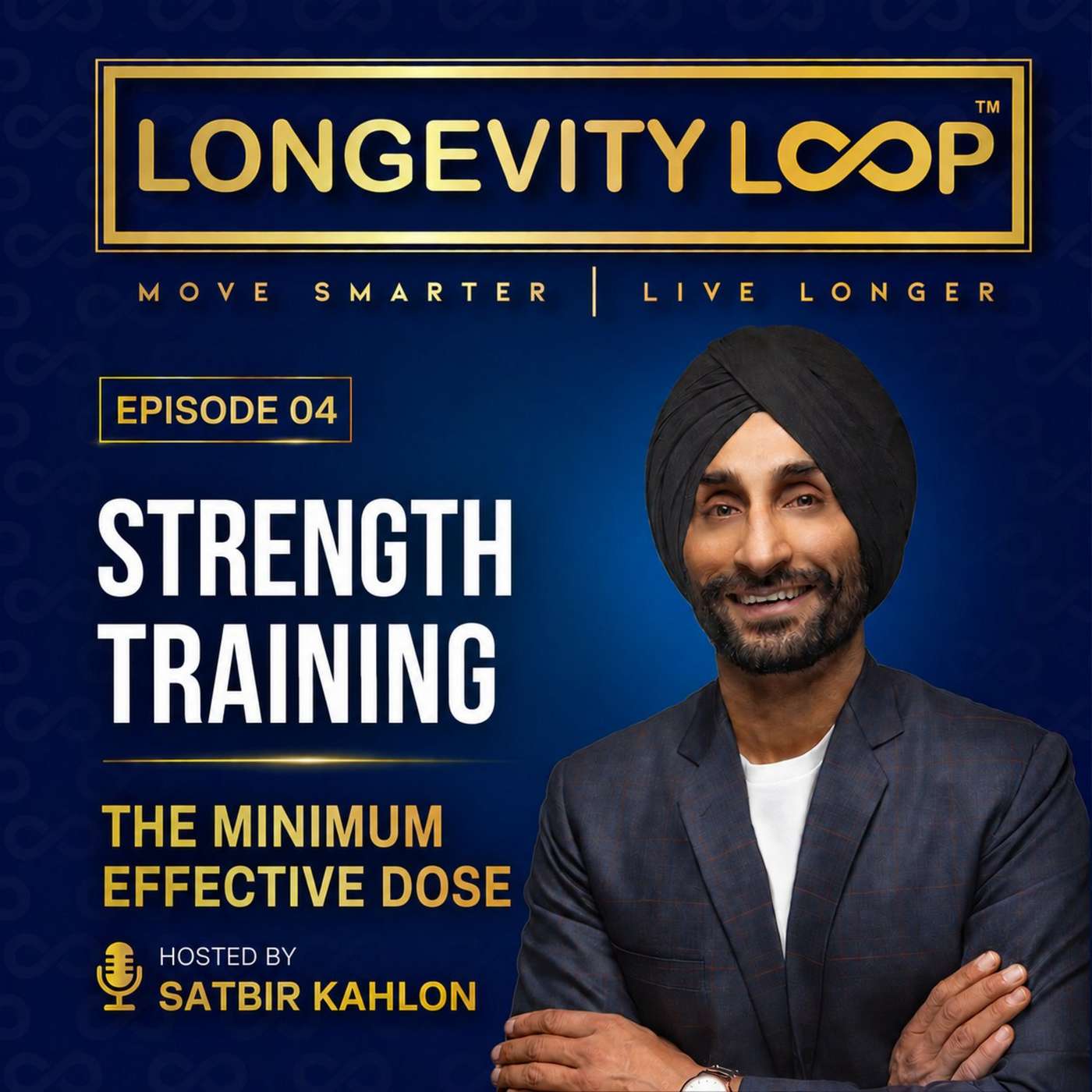
Ep 4: Strength Training: The Minimum Effective Dose episode artwork

EPISODE · Jun 17, 2026 · 16 MIN

Ep 4: Strength Training: The Minimum Effective Dose

from Longevity Loop with Satbir Kahlon · host Satbir Kahlon

Every year you don't strength train, life gets slightly heavier. The groceries. The stairs. The floor. It doesn't have to.Most people who want to start strength training don't start because they believe they need more time, more equipment, and the perfect plan all in place before they begin. And while they are waiting, the strength tax keeps compounding. In this Loop Short, we go deep on the minimum effective dose for strength training, what it actually takes to build real strength, protect your body, and get results without strength training taking over your life. You will walk away with the exact numbers, the three myths that keep people stuck, the four injury risks to avoid, and one clear action this week to get you started.IN THIS EPISODE:Why strength sits above everything else in the Performance Loop, and why you cannot be cardiovascularly fit and physically fragile at the same timeThe minimum effective dose concept from pharmacology and exactly how it applies to strength trainingThe numbers: two sessions, 45 minutes, four compound movements, three sets, that is the thresholdWhy strength is a skill, not just a physical quality and why consistency beats intensity every timeThe Strength Tax: the compounding cost of not strength training, and why ageing is not the primary cause of decline, inactivity isWhy is it not too late, regardless of where you are starting from? This is physiology, not reassuranceThe warm-up and cool-down most people skip, and why skipping them borrows from your injury accountThe three myths keeping people away from the results they actually wantThe Confidence Effect: why strength training changes how you see yourself, not just how you lookThe four causes of training injury and how the minimum effective dose protects you from all of themTHE MINIMUM EFFECTIVE DOSE: AND THE EXACT NUMBERS:SESSIONS Two to three per week. Two is the floor. Three is the sweet spot for most people. Four and above is for those with more training experience and recovery capacity to match. Two sessions. Non-negotiable. Protected in the schedule.DURATION 45 to 60 minutes per session, including warm-up and cool-down. The working sets themselves can be done in 30 to 40 minutes. You do not need two hours. You need focused, progressive effort.MOVEMENTS Four compound movements per session: a squat pattern, a hinge pattern, a push, and a pull. These four categories load the most muscle mass simultaneously, stimulate the strongest hormonal response, and produce the most meaningful adaptation per minute of training. Everything else is an addition. These four are the foundation.SETS Two to three working sets per movement, taken close to the point where you could not perform another rep with good form. That stimulus applied to four compound movements, two to three times per week, is enough to build real strength.Two sessions. 45 minutes. Four movements. Three sets. That is the minimum effective dose.THE THREE MYTHS:MYTH 01 — "I need to train every day to see results" Your body does not get stronger during the training session. It gets stronger during the recovery from the training session. Two to three sessions with adequate recovery produce more adaptation than six sessions without it. Rest days are not lazy days. They are when your body builds what you asked it to build.MYTH 02 — "Light weights with high reps will tone without making me bulky" There is no such thing as toning. There is muscle building, and there is fat loss. Light weights with high reps produce neither effectively. Building significant muscle mass requires a specific hormonal environment, a substantial caloric surplus, and years of dedicated training. It does not happen accidentally. The fear of bulking is keeping more people away from the results they actually want than almost anything else in the fitness industry.MYTH 03 — "I need a gym to strength train properly" You do not. A set of adjustable dumbbells and enough floor space to hinge and squat is enough to start. The gym gives you access to more equipment and heavier loads as you progress, which matters over time. But it is not the barrier between you and starting. Start with what you have. Progress to what you need.THE FOUR INJURY RISKS AND HOW TO AVOID THEM:Wrong technique, the injury is not from lifting heavy, it is from lifting incorrectly. Learn the movement first. Add load when the movement is clean.Too much too soon, enthusiasm is not a training plan. The minimum effective dose protects you here. Two sessions. Build the foundation first.Skipping the warm-up, five to eight minutes of movement-specific activation is the cost of admission for every session. Skipping it does not save time. It borrows from your injury account.Exercise not prescribed to your specific needs. Not every movement is right for everyone. Previous injuries, mobility limitations, and structural differences mean that following a generic programme without consideration for your specific situation is one of the most avoidable causes of training injury. Prescription matters.YOUR ONE ACTION THIS WEEK:Open your calendar right now. Block two training sessions this week. Not "I'll try." Not "if I have time." Block them. Treat them like a meeting you cannot move.That is your minimum effective dose starting today.MISSED EPISODE 3?Episode 3 — The Performance Loop: Why Strength Training Is the Key to Longevity goes deep on the five pillars of physical performance, the science of sarcopenia and bone density, and the exercise hierarchy. It is the foundation this Loop Short builds on. Worth the time.Listen here: [[LINK TO EPISODE 3]]MISSED EPISODE 2?Episode 2 — The Weakest Loop: How to Find Yours gives you a diagnostic of all five PRIME loops and one action to start moving the needle this week.Listen here: [[LINK TO EPISODE 2 ]]Fix your weakest loop.Move smarter. Live longer.New episodes every week.🎧 Listen on Spotify: https://open.spotify.com/show/033rAeEeV23KVxq2nUdrvu🎧 Listen on Apple Podcasts: https://podcasts.apple.com/podcast/longevityloop/id1896867791🎧 Listen on Amazon Music: https://music.amazon.com/podcasts/64070949-2126-4a18-9ace-c1f76d369bc4🌐 Website: https://podcast.longevityloop.com.au/📺 Watch on YouTube: https://www.youtube.com/@longevityloop/podcastsCONNECThttps://www.instagram.com/longevityloophttps://www.facebook.com/longevityloophttps://www.youtube.com/@longevityloophttps://www.tiktok.com/@longevityloopofficialhttps://www.linkedin.com/company/longevityloop#LongevityLoop #WeakestLoop #PRIMEFramework #Longevity #SecondPeak #HealthOptimisation #Healthspan #LoopShort #PerformanceHealth #RecoveryLoop #Identity...

Episode metadata supplied by the publisher feed · Published Jun 17, 2026

Every year you don't strength train, life gets slightly heavier. The groceries. The stairs. The floor. It doesn't have to.Most people who want to start strength training don't start because they believe they need more time, more equipment, and the perfect plan all in place before they begin. And while they are waiting, the strength tax keeps compounding. In this Loop Short, we go deep on the minimum effective dose for strength training, what it actually takes to build real strength, protect your body, and get results without strength training taking over your life. You will walk away with the exact numbers, the three myths that keep people stuck, the four injury risks to avoid, and one clear action this week to get you started.IN THIS EPISODE:Why strength sits above everything else in the Performance Loop, and why you cannot be cardiovascularly fit and physically fragile at the same timeThe minimum effective dose concept from pharmacology and exactly how it applies to strength trainingThe numbers: two sessions, 45 minutes, four compound movements, three sets, that is the thresholdWhy strength is a skill, not just a physical quality and why consistency beats intensity every timeThe Strength Tax: the compounding cost of not strength training, and why ageing is not the primary cause of decline, inactivity isWhy is it not too late, regardless of where you are starting from? This is physiology, not reassuranceThe warm-up and cool-down most people skip, and why skipping them borrows from your injury accountThe three myths keeping people away from the results they actually wantThe Confidence Effect: why strength training changes how you see yourself, not just how you lookThe four causes of training injury and how the minimum effective dose protects you from all of themTHE MINIMUM EFFECTIVE DOSE: AND THE EXACT NUMBERS:SESSIONS Two to three per week. Two is the floor. Three is the sweet spot for most people. Four and above is for those with more training experience and recovery capacity to match. Two sessions. Non-negotiable. Protected in the schedule.DURATION 45 to 60 minutes per session, including warm-up and cool-down. The working sets themselves can be done in 30 to 40 minutes. You do not need two hours. You need focused, progressive effort.MOVEMENTS Four compound movements per session: a squat pattern, a hinge pattern, a push, and a pull. These four categories load the most muscle mass simultaneously, stimulate the strongest hormonal response, and produce the most meaningful adaptation per minute of training. Everything else is an addition. These four are the foundation.SETS Two to three working sets per movement, taken close to the point where you could not perform another rep with good form. That stimulus applied to four compound movements, two to three times per week, is enough to build real strength.Two sessions. 45 minutes. Four movements. Three sets. That is the minimum effective dose.THE THREE MYTHS:MYTH 01 — "I need to train every day to see results" Your body does not get stronger during the training session. It gets stronger during the recovery from the training session. Two to three sessions with adequate recovery produce more adaptation than six sessions without it. Rest days are not lazy days. They are when your body builds what you asked it to build.MYTH 02 — "Light weights with high reps will tone without making me bulky" There is no such thing as toning. There is muscle building, and there is fat loss. Light weights with high reps produce neither effectively. Building significant muscle mass requires a specific hormonal environment, a substantial caloric surplus, and years of dedicated training. It does not happen accidentally. The fear of bulking is keeping more people away from the results they actually want than almost anything else in the fitness industry.MYTH 03 — "I need a gym to strength train properly" You do not. A set of adjustable dumbbells and enough floor space to hinge and squat is enough to start. The gym gives you access to more equipment and heavier loads as you progress, which matters over time. But it is not the barrier between you and starting. Start with what you have. Progress to what you need.THE FOUR INJURY RISKS AND HOW TO AVOID THEM:Wrong technique, the injury is not from lifting heavy, it is from lifting incorrectly. Learn the movement first. Add load when the movement is clean.Too much too soon, enthusiasm is not a training plan. The minimum effective dose protects you here. Two sessions. Build the foundation first.Skipping the warm-up, five to eight minutes of movement-specific activation is the cost of admission for every session. Skipping it does not save time. It borrows from your injury account.Exercise not prescribed to your specific needs. Not every movement is right for everyone. Previous injuries, mobility limitations, and structural differences mean that following a generic programme without consideration for your specific situation is one of the most avoidable causes of training injury. Prescription matters.YOUR ONE ACTION THIS WEEK:Open your calendar right now. Block two training sessions this week. Not "I'll try." Not "if I have time." Block them. Treat them like a meeting you cannot move.That is your minimum effective dose starting today.MISSED EPISODE 3?Episode 3 — The Performance Loop: Why Strength Training Is the Key to Longevity goes deep on the five pillars of physical performance, the science of sarcopenia and bone density, and the exercise hierarchy. It is the foundation this Loop Short builds on. Worth the time.Listen here: [[LINK TO EPISODE 3]]MISSED EPISODE 2?Episode 2 — The Weakest Loop: How to Find Yours gives you a diagnostic of all five PRIME loops and one action to start moving the needle this week.Listen here: [[LINK TO EPISODE 2 ]]Fix your weakest loop.Move smarter. Live longer.New episodes every week.🎧 Listen on Spotify: https://open.spotify.com/show/033rAeEeV23KVxq2nUdrvu🎧 Listen on Apple Podcasts: https://podcasts.apple.com/podcast/longevityloop/id1896867791🎧 Listen on Amazon Music: https://music.amazon.com/podcasts/64070949-2126-4a18-9ace-c1f76d369bc4🌐 Website: https://podcast.longevityloop.com.au/📺 Watch on YouTube: https://www.youtube.com/@longevityloop/podcastsCONNECThttps://www.instagram.com/longevityloophttps://www.facebook.com/longevityloophttps://www.youtube.com/@longevityloophttps://www.tiktok.com/@longevityloopofficialhttps://www.linkedin.com/company/longevityloop#LongevityLoop #WeakestLoop #PRIMEFramework #Longevity #SecondPeak #HealthOptimisation #Healthspan #LoopShort #PerformanceHealth #RecoveryLoop #Identity...

PodParley-generated summary based on available episode metadata and transcript content.

NOW PLAYING

Ep 4: Strength Training: The Minimum Effective Dose

0:00 16:49

No transcript for this episode yet

We transcribe on demand. Request one and we'll notify you when it's ready — usually under 10 minutes.

MG Show MG Show The MG Show, hosted by Jeffrey Pedersen and Shannon Townsend, is a leading alternative media platform dedicated to uncovering the truth behind today’s most pressing political issues. Launched in 2019, the show has grown exponentially, offering unfiltered insights, comprehensive research, and real-time analysis. With a commitment to independent journalism and factual integrity, the MG Show empowers its audience with knowledge and encourages active participation in the political discourse. French Your Way Jessica: Native French teacher founder of French Your Way Boost your French listening skills and test your comprehension with this one of a kind series of podcasts. Get the chance to listen to a real conversation between native speakers talking at normal speed AND customise your learning experience through carefully designed sets of questions (2 levels of difficulty) available for download at www.frenchvoicespodcast.com. All interviews also come with the transcript. French teacher Jessica interviews native speakers of French from around the world who share a bit of their life and passion. Where else would you meet in one same place a French yoga teacher based in Melbourne, a soap manufacturer from Provence, or a couple cycling around the world? That Hoarder: Overcome Compulsive Hoarding That Hoarder Hoarding disorder is stigmatised and people who hoard feel vast amounts of shame. This podcast began life as an audio diary, an anonymous outlet for somebody with this weird condition. That Hoarder speaks about her experiences living with compulsive hoarding, she interviews therapists, academics, researchers, children of hoarders, professional organisers and influencers, and she shares insight and tips for others with the problem. Listened to by people who hoard as well as those who love them and those who work with them, Overcome Compulsive Hoarding with That Hoarder aims to shatter the stigma, share the truth and speak openly and honestly to improve lives. The Small Business Startup School – Business Notes | Financial Literacy | Retail Psychology – For Professionals & Entrepreneurs The Small Business Startup School Inc. Starting or buying a small business? While personal circumstances may vary, business patterns remain timeless. On The Small Business Startup School, we explore strategies, insights, and practical solutions to help entrepreneurs confidently navigate their journey.Hosted by Ola Williams—a retail entrepreneur, fintech founder, and financial coach with over two decades of experience—this podcast marries financial awareness and retail psychology with optimism to deliver actionable takeaways.Join us to learn, grow, and connect as we uncover the keys to business success.Let’s continue to learn together and be encouraged to keep on connecting!

Frequently Asked Questions

How long is this episode of Longevity Loop with Satbir Kahlon?

This episode is 16 minutes long.

When was this Longevity Loop with Satbir Kahlon episode published?

This episode was published on June 17, 2026.

What is this episode about?

Every year you don't strength train, life gets slightly heavier. The groceries. The stairs. The floor. It doesn't have to.Most people who want to start strength training don't start because they believe they need more time, more equipment, and the...

Can I download this Longevity Loop with Satbir Kahlon episode?

Yes, you can download this episode by clicking the download button on the episode player, or subscribe to the podcast in your preferred podcast app for automatic downloads.
URL copied to clipboard!