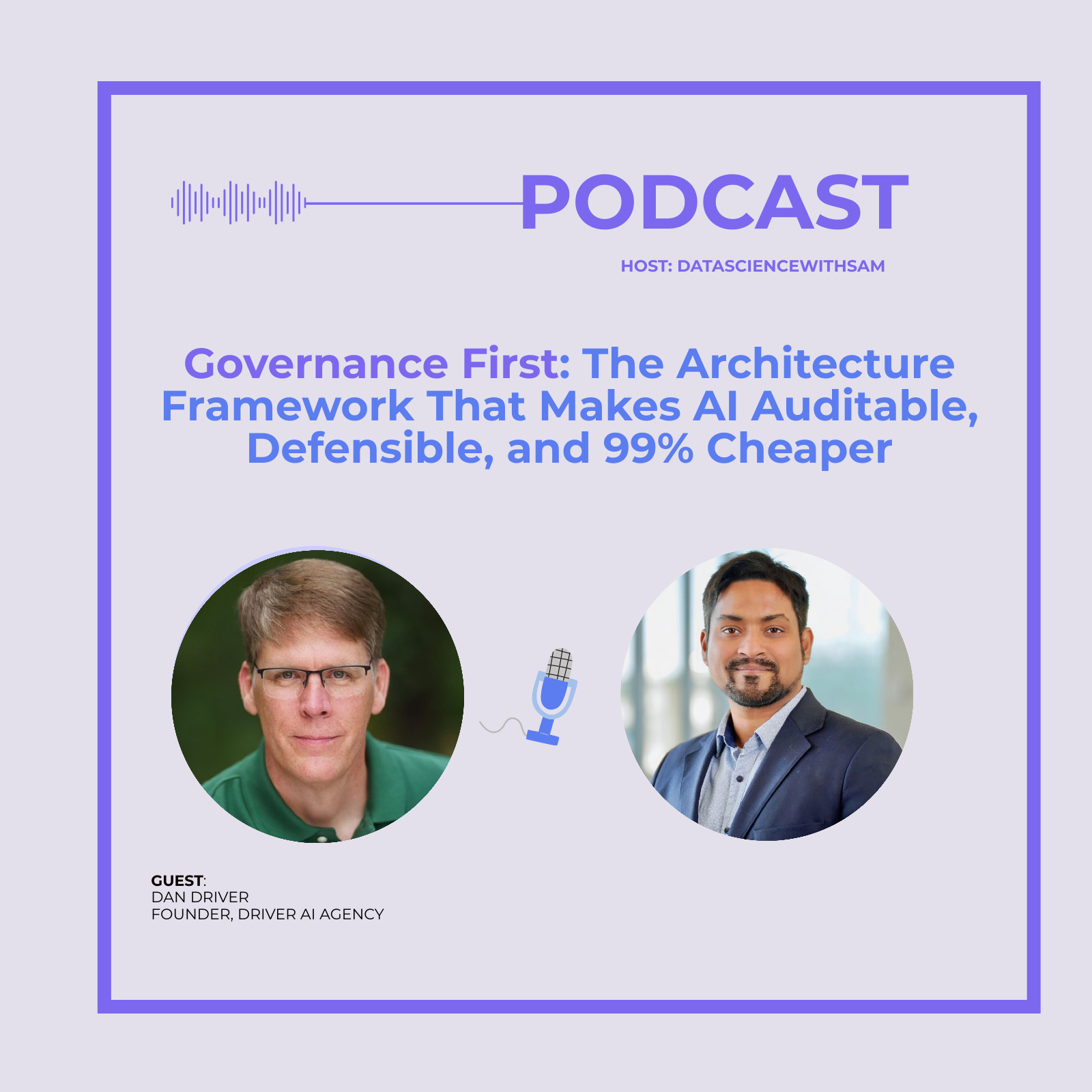
EP 40: Governance First: The Architecture Framework That Makes AI Auditable, Defensible, and 99% Cheaper episode artwork

EPISODE · May 21, 2026 · 27 MIN

EP 40: Governance First: The Architecture Framework That Makes AI Auditable, Defensible, and 99% Cheaper

from Data Science With Sam · host Soumava Dey

Most AI governance is a policy document that nobody enforces. And in high-stakes environments - legal, healthcare, finance - that gap between policy and architecture is where disasters happen. In this episode, Dan Driver, founder of Driver AI Agency, walks through exactly how he built CaseReady Intake AI: a legal AI system with governance baked into every architectural decision, zero hallucination risk by design, prompt injection blocked at the pipeline, and a single architectural choice that cut per-call compute costs by over 99%. Dan is not a lawyer. Not a developer by trade. He's a 25-year problem-solver with a Six Sigma and ISO background from DuPont, who navigated the EEOC employment discrimination process twice without an attorney - and then built the tool he needed. This is a technical governance conversation grounded in lived experience.   ▸  WHAT YOU'LL LEARN ▪  What 'governance in motion' actually means: Dan's 10-page charter that every architectural decision is audited against — and how a pre-launch UPL (unlicensed practice of law) audit delayed his release by two weeks, and why that was the right call ▪  Why governance can't just be a PDF: how banning AI without a governance framework only creates shadow IT and makes the risks invisible rather than eliminating them ▪  How deterministic controls eliminate hallucination risk: Python-based Boolean filters and regex on the front and back end of the LLM pipeline mean the AI is never left alone with a surface that can create legal exposure ▪  When NOT to use an LLM: date calculations, scope checks, and out-of-range warnings are all handled by deterministic Python — the LLM only handles what it's actually suited for ▪  Prompt injection defence in practice: the final stage of CaseReady's pipeline is an AI check that validates whether the output makes sense against the charter — if someone tries to prompt it for legal advice, it fails by design ▪  The 99% compute cost reduction: a Python pre-flight date check at the front door determines whether the case is in scope before a single LLM token is burned — if it's out of scope, the user is warned and asked to decide, without triggering the full pipeline ▪  Why legal was the right proving ground: it's not about legal being Dan's background — it's that the ABA doesn't care how good your AI is, only whether you're practising law without a licence. That hard constraint forced every governance problem to surface immediately ▪  Colorado SB 205: the AI governance framework Dan built toward — what it requires for high-risk AI in legal environments, and why even after recent softening, the requirements for high-stakes verticals haven't changed ▪  What the minimum viable governance stack actually looks like: auditable decision trails (who made the decision, why, when), human-in-the-loop pull requests, charter-referenced testing on every deployment, and deterministic controls as hard walls rather than guardrails ▪  The Anthropic Courtroom 5 and Claude for Legal launch: Dan's view — it's extreme validation, not competition. His product is highly specific where theirs is broad. And Anthropic's head of legal pointing to legal as one of the most active Claude verticals confirms he built in the right place at the right time ▪  Dan's advice for AI builders: guardrails aren't enough when stakes are high. You need hard walls. And the governance architecture that produces predictable, defensible, auditable outputs every single time is the only version that holds under regulatory scrutiny.   ▸  STANDOUT QUOTES "Governance has to be more than a document. It has to be governance in motion." "The LLM is never left alone with a surface that can create legal exposure." "Guardrails aren't enough when you're dealing with legal. They have to be hard walls that it cannot cross." "It's not just what it produces — it's what it doesn't produce, what it doesn't do. That's its strength." "I'm not an attorney. So for me, the critical nature is UPL — unlicensed practice of law. I cannot cross that line." "If anything, Anthropic moving into this area is extreme validation for the tool I've built. I'm in the right place at the right time — and it's not by accident."   ▸  LINKS MENTIONED IN THIS EPISODE →  Dan Driver on LinkedIn →  Driver AI Agency →  CaseReady Intake AI (contact via Driver AI Agency) →  Email Dan directly →  Colorado SB 205 AI Governance Framework →  Anthropic Claude for Legal / Courtroom 5 →  Clio (legal practice management) →  Eve Legal ▸  ABOUT DATASCIENCEWITHSAM DataScienceWithSam is your weekly deep-dive into AI, machine learning, data science, and the governance frameworks shaping how AI gets built and deployed. Season 4 launching next episode. Subscribe on YouTube, Apple Podcasts, Spotify, Amazon Music, and iHeartRadio. #AIGovernance #LegalTech #ResponsibleAI #AICompliance #LegalAI #GovernanceFirst #HallucinationRisk #PromptInjection #DeterministicAI #EnterpriseAI #AIArchitecture #DataScience #MachineLearning #ArtificialIntelligence #DataScienceWithSam #DanDriver #DriverAIAgency #CaseReady #AccessToJustice #EEOC #ColoradoSB205 #AIRegulation #EUAIAct #HumanInTheLoop #AuditableAI #SixSigma #AIRisk #AnthropicClaude #GovernanceInMotion

Most AI governance is a policy document that nobody enforces. And in high-stakes environments - legal, healthcare, finance - that gap between policy and architecture is where disasters happen. In this episode, Dan Driver, founder of Driver AI Agency, walks through exactly how he built CaseReady Intake AI: a legal AI system with governance baked into every architectural decision, zero hallucination risk by design, prompt injection blocked at the pipeline, and a single architectural choice that cut per-call compute costs by over 99%. Dan is not a lawyer. Not a developer by trade. He's a 25-year problem-solver with a Six Sigma and ISO background from DuPont, who navigated the EEOC employment discrimination process twice without an attorney - and then built the tool he needed. This is a technical governance conversation grounded in lived experience.   ▸  WHAT YOU'LL LEARN ▪  What 'governance in motion' actually means: Dan's 10-page charter that every architectural decision is audited against — and how a pre-launch UPL (unlicensed practice of law) audit delayed his release by two weeks, and why that was the right call ▪  Why governance can't just be a PDF: how banning AI without a governance framework only creates shadow IT and makes the risks invisible rather than eliminating them ▪  How deterministic controls eliminate hallucination risk: Python-based Boolean filters and regex on the front and back end of the LLM pipeline mean the AI is never left alone with a surface that can create legal exposure ▪  When NOT to use an LLM: date calculations, scope checks, and out-of-range warnings are all handled by deterministic Python — the LLM only handles what it's actually suited for ▪  Prompt injection defence in practice: the final stage of CaseReady's pipeline is an AI check that validates whether the output makes sense against the charter — if someone tries to prompt it for legal advice, it fails by design ▪  The 99% compute cost reduction: a Python pre-flight date check at the front door determines whether the case is in scope before a single LLM token is burned — if it's out of scope, the user is warned and asked to decide, without triggering the full pipeline ▪  Why legal was the right proving ground: it's not about legal being Dan's background — it's that the ABA doesn't care how good your AI is, only whether you're practising law without a licence. That hard constraint forced every governance problem to surface immediately ▪  Colorado SB 205: the AI governance framework Dan built toward — what it requires for high-risk AI in legal environments, and why even after recent softening, the requirements for high-stakes verticals haven't changed ▪  What the minimum viable governance stack actually looks like: auditable decision trails (who made the decision, why, when), human-in-the-loop pull requests, charter-referenced testing on every deployment, and deterministic controls as hard walls rather than guardrails ▪  The Anthropic Courtroom 5 and Claude for Legal launch: Dan's view — it's extreme validation, not competition. His product is highly specific where theirs is broad. And Anthropic's head of legal pointing to legal as one of the most active Claude verticals confirms he built in the right place at the right time ▪  Dan's advice for AI builders: guardrails aren't enough when stakes are high. You need hard walls. And the governance architecture that produces predictable, defensible, auditable outputs every single time is the only version that holds under regulatory scrutiny.   ▸  STANDOUT QUOTES "Governance has to be more than a document. It has to be governance in motion." "The LLM is never left alone with a surface that can create legal exposure." "Guardrails aren't enough when you're dealing with legal. They have to be hard walls that it cannot cross." "It's not just what it produces — it's what it doesn't produce, what it doesn't do. That's its strength." "I'm not an attorney. So for me, the critical nature is UPL —

NOW PLAYING

EP 40: Governance First: The Architecture Framework That Makes AI Auditable, Defensible, and 99% Cheaper

0:00 27:30

No transcript for this episode yet

We transcribe on demand. Request one and we'll notify you when it's ready — usually under 10 minutes.

MG Show MG Show The MG Show, hosted by Jeffrey Pedersen and Shannon Townsend, is a leading alternative media platform dedicated to uncovering the truth behind today’s most pressing political issues. Launched in 2019, the show has grown exponentially, offering unfiltered insights, comprehensive research, and real-time analysis. With a commitment to independent journalism and factual integrity, the MG Show empowers its audience with knowledge and encourages active participation in the political discourse. French Your Way Jessica: Native French teacher founder of French Your Way Boost your French listening skills and test your comprehension with this one of a kind series of podcasts. Get the chance to listen to a real conversation between native speakers talking at normal speed AND customise your learning experience through carefully designed sets of questions (2 levels of difficulty) available for download at www.frenchvoicespodcast.com. All interviews also come with the transcript. French teacher Jessica interviews native speakers of French from around the world who share a bit of their life and passion. Where else would you meet in one same place a French yoga teacher based in Melbourne, a soap manufacturer from Provence, or a couple cycling around the world? That Hoarder: Overcome Compulsive Hoarding That Hoarder Hoarding disorder is stigmatised and people who hoard feel vast amounts of shame. This podcast began life as an audio diary, an anonymous outlet for somebody with this weird condition. That Hoarder speaks about her experiences living with compulsive hoarding, she interviews therapists, academics, researchers, children of hoarders, professional organisers and influencers, and she shares insight and tips for others with the problem. Listened to by people who hoard as well as those who love them and those who work with them, Overcome Compulsive Hoarding with That Hoarder aims to shatter the stigma, share the truth and speak openly and honestly to improve lives. The Small Business Startup School – Business Notes | Financial Literacy | Retail Psychology – For Professionals & Entrepreneurs The Small Business Startup School Inc. Starting or buying a small business? While personal circumstances may vary, business patterns remain timeless. On The Small Business Startup School, we explore strategies, insights, and practical solutions to help entrepreneurs confidently navigate their journey.Hosted by Ola Williams—a retail entrepreneur, fintech founder, and financial coach with over two decades of experience—this podcast marries financial awareness and retail psychology with optimism to deliver actionable takeaways.Join us to learn, grow, and connect as we uncover the keys to business success.Let’s continue to learn together and be encouraged to keep on connecting!

Frequently Asked Questions

How long is this episode of Data Science With Sam?

This episode is 27 minutes long.

When was this Data Science With Sam episode published?

This episode was published on May 21, 2026.

What is this episode about?

Most AI governance is a policy document that nobody enforces. And in high-stakes environments - legal, healthcare, finance - that gap between policy and architecture is where disasters happen. In this episode, Dan Driver, founder of Driver AI...

Can I download this Data Science With Sam episode?

Yes, you can download this episode by clicking the download button on the episode player, or subscribe to the podcast in your preferred podcast app for automatic downloads.
URL copied to clipboard!