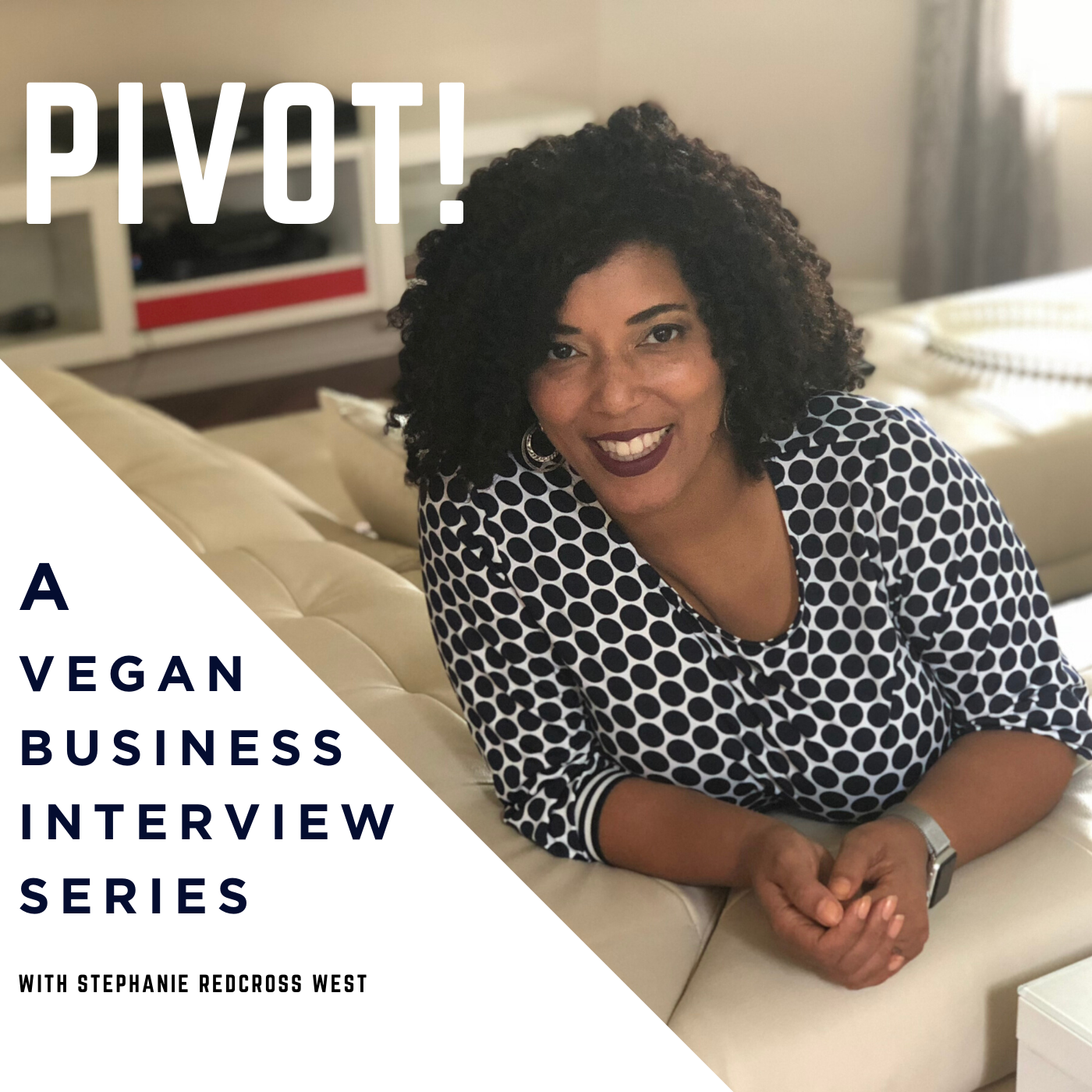
As vegan and plant-based business owners and entrepreneurs, we're often adapting to a new reality. This new podcast series from Vegan Mainstream is an opportunity to help you when it's time to pivot. These interviews will come from inside and outside of our community, and I hope as your host, Stephanie Red Cross West, I can inspire you and give you the tools that you need to move forward. Hi everyone, welcome, welcome to our next interview.
I have today with me Duncan, and Duncan is not only an entrepreneur, not only a founder, but also an inventor. I think it's really exciting when we bring people kind of here today for everyone to hear their stories. It's really exciting to get perspective on someone who's invented something, who's created something, not only for many of us as vegans that will help us, but also help the world and help more people eat vegetables and enjoy fresh vegetables. So we're all excited about not only exploring Duncan's journey, but also talking about how 2020 has been and how we're looking towards the future.
So I want to officially welcome, I guess, Duncan Burns for Veggie Dome, and I'm excited to have you here with me today, Duncan. Thanks so much for taking time out of your day to chat with me. Thank you, Stephen. Thank you for having me too.
Great. So before we talk about the business, before you took the leap in became entrepreneur, founder, inventor, let's rewind a little bit and let's also talk about your background. Let's first maybe just ground everyone in kind of a little bit of your vegan story, how long you've been vegan, and maybe what was a little bit of your path along the way that helped you get on this vegan journey. Well, I grew up in a household that had a lot of fruit trees and we grew some vegetables.
So I really grew up with always something out on the table that was picked from the garden, and I loved the freshness, and anytime I would eat fresh produce, I would feel really good and healthy. But I became vegan when I read about really the health issues. And that was a while ago. The China study is a book that really changed my life.
And I did read other books also on it, but it became first a step towards wanting to be as healthy as possible. And certainly when you read a book that says that eating flesh gives you a more chance for cancer and heart disease, and you think about maybe cutting those things out. That's pretty much what my journey was. And as the years have gone by, I've realized there are layers upon layers of reasons, including the health of the planet.
And of the fact that there is cruelty to the animals that are now we're seeing much more of the visuals that are coming out that we're illegal to get many times. I'm realizing that there are just multiple reasons. But the first one was health. Yeah, and that makes sense.
But my initial journey actually started with health as well. And yes, we've all been so blessed with books like the China study that has really brought the science to the table as far as when it comes to our health and really the impact of what we eat. So I'm really excited to hear that that's been one of the books in your repertoire that helped you make this leap. Now you've been officially vegan for about four years now, correct?
Yeah. Okay, now I know you've been vegan for about four years, but let's talk a little bit about your professional side. One thing we love to do in these sessions is give people a glimpse not only into, you know, how many of us live as vegans, but how we live as entrepreneurs, as we live in this kind of business world. So Betty Domingo is your current business and it's what you're currently working on.
But have you always been an entrepreneur? Have you always wanted to be an entrepreneur? No. So back around in your career and your professional.
I was from many, I started my life really just always making little movies and college and decided, you know what, I should go into that. And I was a film editor for many years, 20, over 20 years. And I was in the film business, but I also did documentaries and worked at Universal and Warner Brothers TV. So I worked in Hollywood for quite a long time, but jumping from one project to the next as an independent film editor and several independent films.
But it was really when my kids were growing up and they were only about three and seven years old, I wanted them to go come back from their schools and have a good snack on the table. And so I started messing around in the kitchen with different devices of how can I make it so that vegetables that are already clean and ready to grab and eat, can they stay fresh out on the table? And so that's when I invented the vegidome. I did have a background also when I told you that I had fruits and vegetables growing around a kid in the garden.
My brother and I built a little greenhouse out of scraps of glass and wood and doors. And in that greenhouse, we grew orchids and bromeliads, which are plants that hang on trees with their roots. So I asked my older brother, well, if they're holding on to the tree with their roots, how are they getting water? And that's what he told me, they drink water from the air.
And that's forward to when I'm trying to devise something to keep my vegetables fresh on the table for the kids, I thought, well, I could just kind of some sort of like greenhouse type thing. So that's how it all started. And also that's kind of my journey from being a film person to then saying, cash, if this is something that my kids can use when they come home from school, they were gobbling it up, like every other day I'd be filling the thing up. But as I realized that there were things that were in there that were being like because of lettuce and stuff, that were lasting for well over a week.
And I never thought it would last that well. So that was my journey of going from film to then being an entrepreneur, because I really felt this is an important thing that people can have in their houses. Nice. Now, before we get into video-dom and show everyone, maybe give us a little bit of background just on the path of being an inventor, because there's one thing that we talk about a lot is becoming an entrepreneur, which is a huge leap and a huge transformation for a lot of people.
But as an inventor, it's a very different path. Our mission in different paths is that there's another parallel path that you probably had to go down of sourcing your materials, of figuring out how you're going to create what you wanted or what you envisioned. Maybe walk us through that process and some of the things that you learned along the way. That's interesting that you bring up the idea of process, because as an editor for decades, the process, the way in which you went about making the film or adding images and making a story or telling many times in documentary that as much the truth as you can, I really realized that the way in which you do it is what you end up with.
The process is important. And so the process of inventing was also helped by my ending, which is that you never can have the best version right off the bat. You've got it as an inventor and as a business person. And you have to realize that you take your best shot, you really think this is the way to do it, but you have to really keep it in the back of your head, that this is only step one.
And there's going to be a thousand steps. And there's kind of a sense of needing to persist that helps in business and in inventing and all the idea that you may feel like something works, but you should be open to other ways in which it can be done. That's better. Okay, as an editor, I learned how to know that you actually, in the ending rooms, you would never show the first version to anybody else.
I mean, just the director and you are working out because that's going to be the worst version. And I love that because I think sometimes when people start businesses, they have this vision and idea, and they think the journey is just creating what they started with. And the idea that these often are not only your first drafts, not only the idea that things will kind of transform and develop over time. And like you said, and maybe even put words in your mouth, but like accepting and in some ways, even enjoying the process is so important when you are in that creative space.
And as kind of many of us have started our businesses or even ran our businesses here in 2020, there's been a little bit of managing that process and building that resilience and endurance that I think all of us need to be sometimes reminded of, but also I think is part of the fun of, you know, starting a business or in your case, creating something and bringing an idea into existence. And as you were speaking, I was actually thinking that there's a secondary thing. One thing I said right now was that, you know, don't think that you've come up with the best idea first. You actually have to be open to growing and understanding what your mistakes are.
But then there's the other side. When you work on, that's certainly as an entrepreneur, you can have an idea that you feel that the core of it is really true and that you want to stay by it. And then everybody else has a different idea for what you're supposed to do. Everybody's gonna come up with hints and ideas and you can be running around trying to chase your tail in trying to set up a business.
And I think that you've got to be able to understand, you have to really embrace the core of what it is. And that's one thing that I found my invention. There's a lot of different things you can do with the veg you don't, but there's a core thing, which is that it keeps vegetable fresh on the table. And I'll go more into that if you like, as we talked about.
Yes, I'm actually... So I'm contradicting myself, right? I'm saying, you know, be open to change and adapt and know that you need to grow. But also, you know, you have to be able to be strong with your core belief as to why it's important.
Yeah, and I don't know if that's so much of a contradiction of more of how things are built, you know, how things are created. And it's almost that sense of, you need the vision, but what will 100% be in the end, maybe a little bit different than what you thought it was gonna be in the beginning. So the idea is making those kind of flexes, those pivots, and being able to move through those things. And like you said, making sure that you understand the core purpose of your business.
I think that's so important. I'm glad you mentioned that. Because for many of us, yes, there's things that we can do, or we can add on, or there's ways that our business or our products can be used for other purposes, but we can dilute our businesses if we try to do it all. And if we try to listen to everybody.
Yes. Can't please everybody. Definitely. And you can't.
And you want to be open for feedback, and that's key, so you've been a little weird and incorporated, but it's a delicate dance. And I think that's why not everyone's an entrepreneur, and that's why, you know, we all learn as we go, which is like everything in life that we learn. So I think it's just part of that journey. I think the hardest part for a lot of people is just accepting that that is what's part of the journey.
That it's not, I decided it's going to be this, and the end, it may be slightly different, being able to accept that it will more fiddle change. And also, I think as entrepreneurs, it's so important that we give ourselves that chance to grow, that opportunity to expand and to take kind of a initial dream and really make it into something amazing. But I'm getting all excited here because I want to show everyone the veggie dome. I want to break it down and kind of show everyone what it looks like.
Maybe give us a little bit on the science, because most of us, you know, we get our vegetables, we throw it in a bowl on the table, and then a couple of days later, we're frowning because we're like, ah, I meant to eat that. I meant to get to that. So walk us through the practical application. Certainly, I'm going to show you the veggie dome now, and I'm going to apologize for some of the camera work that's going to happen in the next few minutes here, because I'm going to add that.
So here goes the veggie dome is here. This is an empty one. It has a lid, just like a cookie gar lid. It has the dome, and that's the important part.
It's open in the bottom, and it's open on the top. And then there is a stainless steel colander, and it's like a little stage. The vegetables sit on here, and if they get wet, they drip through, and that is lifted up here, and you can see the base, okay? I'm going to put it back together again as we talk.
And I'm also describing, think of this, and this is one thing that I'm actually stepping, exploring this right now with you, is that if you think about it as just like, oh, it looks like an upside-down bowl. That's where you're missing the point, that this is actually kind of a natural design that has not been really done. Glass makers don't like making something that is a hole in both sides. You know why?
Because when it's molten, it collapses. They need to have something that has like a bowl or a roundness that holds its shape, and this doesn't. So that's one of the reasons why I think a vegetable hasn't been used before. But what happens is, you put the vegetables inside, you water them, you trim them, and you put them inside like a scoop and jar thing, and here it is, one that has vegetables in it, okay?
So what happens is, the vegetables emit water vapor. I mean, if you just took a piece of lettuce, and you put it on the table, it'll get wilted, right? But the wilting is the moisture coming off of the vegetable. And the thing is, here is, like this lettuce has been in there for a couple weeks, actually.
You know what kind of growing, it's kind of curling, you know, from the camera. It's kind of curling and everything like that. It's because it's been sitting there. Now, that's just because I like sometimes leading lettuce in there and it's been growing.
But really, you want to be eating it every other day. You want to be reaching into your bedroom every day and grabbing some of these, and you're gonna be putting some things in there every couple of days. Many times, it'll be like a Sunday afternoon, I'll have gone to the market. I fill up the bedrooms, you know?
And over the next couple of days, then I'm eating from it. But by Tuesday or Wednesday, I'm already putting some new things in there. So people, this is where the inventor and the idea and how people try to change ideas, this is when you buy vegetables, you buy them to eat. You don't buy them to store them, okay?
But you want to store them and keep them fresh. But everybody's thinking, oh, I bet you don't keep vegetables longer than a refrigerator. And yes, I mean, here's a piece of lettuce, that I don't know if you can see it very well. This one's been in there for like a couple of weeks, two weeks at least.
See how it's kind of like a little bit funky? Okay, that's only because I didn't get to it yet. And I do keep lettuce in there a lot. It keeps it fresher than the refrigerator.
Now that we're gonna be eating more vegetables. Now they're gonna be going more plant-based. We need to just change what we're doing with that food. Right now, we're putting in plastic bags.
We're putting in the refrigerator. We don't even see it for a couple of days. Oh, there's the bok choy. I paid $3 for it and now it's all-wheeled, right?
Okay, so there is an aspect of not wanting to throw away so much food. But the real thing about the veggie dough is more of a celebration of how beautiful this food is. It's natural, it's the shape of plants or and the fruit is beautiful. And you can put a tomato in there and watch it ripen over a couple of days and strawberries also.
So fruit can be right. And what I'm trying to get across is if we're going to be changing our nation, if we're gonna be changing how we're eating, we need to make a change in the kitchen because no change has been made for 50, 60 years. I mean, fruit bowls have been around for thousands of years, right? So if we're going to be changing away from farm, what is it?
Industry, animal, farm, so what are those things? We're getting away from those things. We're going to embracing another vision which is that we want to be eating vegetables. They're delicious, they're good for us.
They're what our bodies use to make proteins. We're making proteins, you know? We're making in this food. But the idea is to celebrate it by having it out to be seen.
And so it really, my inventivist, I thought I was going to be filling it up every day or two. It turns out it lasts five or six days at least with some of the vegetables and it became more successful than I thought. So that's when I patented it. That's when I made a company.
But when it comes down to people say, oh, well, what about competition? People are going to make that same type of thing. I welcome that. I want to have people have their vegetables out on the table.
Okay? So there's the deal. I love that because I think a lot of times we think about storage and like you said, how long can we keep it and so forth? And I love that we have to make sure we understand your original vision.
And your original vision was really making sure that it's rightly available, it's out on display, and it's out on display in a way that makes us embrace it. We can grab it. We can grab it on the grow. We think we need a snack instead of, you know, all those prepared foods sitting out and being visible.
We want these vegetables to be visible. And then there was the extra benefit that it keeps these vegetables well. That it lasts long. And that now you can put all types of things in it.
I think the thing that blew me away when I learned about your product is when you put lettuce in it. I was like, wait a minute. Lettuce is one of those things that is just so delicate. And so...
It took me several months before I put lettuce there when I was inventing it because I thought it would just wilt. I didn't know, actually, you could put a single lettuce leaf in there and it'll stay fresh for several days, if not a week. Exactly what you said. I was inventing it.
And there were two things that we were talking about, developing ideas and how an inventor has to grow, an entrepreneur has to see how different ideas. I started with putting a lot of water in it. When I watched them, I'd make sure they thought, because why? Well, think rain forest or think about making it so that the plants can have water themselves.
What turned out, the drier I made it, the less water I put in, the less spoilage I had, and the plants emit the perfect amount of water themselves. You let them do it. I love that we lean into nature a little bit. Yeah, in nature.
So anyway, that's what I always say. But you should let us, to me, I didn't even put lettuce in there for like the first six months of inventing it, because that's not going to work, but it turns out sprouts and lettuce and things like that can grow pretty well. Sprouts. Now, do you mix things up?
Meaning, I notice you have a lemon in there with a lettuce, and sometimes people are like, don't put the lemons in because the lemons will help make this, you know, spoil them no longer. Do you just put anything in your don'ts? Or do you usually do it differently? You can put anything in there.
But generally, think about this. It's things that you're going to reach in and grab and eat. So, I mean, and there's one of my partners who put a bunch of egg plants in there. And it worked great.
Okay. So I don't mean to say don't do something, but like let onions, potatoes, garlic, yams, I mean, they do fine without the vegetables. So leave them on the counter. These are things that you'll be filling up the space for the other vegetables.
You'll be taking up room for other things, and apples, I didn't try apples or even fruit for a long time, because I was thinking, hey, they've had fruit balls for years. You know, I made this for vegetables. Keep those things out of there. But instead, while I start, this is one of the things again, from learning as an entrepreneur.
As I was selling a lot of the veggie dumps to people, always the question was, can I put fruit in there? Can I put apples in there? Can I put bananas in? And you know what?
I've tried it, and they've worked really well with those. And it ripens fruit like peaches and pears, avocados and tomatoes, and strawberries. Really well. Think about this.
Inside is the most delicate environment for plants to be in. I mean, it's protected, it's moist, it's not, you know, trees, mostly, and flies aren't flying around. So it's the most delicate environment to put them in. So yeah, it's good to write them fruit and things like that.
I had to learn that. Again, that was one of these things where I opened my mind and say, okay, don't just keep vegetables in there. Sure, I love that. I love that.
So we've gone a little bit past our normal 20-minute mark. So I don't want to keep you too much longer. But I do want to talk about how your business is doing with all the change that's happened this year. And then also maybe just wrap up with what are your plans for next year, because I know many of us have been impacted with fresh little shutting down, you know, events and so forth.
Can you give me maybe a little bit of kind of perspective on how your business has kind of either pivoted or changed in 2020 and what you're planning, maybe, as we go into 2021? We were, like, over half of our sales were in veg fests and festivals, home and garden shows. We had the best one in February of 2020. And then the next day, everything shut down.
And whenever it was that everything shut down, we had the best, most profitable show. And we were thinking, oh, good, 2020. It's going to be amazing. And then everything shut down, no festivals.
So we've gone online and that's what we're going. We're having some sales on. So that's helped us a lot. We're kind of looking at doing online sales more.
And I mean, we can benefit by the fact that we're just shipping an object to somebody or is it simple? We can do it that way. So we're staying online. And you asked, so do you ship internationally?
Just give me your perspective. No, we can't. We can't ship it. It's just ways too heavy.
But we're going towards a next phase of our company where we want to have an internet. We're growing. And that'll be international. A lot of people in the UK love it.
And they want it. But we can't send it to them yet. Oh, I can imagine I want to get their hands on. One.
I'm eyeballing it myself. Like, ooh. Maybe for people like me and others that are watching, if they want to get one for themselves, if they're interested in getting a veggie dome, how do they either get in contact with you? What's the website?
Let's just give them a little bit of information. The website is the www.vegetome.com. Veggie with VEGGI and then D-O-M-E. And that's one I forgot that I didn't tell that ethylene gas escapes out the lid, okay?
So we see veggie dome. It doesn't have the E in the middle. That's the ethylene that escaped. So again, VEGGI, D-O-M-E, vegetome.com.
And you know, Stephanie, for your followers, for your listeners, I'm going to send you a code. We didn't set this up for her. So I didn't do it. I'll send you a code so they can get like $15 off on the price, okay?
So I'll email you, you send it to your folks later, okay? Absolutely, I will. Oh my goodness. It's been really great having a chance to chitchat with you and learn a little bit more about the veggie dome.
I know we had initially chitchatted on LinkedIn. It was almost a year ago, maybe. Yeah. Yeah.
So it's good that we're getting a chance to chitchat. And I know this session is so short, we didn't get into everything that you're doing. But if you have any final recommendations out there for anyone who is starting a business, anyone who's been running a business this year and trying to keep hope alive as they move into 2021, any words of wisdom you'd like to share with anyone? I wish it was positive.
It's kind of like, I don't know how we do it. But let's just keep going. No, I love that. It's very practical.
I think a lot of us can use right now. Thank you so much, Stephanie. I appreciate it. Absolutely.
Thank you so much. We have to give a thank you for tracing. Thanks so much, thank you for joining us here. And I'm so glad we had a chance to chitchat.
I hope everyone goes and connects with you, reaches out to you, connects with you on social media. And thank you so much for your time today. I appreciate your time. You're great.
If you have any questions, please, as always, post them in the comments. We will make sure those comments get over to our guests. We will make sure that we get you in touch with everybody over in Veggie Dome. You should see the links in the description so you can go and snag a copy that I'll also make sure I updated with that coupon code.
And as always, if anyone enjoys these sessions, please give us the likes, the thumbs up, share this with a friend, share this with someone who's vegan, but share this with someone who's maybe not vegan. In case they're interested in trying to give a little more veggies in their lives and make sure it's in line site as they're cruising around the house, walking past the kitchen because the more we make these visible, I really believe it's much easier for us to grab them. Much easier for us to consume them and also make them a part of our daily life. So thank you so much, everyone, who's been joining us and just putting it in the comments.
I really do appreciate it. I'm going to wrap this session up a little bit early because we do have a session right after this one, but I want to thank everyone and as well, Duncan, I want to say thank you so much for being here with me today. Thank you, Stephanie. Great.
I appreciate it. I appreciate it. Okay.