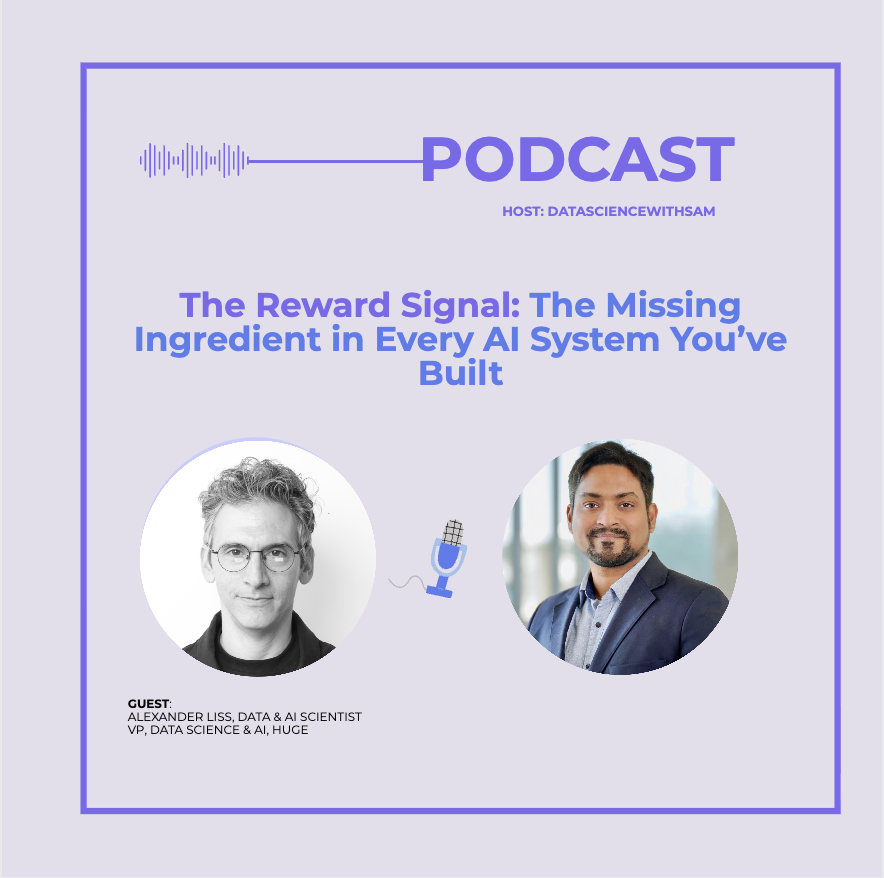
EP 41: The Reward Signal: The Missing Ingredient in Every AI System You’ve Built episode artwork

EPISODE · May 26, 2026 · 44 MIN

EP 41: The Reward Signal: The Missing Ingredient in Every AI System You’ve Built

from Data Science With Sam · host Soumava Dey

74% of organizations hope to grow revenue through AI. Only 20% are actually doing it. That gap isn't a technology gap — it's a design gap. And today's guest has a name for what's missing: the reward signal. Alexander Liss is a Data and AI Scientist based in Denver, Colorado, with a 30-year career across analytics, strategy, data science, machine learning, and AI. He's built systems that solve established problems in novel ways, and the long-term problem on his radar is ensuring AI tools provide responsible augmentation of human ability. His research includes Attention Fine Tuning (AFT) - a method for training language models without human annotation labels - and the Experience Orchestrator, a control theory-based governance framework for multi-agent AI.   IN THIS EPISODE: ▪  Why 95% of AI pilots fail - MIT research shows businesses bolt AI onto existing processes without tying it to real outcomes ▪  The biology analogy: hunger isn't a goal, it's a continuous feedback signal - and the same principle should govern how AI systems behave ▪  ServiceNow dynamics blindness: LLMs are stateless - they can't consider cumulative impact, and you can't prompt-engineer your way out of that architecture problem ▪  Contextual bandits in marketing: how a reward signal anchored to real conversions creates a self-learning personalisation system that adapts in real time ▪  Knowledge graphs and agent memory: why RAG retrieves answers while a reward-signal system asks what the user needs to do differently ▪  Attention Fine Tuning (AFT): a three-component reward signal (coverage, focus, repeat penalty) that trained a T5-large model to outperform a supervised fine-tuning baseline by 9% — with better multi-turn recall, and no human labels ▪  The Experience Orchestrator: aerospace control theory applied to LLM agents — +32 point task completion lift over a naive system-prompt baseline by calibrating persuasion to user resistance ▪  The Scott Shambaugh incident: an OpenClaw agent rejected from Matplotlib wrote a blog criticising the human reviewer - why this happened and how reward-signal-based governance prevents it ▪  Alex's final advice: define your goal first, then determine scope - and consider a post-training approach like AFT when you need responses that consistently hit the mark.   Useful References: LinkedIn: https://www.linkedin.com/in/aliss77777/ AFT paper and Experience Orchestrator links: https://aliss77777.github.io/aft.html Deloitte 2026 State of AI Report Scott Shambaugh & OpenClaw AI Agent incident: https://www.fastcompany.com/91492228/matplotlib-scott-shambaugh-opencla-ai-agent   DATASCIENCEWITHSAM: Weekly deep-dives into AI, machine learning, data science, and the frameworks shaping how AI actually gets built. Subscribe on Apple Podcasts, Spotify, Amazon Music, iHeartRadio, and YouTube. If this episode resonated — define the signal, measure what matters, and share it with someone building AI without a reward signal.  

74% of organizations hope to grow revenue through AI. Only 20% are actually doing it. That gap isn't a technology gap — it's a design gap. And today's guest has a name for what's missing: the reward signal. Alexander Liss is a Data and AI Scientist based in Denver, Colorado, with a 30-year career across analytics, strategy, data science, machine learning, and AI. He's built systems that solve established problems in novel ways, and the long-term problem on his radar is ensuring AI tools provide responsible augmentation of human ability. His research includes Attention Fine Tuning (AFT) - a method for training language models without human annotation labels - and the Experience Orchestrator, a control theory-based governance framework for multi-agent AI.   IN THIS EPISODE: ▪  Why 95% of AI pilots fail - MIT research shows businesses bolt AI onto existing processes without tying it to real outcomes ▪  The biology analogy: hunger isn't a goal, it's a continuous feedback signal - and the same principle should govern how AI systems behave ▪  ServiceNow dynamics blindness: LLMs are stateless - they can't consider cumulative impact, and you can't prompt-engineer your way out of that architecture problem ▪  Contextual bandits in marketing: how a reward signal anchored to real conversions creates a self-learning personalisation system that adapts in real time ▪  Knowledge graphs and agent memory: why RAG retrieves answers while a reward-signal system asks what the user needs to do differently ▪  Attention Fine Tuning (AFT): a three-component reward signal (coverage, focus, repeat penalty) that trained a T5-large model to outperform a supervised fine-tuning baseline by 9% — with better multi-turn recall, and no human labels ▪  The Experience Orchestrator: aerospace control theory applied to LLM agents — +32 point task completion lift over a naive system-prompt baseline by calibrating persuasion to user resistance ▪  The Scott Shambaugh incident: an OpenClaw agent rejected from Matplotlib wrote a blog criticising the human reviewer - why this happened and how reward-signal-based governance prevents it ▪  Alex's final advice: define your goal first, then determine scope - and consider a post-training approach like AFT when you need responses that consistently hit the mark.   Useful References: LinkedIn: https://www.linkedin.com/in/aliss77777/ AFT paper and Experience Orchestrator links: https://aliss77777.github.io/aft.html Deloitte 2026 State of AI Report Scott Shambaugh & OpenClaw AI Agent incident: https://www.fastcompany.com/91492228/matplotlib-scott-shambaugh-opencla-ai-agent   DATASCIENCEWITHSAM: Weekly deep-dives into AI, machine learning, data science, and the frameworks shaping how AI actually gets built. Subscribe on Apple Podcasts, Spotify, Amazon Music, iHeartRadio, and YouTube. If this episode resonated — define the signal, measure what matters, and share it with someone building AI without a reward signal.

NOW PLAYING

EP 41: The Reward Signal: The Missing Ingredient in Every AI System You’ve Built

0:00 44:44

No transcript for this episode yet

We transcribe on demand. Request one and we'll notify you when it's ready — usually under 10 minutes.

MG Show MG Show The MG Show, hosted by Jeffrey Pedersen and Shannon Townsend, is a leading alternative media platform dedicated to uncovering the truth behind today’s most pressing political issues. Launched in 2019, the show has grown exponentially, offering unfiltered insights, comprehensive research, and real-time analysis. With a commitment to independent journalism and factual integrity, the MG Show empowers its audience with knowledge and encourages active participation in the political discourse. French Your Way Jessica: Native French teacher founder of French Your Way Boost your French listening skills and test your comprehension with this one of a kind series of podcasts. Get the chance to listen to a real conversation between native speakers talking at normal speed AND customise your learning experience through carefully designed sets of questions (2 levels of difficulty) available for download at www.frenchvoicespodcast.com. All interviews also come with the transcript. French teacher Jessica interviews native speakers of French from around the world who share a bit of their life and passion. Where else would you meet in one same place a French yoga teacher based in Melbourne, a soap manufacturer from Provence, or a couple cycling around the world? That Hoarder: Overcome Compulsive Hoarding That Hoarder Hoarding disorder is stigmatised and people who hoard feel vast amounts of shame. This podcast began life as an audio diary, an anonymous outlet for somebody with this weird condition. That Hoarder speaks about her experiences living with compulsive hoarding, she interviews therapists, academics, researchers, children of hoarders, professional organisers and influencers, and she shares insight and tips for others with the problem. Listened to by people who hoard as well as those who love them and those who work with them, Overcome Compulsive Hoarding with That Hoarder aims to shatter the stigma, share the truth and speak openly and honestly to improve lives. The Small Business Startup School – Business Notes | Financial Literacy | Retail Psychology – For Professionals & Entrepreneurs The Small Business Startup School Inc. Starting or buying a small business? While personal circumstances may vary, business patterns remain timeless. On The Small Business Startup School, we explore strategies, insights, and practical solutions to help entrepreneurs confidently navigate their journey.Hosted by Ola Williams—a retail entrepreneur, fintech founder, and financial coach with over two decades of experience—this podcast marries financial awareness and retail psychology with optimism to deliver actionable takeaways.Join us to learn, grow, and connect as we uncover the keys to business success.Let’s continue to learn together and be encouraged to keep on connecting!

Frequently Asked Questions

How long is this episode of Data Science With Sam?

This episode is 44 minutes long.

When was this Data Science With Sam episode published?

This episode was published on May 26, 2026.

What is this episode about?

74% of organizations hope to grow revenue through AI. Only 20% are actually doing it. That gap isn't a technology gap — it's a design gap. And today's guest has a name for what's missing: the reward signal. Alexander Liss is a Data and AI Scientist...

Can I download this Data Science With Sam episode?

Yes, you can download this episode by clicking the download button on the episode player, or subscribe to the podcast in your preferred podcast app for automatic downloads.
URL copied to clipboard!