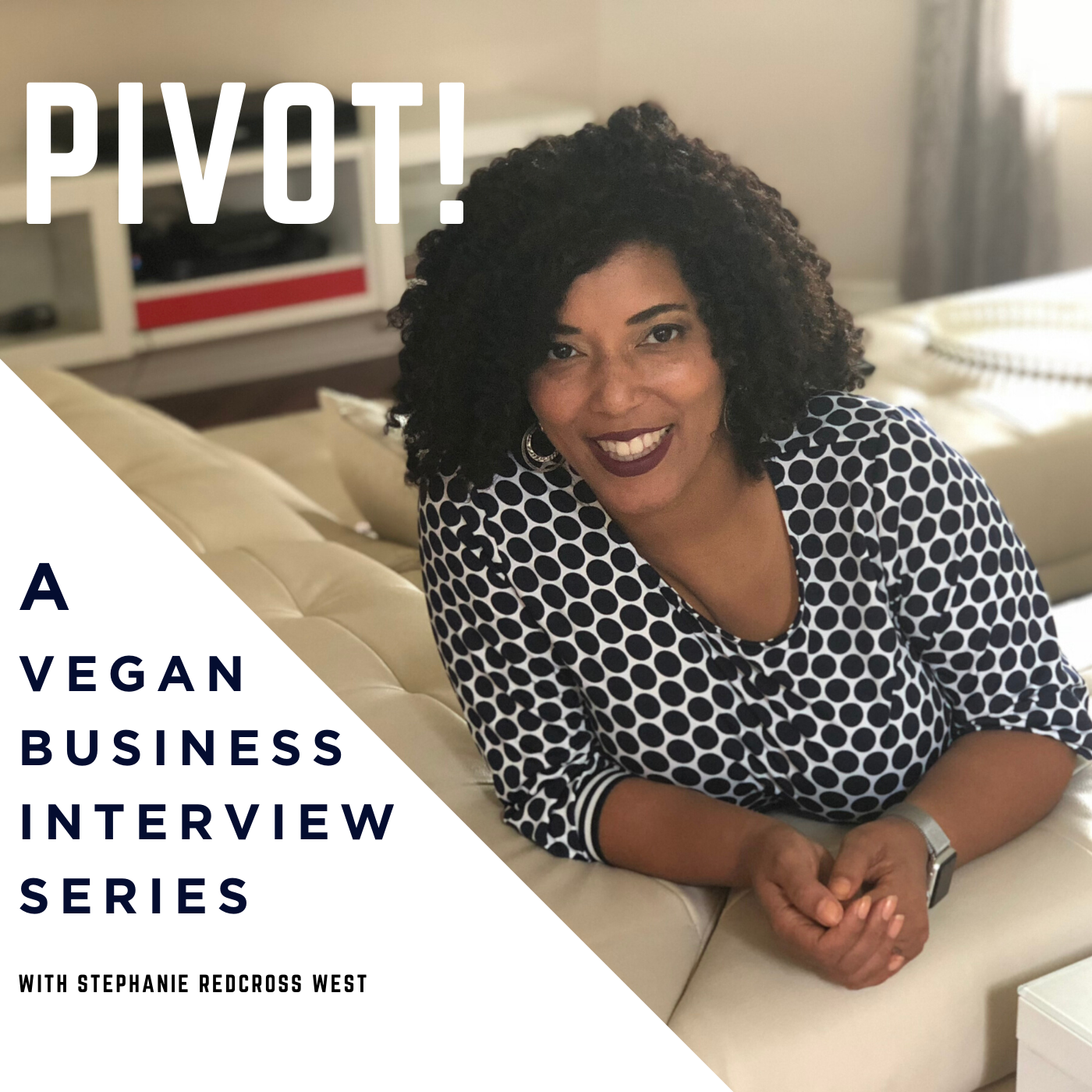
As vegan and plant-based business owners and entrepreneurs, we're often adapting to a new reality. This new podcast series from Vegan Mainstream is an opportunity to help you when it's time to pivot. These interviews will come from inside and outside of our community. And I hope as your host, Stephanie Redcross West, I can inspire you and give you the tools that you need to move forward.
Hello, everyone, and welcome to our interview series here called Pivot. We love to spend a good amount of time talking with individuals inside and outside of our vegan community that have learned how to make changes in their business, in their environment, and in their organizations. One of the things that we believe is one of the most challenging parts of being a business owner is being able to adapt to the environment that's around you, being able to make, as they say, lemonade when you've been sent on events. And this year, when you think about 2020, a lot of us have had maybe less or less of lemons this year.
And the idea is I love to bring examples of people who have found a way forward and maybe help them help you by providing not only some of their experience, but what they have learned. So I'm excited for our guest today. Eugenia is going to be here talking about her pivot story, her transition story. And specifically about transitioning the support that she does as far as people transitioning to a plant-based diet, but how she did it in this digital space, going from, you know, maybe a planned process of doing a lot of this work in person to transitioning it to an online space and how Eugenia has made it work, how she's grown it over time, and also potentially tapping into what her future plans are as we look at 2021.
So welcome, Eugenia. I'm so glad to have you here today with us. Thank you for having me. Great.
So let's do a little bit of background, because anyone who's joined today and thinking about their business, thinking about things like helping people transition, go plant-based, this is a big thing for many of us because we see the world seems to want to embrace some of these dietary changes, really embrace the idea of maybe transitioning their lifestyle. So there seems to be a demand for it, but there's a little bit of different perspective on, you know, learning online as opposed to in person. So I'd love for us to spend a little bit of time and hear about your experience with that. But before we dive in, maybe let's give everyone a little bit of background.
Let's explain, you know, how long you've been vegan and, you know, what's been your journey to now, especially professionally, what got you to where you are today? Sure. So my journey started when I moved to New York to go to Columbia for nursing school. I went to become a family nurse practitioner.
After the first year, I did the program where I got a second bachelor's BSN in one year. So it's two years of school in one. So it's really crazy. All of us had awful food habits.
Like even if you exercise, it's just impossible to out-exercise a bad diet. And by the end of the year, I was feeling so awful that I had tried a couple of little diets, looked into various stuff. And one week, I think it was after I was for several weeks eating a lot of meat. It wasn't necessarily keto, but I was just eating a lot of meat.
I don't know why. And I just went grocery shopping and I was repulsed by any animal products. And that's really good for me because I love, I love steak. I love cheese.
Like it was my favorite food before. And so I got only just happened to only get that. And I ate the whole week and I didn't starve. I would kind of figure out stuff to eat.
I felt really good. And I started, and honestly, that was what made me look up. I didn't, I don't think I even knew the word vegan. I just started looking like, do you need meat?
Do you need cheese? And the research just kept piling in. And I discovered all these documentaries and books. And the uh, the China study book was what came, was really what just nailed my scientific brain in.
And then while I finished my schooling at Columbia, so the next two years, I was shocked to me. Never talked about nutrition. We never talked about preventive, um, preventive lifestyle changes. It was like maybe 15 minutes.
And the entire two year program was, yeah. Okay. You know, what's the first line for anything? Hypertension, diabetes, um, cancer, it's lifestyle changes.
But then it was always, okay, three, six months of lifestyle changes. And now let's dive into what you're really going to be doing, which is prescribing medications and adjusting them and doing labs. And that was really frustrating. So I, um, you know, graduated.
I learned what I needed to learn and I started practicing and I've still practiced in the same place to this day. So it'll be my fourth year, uh, in the Bronx. And it is a very difficult. It's like the hardest job I'll probably ever have in primary care.
It's, uh, they're the least healthy county in all of New York state. We have high everything from like uh, transmissible diseases to uh, preventable diseases from lifestyle. So a lot of people could benefit from preventative nutrition. So I, within just a few months of just making sure I understood just the basics with medication and was comfortable with that, I started approaching every single client about lifestyle changes.
Like I would spend, I would, I would portion my time so that most of the time was spent talking about lifestyle and I only had 15, 20 minutes of patient. So I got really good at it. Yeah. I was like, okay, okay, let's, let's get the foundations down.
These are the foods you more of, these are the foods you less of. I use Dr. I think it was McDougall. He has a green light, red light, yellow light system.
I was like, okay, you want your yeses and nos? Here are your yeses and nos. And in 2018 towards the end of 2018, uh, or sorry, 2019, I was all of 2019. I was trying to convince our chief medical officer to start a comprehensive nutrition program because we had one nutritionist.
We still have one nutritionist and we have five primary care sites, thousands and thousands of people come through our, we are their primary care providers, and yet we have one nutritionist who will probably see you once a month for 30 minutes to 45 minutes and then you don't see them for a whole another month. And you know, there's no real like system in place. You just generally like you see one-on-one. It's not a very sustainable way to change.
None of us really, unless you somehow got some revolutionary aha moment from one visit. Yeah, that's really difficult to change. But that's it. Yes.
So yeah, so I, um, I basically, I mean, you're, you want your audience wants to know how to overcome challenges. My first challenge is even like starting it. Um, I was not trying to hide that I was promoting plant-based. Every clinician at my organization knows that I am vegan.
I try to use the word plant-based to try and make it not so abrasive. But but we know where you were going. You were going, yes. And so, yeah, and so over the course of a year, I kind of wore down my CMO.
Basically it was like, I'm gonna, I'm not, you don't want to let me hire anyone. I'll do everything. Um, there's no, there's no overhead costs. It's just, you need to give me time.
Your overhead cost is my salary that you're letting me take hours to create this program. Um, and then every, you know, him and other providers there issue was who's going to want to eat plant-based in our community. People don't have enough food to eat. They don't have enough money to buy food at the end of the month.
Sometimes um, they don't, their cultural food is really meat heavy and cheese heavy. You're going to be offending them. All these reasons when, when I did the research online, it looked at research studies. Research studies disprove that over and over again, that it doesn't matter your cultural background.
There's vegetables and fruits and whole grains are still part of that. And you don't have to, and, and the point of, you don't have to tell people you have to exclude things. You can just minimize. So you don't, you never have to really even say, you know, there's a food that's totally off the menu forever.
It's their choice if they decide to. Um, so anyway, long story short to get to the, you know, things I adjusted during COVID, but I got a yes. And then I, uh, applied for a grant, um, to fund um, in-person cooking classes. Cause I was trying to find a way to do this, uh, to engage people and I couldn't quite think of a free way because just getting people to come into the clinic.
So I did actually get my own funds, small amount from veg fund, which is amazing. And they're amazing. And everyone just said, uh, it was any ideas about how to spread the plant-based message should absolutely apply to veg fund. I didn't even know other clinicians even got uh funding through them.
I just thought, I know I want to do this. I totally promote their mission. And so they were the ones who first believed in me and gave me the funds to do this. So we started out.
So the program was just like you implied in the beginning entirely in-person classes. My whole draw was I will give everyone a sample of a plant-based meal during the class They're able to hop on Zoom. They're probably text capable. So I was like, OK, let me go ahead and try texting them.
Text everyone from your phone, even though you copy and paste it. Oh my gosh, such a hard, such hard work too. And you have to type in each number because you have different numbers. Oh my gosh.
So I did that. Well, so I'm getting more attention and I am getting access to people in the organization that didn't even know existed. I didn't know we had a media person. I didn't know.
I didn't know any of the people who did data at my organization. So now I am kind of buckling down on data. So we're going to have a page on our website now to refer people. So and it'll be very similar to Bellevue's program also.
They were actually one of the programs that I pitched to my CMO to say this program is in need. It's only other similar programs in Manhattan or in the Bronx. And then we are going to collect data on all patients that have attended through this data system that we have and we'll track outcomes. So then we'll be able to demonstrate that to other grants to internally to show providers that they refer to us to here are actual data of actual patients.
And then we're starting Spanish classes. So there is another nurse practitioner that works with us and she has expressed a lot of interest about learning about nutrition. Again, we don't learn it in schools. MDs don't either.
And so I've been kind of answering questions as I go, sending her my resources, you know, nutritionnutritionfacts.org, PCRN, you know, all my favorite resources that all of us know and love and are so grateful for and couldn't know all this information without. And she was telling me, I mean, I just had the thought, she's Spanish speaking. And she was telling me that she wanted to even read How Not to Die in Spanish so she would know the words in Spanish. And I said, well, you know what?
It would be really great if you actually taught patients in Spanish. Exactly what I'm doing. I just, I speak very limited Spanish. I can get through a basic interview, but I cannot tell someone how to cook like chicken masala in Spanish.
That's just not my level. And so she, yeah, she was really excited. And yeah. And so I think the more people you can bring in your organization that want to contribute, the greater the excitement spreads and your impact is greater because like you might have these skills that have gotten you this far and that are, you know, are the reason that this program even exists.
But to get to the next level, you need other expertise, other ideas that you may not even possibly imagine that you need. So I am sure that she's going to have some ideas for the program that I've never even thought of that I may not even think works, but we're going to try because she's another person that can bring their own special gifts and skills. So I love that. And I think that's the key of like building something great or building something that's impactful is a lot of times it may take one person like yourself to really push it forward and get it to a point that people take notice that people really pay attention and create that process and then being willing to kind of share that glory with others so that you can make it even bigger so that you could maybe do offer it at, you know, for multiple facilities to be able to make it kind of into the dream opportunity where, you know, you may have four or five classes in a week eventually, or even something one day.
And the idea is that bringing other people in, collaborating, and then being able to offer them classes, especially classes, I think is brilliant. So I'm glad that you're not only finding a way to make this happen, but finding a way to continue to expand it, especially in this environment, which has been a little bit difficult and challenging for a lot of people. So I guess one thing I'd love to do as we kind of wrap our time today is any advice that you've had for people? Because I feel like what you did is you kind of took that entrepreneurial mindset and brought it into this role.
You know, not necessarily this is like your small business kind of kind of feel because it's a piece of pulling out the work that you already do. But anything that you would recommend to anyone out there that's trying to get a project like this off the ground, whether it is cooking classes or whether it is another type of project or idea of that resilience that you had and patients that you had to push through any recommendations that you have for anyone out there that is trying to start a new move during this time? I mean, the thing that comes to mind seems so obvious to me, but I guess I'm just attest to me that it works, is that if your project's existence depends on somebody's permission, then find out what they are motivated by and what their goals are, whether it's, you know, increasing the bottom line or if it's, so my leader is actually fits into the demographic of the types, like his background is for the demographics of the patients that we treat. And so for him, learning about the health outcomes of the health benefits was actually a pro for him.
So, you know, showing that patients from low income environment, low income, I wouldn't say house, but it's not low income, but people who are low income can still benefit hugely from plant-based diets and it's not more expensive. And I gave him even journals. I just brought him for him to take home and look over and I know him and his wife looked at them because his wife is really into that stuff too. So just find a way to connect with the exact person that you want to connect with is worth it.
And then obviously, so then the second thing for me, that was definitely, and I think this is going to be for everyone, is making sure that your program doesn't lose money because the bottom line is if you make your patients healthier, they're ideally not returning back to you. Right? So you don't want to sell that point, but you do want to sell that on the way there, you'll be helping, you'll be helping the patient will be coming in more often. And then uh you'll be getting more referrals from outside of the organization.
That was, that's like a very personal to my work of my program, but um sorry, I feel like I explained that really step by step. Yeah, it's not that it's aligning the goals, meaning you're going to get people healthy. You want to get the good outcomes. But at the same time, the organization wants to stay afloat.
So the question is, how do you get those goals to come together? So if you are helping people, if you can create enough referrals, then that creates a common goal between the two. They're not fighting against each other because if you're fighting against each other, it's hard for this program to continue. Right.
And then the more people you can get on board, the better. So if you, you know, if you somehow I know we're not getting in a room with too many people, but every time I was in a room with anyone who remotely could possibly understand anything about the program, I would tell them about it. So anyone that I've seen in the last two years in my clinic knows that I'm plant-based, knows that I want to support plant-based diets, that I want to help their patients become plant-based. So just keep talking about it because you never know someone who might be able to have sway in a room that you're not in or can give you an idea, even if they can't do it.
There's been so many people who I didn't even think of possibly do anything to advance the program, but I'm just so excited about it, talking about it all the time that it just that they ended up being able to give me their feedback or connect me to another person. So just always be networking. I know these are also generic, but it works. Always be networking.
But I think we need reminders sometimes. And also I think a lot of people struggle with how much should they talk about it in their talks? How much should they talk about it when they're talking to people because they don't want to become like the, you know, the plant-based police. They don't want to feel like sometimes they get labeled as like, oh, you know, here's Stephanie showing up with her plant-based stuff again.
You know, that thing I think sometimes people get concerned about. So I love that you are showing that it's important to speak, to talk about it, to not hide that because if you want people to be aware of it and you want people to go on the journey, they have to be aware of that you have it before plant-based lifestyles. It doesn't, it doesn't work if you, yeah, you can't be planning to be the leader of, you know, the representative of this program, but also be very covertly plant-based or covertly. You want to be aligned to how people see you and the position that you get, because then it's just a big question mark.
If I approached my CMO and told him I wanted to start a nutrition program and I'd never, ever talked about how important nutrition was to me, that would be a much harder conversation. I would have to spend a year telling him my qualifications of why, because again, we don't get nutrition education in school. So I never got those questions about my qualifications and I don't have to prove anything because I've been talking about it forever. Yeah, I love that.
I love that. So I think this is such a great example of how to implement into your workplace, how to talk about it, how to get people excited about it. And like you said, it's not always the things that sound like, oh my goodness, this is a brand new idea. Where is the plastic off of it?
No one's ever thought of this before. It's the idea that sometimes we have to do