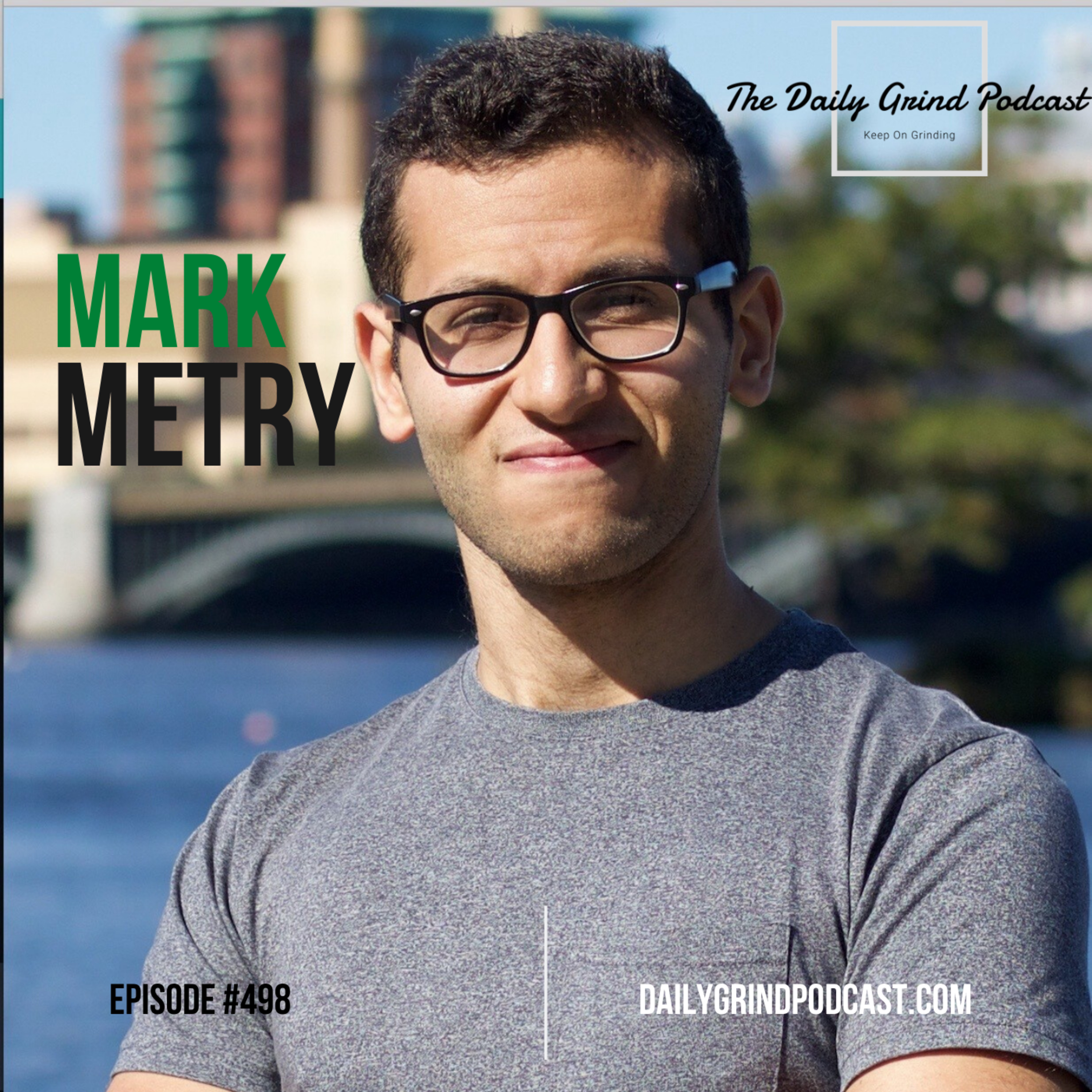
Hey everybody, happy Tuesday and welcome back to another episode here of The Daily Grind. Thank you so much for tuning in. Hope you all are safe and healthy during these times. Today on the podcast, I am joined by a good friend of mine, Mr.
Mark Metry. Mark Metry is a very interesting guy. I had him on the podcast about a year ago. He interviews billionaires, New York Times bestselling author, and legendary world-class human beings on his top 100 podcast, Humans 2.0.
He is a speaker on social anxiety. Today we're talking about his new book, Screw Being Shy, plus so, so much more. He's also the founder of VU Dream, which is a digital marketing growth agency focusing on virtual reality and mixed reality. His primary goal here on earth is to help others eliminate their internal enemy within and live a life of mental and emotional freedom.
This is an awesome episode. You guys are really going to enjoy. Be sure as always that you have a pen, a piece of paper, sit back and really dive deep in today's interview with Mr. Mark Metry.
Enjoy. There has honestly never been a better time to start a podcast than right now. Listen, if you've been thinking about starting one, but maybe you don't know where to start or what you're going to talk about or how to create an impactful show that will make you money, I am taking on three projects until the end of this coming month. Now, this is not free, nor is it easy, but I can show you how in your first year of podcasting, you can generate a minimum of $15,000 with your show.
Again, a guaranteed $15,000 with your show or your money back. If you are serious and want to be one of these three people, all you have to do is visit dailygrindpodcast.com forward slash start. Again, dailygrindpodcast.com forward slash start to book a free 15-minute consultation with me today. Now, without further ado, please meet Mr.
Mark Metry. Well, Mark Metry, welcome to The Daily Grind, my friend. How are you? Dude, thank you so much for having me back on.
And yeah, man, I'm trying to manage in this post-corona world. It's been an interesting time, to say the least. So are all of we. And hopefully this episode today, we can bring a little, give you some smiles and some insight and bring people, take their mind off of all this what's happening, right?
Yeah, man. I think, like, honestly, I don't really have the answers. And I don't think, uh, you know, everyone, anyone does really to an extent. So I just think, uh, this is a good time for us to have conversations, you know, maybe not, maybe not face to face, maybe not right in front of each other.
But I think this is a time where just like people from different ends of the globe, because of this, like seemingly random event happening, I think it's really forced us to just ask a lot of questions that like we've been running away from. Like just what are the most important aspects of our life? People that have been neglecting their health. You know, I think, I think now it's, and health in other ways, not just physical health, emotional health, mental health.
Um, I think this is really a time where we're going to sort of see these things in our society highlighted sort of because of the extreme environment scenario that like we've basically all been sent to our rooms for the most part around the world. Super interesting. Yeah, it is right. And it's, it's hard to get used to because oftentimes like we're not stuck in our rooms, you're out and about.
And I think it's an interesting time. What are some things you're doing right now, uh, whether to keep you busy or to, to keep you on track and, and all that. Yeah, man. So, I mean this, you know, I'm sure like a lot of us, it's been a super, super interesting month.
Um, last several months I kind of took a backseat from like speaking and stuff because I've been working on my book. So I was super head down. And then this month for me was supposed to be like my launch month. Um, of not just the book.
I had a TEDx talk going. I had a ton of like book related events and just other events that, um, that have all now been shifted. And so it's been super interesting because I kind of spend maybe the last six months, like a year kind of prepping for this month. And like the weeks prior to this, just kind of like hustling super hard, just trying to squeeze in every minute, every ounce of like just trying to put in my all so this book comes out great.
And then now it kind of feels like the, the finish line has greatly shifted. And so, yeah, I mean, it's interesting. And so for me, like I'm trying to take things easy, uh, because honestly, like over the weekend, I kind of caught myself just like freaking out about so many different things. And so I'm just trying to like go back to basics.
Like for example, one thing I'm doing now is like, um, before this call, before on like my early AM meetings, I just took them all on my phone and I just went for a walk outside. Um, I live in a pretty rural neighborhood, so I don't live in a city or anything. So there aren't really people next to me. Um, that's massive because one, I mean, walking, any kind of physical exercise, of course, it's good for you.
And then two, um, this doctor by the name of Dr. Daniel Amen, uh, great guy. Uh, one of the top doctors and top neuroscientists in the world. Um, he said that all mental health issues have one correlation in common, and that's a deficiency in vitamin D, which you primarily get from the sun.
And then also different kinds of specific foods. Um, so yeah, I mean, I'm just trying to like really use this time of like, rather than like hustling super hard, which was my plan, I'm kind of doing the opposite. And I'm just kind of feel like it's just a, not a season. This is just a time in my life where I've just got to sort of go back to basics and sort of just kind of take these things one step at a time because, um, you know, social isolation is probably the worst thing you could do for your mental health, but because due to public safety and just the current state of the world, we have to do it.
So, so honestly, it's, it's been rough, man. I'm not going to lie. So it's been interesting, to say the least. No doubt.
And just before we move forward, everyone, if you want to learn more about Mark and his background, you can check out episode 289. Mark mentioned this is the second time he's been on the show. Honestly, Mark, there's not too many guys I have on back for a second time, and you're one of them. And that's for a reason.
And, um, one thing I noticed about yourself is you've got some really, you have some really cool things on the go. You had mentioned your book, so I kind of want to start there. Screw being shy. Uh, maybe talk about kind of the, how the idea came about for you or wanting to write the book and then sort of the process.
Yeah, definitely. Yeah. So people can definitely, uh, check out my story in the episode previous to this. But, you know, for me, I, I struggled with, uh, you know, not just being a little shy, but I struggled with pretty, pretty extreme social anxiety, um, for really the first part of my life.
And, um, you know, social anxiety is not you being afraid to ask a girl to the prom. Social anxiety, uh, can be defined as extreme nervousness where your nervous system puts you into a fight or flight any time you think you have to speak up. And then also it can be defined as a perceived social deficiency with your physical appearance, your character, your personality, your social skills that make it seem like you have to try extra hard or compensate, or else people are going to find out and judge and mock you. And so I kind of faced this for I saw 10 years of my life.
And then the really interesting part about social anxiety is eventually it begins to leak over into every area of your life. And it doesn't just become about like, you know, you having trouble speaking with others. Eventually for me when I was like 18, 19, um, I was obese. I was overweight.
Um, my lifelong social anxiety turned into social isolation and I began to develop pretty serious depression and even flirting with suicide at one point in my life. And long story short, I was able to, you know, through one way or another, begin to climb out of this. And sort of, as I began to emerge from this, I really began to sort of find who I am. That eventually led me to, you know, doing all the things I do now from starting a business to my podcast to this Amazon prime documentary series, all this stuff.
And basically like I came up with this idea for this book maybe about six, seven months ago because I realized that whenever somebody hears my story, whenever someone, like I'm at a speaking gig or maybe it's a podcast like this or just whatever kind of event and someone hears my story, like the number one genuine ask that I get from people is how did you get out of social anxiety? Like I'll, I'll see someone come up with me who is super shy, their voice is like trembling, they're shaking when they're trying to talk So the opposite. And so, is there no way, like in part of that definition that people who are introverted are shy? And it's also totally okay and normal and healthy to be shy every once in a while.
Like you're in a new environment. You guys, sorry, go ahead. Yeah, I'm just agreeing. Oh, okay.
I thought you were gonna ask something. Yeah, so then, so it's also totally okay to have a healthy, normal level of being shy. But there are people who usually, it starts off as a kid, although this can also sort of trigger when someone's an adult, there are people who in every room they walk into, no matter who they are in front of, they are shy. And what happens is eventually, if they don't grow out of this, then it becomes social anxiety.
And essentially what that is, is, you know, someone with social anxiety, they'll be sitting in a room and, you know, their mind will start to tell them socially anxious thoughts. They'll say, oh, you know, like, look at your shoes, and then look at everyone else's shoes. Your shoes suck. Or, like, look at, look at how fat you are compared to everyone else.
Or, man, I bet everyone in this room hates you. Or, man, I cannot talk. Like if everyone, if I talk, then people are gonna judge me and hate me. It usually starts off in the mind and then what'll happen is your body will begin to feel that anxiety and then your body might begin to, you know, your forehead might start to sweat, your armpits might start sweating.
You might start frantically tapping your legs. Your throat might tighten up. A wide variety of things can happen. And so the real issue with this is that someone will be going about this, not really knowing this is happening.
And then if this happens long enough, if this pattern is stored, eventually it gets stored in your physical body so that if someone with social anxiety walks into a room and they may not even be socially anxious in their mind, but as they sit down or as they do whatever, their body will automatically begin the signs of physical anxiety of the legs tapping, the throat clenching. And then what'll happen is your mind will look at that and then it'll get socially anxious. And so, like, this is really like a mental, like matrix prison that someone can get stuck in where even if they really do want to talk to people, even if they are a social person, their brain just won't let them. And so, you know, I was talking about this with with Gary Vaynerchuk's company, VaynerMedia.
I was in their office in New York City and I was speaking with their chief heart officer, Claude. And she kind of asked me the same question that you just asked me. She was like, yeah, I don't really have social anxiety. Like, what would you do?
Number one is like, I remember for me when I was a kid, I was always called, oh, Mark is just like that shy, quiet kid. And like the matter of the fact is, is like, there's nothing wrong with being an introvert. There's nothing wrong with being a quiet introvert. But if you feel a lot of stress, a lot of psychological stress and feeling nervous around talking to people, then that's not just introversion.
That's called extreme shyness and maybe even social anxiety. And so number one is like, we have to understand that because we have to actually distinguish who's an introvert versus who is, who actually faces this problem. Because if you ask most people in our society, they'll tell you like, oh, yeah, that kid or that person sitting alone at lunch or in the library is doing so because he or she is an introvert and they choose to do so. That may be very well the case, but also they could just have social anxiety and they don't know how to socialize and how to be with people.
And so I think one is kind of understanding that issue, because again, it's totally okay to be an introvert. There's nothing wrong with that. Number two is, you know, this is kind of like in the general realm of, of like a lot of the stuff that I hear in like entrepreneur land of a lot of like motivational speakers and whatnot, just telling people like no excuses. You just have to try harder.
And the matter of the fact is like, I generally agree with that. But when it comes to any issue with mental health, specifically, you know, my expertise, social anxiety, that just doesn't work. So like if you go back to the scenario of what I told you of, like what social anxiety actually is and someone being stuck between their brain and body, almost like this prison and you tell them to try harder, it's just not gonna work. They're gonna try doing the same things they've always done and they're actually gonna cause themselves more stress.
And so that's, that's sort of number two, because again, like there's a lot of science in my book. Like I'm not a, I'm not a neuroscientist. I'm not a doctor, but I have friends who are and I cite their studies and I cite their research because I think that's sort of a, sort of like a great equalizer. You know, I'm not, I'm not like, obviously I'm not a 100% like strict, purely science person because I think there are some things that science can't explain.
But when it comes to mental health, when it comes to, and by the way, that word mental health has, there's so much stigma around it. I actually prefer if we call it like brain health because it's like, if you have a brain, then you have brain health. The same way that if you have a body, you have physical health. And so that's number two.
And number three, I think is just maybe like, not necessarily trying to like force your friend who has this issue to like go out there and talk to people or to get people. I think just kind of opening your heart up, opening your hand up and being like, hey man, you know, if you want to talk to me, I'm happy for it. You know, if a friend of yours has specifically expressed that they have this issue, which not all people do, because a lot of people who actually face this don't know. Like I didn't even realize I had social anxiety until the tail end.
But if you have a friend who's telling you about that, then maybe you can tell them to like do their own research, tell them to check out my book, Screw Being Shy, really just open it up for them. But I mean, I've seen a lot of the times where, you know, you'll have a friend who's facing this issue and a lot of us just think that we can give that person advice and that doesn't really work because a lot of the times if you know, if someone isn't in that spot in their mind to be there, it just simply won't work. And that's because, you know, the human mind is it's mostly a sort of closed off organ. But the real way to unlock it is to begin asking yourself questions.
It's to begin to get more curious. It's to begin to open up the mind with questions, being a little bit more inquisitive. And then maybe someone can find a book, can find something that they can use to help themselves. And so, I mean, again, I wish there was a better answer, but this is one of those things where it's like, again, like support is important, caring for other people is important, but also like, especially in terms of this mental game, I think a big part of this is stuff that someone quite frankly, has to do by themselves because it's where sort of the root cause of this issue is.
But yeah, I mean, aside from referring books to them and just being an open, caring person, and then you living the life that you actually want to live yourself and being that active source of inspiration for them, I think that's a great way to help some of your friends who are dealing with this issue and want to get out of it. I love that, man. So say someone like yourself who is facing it, like, I don't know, how important is, is like trying to create some structure in your day to day? Yeah, so I mean, so it's interesting, right?
And then, you know, the general rule is like, you know, personally for me now, I mean, for sure I definitely get like generally anxious from, like, I still have problems. I'm, I'm a normal human being. When it comes to social anxiety, you know, I kind of feel like for most of my life, it had like a 99%, like strong grip on my neck that controlled my life. Now I probably want to say it's like anywhere from like, probably like 5%, like less than 5%.
And so it's a problem for me that I've largely managed. I don't really get socially anxious anymore. But I mean, in terms of structure, it's interesting because I think, and in terms of mental health in general, there are people who have mental health issues and they are either way too structured and way too orderly, or they're all over the place. Like I, like I had a, actually the call before this, I had a friend of mine tell me this is public knowledge, obviously, tell me that his uncle um was diagnosed with a mental health issue.
And he was telling me like, yeah, I had no idea. Like I walked into his house. Everything is super ordered. His closet is like organized by like the colors.
And I'm like, yeah, dude, that's like a, that's a potential sign for mental health issues. Like it's either too much order or lack of order. But when it comes to structure, I mean, I think it's absolutely important. I think when Chemistry.
I'm talking about like when you research mental health and when you research the brain, and then even when you look at how like the mental health medical community is tackling this, and then also even the leadership circles too, a lot of people talk about a neurotransmitter called serotonin. And serotonin is... does a lot of things in our body, from regulating our mood to regulating our appetite, regulating our sexual desire, our sleep, and specifically, serotonin controls our functioning in social groups. And so this is extremely important for social anxiety.
And so when you look at serotonin, I mean, most of the previous science for maybe just like the last 20 years, most researchers and scientists thought that because serotonin is a neurotransmitter, it's got to be in the brain. And it turns out that's only partially true. It turns out only 5-10% of serotonin is in the brain. And 90-95% of serotonin is actually in this thing called the gut microbiome, which is a vast ecosystem of trillions of bacteria between our stomach and intestines that we have formed a symbiotic relationship with that does a lot of things in our body.
And so when you look at it from that biochemical level, you have to realize that like, even if someone does have the mindset, even if someone does know their life's purpose, but there's like a fundamental biochemical issue with their neurotransmitters, which happens a lot, then they're going to be depressed. They're going to be anxious. I mean, it's gonna look different for each person. But like, that's a major point that I'm trying to push across to my book.
Because, like, for sure, mindset and beliefs and all that stuff is important, but so is your biochemistry. So is your brain chemical. So are your neurotransmitters firing. And if there's an underlying issue in that, I mean, it's gonna be very hard to even get somebody who maybe defined themselves as like positive or as a leader.
Be themselves if they have that underlying biochemical issue. And so that's like a big part of the conversation that I'm trying to push because, like, you know, going back to the whole sort of entrepreneurial slash motivational speaker, basically a lot of people saying like, Hey, just try harder. You know, no excuses. Like, yeah, again, I can agree with these on a general point of view, but for anyone who faces, you know, potential, you know, mental health issues, you really have to look at that biochemistry because, you know, if you're not, you're just ignoring a major piece of the conversation.
And I've even seen people who have had the best jobs, have been surrounded by like the most loving family members, people who love them, but they still kind of fall down this path because their biochemistry is severely flawed and it's dysfunctional due to their, you know, lifelong health choices, really. Yeah, I love that. So just briefly, before we move on to the next subject here, where can people grab a copy of Screw Being Shy? Yes.
Thank you for asking, man. So if you go to Amazon, and I'm not sure when this podcast will be up, by this week, the audiobook will be up too. So it's out on Audible. People can get digital or paperback versions on Amazon, but Amazon right now is, they're not shipping or it's taking them like an extra month to ship things that are nonessential because of this virus.
So the fastest way to get it is at Barnes & Nobles. So if you go to, I don't know if you guys have it in Canada, but if you go to Barnes & Nobles' website, that's the fastest place to get the book in your hands. Beautiful. Awesome.
I'll share that in the show notes section. And now, Mark, we're going to shift gears slightly. We're going to move into a new segment we're starting here on the show. All right.
This is called Do or Don't. You must unlearn what you have learned. All right. I'll give it a try.
No, try not. Do or do not. So it's kind of, I wouldn't say it's like a game show, but I'm going to give you a scenario. So you're an entrepreneur, you're a business owner.
I'm going to present you a scenario, and you're going to tell me do or don't. And then you can give a little background as to your answer as well. All right. Oh, man, I'm so excited.
I love it. All right. First scenario here. Someone sends you a cold email offering a service that they can help you with in your business.
Do or don't. I mean, I think it totally depends. Like, so, for example, like, I got an email yesterday from this sales guy who I've never talked to. And the title was something like, Mark, you're making me upset because you're not opening and checking my sales email.
That is absolutely horrendous. I mean, if you're doing that, then you're just, you have no idea what's going on in the world and stop doing that. But I mean, honestly, I mean, I always try my best to look at my email if it's something that is relevant towards me. Like, they're not trying to send me like, Hey, do you, you know, do you need a shipment of, of webcams?
Like I get all these random emails from Chinese manufacturers. They're like, Hey, do you need, do you like this radio transmission receiver? I'm like, no, I don't need 7,000 cases of these. So I think if it's relevant, um, if it can actually help me, if whoever's sending me this email has some sort of credibility that they can actually back up what they're offering, what they're saying aside from just words on my screen, then, and then my schedule is, you know, kind of open, then yeah, I mean, I'll definitely try to see if, uh, if there's some potential synergies there because, um, you never know.
I mean, sometimes I think some of the greatest opportunities have come for me from just like random, random emails like that. So it totally depends, you know? I like where you went with it. So it's more of a do, but you got to do it the right way, right?
Yeah, that's exactly it. Especially now. No doubt. All right.
Next one. Uh, you're a LinkedIn expert. If people don't know that, follow Mark on LinkedIn. He comes up with some awesome content, but this next scenario, someone connects with you on LinkedIn, then tags you in all of their posts.
Do or don't. Definitely, definitely don't. And, um, and I mean, honestly, like I, um, Like people ask me this question, like all the time, and some people get like freaking pissed off about this. I honestly like don't really care because like I get so many notifications either way that I can't even see them.
So like by the time someone tags me in things, my notifications are already blown up. So I don't even see it. And so, yeah, I mean that probably happens to me like 6,000 times a day. Um, it doesn't really bother me just because it's like one of those things where like, I'm putting my time and energy on other things that are important.
So definitely don't do that if that's what you're doing for sure. Okay. We're going with don't there. I think we all know that person who just always tags in every post, drives me nuts.
Yeah, no, it's crazy. And I'm like, I'm trying to like think like, where did they learn this from? Like, do they think this is working? Like, I'm just like imagining someone like on their phone or just like hunched over at the computer, just like typing in the at symbol and typing in like every single name, like a essay.
I'm like, dang, man, like you clearly, you have a lot of time on your hands. No doubt. All right. So next scenario, someone, you know, maybe, maybe you connected with them.
Maybe you talked to them on the phone. You had them on your podcast. You missed 2.0, whatever. But after you connect with them, they ask you if you can put them in touch with someone else.
You have connected with whether they've been on your show or someone who's well known. Do or don't. Yeah, I mean, this, this happens to me literally all the time. And, um, and I mean, again, it's like one of those things where like, if I kind of know who you are and, and, um, you know, this person like has credibility, like this person actually has a track record of showing up, being a nice person, being respectful.
Like, for example, you, if you ask me like, Hey man, can you introduce me to this person to interview on my podcast? I would absolutely be down because I know that you are a totally credible and awesome person. But if someone else that doesn't have that track record, that's public that I can see, um, then very unlikely because, you know, you and I both know that, you know, if I introduce someone to example, someone we both know, uh, David Meltzer, um, who's also endorsed my book, by the way. Oh, amazing.
Yeah. He said something awesome, said something super nice, but, um, yeah, I mean, if someone asks me like, Hey man, can you introduce me to Dave Meltzer? And I have no idea who they are. Then it's like, if I introduce them to Dave Meltzer and it's like some scumbag, it's like some person who is just interested in like transactional relationships, then I think that definitely puts a damper on me and Dave's relationship as well.
And so I'm super, super concerned, not concerned, but I'm super aware of that. And then like the I'm in the middle of making another one for my book, but I mean, I already have an audience. And so I mean, this, honestly, like, the way that I think about it, Colin, is that, you know, I view everything from sort of an investment basis, right? So it's like, so I make a LinkedIn post, I hopefully create some kind of value that people can actually learn from and benefit.
That's like me investing one, right? Every time I make something that's valuable, a piece of content, whether it's a podcast, maybe it's I release something for free, that's an investment. And then now when I am asking people to do something, it's not that it necessarily takes away from my investment, but whatever I have is going to work better if I've already been investing for it for years. And so honestly, like, I don't know what your thoughts are on this.
I'm sure it depends on the person, but if you don't have an audience and you have an online course, that's probably not the best way to go about it. Maybe you should spend a little bit more time on actually trying to create a real meaningful audience, because I think now with, you know, the whole, you know, uncertainties in the economy and in the world, people are obviously getting much more sort of like focused on their money, what they're spending money on. And it's like, if you haven't even put in the time to build an audience that actually cares about what you have to speak, then I mean, that could just be a waste of time. But I think if you kind of spend now, maybe instead of making that online course, again, this depends on the person, I could be wrong, but you maybe you start a podcast or maybe you start to make those investments day by day by day, actually begin to make a brand for yourself and actually begin to connect with people.
Then, I mean, that's just a golden way to go about it. And so, like, for example, like my book is like, it became a bestseller. I'm checking the charts right now. Thank you.
I'm checking the charts right now. And it's like people next to my book are like Brene Brown and a ton of other like well-known neuroscientists and great people. And it's like, this didn't randomly happen. You know, it's because I've built this audience that has then given me the ability to then be like, Hey guys, I launched this book, go check it out.
And it makes it much more willing rather than just sort of starting it from the top. And so that's, that's my perspective because I'm always looking at things from a, from a long-term perspective. I'm always looking at things from sort of a long-term basis. And I know that an audience, for the most part, there are definitely exceptions.
If you keep going, you know, they'll be with you for, for life. And so I'd much rather have that than make, you know, then I, you know, I don't know, like make five sales off a hundred dollar course and just make 500 bucks rather than exponentially increasing that value later on and by doing other things down the road. So yeah. What do you think?
You know what? I lean towards you for sure. I do see, like, as you were talking at the beginning stages, like what I was thinking, I'm like, well, if the online course is really good, then you could leverage other people's audiences. Um, and that would be a great way.
So maybe I was thinking at the, in terms of, of no, but I think really for sustained success and long-term success, I think building the audience is much more important early on. Yeah, that's, that's a great point. And, um, and, uh, and one of my clients, he's a, he's a doctor and he also has a podcast. If his marketing, his brand is not huge, it's pretty small, but I mean, that's what he did.
Like he was able to use his expert knowledge from being a doctor and then the other networks that the other relationships that he's built because he's a very successful entrepreneur. He just doesn't really have a brand and kind of spread it out there, affiliate, break it out there. And he's been pretty successful with that. So I think you could definitely go both ways.
You just gotta be smart about it from one perspective or another, you know? So that's a great point. Awesome, man. Well, that's it.
That wraps up the do or don't. What'd you think? That's the first time I've done that. What'd you think of it?
Dude, that was awesome, man. I might, I might not necessarily steal that for my podcast, but that's like, that's like a scenario that I might put in front. I think that's awesome. I think you should do that with all your guests, man.
That was fire. I love that. Well, let's not think it. Well, I think a lot of people make those mistakes, right?
And they know they are, but sometimes when you hear it back in a different, when someone else talks about it, I think they start to realize, okay, maybe I shouldn't do that again. I think deep down they know though. Yeah, absolutely, man. It's uh, it's truly, truly interesting.
But, um, but I mean, again, there's always, um, there's always, you know, exceptions and whatnot on both sides of the spectrum. But I hope that people, um, are following those who like can actually like have, not necessarily have been doing this for a while, but people that are in it to win it on a long-term basis and not people who are just trying to make a quick buck, but people who actually care. And I think, I think that's another thing that we've been seeing with Corona of like, like you can tell like in, in companies, marketing and things like who's trying to make like a quick buck and who's just trying to like take advantage of the situation versus companies and brands and people who like actually care and are just trying to be helpful and make that long-term connection because that's going to be valuable. And then in turn, you know, a lot of these companies who maybe took that short-term Avenue, I mean, I bet they've lost customers for life.
And so it's, it's interesting to see that perspective and it's interesting to see, you know, when someone in the whole world is in a scenario, what people are sort of pushed to do because of that. And based on the information that we all have, that's, that's growing rapidly. So it's super interesting. Yeah, totally.
Awesome, man. Well, uh, the way we're going to end the show here, Mark, is, is like we did last time, we'll get, we'll give you the floor and you can share with the audience a thought of the day. So something you're thinking about or a message you really want to drive home, uh, to end the show off today. Yeah, it's super interesting because I actually remember my last message when you asked me this and I, and I would, I would not necessarily don't agree, but, um, but I would totally, uh, have said a different thing.
And so honestly, man, like what I would say is this, um, I, I know that, you know, this period in our world today is going to end, you know, nobody knows when it's gonna end, whether it's two weeks, two months, six months, a year. I've no idea. But I think when we look back at this time in 10 years, we're going to be like, oh man, I wish the whole world was quarantined. Oh man, I wish I had way more time to have.
And so, you know, this is a, this is a very serious issue of what's going on with the coronavirus and those people who are, who are sick and were quarantined and whatnot. And so what I would say is like, if it's happening, you might as well try to take advantage of it. If it's happening, you might as well try to seize that opportunity. Um, someone who I had on the show, uh, Jay Samet, you, you should totally have him on on your show.
He's, um, he was like an early player in like eBay and Microsoft. He's a massive entrepreneur. And he told me when he came on my show is he said, when you are in a funk, when you are feeling pissed off and ungrateful, the part of your brain, I forget, I forget it, but the part of your brain, what it's job to detect opportunity literally shuts down. And so for sure, it's not about being positive a hundred percent of the time because that's just not real.
And that's fake. But if you, if you find yourself sort of getting caught up in like the, the, the drudgery, the, the pain of socially isolating yourself for sure, you have to take care of your mental health. You have to take care of your emotional health. I think that's way more important than just hustling and trying to make an extra income stream.
But as long as you take care of that, then I think we're going to be looking at this time. Like, man, I had so much time to like, you know, begin to explore what meditation really is and build it in as a habit, man. I can actually sleep now for seven to eight hours rather than me sleeping for four to five hours every night. And so I think this is going to be a time where we're just going to be learning so much about our own personal behavior, because I think in sort of like these strict environments, we sort of see aspects of our behavior happen that wouldn't normally happen when we're with other people.
And so I think this is just a massive sort of mirror for humanity, for companies, for leaders