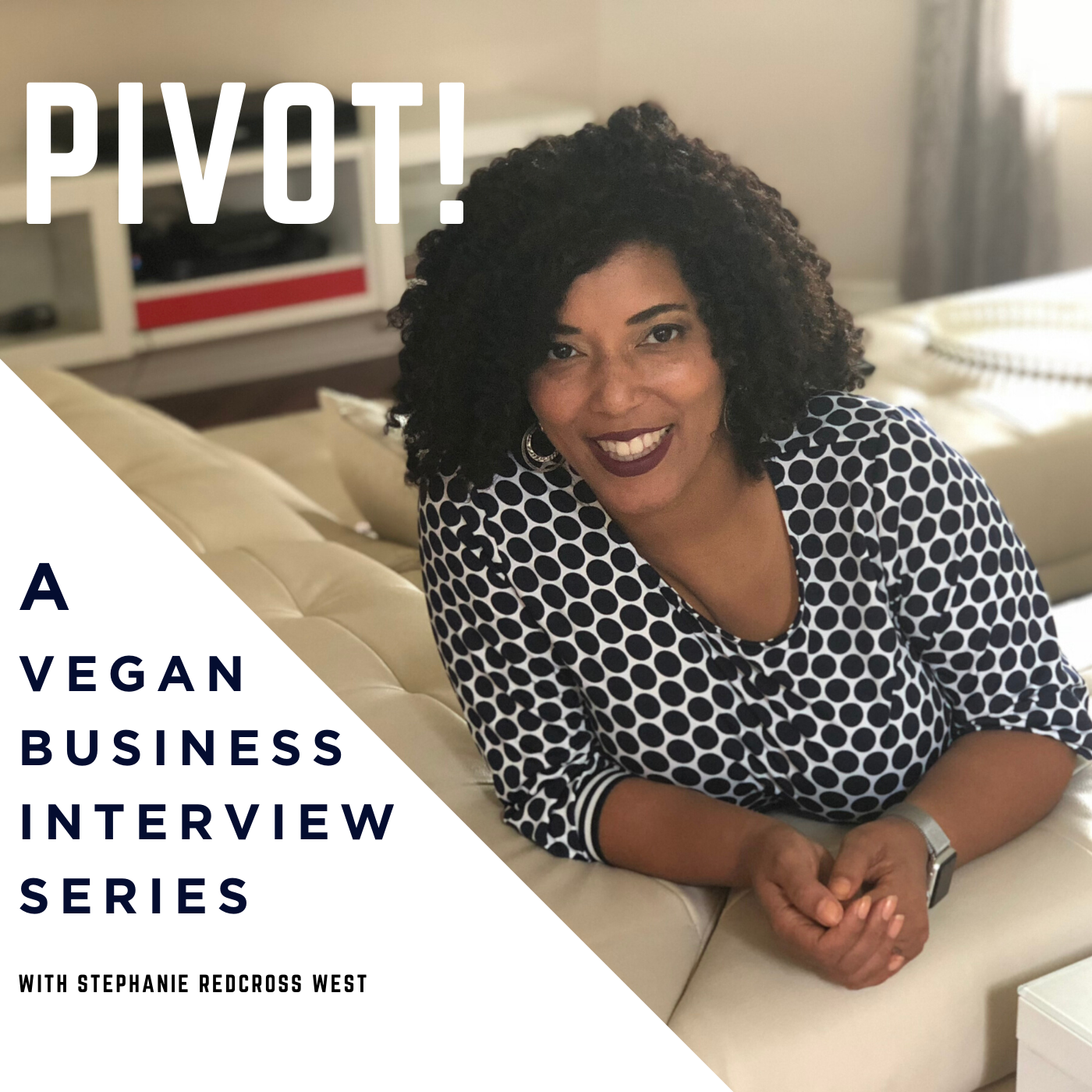
As vegan and plant-based business owners and entrepreneurs, we're often adapting to a new reality. This new podcast series from Vegan Mainstream is an opportunity to help you when it's time to pivot. These interviews will come from inside and outside of our community, and I hope as your host, Stephanie Red Cross West, I can inspire you and give you the tools that you need to move forward. Hello everyone, welcome to our new live segment.
We're really excited about taking this opportunity to bring to you interviews with various and truly diverse vegan entrepreneurs out there. Today, I have our guest, B, from B and Annoying, and today is really an opportunity to kind of talk about how not only has B built his business behind the scenes, how he's built his consulting support, and really helped kind of drive the movement forward, but how in these times, in these conditions, how what he is doing is kind of accelerated. Whether it's accelerating and helping his clients move forward, accelerating because the need and the desire and as more and more people are exploring veganism, that drive is creating opportunity for B and his business, that I'm really excited today to kind of talk about that, because sometimes in these current environments, we've been talking about the challenges, the problems, the issues, and yes, they exist, but it's really also exciting to make sure we're looking at all sides of the coin and talking about where these opportunities are coming and how vegan entrepreneurs are responding to that. So with that today, welcome, B for being with us.
Thank you. Now just around us, B branding, all the startup things that you can think of, blockchain and other buzzwords these days. I have centered a lot of the branding that I do for myself and other ventures around kind of the DEI space, versus the equity inclusion. And as I've learned more about how veganism shows up in the world and in businesses and the kinds of questions that people have, kinds of challenges people have, I just naturally just draw on all of that learning and all of the skills to recognize one of the needs in the space is that we need more and more folks who can integrate across different fields to make things easier for vegan businesses and vegan folk learning.
And in particular, one thing I'll mention is I found that a lot of people have found it really helpful to have it demonstrated that, hey, we can start this venture and we can have support from people who are already established in the industry and we can have a technological platform to make the back office business easier and faster and less expensive. I'll leave that as an initial response. No, but I think that's great. I think the idea that we should be looking at really the entire, all the dimensions of our businesses, looking at what are all the things that we're building and also thinking of our business as systems, thinking of our business as processes, because a lot of what I preach often is about leverage, is about helping people really start to understand how do you do more so that everything isn't customized, one-off offer, and one-off process, what can we do so we can consistently deliver great quality at the same time by putting some great systems in place.
So I love hearing that. Now I have to ask, why naming, why did you go with the name vegan annoying? Maybe give people a little bit of background or perspective on that. So let's see here.
First off, one thing that is important to know about me, I am not funny, but some of the things that I do might come across as funny. So vegan annoying is, in part, informed by kind of the snobbery that a lot of people associate with vegan spaces or historically have, just the ways that some people consider vegan-s to be looking down on everyone else. And I totally look down on everyone else, because that's you. That's clearly the only way forward, that was a joke.
But that's part of the brand, just that I don't actually personally look down on anyone for anything ever. But as part of this tongue-in-cheek notion, vegan-knowing, like, well, vegans are kind of annoying in some people's estimation and embracing that and leaning into it and just welcoming people to explore where they are is part of, I think, the healing potential of humor. And part of how humor can be a foundation for understanding between maybe different perspectives of what veganism can be and how welcome it might be. So yeah, it's a joke, but it's also very real.
I mean, people find vegan beings to be. Well, whatever they find beings to be. I mean, yes, sometimes we can get some labels. So I definitely can see that.
But I also understand the idea of sometimes owning some of these labels, not running from them, but embracing them in cases to really help people understand who we are to understand how diverse we are. And also helping people understand that, yeah, we may have some people in our crew that are a little overly aggressive and a little bit of that. But some of those people come from a good space. And with every movement and with everything, we need diversity.
So you've got to have a little bit of both. But I really like the idea of leaning into terms and not shying away from or being afraid of terms. I think that's really important when we're all going out there. And we're trying to drive the change in the world.
Thank you. I feel that part of the work that I recognize in basically doing the same thing that I've done elsewhere and stepping into this kind of even branding space, experience space, it has very much a lot in common with other areas of just collective learning. And I really have sought to have that reflected in the style of growing and introducing the annoying humor first, just because it's not easy for everyone to change or to consider change. It's not easy for anyone to consider why that even makes sense to think about, talk about.
But if it's part of something that could be funny, but also on second look is also very real and very serious, people can take whatever time or pacing that they might need to process that. And I'm not here to rush anyone. So yeah, it's definitely a celebration. Perfect.
So in that celebration and also even thinking about current times, can you give me an example of how has the current environment accelerated either what you're doing or accelerated some of the work that you're doing with your clients so that people who are watching this interview can kind of take those items away to either inspire them or help them through some of the difficulties that they're facing? Yeah, so let's hear the broader team behind the annoying and my work elsewhere was really catalyzed very quickly in the past, just within the past little over a month, in part just by a number of business shifts from prior employers and contracts and so forth, being impacted by these questions of, well, what does cash look like? What is our client demand going to look like? Well, from those questions came some very clarifying actions.
One, I had some very clear support in leaving my prior employment. Like many people have experienced during the COVID-19 responses, and that for me was very helpful. It was very, it was freeing for one to focus my time on the things that I recognize as essential for not just myself, but also community. And the annoying is very much part of that.
This is a very community focused brand and initiative and all the consulting that we do is rooted in that collective learning. And one thing about COVID-19 is it has been whatever else it is, it has reminded a lot of people about how connected we are and how many of the habits that preceded COVID-19 don't necessarily fit us, don't necessarily fit every individual, every company, every team, every community. And when I lean into the annoying, when I lean into my learning and sharing with community, that this dialogue, the annoying is a dialogue. I am acknowledging that at the end of the day, this is a time of kind of maybe new honesty for many people.
And in creating this brand, I've brought together, not just looking at veganism as lots of tasty food, which it is, but also that there are a number of communities within the vegan space that welcome resources and support that have been traditionally represented and so forth. And that work that I've done outside of the vegan space, bringing it into the vegan space, I've learned it's helped me and others to prioritize differently and be aware of say, the companies that are providing an outstanding benefit, they're bringing meaningful service, food, education, health practices, research. But they're not always in the spotlight, they're not always getting funding or clients and stuff worth and now everything I'm doing is the same thing. It's just recognizing the challenges of learning in the broader community, that I have those kinds of impacts.
So yes, COVID-19 has been an accelerator. It has been a conceptual accelerator in making clear how relevant the vegan dimensions of my learning are more broadly in the world and in applying all the technological conceptual research, business, branding, all that, in the vegan space as innovation because everyone in this space can learn together and maybe spend less money in not reinvent the wheel. That's fair, that's fair. And do you feel like, especially as people are listening to this and watching this, is there any specific advice that you would have?
I think it's different when you have individuals like, you know, like both of us when we do a lot of consulting, we work with a lot of businesses across a lot of different platforms, you sometimes pick up visibility or see things that maybe not everyone else would see. Do you have any recommendations for anyone who is maybe in this scenario where they're trying to figure out how they're going to pivot, what's the west of, not that we all have any crystals, but I know what the rest of the year is going to be like. But do you have any recommendations on what they should be thinking about, what they should be doing either now to just continue to say nimble and like you say, kind of shine in this opportunity? So these days I tend to only offer advice when solicited, the part of my learning.
And so one of the challenges of that in this format is just that everyone listening is going to be a little different space. So I will respond carefully. So one of the things that I think about in this advice space is let's see, first and foremost, that it might be helpful to root ourselves in kindness as the heart of veganism. And I find that relevant not just in a personal context of learning about veganism and where it fits in in broader pursuits of understanding and social good, so to speak, but also also when it comes to navigating challenges.
Remember what we're here for. I don't see myself as here to convert people or to make people think the way that I think, or to build things in a way that makes sense for me, which might not make sense for other folks. And I think all of that relates to kindness and empathy. And maybe more practically, I would say keep learning and keep listening to many different stories, many different perspectives, many different life paths.
I find that to be really helpful in business and consulting as a solutions person. I'm often in a place to offer solutions that nobody else at the table has allowed for or voiced in part just because I don't rule anything out and I'm listening all the time. And lastly, a lot of the reputation of veganism is a real opportunity. Perfect.
Now, do you feel that as vegan entrepreneurs and vegan business owners, do you feel that we have any unique kind of challenge when we're structuring our businesses, when we're coming in, like you said, and making sure that we're exploring all the options on the table? Do you feel that that's something unique to kind of vegan entrepreneurs? Or do you feel that that's really something across the board that all of us should do? It's just as vegans, we really need to make sure that we don't maybe get lost in the movement and make sure to be safe-grounded.
I mean, where do you think there's any differences or similarities across all entrepreneurs versus maybe a vegan entrepreneur? Okay, well, one thing that comes to mind is that, again, that notion of mainstream versus niche and perspectives on both sides. How vegans perceive from the outside by folks that are less familiar with the end of the world, and how sometimes even in any space, vegans in some extremes can get carried away. And so when I think about the challenges, it really boils down to cognitive bias, just human bias.
And I think that that can become a superpower for folks that can allow room for that process, that learning process, to acknowledge our own biases and to hold space for real human beings that have biases. It helps us to manage our expectations. And it also helps us to make services and foods and experiences that foster belonging. And wherever we do that, whether we're vegan or not, that helps society, it helps the village, it helps community, it helps people to celebrate together and heal and maybe see across those biases and to welcome things that could be really helpful and meaningful, but from a business perspective in particular, getting beyond the more abstract things there, I would say that one commonality I've seen is that most people feel that it needs to take a lot of time, that it needs to cost a lot, that applies to business, it applies to the rest of our business in particular, it applies to initiatives, it applies to mounting a response to a need.
And in my experience, it takes less time than people tend to think. It takes less money than people tend to think. And sometimes we might put too much weight on what we see in the movies, as opposed to the small changes that we can make on any given day. And that's it.
OK, so it's more of your own talking perspective that some of us maybe have some growth that do other on our perspective and also maybe even, I guess, I don't want to put words in your mouth, but is it also an opportunity that we don't hype up the experience too much so that we aren't building this, I have to work all day and all night, I have to borrow resources, everything into it for it to be successful, that sometimes it really can be success without it costing everything. Is that fair to say? That makes sense, yes. I mean, it's essential no matter how vegan we identify ourselves to breathe.
Like, we need to breathe. We need to encourage others to breathe and support others breathing. That's part of kindness when you let it just, when you allow room for what kindness can be, it's not about any one of us as far as I'm concerned. That is crucial.
Sometimes, again, there's so many different ways to be a person, so many different ways to be a vegan. We need to be kind to ourselves. We need to not necessarily floor the gas or floor the brakes at any decision point. And sometimes it's maybe helpful reminder to have maybe an accountability partner who can check in with surrounding major decisions or just to make sure that you even do the thing that you said you're going to do, because we can tend to extremes.
Old habits can take over. Sometimes we are very enthusiastic, and we burn out. And both of those extremes, they don't last. And if we want to create something lasting together for ourselves and with others, whether it's family, community, or the world, we might want to allow room for the global scope and the time scale outside of our lifetimes, but not to not get carried away with, as you touched on earlier, the naganda of making sure it has to be the biggest, the baddest, and the best, out the gate.
Get something out. Be pragmatic. Have an MVP, a minimum viable product, or just help one person in a way that that person recognizes as health. Keep it small.
And then as you have capacity for more, do more. Or bring in other folks to compliment your capacity. All that stuff works. And I think COVID-19 especially has emphasized, has underlined how essential community is to scale in a helpful way.
Absolutely. I love that. I love being at this point, kind of in our discussion today where we're talking about the idea of how important community is, how important it is to work with others, to collaborate, and also striking a balance around how we approach our business growth, our business launches, and also our business dreams. The idea of the dream of maybe where you want to be versus where you're starting, where you're going to get that initial jump for your business doesn't have to be so over the moon, over the top, for it to be impactful.
Like you said, being able to impact one person, being able to get that minimum viable product out there is so crucial. And spending some time today, I think, stressing that is, I think, really important, especially now where people are worried about resources towards the future and so forth that maybe breathing, as you said, and breathing away some of that worry. Because I think that worry sometimes creates a little bit too much negative energy in our spaces. But also taking that time to truly understand that what we can do can make an impact even if it's small, even if it's in our communities, in our neighborhood, in our block, even if it's just when our crew, the idea is impact is impact and impact is a beautiful thing.
We don't have to size it necessarily to say it's a good thing. Yes, it reminds me really briefly. It reminds me of times living in New York City, thinking about, you know, it'll be really nice to have a garden, and then looking up in Manhattan. Huh, you know, where would that garden grow?
And in New York City, sometimes people have small gardens on their balconies. Sometimes they're rooftop gardens, sometimes they're gardens between buildings, sometimes they're gardens and basements. Like, there's so many ways to do it. And where you start out is not necessarily where you go next.
And you can't necessarily see the connection between here and here from now. And that's an opportunity for learning. Absolutely, absolutely. So as we're wrapping up our time today, if someone is looking for help, if someone needs support, maybe kind of giving me two part kind of idea, is who should be reaching out to you?
If someone's listening today and they're like, oh, I need help, you know, should I be reaching out to be, maybe give them perspective on when and what kind of get a client or customer should be reaching out to you and getting help? And then also maybe let's give everyone your website and maybe some of your social handles so that they can reach out to you. Okay, well, I think so. I appreciate their giving space for that.
I'll try and keep it brief. Once you're from a business standpoint, or for people who are either already in business and looking to transition their business into a more sustainable space, maybe in the food industry that might be, you know, involving more, shifting more than menu to vegan items or switching their providers, you know, to, again, more vegan food space within business-wise, there are so many ways to do business in the vegan space that I'm not even going to try. But people who are looking to move an established business into a more vegan or sustainable space, whether that's packaging or energy footprint or otherwise, definitely reach out during the mailing list. You know, I'll share a few ways to get started after I respond.
And then for people who are looking to get started, you know, many people are transitioning from employment to entrepreneurship. Many people are resuming entrepreneurship or scaling up personal projects into businesses. Hi, that's me. I would say reach out if what you're doing involves veganism in some form and you'd like help in either ideation or strategic execution, you know, how to get there, who to work with, all the network that might be relevant there.
And one thing I'll emphasize in this first part is this is a global presence. It's a global welcome, wherever you are in the world, whatever language, whatever life path, I think it matters to, hey, consider reaching out. And the second part of your question was the online ways to get started and ways to reach out. Let's see, our website is veganknowing.com, just the word vegan, V-E-G-A-N.
And then it's a little trick in the middle there. And O-I-I-N-G.com, just veganknowing.com. We also have an Instagram. Instagram doesn't have as much space, so it's just veganknowing, vegano-I-V-E-G-A-N-O-I.
And finally, there is some presence now on both medium and Twitter. We're starting to write more, but most probably the easiest way to stand touch. And to have that reminder for when you might want to reach out in the future, if you're not ready now, is to join our mailing list at veganknowing.com. And you can see all the social media links for Twitter and others to come.
Perfect. Thank you so much. I really appreciate you taking the time. I really appreciate you sharing today, even helping me even remember to take that breath and breathe.
I think sometimes I even get wrapped up in everything I have to get done. So it's really great when I have the opportunity to have these types of discussions because they not only think of our audience, but they also help me to make sure that I'm putting back on that right hat and not getting too wrapped up into the grind and all the things that kind of pull us in multiple directions. So thanks so much for hanging out with us today. Thanks so much for taking the time.
And also, thank you so much for sharing your perspective with our audience. Thank you. I'm looking forward. You're welcome.