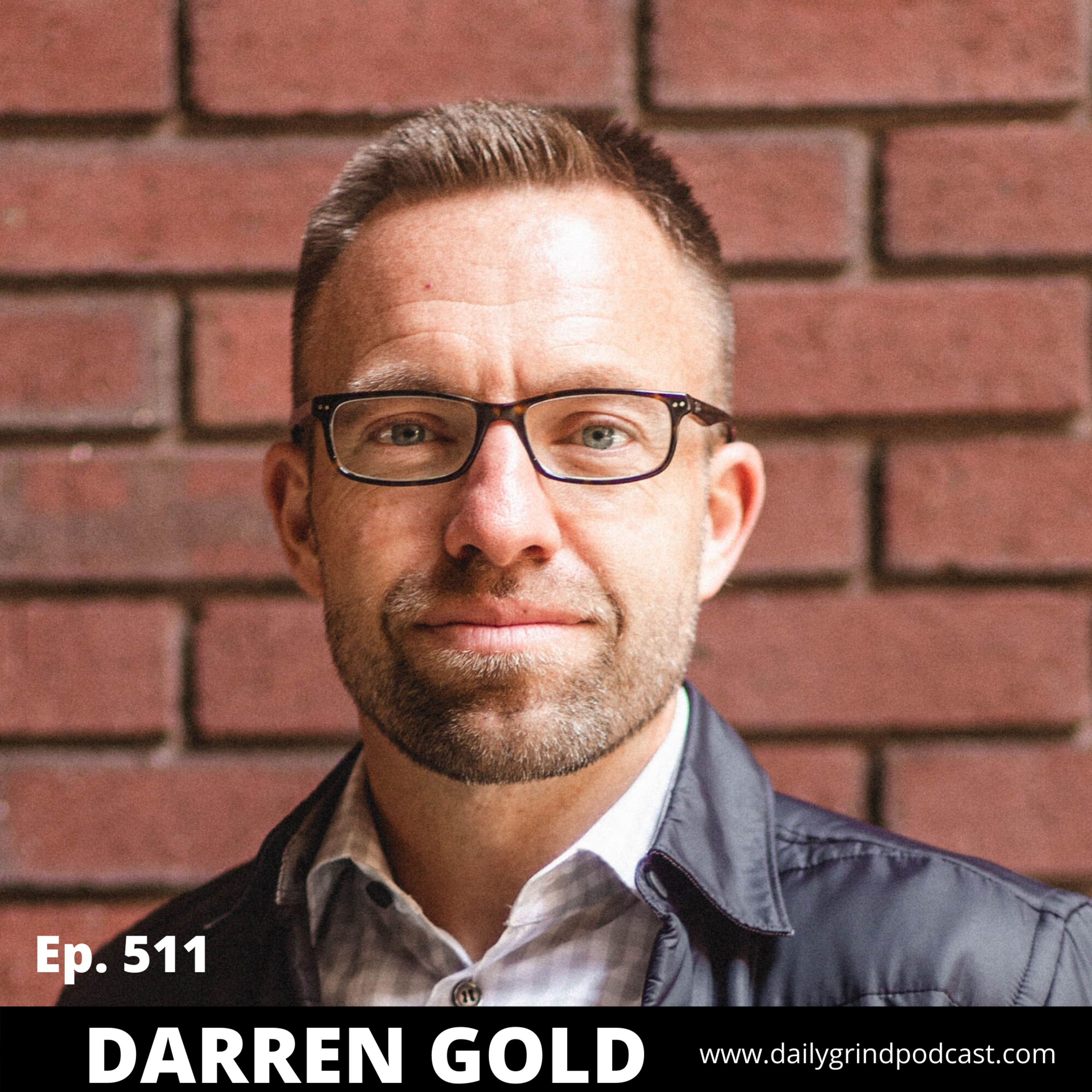
Hey everybody and welcome back to another episode of The Daily Grind. On today's show we are sitting down with Darren Gold, who is the managing partner of the Trium Group where he serves as an executive coach to the CEOs of many of the world's most influential companies. Amazing episode, be sure to always have a pen, piece of paper, sit back and enjoy today's interview with Mr. Darren Gold.
Today's episode is brought to you by Proton Mail. How many times have you ever wondered whether someone else is reading your emails? Or how do those ads know so much about yesterday's conversation? Take an email provider that ensures the privacy of your data can be a challenge.
Proton Mail is a private email solution that offers end-to-end encryption. That means they can't read your emails or sell your personal information to advertisers. The team behind Proton is based in Switzerland, home of some of the world's strongest privacy laws. All of their apps are open source, independently audited and have robust privacy policies.
Plus, Proton is funded by their community of users. There is no revenue from ad sales and they live by their philosophy of people over profits. How amazing is that? You can get started with Proton Mail today.
When you click on the link in the description or you can go to protonmail.com forward slash grind and you get 20% off their annual subscription today. That is protonmail.com forward slash grind for 20% off of Proton Mail's annual subscription. Again, that is protonmail.com forward slash grind or hit the show notes section in this page to get 20% off of Proton Mail's annual subscription today. As I mentioned, everyone we are sitting down with Darren Gold today who is not only an executive coach to some of the most influential CEOs but he is also the author of the book Master Your Code, the art wisdom and science of leading an extraordinary life.
The book has been received significant praise from the CEOs of companies like the Home Depot, Lulu Lemon, Dropbox, StubHub, Roche and from experts in the field of leadership and personal development like Greg McEwen who is the author of the New York Times bestseller, Essentialism. The feedback has been tremendous with some calling Master Code the most important thing that they have read in years, one of the great personal development books of our generation. As you can hear just from this intro, Darren is a special man with so much to share. So as I mentioned, be sure you have a pen, piece of paper and enjoy today's interview with Darren Gold.
Darren Gold, welcome to the Daily Grant. My friend, how are you? I'm doing really, really well. Thank you.
It's great to be on your show. It's great that you're here. Darren, the way we always start is for people to be first introduced to you and what you do. If you wouldn't mind just kind of briefly sharing a little bit as to who Darren is and what it is that you do.
Great. Well, I'll give you the brief version I'm sure we'll get into the longer version hopefully as we chat but usually start with you just personally. I've been married to my wonderful wife for about 25 years next month and I have three incredible children. One of the gifts of this shelter in place is they've been home with us for the past few months, 2018 and 14.
So a really wonderful personal life. And professionally I do work that I love which is I work with CEOs and their teams at the intersection of strategy and leadership development. So I'm really about helping leaders scale, grow and transform themselves. The premise being that you can't scale, grow and transform an organization if you're not willing to do so yourself.
So that's the work that I do. How long have you been doing that for? This particular direct work about a little over five years, now six years, close to six years, but prior to that I was the CEO of a couple of companies and I was really doing that work as a leader of an organization. And then I have a very varied background before that.
Years in private equity where I was on the boards of companies, consultant at McKinsey, I started as a lawyer. So I try to bring all of that mixed experience to bear on this central question of what does it look like to be an extraordinary leader and how do you build an extraordinary organization. So that's awesome. And after doing some research and learning more about you, obviously where I kind of want to start is your childhood, I realize you have a very difficult childhood to say the least.
One of the things that really interested me is you became very determined to lead a different life from your parents. Can you talk a little bit about that? Yeah, I would say it was a mixed childhood. In many respects, challenging.
My parents, I grew up most of my life with a single father in a small apartment in a pretty crime ridden neighborhood of LA. My dad was essentially engaged in a lot of illicit activities himself. That was sort of the way he knew how to make money, dropped out of school when he was 14. With my parents spent some intermittent time in jail and my mother unfortunately succumbed to some drug and alcohol addiction.
So it was a volatile childhood. The one constant that was an extremely loving father. So I had that as essentially an antidote to the uncertainty and volatility of my childhood and I can't overstate how important that was to me and how much it shaped me as a father. But nonetheless, my dad was very determined that I lead a very different life and I was well.
And the theme in my childhood was education and achievement. And that really propelled me into a kind of obsession with learning and doing well in school and getting ahead in life. And I ultimately became the first in my family to go to college and had a lot of early professional success out of that really interesting childhood. We can talk more about how that served me and where I ultimately came to see the limits to the strategies that I was employing.
Yeah, it's really interesting because usually when you hear a story like that and you come from a difficult spot and say your parents have trouble with a lot of oftentimes, people sort of follow down that route and the parents don't push you towards a different life. But it was interesting how even though your father was into those things, he was wanting you to do something different. Yeah, that was a gift. So I can imagine my life having gone a very different way without that simple, yet I think important direction that my father gave me.
There wasn't a lot of nuance and morality and complexity in it. It was just like live a different life and get educated, like live the life that I would have wanted to have lived but wasn't able to. And that was an incredibly empowering message. It was also something I felt innate in what you call it, my soul or just who I was and who I was becoming that was guiding me really from a very early age.
I remember that. So I gave myself a little bit of credit as well for tapping into some of my intuition early because I didn't have a lot of guidance and direction. And then I think a lot of just good fortune in life can turn out in so many different ways and might happen to turn out in a way that has worked and in ways where I really had to confront myself and that's been an extraordinary part of my journey and the lessons from that I bring into the work that I do. And what are some of those lessons?
You hear people kind of talk about whether they're critical points or critical lessons learned at different life stages. What were some of those lessons for yourself? Yeah. If the late leadership expert Warren Venice calls these crucible moments that you're lucky enough to have and it doesn't seem like you're lucky when they happen because they can be really severe crises that happen personally.
And I view them as what a gift if something like that can happen because what it can serve to do is totally disrupt your patterns and your comfort zone and give you an opportunity, whether you take it or not as another question to really explore yourself in ways that you hadn't. And so for me, there were sort of, I wouldn't say it was any one, but there were a series of these sort of catalytic moments that I really that really sort of woke me up and began an inner word exploration. I've written a book where basically the whole premise of the book is that I draw this distinction between a program and a code. And I argue that everybody has a program, a set of subconscious safety based beliefs, values, and rules that automatically drive your behavior and limit your results.
You don't even know we haven't. It's subconscious and yet we're living our life. I say in the book somewhere, I was almost 40 years old when I figured out I was living a life run by a program written by a seven year old boy. And when you get that realization, when I got that realization, I got it after being fired.
That's sort of what I thought was the pinnacle of my career. It opened up everything. I began to see for the first time that much of my life while it had worked was being driven by this unconscious program and that I had a choice. And the choice is I've come to write about it is this, what I call the human superpower.
It's this choice that consciously construct your beliefs, values, and rules in a way that really serves you and produces extraordinary results. And I call that your code. So I sort of play with this sort of distinction between program and code. And that to me changes everything and it has for me.
And it's the basis of my life's work. And I've written a book about that journey and also the sort of lessons from that. Yeah, it's interesting. When you talk about that, maybe during those moments, you mentioned when you got fired and this is when you began to realize it.
What were some of the behaviors you noticed that needed to be changed and maybe what were some new ones that you implemented? Yeah, I talk about in my book, This Notion of Survival Strategies. And let me just describe what they are. And then I can give you a couple of one of the ones that I began to see for the first time.
So this is an idea that in childhood, particularly in the early part of our childhood, we're confronted with some form of trauma. It can be serious trauma. It can be what I call lowercase t trauma where you're teased or bullied or made felt psychologically unsafe. And I had that.
I was an immigrant from England. I came to Southern California from London, England. And I was having an English accent at age 18 is really cool. At age seven or eight, it's not cool at all.
And I was teased and bullied a little bit because of that. And so in that moment, what will happen almost invariably as a child is you will begin to develop a strategy for dealing with that so that you never have to avoid that experience again. And they can take different shapes and forms. And the same was what I call a belonging strategy.
I was committed to being likable. I didn't know that at the time. And it was only decades later that I began to see it. And it really began to serve me.
I did really well in school. I was very popular. I was the student body president of my high school. I developed this likability, superpower that really served me.
And they always usually do. What I began to see was how much it was limiting my effectiveness. And largely I was just unable to have the kind of direct, honest, challenging conversations with people. And when I began to take on roles of increasing responsibility, not being able to be direct, honest, and mature in those conversations was really holding me back in pretty significant ways.
And it was doing a massive disservice to the people that I was being asked to lead. But I didn't have this distinction. I didn't know that I was being run by it. I just thought, that's the way the world is.
You've got to be likable. It was so fused with my identity that I had no room to do anything different. And it wasn't until I figured out that that, wait a second, this is a totally made up rule. A rule made up by a scared little boy.
And I don't have to hold on to it so tightly. I can still be likable, but I don't have to be driven by it. I have choice. And that's where the magic happens, where I was able to say, wait, I can have really honest, direct conversations with people put at risk my likability.
And the irony is I became more likable, right? When you're mature and authentic and congruent and you show up and you're clear, people are attracted to that. So what it points to are these myriad of rules and beliefs we hold, most of which we don't even know we hold. You know what you can't change, what you can't see.
But once you begin to see them, and realize that you have choice, you can make it all up, then you begin to massively expand your degree of action. And so in the work that I do with leaders, it's about taking a look at the underlying way of making meaning, your underlying belief structures that give rise to how you behave, and changing that underlying programming to really serve you. And that was one of many realizations I had that really opened things up for me. Wow.
Because obviously you work with a bunch of different leaders. You find that there are some commonalities between certain leaders when you first meet them. Yeah, I like to say there's two meta beliefs. What these usually show up, at least one or two of them with leaders.
What is the belief I have about my circumstances? And I can either, there's a spectrum, psychologists call it locus of control. I can either believe that I shake my circumstances. There's always something I can do.
I like to say I'm 100% responsible for shaping my circumstances, which I call a responsible mindset. Or at the other end of the spectrum is, circumstances happen to me. There's very little I can do. And it's amazing to see how many people, even in advanced parts of their career, operate out of a default victim mindset.
Interesting. Yeah, so that's one where I usually go to right away. And how it'll show up is complaints and judgments. And what you'll hear from everyone, I fall into this all the time, is I begin to complain.
My team's not innovative enough. The culture isn't this. And what that is evidence of is a relationship to my circumstances that's not very powerful. And so that's one of them that shows up a lot.
Do you find often, maybe not often, but there's almost maybe a sense of hierarchy that they put themselves, maybe on a scale because they're in a certain position or they've achieved a certain amount of success that they believe that they are more than or that they are more important than? Well, what I would say is that the more successful you are, the more resistant you are to taking on the parts of you that have gotten you to that place. So it's the paradox of success is that you've employed a bunch of strategies that have served you. And because they've served you so well, you're really reluctant to take a look at them and take them on.
Even though you can intellectually get that they're getting in the way of you being a better version of yourself, being a better leader, being a better family, husband, wife, spouse, partner, whatever it would be, your mother, father. So I often find that people that have achieved success in their careers, even though they're intellectually open, can find it quite hard to take on parts of themselves because of that. Yeah, and that's why I think it's really important what you do, right? Because oftentimes we're taught on how to get to the top, but it's difficult for people, I speak to athletes and business owners all the time too.
Once you reach that level, then what? And if you're not prepared for it, it can be a very difficult balance in your whole life and even in your business. Well, yeah, that's a great point. You know, the psychologists call it the hedonic treadmill.
Okay. You're constantly looking for the next thing. There's no such thing as being satisfied or you might have heard like this phenomenon of a lottery winner, right? Yes.
So, I think that's really within like a matter of weeks, you're back to the same sort of set point, right? So this idea that we achieve something and it will give us what we're really looking for in life, which is ease and joy and fulfillment is a total delusion. What I recommend and I write about in my book is that it's a path that needs to be the thing that brings you fulfillment, the path to your own self-mastery, and that each day is an opportunity to take an inch forward and becoming sort of really reaching your full potential that you'll never finish. And this realization that it's just being on the path of mastery that is what's going to bring me fulfillment and joy, but there's no such thing as like, I'm going to get into best college and then what?
Now I got to get a job and I get a next job and I got to get a promotion. It's this constant thing and all of a sudden you find yourself at the end of your life not to get too philosophical. Looking back and going, wow, what was I doing? Yeah.
No doubt. So, I mean, there's people listening who haven't achieved that fulfillment. Obviously, they're difficult times. People are going through right now and they're listening to this podcast.
They're trying to change that mindset for themselves. What are some things that you have found is super valuable that someone can start to do, whether it's something you've said, something small, someone can start to implement to help them get out of maybe the current mindset and into one more leaning towards the eventual fulfillment in their life? Yeah, it's such a great question and it's such a big question because it's hard to reduce it to any one thing, but I will. I'll offer a few things for sure.
I would say the big part of it is what I alluded to and it's one of my favorite quotes is from Abraham Maslow says, what one can be one must be. And this idea that there is a singular purpose in life, in my humble opinion, it's this notion of self-actualization, this notion of how do I become the very best version of myself? How do I commit to a practice, a daily practice of becoming a better version of myself? However, I define it.
So that is the bigger answer to that question. We can explore it a little bit more if we want. There are some simple things and I find one of the maybe the most easy thing to do and yet very few people I talk to will do this is the very first moment you regain consciousness, which is when you wake up. I encourage people and I do this myself.
The very first thing I say internally to myself is that God, I'm alive. This is going to be an extraordinary day. And I do that partly because I believe it. I'm incredibly grateful just for my health, the fact that I'm getting up in the moment, like I'm waking alive and that I have what I have, by the way, regardless of my circumstances.
I think I had that orientation as a kid is a way of priming yourself because the world will show up to you very differently if that's the way you take on your day. If you wake up like most people and I have for a long time until I started really implementing these practices, reaching for the alarm and going, oh my God, I can't believe I got to get up and I got 10 meetings and this is going to be crappy day, which is essentially without really being aware of it, kind of what you're saying. You're going to create an experience. You're going to construct an experience that's very, very different.
And so this notion of using gratitude intentionally to prime your emotional state and how you make meaning of the day is such a simple thing to do. It takes two seconds and it is transformative. And you know what? I've heard that before too and I forget who said it, but one of my favorite things I've heard someone say is being blissfully dissatisfied.
It's being thankful, but it's also not staying put. It's wanting to improve and get better. And I've found that I practice that for a little while and I'm trying to wake up. I think David Nelson, that's who it was.
He said to go to bed saying thank you and to wake up saying thank you. But oftentimes I found that I would forget and it wasn't that I wasn't thankful. It's like it was not trained in my mind. It takes time to get to that point.
Yeah, it's so true. It's not a natural practice. And I find that what's natural is to see what's wrong. And that's part of our evolutionary wiring.
Because our species has survived because our brains are built to detect risk and danger. And so what's second nature and default for us is to see the things that are risky and dangerous and what's wrong. Very, very good at that. What we're not very good at is seeing everything that's really right.
And what you focus on is what you'll experience. So what you're pointing to is that we have to begin to train our attention, our focus and direct it towards the things that really are working in life. And it's all around us. If anybody's listening has tried this, I've heard it like called a gratitude bath, which you just bathe yourself for three minutes.
And in gratitude, the number of things that you will find, simple things that you're grateful for is astonishing. And yet it's not nature. And I love the fact that you said blissfully impatient. Is that what you said?
Blissfully dissatisfied. Blissfully dissatisfied. What you're pointing to is also the paradox. And I talk a lot about paradox of polarity, which is we want to be on the one hand incredibly grateful.
And on the other hand, really hungry for growing. If we can manage to integrate that paradox, wow, that's incredible. And I think in much of living an extraordinary life, much of quote unquote success in life, is the ability to see these inherent paradox and polarities and begin to recognize them and capture them with the kind of language you just use so that we don't over rotate one way or another. And that ability to rest and to be active, that's a kind of classic polarity, right?
We have to be both of those to really flourish. Yeah. And I think it's something that you found and it's almost it's loving what you do. And you would mention a few minutes ago about self-actualization.
I think really to find what you love to do is going through that process of self-actualization. So I'd love to, you mentioned a dive in deeper. So I'd love to dive in deeper that for it with you. Yeah.
Yeah. It's a question, you know, like this question of purpose is one that's often asked. And I get it. That question posed to me a lot, particularly people that I'm mentoring, you know, younger people that are like, what's my purpose?
How do I figure it out? And where I usually start is, which can be a little frustrating for people on the receiving end of this, which is like, take your time. You don't need to figure it out because the more attached you are to figuring out the harder it is for you to be able to see it. That's again, another paradox.
Right. And so it's just being open to and attuned to the things that begin to light you up without like this rush. And because what it will end up being is one of those, you know, again, this kind of notion of a hedonic treadmill, I've got to achieve my purpose. So purpose becomes something you're achieving, just never going to leave you satisfied.
Then I offer usually a more practical answer to that question. And the one thing I love to share, which really worked for me, is this Japanese notion of Ikigai. And it stands for, it's literally translated as the reason for waking up in the morning. And what the term points to is the intersection of four things.
What I love to do, what I'm good at, what the world needs and what I can get paid for. And I love that because it's very practical. I mean, you can do things that you love to do, but you're not really good at. Or you can do things that you love to do, you're really good at, but the world doesn't really need.
And so if you can find like, wow, I'm really good at this and I really love it, it turns out the world's asking for it and they're willing to pay for it, which is they're not just kind of on it, but they're, they're, they value it. That can be a pretty cool place to focus my attention. And again, to do it without a rush or, you know, attachment to figuring it all out, you know, for some people, purpose shows up in the first few years of their lives, for others, maybe they're 60s and 70s and it's going to happen when it's going to happen. And it's very difficult to accept that, right?
It is. Yeah, it is. And I understand, you know, I think I asked myself that question for a long time and finally got to a place where even I couldn't quite name it with the precision I just articulated just sort of settled into a trusting that I was going to remain open and attentive to what it was and ultimately through a whole, there's not, was not a straight path, my career. A whole bunch of twists and turns, you know, it emerged and showed itself and what it does it's unmistakable.
And, and so it's like, it is a little bit of a paradox which is to be like looking for it, but don't be too keen on finding it. Yeah. And it seems to me, based on a lot of the people that I've spoken to it, it happens that at moments you're not expecting an oftentimes even at darkest moments. Yeah, for sure.
You know, when things are unsettled or where you're focused somewhere else, it's like the whole, you know, being in the shower, your best ideas, right? Or even a walk or, you know, one thing I don't run a ton, but when I do exercise a ton, when I usually go for a run, which is a couple of times a week, my best ideas come out of that because I'm freeing up my mind for those things to emerge. So I guess what, you know, it's a great point because when I'm suggesting is really that the process of purpose is an emergent process, right? You have to sort of allow it to create enough conditions for that purpose to emerge and it will.
And that requires some trust and faith. But it's been my enduring experience that for people who find their purpose are people that have the patience and maturity to allow it to emerge and it will. I love that. So you mentioned your book a couple of times on here.
Firstly, for people who wanted to learn more about it and grab a copy, where's the best place they could do that? It's on Amazon and like all the forms, Kindle and paperback and our cover, I narrated the audible version, which was a lot of fun. Oh, cool. Yeah.
Yeah. How long did that take you? It was an incredible process. It was one of those.
It was so exhausting. You know, you get in there for like three or four hours at a time in the studio and I was spent. But I was pretty decent at it. So I did it over the course of about four or five days.
And like, oh, it's not bad at all. It wasn't bad. Yeah, they said it was much faster than it might otherwise be. Yeah.
I've heard of a couple of months. So that's good. No. It wasn't quite that love for me.
Awesome. Well, I'll share that in the show notes section every once. You can go ahead and do that. And then if people wanted to learn more about you personally, where's the best place someone could do that?
It's a website, DarrenJGold, D-A-R-R-E-N-J-G-O-L-D.com. And this year I started a weekly blog, which I really, really enjoyed. And you can sign up for that on that website. Awesome.
And it also linked to my firm, the Trium Group, where I do all my professional work as well. Perfect. Well, I will share all those links to make it super simple. And the way we kind of end the show here, Darren, is we're going to give you the floor and you have the opportunity today to share with our audience the thought of the day.
So one thing or something that someone can go home with today? That's a great question. And where I go is the thought of love. And I think we find ourselves in an incredibly polarized world.
And I wrote a recent piece on virtues and the fact that there are essentially six virtues that are consistent across philosophies and traditions and religions. And one of them is love. And I think it's the master virtue. I think if we can all lead our lives asking the question, what would I do say from a place of love, the world would be a much better place?
That's amazing. Well, Darren, I appreciate your time. Thank you so much for sharing your insight and coming on the show today. Colin, it's been an awesome conversation.
I really appreciate it. Thank you. You got it. Everyone, we hope you enjoyed today's episode.
I want a friend who you feel like could really benefit from today's episode. We'll be back next week with another one in Tildan, Colin Morgan, signing off. And always remember to keep on grinding.