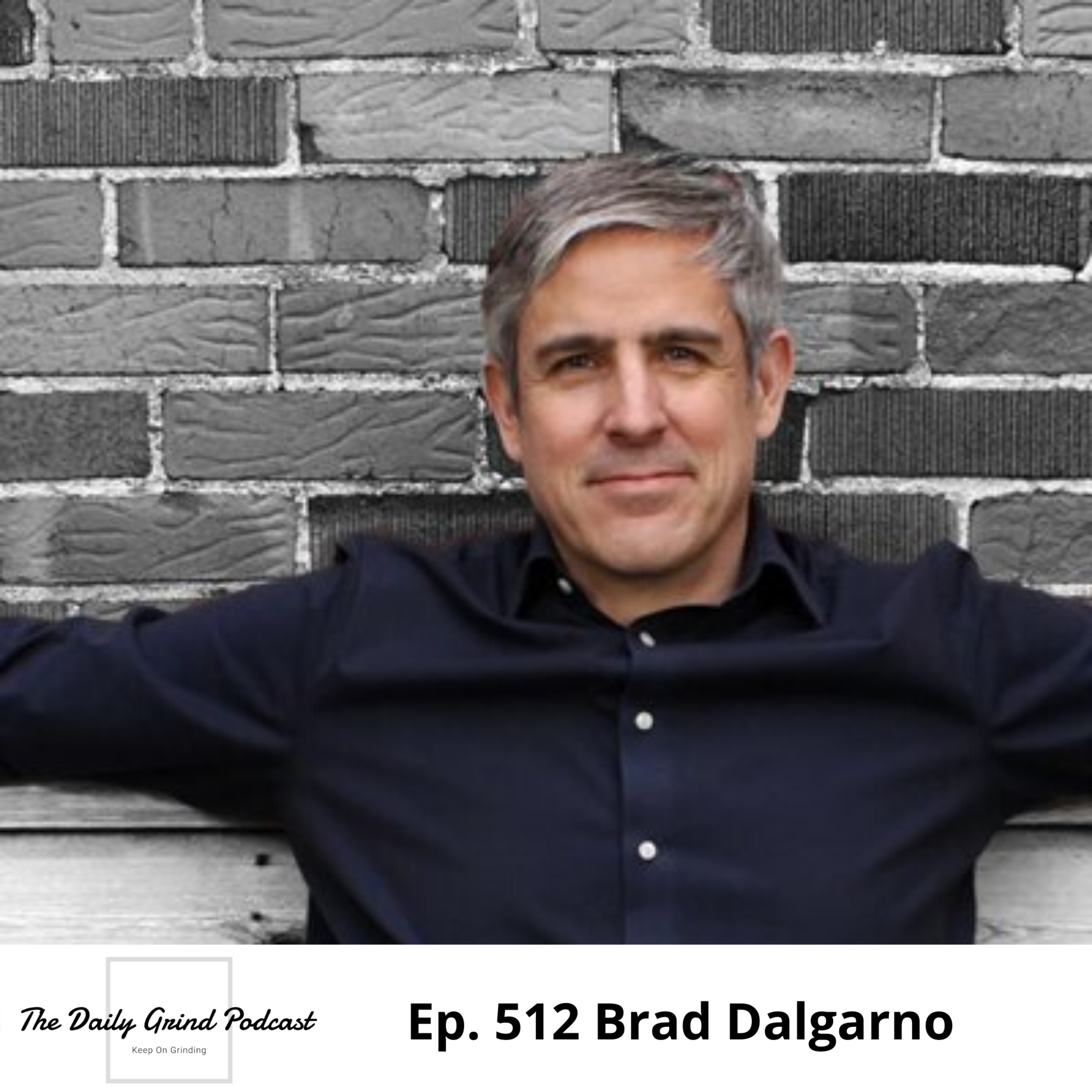
Hey, everybody, and welcome back to another episode of The Daily Grind. On today's episode, we're sitting down with an amazing human being, former NHLer and now successful entrepreneur and marketer, Brad Delgano. A lot to be learned from today's episode. Everyone, be sure, as always, to have a pen, piece of paper, sit back, and dive deep in today's interview with Brad Delgano.
Enjoy. Today's episode is brought to you by the Just Go Grind podcast with Justin Gordon. As many of you know, I went from five days a week here on The Daily Grind to one day a week. That leaves plenty of days and a lot to learn from so many other people, and Just Go Grind in the podcast with Justin is absolutely amazing.
I would encourage you all to go and check out that podcast. He interviews entrepreneurs, CEOs, and other go-getters, giving you actionable insight each and every episode. Some of the episodes and people and guests we've had on are absolutely amazing, from Vanessa Du, who's the founder of 100-plus million revenue dollar company, Healthy Kombucha, and Rob Mather, founder and CEO of Against Malaria Foundation, one of the world's top-rated charities, which has now raised more than $230-plus million, which is absolutely amazing. So be sure, guys, go and check out the Just Go Grind podcast with Justin Gordon today.
Subscribe to the show on Apple Podcasts, Spotify, or wherever you listen to podcasts. Simply search Just Go Grind to find it. You can also find it in the show note section of this podcast, everyone. Keep grinding.
Now, without further ado, please meet Brad Delgano. Well, hey, everybody. Welcome back to another episode of The Daily Grind. We have a very special guest lined up for you all today.
We're joined by former NHLer, now successful entrepreneur, Brad Delgano, someone that I know personally. We've spoken to him a few times. Don't know each other too, too well, but I've had the pleasure of sitting down with him a few times, and we're introducing him to you all today. Brad, how are you?
I'm good. Nice to talk to you, Colin. Looking forward to our chat. Of course, Brad.
So we're going to kind of start from the beginning. I read online you grew up, or you were born in BC, but grew up in Whitby. Talk to us briefly about your childhood. Oh, great.
Okay, so born in Vancouver. All my relatives are there other than my parents. And Whitby was only one stop in seven. So we bounced around.
My dad was not in the military. He was in the printing business, but not unlike me, which we'll probably touch on this, this didn't have a degree, was trying to figure out how to kind of advance. So he happened to be working for a national printing company that had offices across the country, back when you couldn't, you know, just like today where you have to actually brew beer in each province. So there were all these inter-trade policies.
Anyway, so he took opportunities as they arose. We lived in Calgary. We lived in London, Ontario twice, lived in Halifax, back to London. And then my parents landed in Whitby.
And that's when I kind of jettisoned off into my hockey Hamilton world and then onto New York from there. So we bounced around a lot. And then I bounced around, even though I was with the Islanders for my whole career, between the minors, back and forth. I think I actually moved 22 times in my professional life, let alone my son.
I was very used to packing up and moving. Yeah, when you were growing up, was hockey the main sport? Did you play other sports? I didn't, wow.
Like I got to London, which was our third house, just to turn five, heading into six. And my parents didn't know hockey. I do remember having the Canucks broadcast on in the house. I don't know why, but I remember that at a very young age.
But no sports, really, we weren't really sporty. And then my parents asked the neighbor, what do you guys, what do the kids do here? Because I want my kids to meet other kids. And so hockey was the thing they played in London and started with a half ice, but I was big.
I was a big kid for my age and horrible. I mean, everybody was learning to skate, but I was really not great. So power skating and a whole bunch of stuff, not with this idea that I'd make it to the NHL, but so I didn't hit and fall on kids, which I was doing in the first year. So it was very incidental that I ended up in hockey.
Interesting. So at what age, at what level did you kind of realize that there may be a future in hockey for you? It was late. I was out, because of all of that and my size and, you know, some natural ability.
I always kind of played on the competitive team in where I was living, but there were always guys better. There were always guys that everybody talked about. Oh, they're going to go to junior B. Oh, they're going to go to, they're going to play in the NHL.
Never in my wildest dreams did that really settle as an option for me until, I think until just before junior B became a potential thing for me. And I ended up getting an opportunity to play for Markham's junior B, which is not, everybody asked me, was it the Markham Waxers, which was the provincial team. No. Anyways, I played for them for a year and then it was really only then that like scouts seemed to come around and the kids that were supposedly and kind of always perceived as kind of the little kids going there were falling off a little bit.
And without any grand plan at all, I just kind of got, I played in the next where people pointed, okay, well, you're going to go play there now. And my parents didn't have a grand plan. I didn't have a grand plan. And it dawned on me at some point that this could, you know, I could play junior B.
Holy cow. Well, geez, I could actually play in the OHL. And then, you know, this notion of the NHL started after, you know, once you're in your middle of your first year and you're in central scouting and people are paying attention. So none of it was a plan.
None of it was my dream. I think I wanted to be a marine biologist, which is just a bullshit thing, but it sounded good. And I loved, uh, I think I loved Jacques Cousteau back in the day. Oh, interesting.
That's funny. So obviously highly talented. You went sixth overall. What part of the game was strongest for you?
All right. Well, that's also part of my, uh, part of my story is the fact that I was drafted so high, sixth overall, which is a big deal. But you have to go back four or five months of my draft year to realize I was rated by central scouting, you know, middle of the second round. That was, that was pretty great.
And honestly, in hindsight, um, all the advantages I got from being in a first round pick, which there were many, but also comes with expectations to be the next, you know, Clark Gillies and Bob Nyström combined. Uh, but if I would have maybe snuck in there in the second round, in my whole thing was always being that underdog. Uh, and I always loved that position of being an underdog and, you know, being the top dog going into camp was not something I was used to. So, uh, anyway, so we were on the OHL game of the week playing Sault Ste.
Marie with a former against the former teammate who happened to be Bob Probert. And he was Bob Probert back then. He was already on his way to being like just the biggest heavyweight around. And, uh, we were, I think we were actually on a global game on a Saturday afternoon on TV and we had a full-on bench brawl on television.
And I ended up squaring off, not intentionally, but because we happened to be in a scrum together, Bob Probert and I were locked up and we fought. And I did okay, not being a fighter, but, you know, it became a bit of a big deal. I didn't realize it was a big deal, but in the scouting community, it was holy cow, this guy was good. And now he's a, he's, he can hold his own with the heavyweights.
So leading up to draft week, my, my stock, I kept hearing was going up. Wow, you're at the top of the second now. We got these rated there. Oh, the bottom of the first.
And so I think by draft day, based on the meetings I'd had with several teams, I thought best case scenario would be around 13th. I think LA, I thought good interview with LA. Um, Islanders were the worst interview out of all time. It was horrible.
Really? My parents bought me this suit. It was, it was like a light cream suit and, uh, you know, goddamn hotel room that, uh, you know, six men staring at you in a trainer, bunning your knees. And it looked like, I felt like you you're a racehorse getting inspected in a very small room by a bunch of men who were just asking you, you know, so you think you're pretty flashy with that suit?
I'm like, I don't know. I just, I didn't buy the suit. I just got the suit. So I just thought they were, thought I was an ass for some reason.
And I left there totally thinking that was brutal. Uh, so when Leslie, who we'd met. And she wasn't entirely sure what my plan was, but basically she got married, convinced her to come down and live with me. She couldn't work.
And then, I mean, within two weeks, I quit and we were heading back. But I'd never felt until that day that I had truly made a really difficult decision without looking for a pat on the back or an attaboy. I realized I was so externally motivated through hockey that, you know, you started to realize that when people gave you a pat on the back after a game and you know it wasn't a good game for you, that you started not feeling, it didn't feel good anymore. It was like, this is bullshit.
But you, you were so trained to look for those external measurements that that was really the first time that I'd taken something very complicated and difficult and made a very unpopular decision with a lot of people. But it fundamentally changed me. And that year was so important. It just, it changed who I thought I was, who I wanted to be, what mattered.
And, you know, on one hand, I wish it would have been nice if I could have had the support and maybe been groomed a bit out of that injury and see what that could have become. But I went out on my own and through a series of interests and trying to create something out of nothing, I learned a lot about myself. And it was only through that self-discovery. And funny enough, my dad had taken Leslie and I both to Bob Proctor, who's kind of like a For sure.
I know Bob, yeah. And he had explained, first of all, I didn't, I didn't like half of the presentation. It was very rah-rah salesy. I thought, but he described dealing, how people's brains deal with adversity.
And he had drawn these very simple stick figures and it was just like a light bulb went off. And I went, that's it. That describes how this stuff is happening in my head and, and gave me a bit of a roadmap to overcome it. And I went back to school that year.
I started trying to sell fitness equipment. And I, actually, I'd also taken interior design at Sheridan because I thought I'd be, I thought I'd be selling equipment into offices and developments. And I thought I should understand the languages that they speak. So interior design.
And it was me, honestly, I think I was the only guy. It was a bunch of gals. It was a hard-ass course, but I'd written, I think my final test or exam in the spring of that year. And the Islanders were in the old Maple Leaf Gardens.
They were coming to play and my old roommate, Derek King was in. And I thought I'd go after my exam to say hi to the boys. And I got there late, bought a scalped ticket. I was up in the grays and then I decided kind of at the very last second, I go downstairs and say, hi, I wasn't sure I was going.
And I passed Bill Torrey and the coach, Al Arbor, and I went and said hi to the boys. I went back home that night, not thinking anything of it, but they saw something in me that they had not seen in me prior to leaving. Confidence. I carried myself differently.
I don't know what it was, but I was definitely a changed guy. And they had called my agent the next morning, who called me and said, what the hell happened last night? You know, Bill Torrey thinks you're looking great. And he gave me Bill Torrey and probably with the support of Al Arbor, they gave me a really rare opportunity.
Come back and give it another shot after quitting. And, you know, very few people get that shot, that second shot. And I thought I wasn't totally sold on it right away. Leslie helped me walk through it and she was fine either way.
Totally fine either way. But ultimately I said, you know, I wish I could have done it and tried dealing with those challenges as the guy I am today versus the guy I was before I had this year. And I went back and we set some goals and established some, you know, if by this time I'm not doing these things or I'm not playing a style of hockey that I'm proud of or happy of, we'll pack it in. Like it was just, that's it.
And it was, you know, it took a few years and then all of a sudden things started clicking. I started, you know, playing a lot more. I played in a regular line for 92, 93, which was our best year the Islanders had since a couple of years. And I was really part of something great, but I don't think I could have done that without that year and that self-discovery.
So it really, really helped me become a stronger individual that was motivated more internally. You know, that notion of looking at yourself in the mirror at night and going, did I give it an honest effort today? Yep. There were times where I was like, I'm calling bullshit.
Like, I don't think you gave it to me. I don't think you did it. And so I was much more hyper aware of that. I was able to deal with adversity when I could feel it hitting that side of my brain and the Bob Proctor symbols were, were firing off and it, you know, instead of this other book I read explained it differently.
You know, people either become a possum when faced with adversity, just emotionally dumb themselves down and kind of go through it just enough to not fail fully, but not to, to achieve success. And that was really how I was facing hockey prior, which is like, well, I'll just, I'll get by. I don't really want to wake the bear over there because I don't want to have to fight that guy. And I don't want to have to do that.
And then now approaching it, you know, you were either the bear where you're going to attack the problem in an aggressive way and use that as energy, or you're going to be this possum, which is kind of a lack of emotion. Um, uh, way. And it's really the equivalent of what you see all the time around you. People committing this career suicide.
Yeah. You thinking just show up on time. The basics are pretty easy when it comes to work and careers, just a lot of this stuff. Just get up and show up on time and be engaged and be teachable and be present.
And so many people start checking out and they don't realize intentionally what they're doing is they're creating this negativity and anyway. So that was my big lesson. And, uh, you know, I think I, I pull from that well of experience, uh, more regularly than I can imagine than I maybe I'm even aware of. Yeah.
So when you went through that transition and then went back, was there something where maybe you sat down with a coach and you told him I'm not going to play that style of game anymore? No, that conversation never would happen. Interesting. Um, I played, I think I played tougher.
I just, I, you know, and I just, I think they just knew that wasn't me, but I, I was serving enough of a purpose that I was this third line checker and, you know, we had a good run there after I come back, um, where I added enough value, like a momentum player, you know, that we're gonna get the energy guys. We're gonna get those guys. And I hit a ton. I just, I hit a lot in a, you know, uh, finish checks, get pressure, um, start penalty killing.
So, you know, I get, I mix it up more physically, but I was not the guy sitting on the bench, which was this era of hockey that I played in it. You know, when I talked to guys that played in that era to that, you know, nineties, really late eighties, nineties. It was a really unique and I don't mean best type of hockey. I mean, it was like, it was a really odd era of, of, you know, nuclear bombs on every bench.
And it wasn't a, you know, I love the skill today. I wish there was a bit more elements from the past, but, uh, you know, I look at the tough guys in the league at the time and, and the guys that got paid to sit there and just get tapped on the shoulder and go out. Um, I just couldn't be that guy. And for a while there, I think they thought, well, if he can't score, that's going to be his job.
Um, so I don't know. I settled into this third line checker, sometimes up on the second line with injuries. Um, and I felt good. I felt, you know, I didn't have anxiety.
I didn't have, uh, and I enjoyed those last six years, you know, so much more than the first two, you know, two and a half, um, just because I had a different perspective and I didn't, I didn't let the things I couldn't control bother me as much as they used to. Gotcha. That makes sense. So then when you finally were done with hockey, what age were you?
Uh, 28, 29, something like that. So you're young, right. And, and hockey is pretty much, I mean, you went through that year of transformation, which really helped, but hockey up until that point was pretty much everything you've known. And now you've got to reinvent yourself.
Walk through that process. Like you, you realize now hockey is done. Now you need to find something else. Um, what was that transition like?
Well, and I don't know how I was so naive, but I, I mean, I didn't, I, I, throughout my hockey career, Which was a highlight for me. And then oddly enough, I think probably the put it over the top that year was Mike, on his street in East Oakville, a Charlie Sheen film was being filmed. And so I just happened to say, Hey, take Charlie some bagels, like take him some bagels. Mike not only goes, but he puts his uniform on and walks up the street.
And next thing you know, Charlie's his buddy for the month that he's shooting. a picture in the paper with Charlie Sheen and Mike and he's like a local celebrity. Mike's now a local celebrity. And then all of the goodwill that we maybe put into it paid off and you do all the basics, ad stuff.
But you also learn that you're creating patterns in your customer base by, you realize that when you put on specials, you sell at a lower margin, but you have these great sales. So you start realizing, you know, how do we do this maintaining margin? How do we do this a bit more effectively? How do we bundle something?
So you learn those lessons that you're training your customers to only buy when your bagels are on sale. So how do we actually create more experience here? And so all of that was a great experience for me that I'm glad I'm not doing. And I would say this, if anyone's looking to get into a franchise, you know, do a bit more homework, but also realize that many of them, you know, they really aren't, it's kind of people say, I've heard it said that, you know, you buy a franchise, you invest your life savings to get a minimum wage, you know, if you're not careful.
And if you're not careful and you don't have those business skills that I didn't have, I fortunately developed some of them, you can end up being handcuffed to it. And particularly if you look at a business, it's a seven day a week operation, you never really mentally take a break. So when I started working a traditional marketing job and I was doing some work for a tech company, some consulting, which I ended up working for them on a biz dev marketing role, I didn't understand, I don't think I'd ever had weekends off in my whole life. It was like a month.
It was fantastic. So anyways, all of these things progressed and getting the rhythm of a different type of business and applying those experiences were, you know, weirdly, none of it really seemed to be part of my original plan. But I think they've all shaped me in ways that I'm pleased they did. Yeah, no doubt.
Well, I mean, my father, I grew up in the restaurant industry, so I know how difficult that is. So when you're going in raw, not knowing much about business, food and beverage is a very, very difficult business to start with. Yeah, I totally agree. So you get into marketing.
Now all of a sudden, you know, you go through probably through a whole bunch of different things and you start a company. Well, that, yeah. So that was, that was a couple of years after, I know, because I'm going back, the connection that I will, when I was playing for the Islanders, I was the, our player rep for a while. It was not a popular job to put your hand up and say, well, I'll be the player rep of the union, particularly when you're not one of the top players.
But I did. I was interested in it and it ended up being, that ended up being a very informative era for me because we, went through a lockout, went through a strike. It was really fascinating to watch that process. But somebody had heard through someone who knew me that I had been on this committee.
I was on the, on the player's association that I might be able to connect them to the folks that do licensing around the Nagano Olympics, I think it was. And so I just literally stepped in, did some intermediary stuff. I introduced them and joined this fellow, David Lukash at a few events, a few functions, a few announcements, and we hit it off and he invited me to come on board, which I was thankful for. Cause I really wasn't sure what I was gonna do next, but it was in areas that I was finding that I had stepped off of.
And I spent two years there. And the problem was I was doing that at the time of, just on the front end of the tech bubble at the end of the nineties where everybody and anyone was in, in tech and investing in dot-com, this dot-com, that. And David, unfortunately, you know, we, we had this really great product, which was a universal payment gateway, which was way ahead of people actually shopping online. Like it wasn't happening.
We were trying to develop programs to get people to buy stuff online, which was, you know, God, back then it was quite something. But we just never really seemed to advance. A lot of, a lot of pipe dreams, a lot of backend deals and, you know, the smoke and mirrors of that era really stuck with me. And so we had the guy that ended up being my business partner in another brand, Brad Friesen.
He was a, he had left a big agency communications firm and was doing PR for him and investor relations. And I was working with him directly to develop these programs for these investor, these venture capitalists. So we were chasing all their deals and they seeded us with a little bit of money to start a business to support them outside of that, which was Starshot, which is what we run today, 20 years this summer. And I think, you know, in the first four months, we'd spent that money on flights and travel and whatever we had to do.
And then the market kind of crashed and everybody ran away and we should have probably folded shop, done, left and just said goodbye. But Brad and I just had nowhere else to go at the time. So we stuck it out, stayed in that tech space and probably the most organic mid-level pace growth of a company that you could imagine. And, you know, we had these little milestone moments that got us to another level, another level.
And, you know, that's been our development, but we have firmly been placed, placed ourselves within the tech world. Most of our company, our clients, we're a marketing firm. I didn't, I don't know if I even said that. So we're a marketing shop, primarily B2B.
A big chunk of our business is supporting Fortune 100 tech companies in their channel marketing programs. So we're doing channel marketing, sales support, sales incentives, sales training, appointment setting on that side of the business. And then the other half are events. And of course that currently is the most affected due to COVID and shutdown.
We are doing virtual events, but we're certainly not, you know, that's an area of the business that we are forced to be a bit more patient with right now. But so we're, we're this marketing shop, but you know, it's, it's that time you kind of, you know, you make your first $500,000. You know, that stretches you. Then you start, well, we can't scale this way.
Our biggest scaling moment, you know, Microsoft was a client at that point and we had kind of worked our way in on a, I think it was a six event pilot program that delivered the gangbusters. It was fantastic. And so that became 30 events, a hundred events, 300 events, and then a whole bunch of other design and created around that. But the reporting requirements of working for a fortune 100 firm were going to kill us.
We didn't have the manpower to do all the reporting they required at the level that they needed it. So we started actually, you know, investing in our, you know, we did most of the work ourselves. We did most of the development ourselves, quite frankly. We started using their technology to find more efficient ways of working.
You know, we, we were using SharePoint back in a time where it was just a file repository and we were using it with relatable databases, relatable lists and databases that were functioning together. And it gave us a dashboard for the first time. And it allowed us to not have to work two weeks to deliver a report because we were doing it all behind the scenes manually. And that we changed the way that we're doing work.
And then we converted at some point again, a scale and growth started to challenge us. We were selling a lot of CRM at the time or marketing a lot of CRM for them through their partner channel and realized that CRM wasn't just a customer relationship database, which it was being primarily marketed and used as, but it was a, it was just a relational database. Once we understood the mechanism of it, we actually built an operational platform that we still use today. It's been evolved, but it, our entire company, everybody's calendars, everything just runs through our CRM.
Functionally. We don't use it really for our own marketing efforts. The best thing it's done is it's made us a wickedly operationally efficient agency. I think beyond many agencies abilities.
So it's allowed us to compete against much larger, better funded agencies. And it's allowed us to also scale more than the scrappy smaller agencies, which we were and still feel we are. So investing in that technology that we were helping the market changed us fundamentally. Gotcha.
And it is still today, I would say the major difference in how we operate as an agency versus I think any of our competitors. It's been very helpful. Interesting. So like during those times when you're kind of going through, maybe you talked on, I'll call them pivotal moments.
Is this something where you and your partners just kind of sat down and made these decisions together? Was there like an outside? Was there someone from an outside perspective you could lean Yes. So that didn't land very well.
And then this woman just looking into her hands, paused. And the whole world was waiting for what she thought. And she just looked up and said, this gives me hope. And it was like, boom.
It was like bells going off. And for the first time, validated us on a big scale. Yeah. And so then we went off and we had a good run with them.
In Canada, we were doing such unique work in Canada that we won in the States and we got put on the roster in the States. And so that was our launchpad. And the beautiful part is we were learning their technology because we were helping them market it. And secondarily, they were a customer that would tell you what they needed.
If you just listen, they actually gave you your business roadmap. And so we listened and we developed and we built and we tried stuff. And it was where we cut our teeth. And it's where we, I think, you know, we still, Brad and I refer to many of those lessons and the lessons of how we ended up focusing on operational efficiency instead of just, you know, navel gazing and bells and whistles.
Yeah, interesting. So I'm curious, like through your time doing this as an entrepreneur, how much support was given to you by the NHL or the Islanders organization that you were in? Nothing. So there was the bones of a transitional program happening with the alumni, but they had no money.
They had no resources, very little stuff. But I put my hand up very early to suggest, again, the setup to that is I'm not going to throw names around only because it's not flattering at that era. I went in and had a meeting with the president at the time of the alumni. When you're gone from the Islanders, you're gone.
And they were not an organization that had an active alumni if you didn't live on Long Island. You got invited to nothing. You did nothing. You heard from nobody.
And that was fine. It wasn't great, but that's just the way it was. But on the other hand, I thought, well, this alumni thing probably has to have something going on. And when I went in, I described this vision of, you know, hockey is one part.
And this transition, which there was talk of a transition type of support, meeting with people to talk transition. I said, transition is only part of the puzzle. We've got the rest of our lives to have to make our way. And if we don't have anywhere to plug in or any resources or any network, I always felt it was just not, it was kind of cruel, really, that I couldn't pick up a phone and call someone as an alumni and go, hey, listen, I'm going to be in New York and I would love an introduction to someone at the stage.
That just didn't happen unless you happened to know somebody. So I was really talking about a business networking approach with the development of skills and getting plugged into corporations who would love to share some of that knowledge with ex-NHLers. And I thought, I just want to hear from people out there in the world doing it. When I retired, I felt I was eight years behind all of my peers.
They'd all been working in the industry. Some of them were VPs already out. And I'm like, where is that? How do I plug in?
And anyway, so I was told at the time, Brad, you know, basically slow down. You know, all the fellas really want from the alumni. Brad is a nice place to get together and have a social, have a few beers, raise a bit of money for charity. And I thought, well, then, you know, first of all, I was not a guy of a brand that was needed for such activities, really, you know.
Oh, we've got Brad Delgano coming. Sorry, who? Oh, sorry. I thought I did not.
But anyway, so I was very disheartened. So I actually started spending my own money to start a business networking thing. And I had brought at some point 20 guys showing up and I would invite people that I'd met along the way to come and talk, not to sell us, but just to talk about their personal business experiences. And that was awesome.
But then after a little while of that, I'm like, well, I don't want to spend my own money. So then I started getting creative, which I guess is that marketing side of me. And I started calling organizations like the RBC and others and saying, listen, I'm running a business networking group with the alumni. I would love to host that at your boardroom.
And I would love to have the first half hour to us and then invite some of your senior leaders down to talk to us and share some experience. And I, you know, RBC, I don't want you selling financial services. I don't want you selling anything. I want you guys to open the curtain and say, here's what business is like and here's what you need to learn.
And here's what we do. Take the mystery away from business. And it happened. We did Microsoft at RBC.
I think I did one more. And personally, funny enough, you know, RBC often offered me a job after just because I had the initiative organized. I didn't take it. But I learned you could create things from nothing.
And then guys started getting restless. I had a few guys at one point say, hey, Brad, you know, I've got no business. What's happening? Nothing's happening.
I'm like, all right, piss off. I just like I can't just push this rock by myself and without anybody understanding this is a long-term proposition. It's just, let's just share this experience together. The alumni started getting better.
Certainly. I think Glenn Healy is doing a remarkable job in there right now. And Mark Napier pushed it as far as he could. Glenn's the right guy for the right time.
And they're really rethinking how that works. So, you know, good on them. I've put my hand up to pitch in and help out any way I can, but it's, there's really been no roadmap or no help for not only me, for anyone. So there are people that are fortunate enough to have mentors and folks that point the way.
I think I've had a few of them along the way, but I wish I had more. Yeah. I want more people that could demystify the stuff I didn't know because I had such an insecurity complex and a lack of confidence in something that I thought was, I was missing. I thought there was a magic toolbox you got when you left university that answer all these questions.
And I obviously learned that that wasn't the case. And so I stopped being worried about it because I kept doing work and people were saying, hey, that's good work. And so that's the evolution, quite frankly, of, you know, you just realize at some point you've got to make your own way. There's no, there is no easy path.
And as much as I thought I would, I would end up somehow figuring it out. I didn't realize how bloody hard it was going to be. Yeah. That's interesting.
Really not the journey I thought it would be. So, I mean, there's athletes who listen to this. We've had some hockey players, some guys in the NFL, and all the stories kind of sound very similar. What piece of advice would you give someone who maybe is an athlete right now or making that transition or thinking about it?
What's something that you would tell someone like that? Well, two things. There's, there's two camps I have noticed, even in my day, there were, there was a smaller group of us that would be interested in life outside of hockey. You know, there were guys like, you know, Ken Baumgardner, you know, tough guy.
You know, he was studying. He was taking courses. He was doing summer courses. He was reading on the buses, you know, big thick textbooks.
Then there's, you know, other guys that were, you know, had started small businesses or they were just, even you could tell by the conversations you had, they were, they were interested in things outside of hockey. And they were articulate. Whereas the other camp, I do worry, there are some guys, and I still hear it. They think to that superstitiousness about even looking past your current day.
If you look past the job today and my career today, it's going to fall apart. The minute I think about life after hockey, it's going to fall apart. And so guys, I think a lot of guys wait too long to start thinking about it. I think, in fact, you become a bit more, and it maybe sometimes it hurt me versus helping me, but I think the more analytical you get in a sport that requires the level of commitment and physical execution by or not.
I think the more, I think being a thinker doesn't always help you. You don't always get rewarded for that. And sometimes you're too analytical. Sometimes you just got to throw the mitts off and not, you know, throw caution to the wind.
But the guys that I saw that were doing those things, interest outside, reading things. You could speak to them on a number of topics, have done better. They've done well. And they've all had to create their own route, their own path.
So one thing is just, I guess the first step is you're not going to die by thinking about life after hockey. Your career won't end. So get over that and have an interest, whether it's with your goddamn money. Oh, I got someone looking after that.
Understand it. Be interested in it. And then secondarily, do something. It's the same advice that really I give my kids is I only advanced and got where I had gotten today by having an interest in something