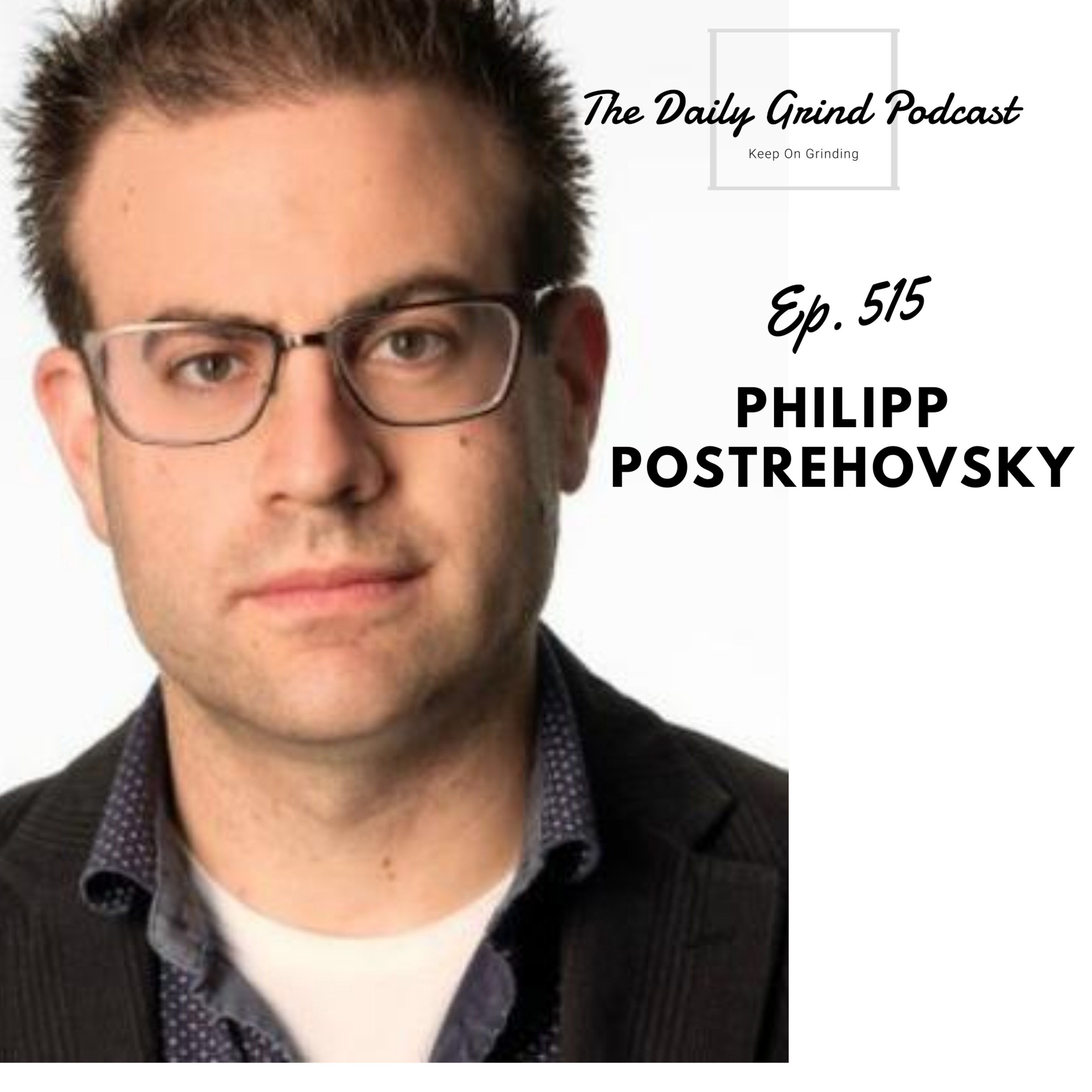
Hey everybody and welcome back to another episode here of The Daily Grind. Today we have a very special guest. We are sitting down with Philip Postarowski. Philip is the CMO at Vope, but more than that, Philip's an entrepreneur, he's a visionary and he's a marketing expert.
So be sure as always everyone you have a pen, you have a piece of paper, sit back and dive deep in today's interview with Philip Postarowski. Today's episode is brought to you by the Just Go Grind podcast with Justin Gordon. As many of you know, I went from five days a week here on The Daily Grind to one day a week. That leaves plenty of days and a lot to learn from so many other people and Just Go Grind and the podcast and Justin is absolutely amazing.
I would encourage you all to go and check out that podcast. He interviews entrepreneurs, CEOs and other go-getters five days a week. Yes, you heard that right. He is going daily, giving you actual insight each and every episode.
Some of the episodes and people and guests you've had on are absolutely amazing from Vanessa Dew, who's the founder of a hundred plus million revenue dollar company, Health Day at Kombucha and Rob Mather, founder and CEO of Against Malaria Foundation, one of the world's top rated charities, which is now raised more than two hundred and thirty plus million dollars, which is absolutely amazing. To Austin Reef, who's the co-founder of Morning Brew, The Daily Newsletter with more than two million subscribers. As you can tell from those interviews alone, this podcast is phenomenal. So be sure, guys, go and check out the Just Go Grind podcast with Justin Gordon.
Today, subscribe to the show and Apple Podcasts, Spotify or wherever you listen to podcasts, simply search Just Go Grind to find it. You can also find it in the show note section of this podcast. Everyone, keep grinding. Today's episode is brought to you by eBay Canada.
eBay Canada continues to help retailers bring their businesses online quickly through the up and running program. When you sell on eBay as a retailer, you can continue to serve your existing customers while gaining access to more than 180 million buyers in 190 countries, allowing you to stay local, yet sell global. This up and running program is incredible. And as a Canadian business seller, you gain access to no listing fees on up to 200 listings per month, where you only pay fees when you sell access to the eBay community group, where you can get real time advice and inspiration from experienced sellers and eBay team members, powerful selling tools and insights and access to eBay's 180 million plus buyers around the world.
eBay Canada is here to help you. They've been supporting Canadian small business retailers for 25 years and launched this up and running program to meet an urgent need today. So if you're a Canadian small business retailer, or you know someone who is, visit ebay.ca forward slash up and running and get started with this today. Again, that is ebay.ca forward slash up and running.
A website is your home online. If you don't have a strategic website that is branded, if you don't have a website that is working for you, you're missing out on opportunities. It is that simple. If you want a website to start working for you and generating revenue for you and your business, visit tailor page.com today.
Again, that is tailor page.com today. All right, everyone. Welcome back to the daily grind. As I mentioned, we're sitting down with a phenomenal guest today, Philip Postor-Hoski.
Philip is a product visionary brand builder and an award-winning marketer who has been involved in the Vancouver Tech scene for over 15 years. In 2013, he co-founded Rent Mula, which continues to be one of North America's leading FinTech companies with the mission to eliminate the rent check and modernize rent collection for the enterprise. Before that, he was a marketing lead for MoGo Technologies and Wanga Canada, and he began his career at electronics arts, EA sports. Most recently, he was SVP marketing at Progressa, ranked number 11 on the 2019 Growth 500 ranking of Canada's fastest growing companies.
He founded Ryan for Kids, a program that raised over 1 million for VC Children's Hospital Foundation and sits on the board of one of VC's top independent schools. This episode is amazing and one very informative. As I mentioned, be sure you got that pen piece of paper and without further ado, please meet Philip Postor-Hoski. Well, Philip, Postor-Hoski, welcome to the daily ground.
My friend, how are you doing? Well, thanks for having me. Colin, appreciate it. You got to Philip.
Philip, for some people, kind of being first introduced today. If you wouldn't mind just kind of introducing yourself and what it is that you do. Yeah, so I've been in the FinTech world now for 15 plus years. I started my career off in FinTech at MoGo.
They went to a few other startups and then ended up finding my own coupon in my own company called Renmula, which I left two years ago, but it's still running and growing to this day. I wouldn't get inside a little bit later if you want. Cool. Then I got into a back into the lending space at Progressa, and now I'm back in payments at VOPay.
So it's been quite the journey and FinTech continues to evolve rapidly. And this pandemic, although has been unfortunate, has been or has caused FinTech to accelerate even faster. So an exciting time to be in the industry for sure. No doubt.
And what's your role currently at VOPay? At VOPay, I'm a Chief Marketing Officer. So I've always held a hat that involves marketing and or product and operations. So those are kind of the three key areas I'm focused on, but at VOPay, I leave our marketing efforts.
Very cool. So when you kind of were starting your career out 15 years ago, was it in the marketing space? Did you always kind of have that vision that you wanted to be in marketing? Or did you have like, were you starting off and envision yourself doing something else?
Yeah, I actually started my career off in the advertising agency world. Actually, before that, actually, I first started my career off at Electronic Arts at EA, on their marketing team, and then moved into the agency world for a few years. So I've always been in marketing and brand strategy in some capacity, but then I've honed my industry to FinTech after leaving the agency world. What are some key differences, major differences?
I mean, obviously 15 years is a lot of time, but say if I reword that, when things evolve and new technologies come into place, how is a marketer? Do you handle what's working with what's new coming up and how to take advantage of those things? Yeah, I mean, I think, you know, things are just evolving just so much faster. So you really need to be on top of trends, but then again, you can't be, you can't just jump on every trend and go with it, right?
Because some trends come and go. So it's good to dabble in different trends that come up and test. And if you can't fail, try and minimize the cost of your experiments. And if something sticks, go with it.
And there's just a lot more real-time data available to optimize campaigns and different channels. And like I said, speed has been the biggest change. Things just move a lot faster. And people's attention span is getting shorter and shorter.
So you have to keep coming up with new ideas together at attention and to also keep their attention. So as you're coming up, say right now, if we talk about that, like as you're coming up with new ideas, as you're testing new things, which I'm sure you are, how much time do you give it until you think, you know, this is either a yay or a nay? Yeah, I mean, it really, it really depends on what your objectives are, right? So if what you're doing is meeting, for example, you want to get X amount of leads per month.
And you know, you find that channels at A, B, and C are getting you that great. If they aren't, then you try to, you try other channels, right? You try and optimize those channels. So really, it depends what your objectives are.
Is it leads? Is it revenue? Is it a combination of the two? Are you looking at getting in clients and growing certain processing volumes?
So it really depends on what your objectives are. And not just what your marketing objectives are, but what your company objectives are and how you can support those. Very cool. So kind of taking the rewind going back back a bit in your career.
Is there a point in your career where maybe you had someone you worked with who was a real mentor to you? Or maybe there was some point where you realized like, wow, like this is the path I want to go down? Yeah, I've been fortunate in my career to always, especially in the early days, to really work with individuals that I didn't consider really my boss, but more a mentor. And they really wanted me to succeed.
And when you're fortunate enough to work with those kind of people, they can be a game changer. I was lucky enough to have that almost right from the get go when I was in the agency world. And I knew that I wanted to pursue the marketing world. But again, it's evolved dramatically, right?
When I started off in the agency world, Facebook was just launching. So the whole social media realm just didn't even exist when I started my career. Wow. So I mean, fast forward, you had mentioned briefly in the intro about a company you started, I forget how many years ago?
Yeah. So my brother and I co-founded RentMula back in 2013. Okay. And what does that give us a little rundown on what the company is?
Yeah. So we really founded RentMula to solve the ongoing pain point of paying rent. So to this day, I run into people that say paying rent is a pain in the butt. So, you know, eliminating that rent check and making rent payment really, really simple.
So that's RentMula's mission. And to this day, it does that. It's not focused on the individual landlord. It's focused on the enterprise.
So really a medium to large property management companies and ownership groups that may have anywhere from, let's say, 500 units all the way to 40,000 units and addressing their pain points as well on the operational side and making those experiences both for the tenant and for the back office a lot smoother. Very cool. And how has that been kind of starting a company from the ground floor with your brother watching it grow? Like, what's that process like?
Because there's a lot of people who want to go through that right now. Yeah. It's, you know, it's, it's, it's lots of ups and downs. I call it, I've always called starting a company kind of, like a, especially a startup, like a kinder surprise egg on the outside.
It looked nice and tasty. But sometimes you get a great toy and sometimes you get a crappy toy, right? So each day, you never know what's going to happen. And we were fortunate enough to really scale it.
We pioneered credit card payments in the rental space in Canada. And you know, it's all about, it's not just about solving a real pain point, but it's also timing, right? So could you start a brand new like 20 years ago? Not a chance.
Will it work? And can you start up in 20 years from now? I doubt it, right? So it's all about timing.
A little bit of luck for sure. Having great support and contacts and really solving a pain point, I'd be focused on that. Being focused in anything that you do, I think is key. Did you know when you were starting it that the timing was right?
Or did it kind of just, you look back on it and you're like, the timing was just there? Yeah, we knew the timing was right because my brother had experienced the pain point of paying rent as an ex-pat. I had experienced the pain point of paying rent here in Vancouver. So we knew the pain point was active and we talked to property management companies and they expressed the same thing.
So we knew there was a problem to solve. And it was just kind of at the cusp where people were really starting to expect a convenient experience for all parts of their lives, including the rent. So it was a good time. Very cool.
So how do you feel like someone could balance that? Because like I mentioned, there's a lot of people who want to start companies on the spot who listen to the show, people in the process of doing it themselves. How do they first of all maybe test if their idea that they have is solid, it's going to be viable? Why don't we start there?
Yeah, I mean, for us, we thought that we were able, we were going to be able to solve a pain point. So what we did is in the early days, you know, before we even started building the platform, we went to conferences in self-mode and we started talking to individuals. We knew what our business model was going to be like, and we knew that we had to have the buying of the property manager to make it work. So we knew tenants would adopt this, but we needed the buying of the property manager company.
So we went to them, we asked them what their pain points were, and we built the platform to meet those. We also got two or three launch clients secured, even before we started building the platform, and we really built the first version of the platform for them. The platform got rebuilt three times over, or even four times over since then, but really catering to your launch partners and clients is key. And really, it's again, solving a pain point for ideally a decent-sized market, right?
If it's too niche, it can be very challenging. If you're trying to build the next Facebook, that's really challenging. And ideally, you are launching a solution where you can partner up with companies that can kind of help push the marketing for you, or help push adoption for you, because that's going to save you a lot of money, because you're probably not going to have the money to do a proper marketing and awareness campaign from launch. Did you and your brother seek any funding?
We did, yeah. At the beginning, we bootstrapped it, but Remuela has raised to this day a considerable amount of funds, at least, considerable being in the Canadian Pintech world, specifically for Vancouver. It's in around the $20 million range. But yeah, we definitely had to see funding as we scaled the opportunity.
Do you feel like that's where a lot of people miss? Is that what you did? You bootstrapped at the beginning, right? You proved the model, you proved the method.
And then once you saw it working, then you were like, okay, we need to scale this up. And do you feel like people need to take that approach? Because I feel like, correct me if I'm wrong, so many people just try to have that idea and they look for the funding from before they do anything. Yeah, ideally, you want to delay the point at which you need to take funding for as long as you can.
You want to get up and running, because again, that's going to drive valuation, and that's going to drive much better terms for you as a co-founder or founder, right? So if you can delay as much as you can and get actual traction and get metrics behind what you're doing, that's going to help you on every front. Something also I would stress nowadays, you really want to ideally have a revenue model in play right from the beginning. I think the days where you can build something where you really have no idea how you're going to make revenue are kind of gone.
These astronomical evaluations for companies with revenue models that just didn't exist, I think are done. And investors are looking for actual companies or for actual startups that have a plan to reach profitability and break even, because that's what a true company really is, if you think about it, a self-sustaining company. When you were going through that planning stage yourself, was that kind of handled by you and your brother? Did you seek outside help and consultancy to help you with that planning?
Planning, you mean the business plan? Yeah. Yeah. We had had experience in the past, so we came up with it ourselves.
We did have some great advisors, especially at the beginning to help guide some of our thinking and some of our direction. But for the most part, it was the two of us that came up with it. Got you. But again, it's always good to surround yourself with people that are smarter than you.
Yeah, so you probably had that sort of guidance from the very start, it sounds like. Yes. Yeah. Do you feel like working inside of a company really helped you build your company?
Yeah. I mean, you know, the more I'm not saying you should be skipping companies every year, but you know, every company you go to, they're going to be doing things differently, and you're going to learn things. So it definitely took some experiences from previous positions and companies that helped guide us. You know, some of the stuff you're doing had hot, because until you actually build a company, there's no, you know, there's no textbook for how you build and run a company.
There's no textbook, even if you do an MBA, nothing can I can fully prepare you for what it's like to actually build and run a company once you're like, you know, in the weeds and, you know, on and just in it every day. But definitely previous experience helps, you know, build some wisdom and some guidance. Got you. And you're still involved in that company, you and your brother started, right?
We stepped away from day to day operation, but, you know, we are well aware of what's going on. It's broken everything else. So, yes, it's great. You know, it's seven years old now, which in itself is a win.
So just watching at scale and hopefully one day it gets acquired. Very cool. Was that a difficult decision to step away from the day to day? Yes and no.
From myself, personally, I, you know, was having kids and everything else. So it was, it was the right time. So yeah, I mean, there's pros and cons to it. But no regrets.
Got you. So now, now if okay, like, obviously, you know, you've been doing this for almost a year now, you've been with okay. If that's right. Yeah.
Very cool. What kind of, when it comes to the marketing side of things there, how are things structured? Like how big is the marketing team and what sort of like the day-to-day roles and the processes that you'd go through? Yeah, the Vope team is still relatively small.
And the marketing team is small as well. And I have a few supports that work with me. But really, you know, Vope is kind of the open banking payments leader in Canada. So it's really continuing to build brand awareness.
And it's very targeted. It's a B2B2C company, similarly, however, as a B2B2C company. So really targeting our solution to the audience that we know has ongoing pain points and really just being focused on those audiences and giving to them. Got you.
And because you're a leader and obviously, like, you've been a leader for a while now, firstly, how has that process kind of developed for you, yourself becoming and developing yourself as a leader? Because I know a lot of people, that's kind of a struggle when you're kind of in it and then all of a sudden you're transitioning into more of a leadership role. Yeah. So when you say a leadership, do you mean an actual like leader in a position or a leader as a like market leader?
Like leading people. Yeah. So leadership, leadership is one of those things that, you know, comes to a lot of responsibilities. But you know, you do have the ability to, you know, make people's lives better and inspire them.
And really, you know, hopefully they can become leaders themselves. I'm a big believer that you have to lead by example. And ideally, you know, you're working to a common goal. And really, you just have to understand that people that people may be looking up to you.
And like I said, you have to lead by example, pretty much day in and day out. What do you look for when say you're acquiring new talent or obviously looking to grow your team, you've been through that before? What do you look for in someone? Is it straight talent that you're looking for?
Are you looking for someone who's going to fit in with your team all the above? Yeah, I'm a big believer that you can't, you can teach skill. You can never teach fit. So I think culture fit, class company fit is critical.
And again, you cannot teach it in my opinion, because you can't really change someone's personality. Right. So yeah, so I think fit is key. I think part of that, you know, is are they driven?
Are they self motivated? Really, you're really looking for somebody who is almost like an entrepreneur in their own right, right? Successful startups really are made up of multiple entrepreneurs. And people and people that seek the startup world are most likely have more have entrepreneurial spirit and traits.
No, there's nothing wrong for working with and for a very large company. But those worlds are different, right? And you're going to be potentially asked to do things that are not into your job description, right? So people are really willing to just step up and just get it done.
And those are different personalities. So ideally, you're looking for individuals with specific traits that line up well with your mission. So when you're looking for those kind of people and you're maybe going through interview process with them, like what are what are either some questions or what are some things you do in order to be able to determine if this person is sort of does have that entrepreneurial spirit or not? Yeah, I mean, just looking at previous work experience can tell you a lot.
I think work experience is key. And just how they answer certain questions, right? It's going to tell you a lot. And also, you know, if culture is very important at a company and you made an effort to really share that culture story on social, on glass during everything else, you're most like going to attract or be able to better attract those people naturally.
And you won't even get those individuals that wouldn't really work out as well in your company, even applying. Totally. Over the last few months, obviously, things have changed in a crazy amount of way. How have things been evoked pay or specifically with you as a leader of your team?
How has that transition and how have all these different changes either affected what's going on? Or how have you guys handled all that? Yeah, I know, very fortunate to be in FinTech specifically in payments. You know, it's one of those industries that has been doing well for a long time.
But the growth has actually accelerated. Yes, we are working remotely still and most likely we will for a while for a while to come. But, you know, everyone has adapted to the new setup. And, you know, it's constant communication using some some core tools to help streamline everything.
And yeah, we're really solving it. We were solving a pain point before we're still solving a pain point, but we're now solving almost, you could say like a vital need because businesses having forced to really fully digitize their payment experience. So we're there to help them. Very cool.
Do you feel like you guys are going to kind of stay remote, like working remotely, or do you feel like when things maybe we get a vaccine or things started to get back to normal, you'll kind of move back to that office setting? That's a great question. I think time will tell. I think there's definitely benefits of being, you know, of some face to face.
I know talking to others at other companies that's, you know, they're not going to be going back to in person for a long time to come. But that said, there are benefits, you know, of, you know, doing brainstorming sessions in person, doing certain things in person. I will, will, will, will, will office culture ever be the same? I don't know.
I don't think it will be the same for a long time to come. There have been efficiencies that have been gained from this. I think business travel has been changed a lot. Because it's, it's shown that it's not really required per se.
Conferences are going to probably change, right? So a lot of things are going to change some for the good, some for the better. But I think overall companies have become more efficient regardless of what industry you're in. You've been forced to become more efficient.
And that's, in my opinion, always a good thing. 100%. I think you're, I think a lot of people you'll see kind of that hybrid method where maybe you go in a few days a week for those brainstorming, for those team building of the things. But a lot of it will be done remotely because, you know, I don't know if you're kind of finding this, but I feel like at the beginning, people were kind of a little weary of working at home and how that would kind of feel.
But speaking from someone who does that kind of full time, once you get into that rhythm and routine or a lot more productive, kind of in your own settings, I feel like a lot of people are finding that. Yeah, I would, I would agree. And it's just having, and there are some individuals that find it more challenging individuals. I think it's something more about ideally giving people the option of working remotely or working in the office and people and kind of meeting people's needs.
I think, yeah, like you said, I think a hybrid model is what the future has in store for us. Yeah, like, I mean, a lot of people that I'm speaking with, they're almost, you know, they work in an office and they're like, if I have to go back five days a week, I'm almost going to like hate doing what I'm doing, right? Like I feel like a lot of people are going to find that. So I think even companies are going to be forced to have these, you know, options to come in or to not come in.
I think they are. And they're also, I think, seeing some, they're seeing lots of cost savings, right? And I think, you know, you're going to see, you know, you already are, for example, in Vancouver, a lot of sub leases going and just a lot of vacancies now happening in office space because companies are realizing and it's always a significant expense for, for companies to have office space, especially, you know, prime downtown real estate. And this pandemic has shown that you actually don't really need all that space.
So true. So kind of moving back, I want to kind of help the listener right now, like, they're going through their business. They're trying to come up with, you know, different ways to market their companies, what sort of things do you feel like separate successful companies and startups from non successful companies and startups, specifically on the marketing side of things, like when you look at companies that aren't succeeding or don't succeed, what are some things that they're missing? Yeah, I think consistency is key from branding consistency to thought leadership consistency.
If you're going to be posting, for example, on LinkedIn, twice a week, do it twice a week, do it every week, don't change, right? Consistency is key people begin to expect certain things if they see it. And again, consistent messaging, consistent brand looking feel, consistency can go a long way. And companies, apps and companies, I don't do that.
And I mean, I am a marketer. So maybe it's more apparent to me, but I know, I know, I know, I know it is companies that do things consistently. And it can go a long way, not just in actually helping sell your product, but actually it's great from a recruiting standpoint and from HR standpoint, because people want to be a part of those kind of companies, right? A hundred percent.
And even for like attention spans, like you think of your favorite TV shows, when there was TV shows coming out and whatnot, like you're sporting events, they're like time, right? You know exactly when they're going to come out on specific days. And that's why they're popular. If they just popped in and out whenever they wanted, it wouldn't be what it was.
Exactly. Yeah. So it's also having the patience. If you're going to launch a program, I mean, you have to give it a chance, you know, launching coming for two weeks or even a month is not going to potentially show you if it's going to be successful.
You have to do it. I mean, certain things you have to run for longer, right? So you have to have the patience and again, consistency is key. No doubt.
So now speaking with FOPAY and yourself, you know, you talk about kind of being able to try different things and test things out and obviously you're doing that. What are some things that you're working on now at BOPAY? Like what are some things you guys are testing out to see, because obviously AI is coming out in the future and all these different things. What are some things going on right now?
Yeah. When you mean testing to me on the marketing side or more on the product side? On the marketing side. Yeah.
Yeah. I mean, for us, it's really making sure that we are getting to our audience in an effective way, right? So testing different, you know, are we are we publishing case studies? Are we publishing?
It's all about really content and what is in that content and what's the medium of that content and how is it getting in front of those individuals? You know, we're not doing mass advertising because we're talking to a very specific set of people. Each quarter, we kind of have a theme of what industry we're going to go after or what product we're going to be pushing a little bit more. So, you know, there is, I think planning can go a long way and kind of sticking to that plan.
Because again, a plan kind of forces you to be consistent, right? You said that in Q3, it's going to be product X month. Well, you're going to keep going and pushing that in Q4. You're going to be promoting something else, right?
So again, a plan can go along with creating consistency. You know, things that we're trying, you know, again, we're big believers in solid leadership. So really partnering out and really forming strong strategic partnerships and finding strategic partnerships in places where you may not even think there could be one. So I can't get into specifics, but we've been very fortunate to and to develop some strong some strong partnerships, thanks to our CEO.
And those have gone a long way in helping not just push our brand awareness, but push our adoption. Very cool. And if people wanted to kind of check out VOPay and then people want to connect directly with you, follow along on your journey, what's new, where's the best place people can do that? Yeah.
So for VOPay, just VOPay.com, VOPay.com. And for me, I'm on Twitter. I tweet pretty much everything I read in the marketing world. The tech world.
So they can follow me at Phil Postro. So at PHIL, P-O-S-T-R-O. Awesome. And what are some things you're reading right now?
You mentioned you're a big reader. Yeah, I mean, for me, I read some business books and some leadership books. But for me, I'm a big, you know, because things are evolving so fast in the tech world, in the marketing world, there's a few publications that I've been reading now for a very long time, some over 10 years, you know, kind of the top four publications I always make a point of reading are e-marketer, payments.com. I always enjoy reading Business Insider.
Business Insider is so much content, but specifically in the top 10 techniques you have to know each day. And another one, really, from a wisdom perspective is Seth Godin. I absolutely love Seth Godin. I love Seth.
Yeah, and make a point of reading his, what I call words of wisdom every day. I'm not sure how he is able to come up with that kind of amazing content day in and day out, but he's a genius, I guess. Hey, brilliant. How do you guys do it?
Brilliant and a nice guy. I can tell you that. Yeah, exactly. Awesome, Phil.
Well, I'll share all these links to make sure people follow and connect with you. And I want to thank you so much for taking time under your busy schedule, coming on the show, and sharing your wisdom with the audience today. You're very welcome. Take care and stay safe.
You got it. And there you have it, everyone. We hope you enjoyed today's episode. If you did hit that subscribe button, share this out with one person who you feel like could really benefit from today's episode with Philip.
We'll be back next week with another one until then, Colin Morgan signing off. And always remember to keep on grinding.