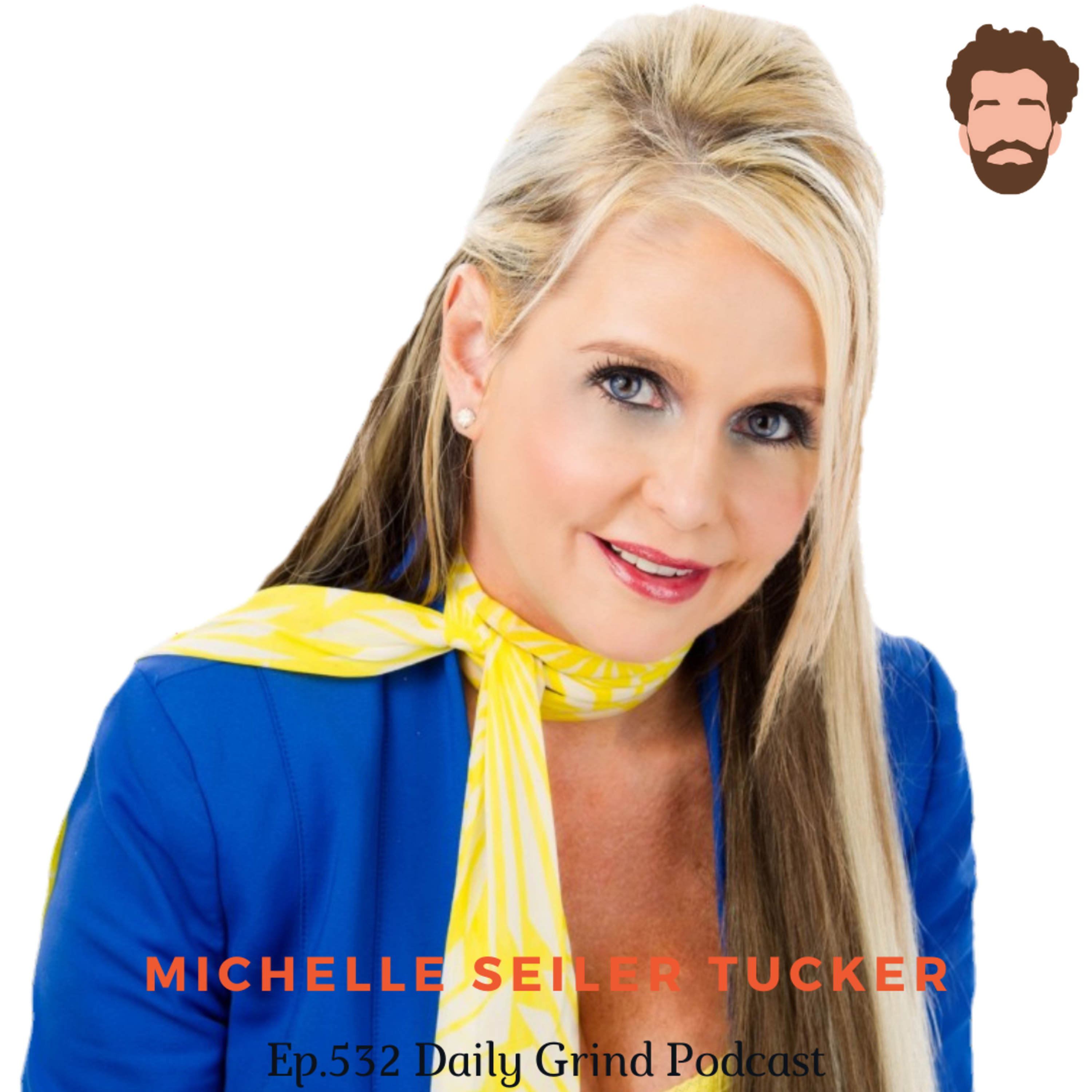
Hey everybody and welcome back to another episode here on the Daily Grind Happy Holidays and Merry Christmas. It's Christmas Week. Hope you all enjoy an awesome time with your families and friends over the holiday. Today, we have a very special guest lined up for you all, Michelle Siler Tucker.
Michelle Siler Tucker is the author of the new book, Exit Rich. She's a business expert, a preeminent expert in buying, selling, and building businesses to sell. She closes 98% of the offers she writes and exceeds her client's expectations. And you're just gonna hear it from today's episode when we sit down with Michelle.
She's super passionate about what she does and she is a true expert. As always, be sure you have a pen, piece of paper, sit back, and dive deep in today's interview with Michelle. Enjoy. Do you ever feel like there's something interfering with your happiness, or is preventing you holding you back from achieving your goals?
For me, this was my past. I kept using my past as a crutch to not move forward and an excuse. And it wasn't until I started to talk about it with a professional that things really changed and I transformed. And this is why I love this company, BetterHelp.
BetterHelp will assess your needs and match it with your own licensed professional therapist. And you can start communicating with them in under 24 hours. Now, this isn't a crisis line. It's not self-help.
It's a professional counseling service done securely online. The best part about this is, guys, is that you don't have to worry about driving in a location, sitting in an awkward waiting room, not knowing who you're talking to. Like, you get to pick your counselor, you get to do it from the comfort of your own home. So it's really comfortable and super discreet for you.
And you can really open up. What I find when I'm in the comfort of my own home, I open up in ways I never thought I would. And there's a broad range of expertise in BetterHelp's counselor network, which is definitely not available for you in your local area. And this service is for clients worldwide.
All you do is log into your account anytime, send a message to your counselor. And in a short matter of time, you get a timely and thoughtful response, plus you can schedule a weekly video or phone sessions. So again, you don't have to sit in the waiting room. You don't have to book a week out.
You can do this whenever you're ready. BetterHelp is committed to facilitating great therapeutic matches. And they make it super easy for you and free to change counselors if needed. So if you're not jiving with someone or they're not jiving with you, you don't have to worry about this awkward thing.
You can just find someone else. So you can spend the time early on to find that person who you really jive with. And that's super I can tell you from experience. It really, really helps.
It's more affordable. This is the best part. It's more affordable than traditional offline counseling. And maybe if you don't have cash right now or you're not as flush as you need to be, financial aid is available.
I can't tell you the importance of this guys has changed my life when I finally decided that I wasn't going to accept all this shit that I kept happening to me. I'm going to deal with my past and when I deal with my past, it helped me move forward and BetterHelp and I want you to start living a happier life today. I want you guys to visit BetterHelp.com forward slash grind. Again, that's BetterHelp.hlp.com forward slash grind.
You can join over 500,000 people taking charge of their mental health with the help of an experienced professional. Again, for daily grind listeners only, you can get 10% off today your first month by going to BetterHelp.com forward slash grind again Better. H-E-L-P dot com forward slash grind. With holiday season quickly approaching, as you're all stocking up much like me on stocking stuffers for friends and families and gifts for your kids and nieces and nephews and your loved ones.
The thing is, although Christmas time is a time for giving, it's also time to give yourself. Don't forget to treat yourself as well. Take a chance on that business idea or side hustle you've been wanting to get to that you have maybe part time right now. You're trying to take full time or that idea you have that's just stuck in your head but you haven't done it yet.
Today's show is sponsored by Teachable. So whether you have an offline business, you're looking to bring it online, you have a niche or a passion or you have a specialty you'd like to teach others. Teachable is here to help. This platform is amazing.
Teachable is a platform that helps independent entrepreneurs, helps creators to build and sell fully customizable online courses and services. This is amazing. There are a ton of different platforms out there that allow you to make online courses but Teachable makes it super simple. You can join over 100,000 instructors who have transformed their knowledge into a world-class online course and have earned more than 500 million dollars to date.
I'm super pumped about this because I'm actually beginning to launch my new online course which I'm excited to share out with you which is in the works and I am going to be launching it with Teachable. I'm super super pumped. Now to help you get started as a special offer for listening to the Daily Grind today, if you visit Teachable.com forward slash grind and you enter your email, you're going to get a free masterclass. It's going to walk you through the exact steps to take to create your own online school and start making money today.
Again that is Teachable.com forward slash grind. Enter your email for a free masterclass to help you get your online school and online course started. Even better than that, check out if you sign up your first three months are going to be 50% off when you enter code grind. Again that's Teachable.com forward slash grind and then enter code grind for 50% off your first three months on Teachable today.
Now let's jump into today's interview with Michelle. Just a quick note. I did realize as I was editing this that I didn't have my mic on, I was using the computer audio. It's still clear but not this what you expect.
Otherwise, awesome interview. Enjoy. Well Michelle, Siler Tucker, welcome to the Daily Grind. How are you today?
I'm great. How are you Colin? I'm fantastic. Thank you so much.
The weather's not great here. We're getting a little bit of snow where I am. So other than that, where are you located? I'm just outside of Toronto at the moment.
So I'm in Canada which is nice cold weather. But we got lucky up until this point. Okay. So you're Canadian.
Absolutely. And yourself? I am from California but I live in New Orleans. How long have you lived in New Orleans?
Tell me about 18 years. Okay. Love it. I love it.
You know, it took me a little while to get used to it but I love it. I love the people here. I love the culture. What brought you to New Orleans the first place?
I actually, my family moved to Texas when I was 11 and I lived in Austin, San Antonio, Dallas and every major city except for Houston and I met my husband in Dallas and when he was in medical school and he made me move to New Orleans. There you go. Awesome. We'll laugh at the show for people kind of being first introduced to who you are, what you do if you wouldn't mind just kind of giving a little brief as to kind of who Shell is and what it is that you do.
Sure. So I've always been an entrepreneur. I've never been your typical child. I always, you know, walked around with a notebook and asked everybody a million questions like you are with me right now.
And my mom always thought I was going to be the next web of Walters but I just always like entrepreneurship. I own several different companies and at any given time I own five to 10 businesses that I built to sell and I got into franchise development, franchise consulting, franchise sales and then I transitioned into selling businesses. At first I transitioned into selling smaller companies like restaurants, bars, cafes, you know, retail businesses and then I transitioned shortly after that into selling businesses $10 million and up and I also transitioned into fixing and growing businesses because according to Steve Forbes who endorsed my book, Exit Rich, eight out of 10 businesses will not sell. So I learned very quickly if I didn't fix them, I would starve to death.
So I really specialize in buying, selling, fixing and growing companies. I've been in this industry over 20 years and at any given time I own five to 10 businesses. I invest my money, my expertise, my core competencies to help business owners sell for their desired price tag. Amazing.
So when you kind of walk into a company, walk into a business, what are some of the first things you look at? Because you know, there's people here who are business owners or they're looking to start a business, what do you see some of the biggest mistakes that business owners are making? Yeah, so there's so many mistakes that they make. I would say that the number one mistake is that they don't plan or exit.
They never think about selling until they have to due to a catastrophic event occurring and that could be internal or external health issues, partner disputes, divorce, death or external like COVID. And trying to sell their catastrophic event is the worst time to ever start your business because your business is typically turning downward and the best time to sell is when your business is doing well. So business owners really need to start their exit plan or exit from they want to buying or selling the company. They need to determine their in-game, their desired price tag.
They need to know what their current evaluation is. I call it the GPS exit model, the solid tech or GPS exit model, know what your in-game is, know what you're starting from, know your time frame, and know your buyers. Who's going to be your buyers? So if you want to sell a $20 million company and let's say that you're in transportation, logistics, trucking, then you need to know who buys, what is your current value?
What's your in-game? What's your time frame? If you want to sell for $20 million in seven years, what do you worth today? If you're worth $10 million today, then you need, you know, to get it to a $20 million company five years and you need to know who's your buyers.
There's five different types of buyers. So, and then you need to know who's my buyers, what's your buying criteria, and then you need to build that business based upon that buyer's criteria. Then the other thing that business owners make a mistake on is they never operate on all six cylinders and all what I call the seller-tucker six fees. So that first P is people.
You don't build a business, you build people, and people build a business. So that's number one. You have to have the right person in the right seat. Most business owners try to do everything themselves.
They always say, well, if you want it done right, do it yourself, well, that's not true. Focus on your strengths, hire your weaknesses, make sure you have the right people in the wrong seats. A lot of times business owners have the right people, but they haven't been in the wrong seat. And then you got to ask yourself the who question, who in my business opens, who in my business deals with customer service issues, who in my business deals with manufacturing, who deals with environmental issues, who deals with the county, who deals with lawsuits, who deals with workers comp, you know, this goes on and on and on.
The secret calling is to never put you next to the who. You can only build a sustainable business. They can operate without you. And the problem is many business owners are doing the who in their business.
So, your name should never be next to the who. So, figure out the who in your business and make sure it's not you and put the right people in the right seat. So, that's one of the biggest mistakes that business owners make other than not finding their exit is they don't have a good solid team. And buyers don't want to buy a job.
They want to buy a business with tenured people and a management team in place. Okay. The second the second P and when I see business owners make mistakes, and let me just kind of set the business landscape for you real quick, because business has changed dramatically. The business landscape is not the same as it used to be.
When I wrote sell your business for more than 2013, you know, 85 to 95 percent of startups one to five years would go out of business, right? That's common knowledge. You know that. Everybody knows that.
But when I go exit rich, I learned, I was shocked actually that the business landscape has changed so much. Now, it's only 30 percent of those businesses. So, startups one to five years will go out of business only 30 percent. So, go start a business.
You know, your risk is less. However, out of 27.6 million companies, those businesses have been in business 10 years or longer, those businesses are going to go out of business. 70 percent of those businesses out, 27.6 million businesses have been in business 10 years or longer are going to go out of business. Now, you hear about the public, the public businesses all the time.
It's time out when out of business, twice when out of business came out when out of business, Jayce Penis is going out of business, Montgomery Ward's going out of business, she and she just closed down on her location, even Starbucks is in trouble. What you don't hear about are the small private companies on every street corner and every town in every state across our great nation that are dropping like flies. These businesses are going out of business and small businesses are back on our economy. There's 30.2 million, small businesses in point half the US workforce.
If we lose small business, we lose jobs. If we lose jobs, we lose spending power, then the American economy is in the tank, the US economy is in the tank. So, the second piece is product. Okay.
And here's a big, big mistake of business owners make. You got to ask yourself, is your product on the way up on the way out? Are you thriving or dying? Do you have an Amazon on your hands or do you have a blockbuster?
And if you have a blockbuster, you better pivot really quickly. You better figure out, you know, how can you add congruent revenue streams? How can you, you know, do something different? Maybe acquire a different industry, but you got to pivot.
So, you should always ask yourself, what business am I in? What do I do really, really well? What does my business do really, really well? And what business should I be in?
And let me just give you a quick example, Amazon. Amazon asks themselves, what business am I in? What business did Amazon start in? Books.
Books. They ask themselves, what do I do really well? We do fulfillment really well. What business should we be in?
We should be in a fulfillment business. If they didn't ask those three questions, they would still be in the book business. And they want to be the Amazon that they are today. So, every business owner should ask themselves that question, because there is a time that their products start going out, you know, you can be in an industry that's up here, and then something gets switched, and now the industry's down here.
It's like COVID. Industries that we're dying are now thriving. Industries that we're thriving are now dying. So, you got to make sure you always pivot and ask yourself, what business am I in?
What business should I be in? And make sure you pivot. Because if you don't, you're going to be out of business. And then go ahead.
Yeah, I was just going to pipe in because I mean, you brought up Blockbuster, and there's other businesses out there that have a really difficult time. I mean, they were probably aware of the direction they were going, right? Like they knew that this probably wasn't the direction they had an opportunity to think of buying Netflix. Why do so many of these businesses fail to take action on a lot of the information that's like right in front of their eyes?
So, how do Blockbuster have the opportunity to buy Netflix? But what they did have the opportunity to do is to create and innovate. And business owners stop, aim. Aim is always innovate and market.
Always innovate and market. And business owners stop innovating. And then they just get stuck in the business. And when you're in a fog, it's foggy.
And that's why I always say, you know, it's how business experts, you really need to line yourself with an advisor, somebody who's been down your road before because a genius learns from other people's failures. So, you need to line yourself with an advisor that can help you be transformational instead of just transactional business owners are so transactional and they get caught in the day to day. Those three questions that I said earlier, what business are you in? What do you do really well?
What business should you be in? Those are transformational questions. You know, so business owners just stop innovating. Blockbuster saw the writing on the wall.
They said back that and happy and thought, well, it could have happened to them. Look at Toys R Us. Toys R Us have been in business over 60 years. Tell me what they did to innovate.
Tell me what they did differently. They've done nothing differently. And that's the problem. And a lot of these companies like JCPenney's tried to innovate and they tried to market and they tried to create a different brand, but it was a little bit too late because here's what happens.
When you have a company like Amazon come in and make it easy to do business with them, that's what you think customers are going to do. Amazon came in and changed buyers habits. They changed the consumer's habits because you can buy anything from Amazon and have it delivered in two days. You can even buy a horse on Amazon now.
So, I know, so Amazon changed the way that we do business. I guess what else changed the way we do business. COVID, people used to go to the grocery store, not again, and go to the grocery store. Walmart is innovating.
Walmart is marketing. Walmart is keeping up. Other businesses are not. So, whoever makes the easiest for the consumer to do business with them is a company that's going to win.
Amazon is winning because of that. Walmart is winning because of that. Everybody else, not so much, okay? So, a product is huge and business owners make a mistake because they just get complacent.
They don't innovate. And that's one of the biggest mistakes they make. The third P is processes. And most business owners never think about process until they have to out of, you know, an unfortunate occurrence.
Like, let's say you want a manufacturing plant and somebody lost a limb. Well, you probably didn't have specific processes in place, okay? So, now they're thinking about processes. Or let's say you're in business and you have a lot of unhappy customers.
But I tell another client to do business with you because, you know, now with the internet, you can just go complain online. And then they try to put together a process. Processes need to be designed from the beginning of buying or selling a company. And it should always be designed with your mission, statement in mind, but most importantly, with the customer experience in mind, design with the customer experience in mind.
Let me give you a quick example. The founder, the McDonald's story. Yep. Did you watch it?
Of course, I watched it multiple times. The McDonald's was back in the 40s. And back then, you just had like the sonic-type drive-in where they would come out on roller skates and serve your food. Problem with that is if it was always cold, the order was always wrong, and it took long, it took forever to get.
So McDonald says, let's change the way the people eat. Let's provide quality food, provide great taste and quality food, provide it fast, get the order right, and deliver it under like two minutes. How are we going to do that? So, they took their entire team to an empty tennis court.
They drew out the processes. They had all their people practice the processes. We have the customer experience in mind because the whole process is designed around getting good quality food fast within two minutes. And no matter where you go in the world, whether you're in China or Russia or America, guess what?
It's the same experience. You're getting good quality food fast. So, they practice and practice and practice. Who takes the order?
Who takes the order? Who cooks the burger? Who puts the two pickles on the bums? Who gives it to the client?
The consumers, right? So, you've got to design your processes with your customer experience in mind. You've got to make sure it's productive and efficient and well documented. And here's the other step that business owners don't do.
Train your employees on such and they get dummy proof, write a process for dummies, you know? And that's what you've got to do and design it with the customer experience in mind. So, the fourth P, and here's another big mistake. So, I've given you all the mistakes as it relates to the P's.
Proprietary. Proprietary is the number one value driver. There's six pillars to proprietary. Number one is brand.
You can build your brand and you can be a brand hero and then you can lose everything by one stupid mistake and really go down in branding, okay? So, I'll give you an instance. Who do you think is the biggest brand? Probably games on right now.
Apple. Is it? Apple. $389 billion.
Just for the brand. That's not cash flow. That's not EBITDA. That's not, that's not inventory assets, real estate, anything.
The Coca-Cola brand alone is worth $89 billion. So, build your brand as long as it's relevant in the mind of the consumer, then you will get more money for your business. Toys or Us brand is not really worth anything. So, you can have a big brand and it can be more zero.
So, you got to make sure that that brand is still relevant in the mind of the consumers. And then, trademark is huge. Here's a big mistake the business owners may call them. They go and they start their business and they just go get a trademark with the state.
What about federal? So, here's what happens. You're in business for several years. All of a sudden, you get to see some of this letter because somebody else has that trademark and you're operating under their trademark and you never even checked to make sure that's available.
Then, all of a sudden, you're spending thousands upon thousands of dollars to buy to keep your business name. You're going to lose. You're not going to win. You'll lose.
The person that has a trademark is going to win. So, then you have to, you're going to have to change your name, change your brand and start from the beginning. So, go out there. People get a federal trademark.
It's not that expensive. It's like $1,500, okay? So, the other, the other big thing that drives value is not just trademarking your name, but trademarking your logo. Like, I got exit, rich trademark.
I got the STGPS exit, I got the ST6B's. Trademark, what's unique to you, what your unique selling propositions are. Trademark those. And then, also get patents.
If you have anything that's unique, get a patent on a protector IP. One of the biggest value drivers is contracts. So, vendor contracts, manufacturing contracts, distribution contracts. Those are all very valuable.
The most valuable of all contracts are client contracts. So, if you have hundreds and hundreds of contracts in place, that's basically residual income in a business and buyer will pay more for that. If, now here's the big caveat. If those contracts are transferable, 99.9% of business owners never have the transferability clause in their contract, 99.9.
So, put their two sentence transferability clause because 99.9% of all sales are asset sales, not stock sales. And if your contracts cannot be transferable, the deal can fall apart like that, okay? So, here's the other value as databases. Build your database.
Build your database and you will build your sales price. If it can be retargeted and re-marketed, then people will pay huge dollars for your database. Facebook paid $19 billion for WhatsApp. WhatsApp was hemorrhaging money, but WhatsApp had a billion users.
So, Facebook knew they could monetize it, knew they could ROI. Buyers buy synergies, databases of synergy, contracts are synergy. They buy synergies and they will pay more money for synergies. The other big valuable thing is what I call business real estate.
And what I mean by business real estate is not your real estate. Let's say you need commerce and you sell cheats. And you have the number one spot on Wayfair. So, when you're searching cheats, boom, there you go.
There you pop up. It's very hard to get that kind of business real estate. Would you agree? Buyers will pay a lot of money for that.
Let's say that you have a unique vacuum cleaner and it's the most unique vacuum cleaner somebody's ever seen. It's a robot and you have patents on it and you own the space on Amazon. Then Buyers will pay a lot for that. Let's say that you have a unique weight loss program and Rush Limbaugh and Glenn Beck and Oprah Winfrey has it in her, you know, 100 best things or Glenn Beck or Rush Limbaugh are endorsing that.
They can only endorse one weight loss product. So, that's huge huge value and Buyers will buy that real estate. Does that make sense? 100%.
And then the fifth piece is patrons. So, you got to ask yourself, do you have a diverse clientele base? Business owners have been in business for over 10 years, have stopped asking their clients. What do you need?
What do you want? How have you want to need to change since COVID? And how can I make it easier for you to do business with us? That's what Amazon started asking you.
What do you want? What do you need? How can we make it easy for you to do business with us? And owners stop asking that question.
We need to get back to the basics. And if you've been in business for 20, 30, 50 years, guess what? Your clients are aging out. So, you got to diversify and you're going to replace with new clients.
But you should always have customer diversification, never customer concentration. So, if you have 80% of your revenue tied up in a few clients, you're in big trouble. Because if you lose one or two clients, you're out of business. And in the last P, the most important P, and people are always like, Michelle, why do you put this last?
Is profits. Of course. Well, I want to make money. Here's the reason I put it last.
Is because profits is never the problem. People say, Michelle, I have a big problem. I'm not making any money. No, you don't have a problem because you're not making any money because you don't have the right people on the right seat.
You don't have the right who's. You don't have the right people doing the who because it's all you. Or you're not in the right industry. Your product is dying, not driving.
You have a blockbuster in your hands. All your processes are not efficient, productive, designed with the customer experience in mind. All you have to protect your IP, so you're spending hundreds of thousands of dollars to protect it now. Very sure.
Profit is always a symptom never the problem. So, those are all the mistakes, but I can go on and on and on. One thing that kind of stood out to me is that we were talking about brand, right? And we were talking about all these different brands.
You brought up Toys R Us. You find there's any value in people maybe purchasing, even though the brand value isn't there. I mean, the brand awareness is there, right? You have a lot of trust.
Yeah, I do. I do. I do. Absolutely.
That's a very good question. You know, Toys R Us brand is not worth $100 billion anymore, like maybe it once was, right? But there is value there because it's awareness. And there are investors that have purchased Dress Farm, they purchased Daimar, Pier One is another one that went out, that investor bought, and are buying it because of that brand recognition, that brand awareness.
However, they have to completely innovate and change the way that those companies do business. So, there is still value in those brands, but nothing like that once was. That makes a whole bunch of sense. I think it's a Tai Lopez company that's buying a lot of those nostalgic brands, right?
Yeah, because I got offered by Tai Lopez and some of, we kind of all went in the same circle and some of his brands asked me if I wanted to invest. And I said no, because I'm a control freak. And when I invest, I want to have majority, I want to be member, you know, managing member. You know, I don't want to invest and have this teeny, tiny piece of a pie, even though it might be a really big pie someday, I would rather control my outcome.
What do you specifically look for? Because I mean, you buy businesses, what do you specifically look for in a business? Yeah, so when I'm partnering with the business, it's very different in what I look for the buy business versus partner with a business owner. Okay.
When I look at the partner with a business owner, it's going to be like, I have to date them for a while because you're literally going to be married. And if you don't like, you know, the way somebody chews our food. And I know, because, you know, silly things like that can bug the heck out of you, right? So I got to make sure that I have, I have chemistry with the partners.
If they're the owners, I got to make sure I can grow the owners. If I can't grow the owners, I'll never grow the business. The business will not grow above the owners. Okay, I always got to grow the owners way beyond any problem that they might experience and way beyond their business.
And so I got to make sure that you can grow them because fish things from the head. And usually if the business is not doing well, you got to look at the head first, you got to look at the leadership. So I got to make sure that I can grow them that they have the mindset to be able to be transformational and not transactional and that they have good business acumen. I also look to make sure it's a niche industry.
I'm not going to be a restaurant, another restaurant, you know, I want to make sure it's a niche. And I want to make sure it's something unique and something that we can grow the footprint across the US and maybe the world. Very interesting. When you look at, because you brought up some interesting stats of, you know, when you started business, it sounds only 30% that go on a business within the first two years, I think you would say.
Yeah, five years. One of five years. It used to be that if you stayed in business over five years, calling, you were golden, right? Not anymore.
So startups, I mean, this is encouraging news for startups. So because of that, right? Like there's a lot of people are looking to start a business, but then there's also the side that you bring up of like purchasing an existing business. Do you see where do you see more value?
Yeah, here's why we see more value. That's a very good question. Because my answer is probably going to be the same as it always was because I used to always tell everybody, don't start it as an as financial suicide. You should always buy a business.
Don't start a franchise. That's financial suicide by an existing franchise. And my answer is pretty much still the same. And here, why it's still the same that you should buy a business first is because these businesses might not be operating on all six fees, but they're probably operating on three or four.
And when you start a business, you're operating on zero. You're running at ground zero. So you got to build your people. You got to build your team.
You got to build your management. You know, you got to get the right people in place. You got to make sure that you have the right product, and it's going to be sustainable because you can be in the right product for a year like fidget spinners. You know, those were hot.
Now nobody cares about fidget spinners. You know, so you got to make sure your product is going to be sustainable. So at least with a business, buying a business, an existing business, you know what you're getting. You typically have people, you typically have people, hopefully it's the right people.
You typically have a product that's thriving or could be thriving more with a new set of eyes, you know, and then you typically have processes in place. So the business might just need minor tweaks. They typically have customers in place or typically making money. They might need tweaks, but you don't need to start from ground zero.
And here's what is nice about buying an existing business. Sometimes owners just get stuck, right? You get stuck. And a new set of eyes can really help you get unstuck.
Like asking that question, do you remember the movie, The Founder when Ray Clark is the one who grew Neganos and Ray Clark had already brought against his home. Ray Clark had already was overlapped. He was in the bank trying to borrow money because the franchisees were not compliant. They were not paying him.
And he was losing money. Do you remember that? He was in the bank and you remember when he walked out of the bank, a gentleman followed him out because he was in the next year ago. And he said, Hey, I just happened to over hit that conversation.
I want to ask you a question, what business are you at? And Ray says, I'm in a restaurant business. He said, No, that's not the business you need to be on. What business should you be on?
And Ray's like, I have no idea what you're talking about. And he goes, you need to be in a real estate business. Now one question right there from that outsider's perspective is what caused Ray to completely change his whole business plan. So he says, you need to buy the real estate, build a building, lease it to the franchisees.
When they're not compliant, kick them out, get a new franchisee in there. That one question alone is what catapult Ray Clark and McDonald's to the next level plus is what made real McDonald's and steel makes McDonald's the largest real estate holding company in the world. So you can go buy a business column and you might have great marketing ideas and a business owner doesn't have good marketing ideas. And you can take the already existing business that's maybe operating on three or four piece and really take that business to the next level.
But when you start from ground zero, it's much harder because you're doing everything from the beginning. So it's always safer to buy existing business. So this is, I mean, you can probably answer this in a million different ways, a big question, but try to make it as simple as possible. So if someone listening to this going makes so much sense, right?
Like why start a business, my conversion to new business versus an existing business? What should they be looking for in a business? Like what people should they hire to make sure that the evaluation is correct? What should they be looking?
That's a good question. And I want to say one other thing before I answer that question is just because you think you're going to start a business. 98% of startups never make it out of the incubator. 98%.
There is a live cycle of a business from incubator to death. Same thing as a person from incubator to death. And there is rebirth. There's rebirth of a business.
And that's what Toys R Us is doing is rebirth right now. But well, here's what buyers should be looking for. Obviously, they want to look for business operates on six fees, but they really need to hire an advisor. And much of the acquisitions advisor, somebody who's done lots of deals, I mean, we've done over a thousand deals, but they rather to me or someone else, they need to hire the right advisor.
Because if you look at a buy a business, businesses are typically not listed for sell by owner. Because number one, most important thing, the business owners confidentiality. And it's very hard for the market to sell the business and not reach confidentiality. So you really need to line yourself with an advisor that has the good businesses on the market.
Good businesses are always listed with an advisor that are never listed for sell by owner. Then you also need to make sure you're hiring the right advisor because there's a lot of advisors out there that don't know what they're doing. So in order to make sure the valuation is correct. Now, I would tell you our checks and balances and valuations, we do valuations at 10,000 to 10,000 valuations.
If the buyer is getting funding, the bank is going to have their own valuator that's also going to come and evaluate the business because banks don't want to overpay. That's true. Yeah, so there's there's a backup there, but you just want to make sure you line yourself with a good advisor. They can also take you through the buyer sanity check.
And the buyer say check is there's five different types of buyers. So it depends on what kind of buyer we're talking about. First time buyers have to go through this buyer sanity check because first time buyers don't know what they want. They all think they want a restaurant.
And then when I tell them, first thing you should ever buy. Don't do it. Don't do it. And so so I take them through, you know, assessment on their skill sets, their hot buttons, you know, what they're passionate about, you know, the lifestyle, the family lifestyle because if you want to have a lifestyle if you want to have quality of life with your family, don't buy a restaurant.
And then I take them through the financial capability and ask them how much they have. And just because they have it doesn't mean they're going to spend it. Most first time buyers will never pull the trigger. So but there's five types of buyers.
So first time buyers, then you have the private equity groups. Private equity groups already know the come advisors. They already know that one's happy business listed. So there's five equity groups based on platform and add-ons.
And then you have strategic competitors. They also know to go to advisors because they know that's where the good businesses are. And then you have serial entrepreneurs that typically will come to advisors because they know that's where the good businesses are. And then you have turnaround specialists.
Turn around specialists will approach business businesses directly because they typically don't want to pay any commissions. Oh, they want to try to get, you know, those don't approach me a lot of times and say, hey, because they sell their basic commissions, they'll approach me and say, hey, what do you got? Turn arounds. So those are the five types.
But that's what you should do is align yourself with an M&A advisor. And then you got to make sure that advisor also has good accountants and tax attorneys because just because you have a local CPA and a local attorney doesn't mean they know what they're doing when it comes to mitigating taxes issues and increase your tax liability. That makes sense. Did I answer your question?
100% super valuable to people. You mentioned there's a few times I see the book behind you, Exit Rich. This is what I'm really excited to get into. So I mean, not your first book, right?
No, I thought, third book. So first book was first book with Saudi business for morning's work. Okay. Then I have another book that I can say to title.
Yeah, because it's not out yet. I decided several years ago, I decided to public exit rich first because of the business landscape and changing so dramatically. And then I wrote contributing chapters to think and grow rich. Very cool.
So where does the white book for you? Why did you feel like that's like the best avenue to kind of get your knowledge out and share with the world? Yeah. So a couple of reasons for that.
Number one, remember I told you as a child, I like to go around and ask people a bunch of questions and write. So I'm kind of a writer by nature. But you know, what I do is a best kept secret. So I did this for 13 years before I ever wrote Saudi business for morning's work.
And nobody knew who I was. And it's funny because even though business pro-grained, merchant acquisitions have been around for decades, a lot of business owners would call a real estate agent because they have no idea that our industry exists. So I wrote it to educate the industry and to educate business owners that, hey, if you need a harvester, you're not going to go to a dentist. If you want to sell your most valuable asset, you need to call an M&A advisor, not a real estate agent.
So I wrote it to really educate the business owners that there's a better way to sell your business. And by the way, eight out of 10 businesses don't sell, so these are the things you need to do first. And then I wrote Exit Rich because the landscape has changed so dramatically because of technology, because of Amazon. And a lot of these baby boomers, they're 70% of businesses that are going out of business.
Unfortunately, they're going to be forced to sell it for pennies on a dollar, clothing or doors. Or the worst thing is finally in bankruptcy because you don't really just lose your business assets. You're going to lose your personal assets too because most business owners call me glass sets. And when you call me in glass sets, you just push the corporate bell.
So they'll go out for your family home. They'll go after everything. Banks don't have any emotions. They don't care.
So that's why I wrote Exit Rich. So Exit Rich is not just about selling the business. Exit Rich is about creating a business that's sustainable because so many businesses are not nowadays, scalable. You have to be sustainable before you can be scalable and then sellable when you're ready.
So Exit Rich is not just for people who want to sell, it's for anybody that has a business that wants to build a better business. And when did you start the running process on that? So I write books and you're going to laugh at this. But I write books in six weeks.
Good for you. I don't laugh at it. Like I think that's great. So I wrote this in 2019.
I know people are asking for a shot. Can you teach that? So I wrote this book in 2019. And Sharon Lecter is my co-author who wrote Rich Jeff Wardad with Robert Kidzaki.
She's been a New York Times best only author probably seven times. And she's also written several books in Napoleon Hill Foundation Thinking for Rich. So she wrote Outwilling the Devil, Three Deep and Go, all kinds of books. Anyway, so she writes a mentoring corner and she's also a CPA and a financial literacy expert.
And she has been an advisor to President Obama and several other presidents. So she knows her stuff. So she writes a mentoring corner after I go to my chapters. Plus her husband is an IP attorney, intellectual property attorney.
So it's really good because they sprinkle this content in the mentoring corner. So you got somebody who's been in the trenches for 20 years, have done over 1000 businesses and 1000s and 1000s evaluations. And then you have their expertise. So that's why I wrote it just to help this because my mission, my passion is it breaks my heart when business owners close their business because we're thinking about it.
Business owners sacrifice everything, right? They sacrifice owners, schools played or school soccer games, go on vacations. They put their heart, their energy, their money, you know, into the last 20, 30, 40 years. And it's devastating to see them lose everything.
So it really is my mission, my passion to help save his main business owners, I can by saying one business at a time. And that's why I think people need this book now more than ever because you're seeing this happen at a rapid rate, but unfortunately, it was what COVID hit back in March. Yeah, because those statistics I gave you calling that's before COVID. Now they say it's closing every nine seconds.
So the exit which is the Ink original, it was endorsed by Steve Forbes and it was also the forward is by Kevin Harrington, the original shark on Shark Tank. Yeah, we've got him on here too. Yeah, I think we got Last Brown, we got Brian Trace, you've got Tom Hopkins, I mean, all these big names. So it's a great book.
And right now, we're in pre-sells and your listeners, it makes a great Christmas gift too, because well, you can get this under the house everything. So they can go to exitrichbook.com and get exit rich now for 2479, which includes shipping. If you buy it on Amazon, Hudson and Barnes & Noble, any of the bookstores that are that are taking exit rich, you're going to pay 2797 plus shipping. So I exitrichbook.com, they get the book for 2479 and Colin, they don't have to wait until it comes out.
They get the digital download today. They get a lifetime book membership into exit rich where you have me doing training like this about what to do to be transformational, not transactional. You also get all these downloads. A lot of people say, Michelle, I'm never single employee handbook.
I'm never single non-copy. I've never seen a due diligence checklist or a simple LOR or a simple PA or a simple closing bus. It's all in there. So all the downloads that you need to scale to create your business on the six fees and sell your business to the downloads are there.
Plus, you get a 30-day free membership into club COs where we do Q&As, hot seats, masterminds, and help you ask those transformational questions so we can help not only survive right now, but thrive later. And it's so very important. I'll share the link in the show notes section for everyone that Michelle just mentioned to make it super, super simple. Grab your copy of exit rich, contact me.
If you're wondering, question, if you have any questions on it, I'll forward you to Michelle. She'll answer anything for you and all those add-ons for especially for business owners right now. I mean, what a super deal they're getting, a pretty small amount of money. Yeah, and then when a book comes out in January, what's shipped the hardcover to your doorstep?
Awesome. Digital copy now, hard copy in January. Correct. Plus all the other value.
Beautiful. And then if people wanted to like reach out, connect with you after they grab a copy of the book, they want to follow you on social media. Where are you most active? So I'm like everywhere, but they can go to my website, saladtucker.com is a good place to go.
They can also follow me on LinkedIn, Instagram, Facebook, Twitter, and I just was told by somebody I need to start doing TikTok videos. I haven't got into that either. I can't do the TikTok. I don't think I can either, but you know, I have millennials that work for me and I like Michelle.
You got to do TikTok. So anyway, but yeah, they can follow me there. And of course, we also send out personal emails. They can have one on one time, but they can have time with me and the club CEOs.
And I do offer a quick 15 minute, you know, down and dirty by consultation with anybody who buys exit rich right now. Amazing. So take advantage of all this, everyone. Urgency's here.
Grab your copy. There's no better time. Michelle, can't thank you enough. Taking your time out, sharing your wisdom, expertise.
We truly do appreciate it. Thank you. Thank you, Colin. It was a pleasure being here.
You can tell I've questioned about this, right? 100% your passion. You can always tell when you get somebody's passionate about what they do, right? Yeah, I love business.
I love entrepreneurs. You know, I'm like a kid in a candy store because I can't wait to find out how somebody built a multi-million dollar skincare company with an eighth grade education. Like right now, we're selling a 72 million dollar company and a guy made it through the owner made through eighth grade. And he made it as 12 million dollars.
That's gonna be my next book running those type of stories. Very cool. Yeah. Love it.
Well, thank you so much and hope maybe we'll be back on here. Okay. Thank you, Colin. Thank you so much.
And there you have it for today's interview. Everyone, hope you enjoyed it. If you did hit that subscribe button, share this out with your friends. We'll be back next week with another episode.
Until then, everyone, keep grinding and have yourself a Merry Christmas.