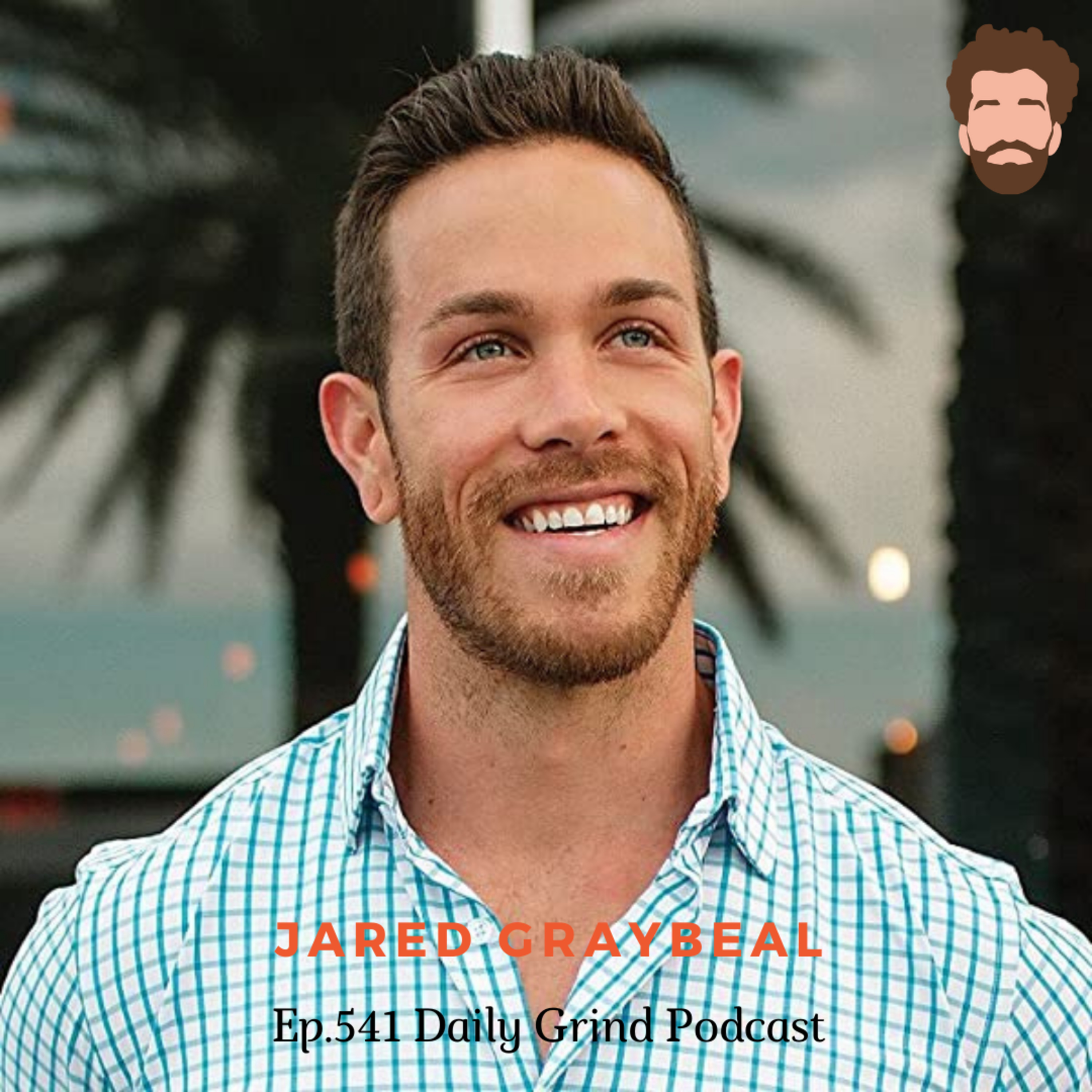
Hey everybody and welcome back to another episode here on The Daily Grind. Today we are joined by Jared Gray-Viel, who owns and operates two companies, one is SuperFit Foods, a healthy subscription based, fully customizable meal prep company, and the other is E3, a business consulting and marketing agency. Most recently, Jared has authored his new book, The Self-Helpbook, Six Practical Ways to Never Stop Growing. In this book, Jared breaks down six practical ways to live a life of consistent growth while avoiding stagnation and burnout.
Jared has an absolutely amazing story. You're going to love this episode. As always, be sure you have a pen, piece of paper, sit back, and dive deep in today's episode with Jared Gray-Viel. Enjoy.
Today's episode in specific is brought to you by LinkedIn Talent Solutions. 2021 is looking up. New beginnings means new opportunity to grow your business. If part of your strategy is adding new members to your team, LinkedIn Jobs finds the right person.
Quickly, to make things better, your first job you post through this ad is completely free. Whether you're looking for someone as a marketing role, whether you're looking for a content strategist, you're looking for an assistant to help you with day-to-day, or you're looking for someone on your sales team to really help accelerate your business and take it to the next level, LinkedIn Jobs is there for you. It's an active community of professionals with more than 700 and 22 million members worldwide. Getting started is easier than ever with the new features.
They can help you find qualified candidates. Quickly, you post a job with targeted screening questions, LinkedIn then goes and finds your role quickly. You get you in front of qualified candidates quickly, and that's really the goal. When you're looking for someone, you're looking for someone immediately.
You don't want it to be two, three months before you hire for that position. You want to find someone right away. It's easy to manage posts and contact candidates. And now you can do all this from your mobile device.
So no matter where the day takes you, that's how LinkedIn Jobs can help you hire the right person faster. When your business is ready to make that next hire, find the right person with LinkedIn Jobs. And now you can post a job for free. Just visit LinkedIn.com slash daily grind.
Again, that's LinkedIn.com slash daily grind to post a job for free. Terms and conditions apply. Well, Jerry, great deal. Welcome to the Daily Grind, my friend.
How are you? I'm doing great, man. Glad to be here. Thank you.
Thanks so much for being here, man. Always a pleasure when I get to speak with you guys. I was like, Jared, you know, it's always a pleasure on my part. Monday morning, I get fired up for those listening.
It's Monday for people listening. It kind of be a first introduce to you, Jerry. If you wouldn't mind kind of just speaking on as to who you are and what it is that you do. Yeah, great intro.
My name is Jared Greviel. I am an entrepreneur recently an author. I own a company called Superfit Foods, which is a subscription based healthy food company that ships nationwide, but we're based out of Jacksonville, Beach, Florida. I have a consulting and digital marketing agency called E3.
And really in the fitness competitive crossfit athlete. And I think that probably defines me pretty well. And how old are you? 31 as of three weeks ago.
31. So what got you involved in kind of the entrepreneurial space, so to speak? How were you introduced to that? What led you down this path?
Being poor, being on the path of entrepreneurship, I think that I don't know that entrepreneurship is necessarily an eight, but I think it's environmental. Some people don't happen to it until they're 50. Some people start when they're 11. I think it's just really circumstantial.
And for me, the first experience that I remember being entrepreneurial was I was really good at drawing as a kid. And so in elementary school, I would draw portraits of other kids. Now, for like a nine, 10 year old, like these were pretty good. These weren't what you would look at.
Now you would expect from a grown adult. But these are pretty good portraits and I charged to do them. And then at 11 in sixth grade, I remember, you know, you start to establish social circles and mind words like troublemakers, because I was we rode the city bus to school. I was from the poor neighborhood kind of thing.
And there was these two twins that I would skateboard to school with. And we would stop by this gas station and kind of have this little operation where these two twins would steal candy. I'd sell it and we'd turn a profit, share the money and then eventually I stopped needing them to sell it or to steal it because I had money to buy it. And I wasn't great at stealing.
I always thought people were watching me. So that was, you know, my early capitalistic ventures of buying and selling was at 11 with this candy. And then I became a pretty good skateboarder and I got a lot of free stuff from the skate shop locally. I was sponsored and so I'd get like these stickers and bearings and like just low cost stuff for me and I'd sell it at school.
And so like that was really how I began to learn how you can take, you know, arbitrage basically. Like I can take something for a cheaper seller for more and capitalize on an opportunity so I can afford dominoes at lunch instead of free lunch or I can afford to smoke some pot on the weekend with my friends because I don't have an allowance or something. You know, that was it for me. Cool man.
So hustler from a young age. When you finish high school, did you do any post secondary? Like did you go to college or do you go to university? I did.
So summer after my senior year, so kind of back it up a little bit at 11 when I got into this entrepreneurial grind, I started smoking pot and therefore started selling pot. I saw the same opportunity there that I did with stickers and stuff. And so from 11 to 17, that's what I did. It was a positive trajectory.
So by the time I was 17, I was moving a significant amount of weight as a 17 year old and making a lot of money moved out at 16. So I say that to say after right after my senior year, I got caught went to jail for the summer after my senior year in Florida, smoke and lead, especially at the time. This is, you know, just wild. Yeah, you're right.
Yeah. Illegal. Yeah. A little flexible now, but so I went to jail for two and a half months and when I got out, I was on house arrest for two years.
So to answer your question, I went to school locally at a community college because I didn't get to go to university. I went on to get my associate's degree and I'm like two or three classes away from getting my undergrad. I take one class of semester and I'm 31 now. So it's like, you want to semester, it takes some time, but I'm pretty close to my undergrad and I'm big on education.
So I am pursuing that. I'll probably go for my MBA. I'm not the type of entrepreneur. I love Gary D.
But I'm not the like, throw the baby out with the bathwater college. Yeah. So yeah, I'm working on it, but I did go to school. Interesting.
Would you say that that was a kind of, so to speak, the turning point or a big turning point in your life when you did spend a year in prison and then you kind of got out. Yeah. So just to clarify, I did two and a half months in county jail and county jail is arguably worse than prison. However, there's a time dynamic right if he spent two years in prison or two and a half months in county jail.
Okay. Yeah, huge turning point in my life. I mean, I won't go into it because we could talk about it. But just a really big reality check for me.
I mean, I had to chip on my shoulders since I was born because it was clear that we were the poor kids in the poor neighborhood. You know what I mean? Like where some kids parents would still get them a pair of nikens once a year like we were drawing Nike on our pay let's use and get made fun of for it. And so I was always extremely ambitious and I'm really, well, I say I'm really smart, but that's kind of a good physical.
I was really smart compared to the people that I grew up with. Yeah. And I knew numbers really well. So I was able to make money early on.
And so going into jail with this chip on my shoulder, but then like this massive reality check of like, I would trade what I used to have for this crappy situation any day. Interesting. Open my eyes to like, I can't just get my break in the rules, not forever. You know, being a drug dealer is not a long term plan.
I was an atheist before going into jail and I found God. And when I say I was an atheist, I wasn't a smart one. I couldn't argue science. I would, again, I had a chip on my shoulder so I was like, there's no way that there's a God.
And so when I got into jail, I was like, no, this actually sucks. What I had before was pretty good. So I turned it around and I pursued a career in fitness when I got out and that's sort of been this what's left, you know, I've leveraged each experience to grow. So when I got out, I wanted to be a trainer and I was a sales manager at a gym and then went on to become a GM and went on to start my business in the fitness industry and I'm sort of built a brand in that way.
Yeah, it's interesting, right? Because like, I mean, I've always, I've always seen and I've always said that there's kind of, there's four people I feel like in this world and maybe you could speak on this that kind of make like amazing entrepreneurs. It's people that have had a difficult past who do have, say, sort of speak a chip on their shoulder like athletes and athletes could be a sport. I also like will group in people who are heavy into fitness because there is like a heavy discipline there and then also like people in the military.
So like those are kind of like the four people and I feel like they all kind of share same values. Do you find that like especially like you being in the fitness industry so heavily in there you've seen so many people probably walk in the gym and so many people kind of change their lives. Do you feel that as well? Yeah, because the thing about the fitness industry that's propelled me in other areas of my life is that it gave me one, it allowed me to set goals on a daily, weekly, monthly, yearly basis of like, okay, I'm just, you know, I started lifting weights and I was 115 pounds.
And so it was like, I want to gain lean muscle mass. I want to get stronger, right? And I was mentioned 95 when I started. And so it was like, there's all these mile markers of success in the fitness industry.
A lot of people is weight loss, right? But for me, I was skin and bones. So it's like, I want to have a six-pack. I want to have a, you know, I want to have shoulders, biceps, I want to curl 100 pounds.
There's all these markers that you can work on. And so that spilled over into my life. I want to read X amount of books. I want to write X amount of blogs.
I want to make X amount of money. And then I reverse engineer those goals and create practical ways of doing it, just like creating a program designed for my fitness goals. And so that's, I mean, that's always been how I've accomplished things, but getting into the fitness industry and getting into fitness in general did a couple things. One, there's a chemical component to regular exercise.
So naturally increase my level of endurance. And then really increase my level of endorphins, serotonin, which obviously trickles over into greater levels of confidence. But then being fitter, being more confident physically, that, I mean, that's going to just allow you to make a lot of progress in your personal and professional life, make more, you know, network better, you're going to get better sleep. I mean, there's just, I mean, I can talk about health and fitness forever, right?
So that is a foundation of my success. I still work out 15 hours a week now. That includes like warming up, cool and down and stuff. But if I don't do that regularly, then it affects my professional life and my social life.
And so yet it's big turning point. It's like, I'm constantly making fitness goals, which when I make business goals, I have to make business goals and I have to make personal goals. So it's just grown from there. So it's like, if I can grow in this area, why can't I grow in every single area of my life?
Very cool. So you mentioned a couple of things that you're kind of involved in now. What was it? What was it say like in your adult life, your first entrepreneurial journey?
Was it the agency? No. So the agency came after super fit, but my first actual professional and legitimate business with a company called, and most people don't know about it's company called Reich Wash. When I got out of jail, I was a telemarketer full time and I was one school full time and I was studying to be a trainer with my free time and I was on house arrest.
I didn't really have anything else to do. But I didn't want to be tied down to this telemarking job because it sucked. But I made 1350 an hour, but it's exactly like you think we're in these little cubicles and headsets and we're trading with our neighbor and that kind of people. And so I was really good at it.
And at the time, minimum wage was like $650, so I was making good money. But I didn't want to be tied down. So I started this car detailing and pressure wash business called Reich Wash. And I actually ended up violating probation about nine months later with a technical, I just came home late and went back to jail for 30 days.
So I had to basically absolve of that business. And when I came out, I wasn't focused on it. So anyways, that was my first legitimate business because of low barrier to entry. I had about $1,000 saved up on a water tank, a pressure washer, all the equipment, and I could market well and I pursued all the people that work at my telemarketing agency and 50 people make you a bunch of money.
So that was my first legitimate one, then fast forward, ended up growing in the fitness industry, became a DM at LA Fitness, did that for like five, six years. And then left LA Fitness in January of 2015, built a business plan to open up my own gym in Lakeland, Florida. And I took a leap of a pursuit investor, you gave me an approval for a quarter million dollars, moved to Lakeland the last weekend of January. And then I celebrated January 31 because February 1 is my birthday in February 2 was a Monday and we were going to begin the construction on a 2012 unit to build this personal training gym that I wanted to open.
And on Sunday morning my birthday, the investor called me and backed out. So this was my first rodeo, I didn't know that people did that. So I didn't plan for that. I only had a plan A, which was a huge lesson for me.
But I burned the farm, right? So I left Jacksonville, I quit my job. So long story short, I pursued personal training and I did really, really well in that area. And then about two months later through a serendipitous encounter and just my risk taking personality, I started Superfit Foods, a partner at the time named Frank in May of 2015.
So right was like 2009, 10, and then worked in the corporate fitness world and then eventually started Superfit Foods in May of 2015, then started E3 in like the middle of 2016 because people were constantly asking me for business advice and I wanted to get paid for it. It's sort of the short version. Yeah, very cool man. So I mean, a lot of people are listening or early stage, you know, they're kind of in the early stage of starting their business.
Maybe they're thinking about it, driving into work. They're starting that side hustle. Seems like everything you do, although like even early stages, you did well at it. It may not have lasted, but like you've always been able to start something and make something out of it.
What would you say to someone who's looking to start something themselves? What would you say for you has really worked? What are some mistakes you feel like you see a lot of people are making? Yeah, well, mistakes that I've made and things that have worked for me and I think this probably plays out in other people's lives too is like oftentimes, if I'm successful at something, that's because I'm really interested or I'm passionate about it.
Now, there's all this talk about passion and like there's a lot of practicality to building a business and being an entrepreneur that you won't enjoy. There's administrative duties as an early stage entrepreneur that you don't want to do maybe. So you won't be passionate about everything, but like the core theme has to be something you're passionate about and I'm passionate about business. I'm not cook, right?
But I'm passionate about not cooking. So I started super good because I know what people are too. So you have to look for something that generally you're passionate about in my opinion because money at the end of the day won't drive you when times get really, really tough because you may not make money for a period of time for a long time. So something that you're generally passionate about because I have gotten into opportunities since I've become this, you know, we'll say established entrepreneur and I've gotten offers and stuff that I've gotten into.
And I don't do very well because I'm not generally passionate about it. You know what I mean? So I let it sit on the back burner and whoever I'm involved with that opportunity with doesn't get the best of me because it's not something I'm not interested in. So that's one thing that I would say if you're going to jump into starting a business, make sure it's not just about money.
It's about like a general theme that you like and you're interested in. Another thing is like we live in a digital era. So there is a lot of things, the automation, outsourcing, delegating, and since that seems to be so easy these days, people try to start businesses that way. And there's just this like if you've got an idea, there's a lot of hard work that goes into building the early stage of anything.
And so it's like, yeah, you want to work smart, but in the early stages, I think the focus should be on like 90% hard work, 10% smart work. And then as you begin to gain leverage, you can make a transition where that looks a little different. But a lot of people are trying to start with 90% smart work and 10% hard work. And you're not going to turn the flywheel like that.
And that's just in my opinion, my personal experience with what I do. But that's just my general recommendation for early stage entrepreneurs. It makes you see it all the time. People start there like, oh, but I'm only going to put like four or five hours into it.
It's like, dude, good luck, man. I wish that was the case. But eventually it can get to that point is what you're saying. Like eventually you could turn it into that for yourself in order to establish that hard work in every area.
Like anything you do is so mandatory. Yeah. And we have this label mentality, right? So you start a business and all of a sudden you're a CEO.
And it's like, we only have one employee. So, you know, early on, you might be like, well, a CEO wouldn't do that. And it's like, well, if you pay someone else to do that, then you're taking away from your margins that may not even exist. So now you're indebted weekly because you're too egotistical to just do the work for a little while.
So it's like, at first, I mean, you got to do the everything. You know, I've delivered. I've prepped food. I've been underneath ovens.
You know, like, I've tried to figure stuff out. Like, so I've done just about everything except for literally work on the grill because I know my strengths and that would just be getting in the way of my chefs. But it's like, but I've answered every call. I've sent emails.
I've written letters. I've gone to client's houses. And I've still done that within the past six months and we're six years into the game. So it's like, I think a lot of people get caught up on like, well, so and so on social media is not doing that.
And it's like, they probably are. They're just not putting it on their Instagram story. So don't worry about so and so because you should be focused on your business because of the end of the day. So instead, it's not going to pay your bills and pay down your debts and get you to the next stage in order to get funding or whatever it is.
Well, man, so I mean, you mentioned this early on, but I mean, recently, you'd said you wrote a book, the self help book for those listening six practical ways to never stop growing. What went into that? Like, where did the passion come from in order to have the idea to write the book and why was it so important for you to write a self help book and this one specifically? Great question.
So about three years ago, I got asked to do a teaching at the church here in Jacksonville that I went to. And it was on like biblical principles of entrepreneurship. And so I called the teaching Taming the Lion. And it was a four part series that I talked to these large audiences.
And so I decided I wanted to write a book around that. And I pursued that for about a year, but to be honest, I don't consider myself to be a very competent writer. I was very mediocre in like, great school. C's in English and literature.
I wasn't interested in it. And I love to read, but I didn't love to write. And I love to speak, but I don't like to write. And so, but anyways, I got into blogging, pursued writing this book, put it on the bat burner and I wrote a blog a year and a half ago called six ways to never stop growing.
And normally my blogs are like 500 to 1000 words short, you know, insightful. This was like 10,000 words. I just kind of went off. And I was like, and this is way too long to post on my blog because this isn't a norm.
And I was like, I love the lot out of this. I bet I can revisit this, make it about 20,000 words, which is about 100 pages. And I could publish this as my first book, get, you know, get some footing underneath me, some experience, some confidence. So I can revisit aiming the lion with a little bit more know-how as to how the publishing world works.
And so that's what I did. And because the outline was already written for six ways to never stop growing, I was like, yeah, I'm already happening there. I just need to fill in more stories, more context, more tips. And so I did that.
And then once I finished the manuscript, I pursued different publishers and found scribe and they were awesome. And it was like a six month progress process to get it out into the world. And that's what we did. And it worked out really well.
And the book has gotten awesome feedback. It's really cool because it's a really insecure process, but it's something I doubt it is very expensive to write writing your first book. I had a good book for you. I'm not like a celebrity.
So it's an investment on my part. And the reason why it's so important to me is because I think a lot of people look at self-help as this like nuanced overly spiritual vague thing. And I think self-help is measurable. It's quantitative.
It's you can write it down on a piece of paper and you can check it off your list. The self-help word is a little overplayed, but helping yourself is so important. And so like when I wrote the book, I was like, what is that I can't call it six ways to never stop growing. That's too long of a title.
That's a subtitle. So like, what is the spool up when I was a self-help book? And then I looked up titles and I was like, nobody's used that. So I just called it the self-help book, six practical ways to never stop growing.
And it's confidence, competence, clarity, connections, commitment, and character. When you're writing the book, was there someone that you kind of, as you're writing the content, as you're thinking of a reader, was there a reader that you kind of had in mind? Like someone specific that you were trying to like really touch, say with this? And then for someone listening, obviously there's a lot to it.
But like, what's the main thing that you want people to take away when they do grab a copy and read it? Yeah. The main person I was writing to is myself, man. I am so far from a finished product.
And I think that's just a human condition. Nobody you look at or admire is a finished product. And if they think they are, you probably should admire them. And so I constantly struggle with confidence, confidence, clarity, commitment, making connections, and my character, for sure.
And so like, these were like foundational principles for me, checklist for me to try to be a better human. And I thought, you know, a lot of people probably struggle with these things too. And of course, some of the things come natural to me. I'm great at making connections.
But I still wanted to document how it is that I do that for people that aren't great at making connections. And I think there's a general theme that grows as linear, right? If you've only grown one area at one time. And that's not true.
You can try to grow in different areas at the same time or different times throughout the year, throughout the season, whatever it is. So I wanted to have a playbook for being a better human. And the takeaway that I want people to have is like, you can help yourself. Now granted, it's great to have a strong foundation, family, spouse, friends that lift you up, a training coach to write your programming, a mentor, a counselor, a therapist.
Yes, there should be people in your world helping you. But at the end of the day, you shouldn't rely on those people. A strong percentage of your reliance should be on yourself because you should always look first. I'm a Christian, so I look first to God.
But God is in me because it's all that stuff. You should look to yourself before you rely and depend on other people. And you're very capable of helping yourself. And that's what this book should show you.
Very cool. So say to give people a little nugget here. Say someone's listening, not where they want to be. Whether it's financially, spiritually, emotionally, relationships they have, building connections.
I mean, everyone always struggles with something. They're looking to make that change. They're like, I'm not happy in this area. They've identified that.
What's say like one of the first steps or first one or two steps that people should take when making that change? Recognizing that you need to make the changes huge. I mean, it's kind of a cliché, but it's just like alcoholics and animals, right? Like that's an important word.
So admitting the fact that you need to grow and that you're fully capable of doing it yourself is like the first step. That's an easy step. Hard for some people, but it's relatively easy because it's just a decision. Then from there, now I'm biased.
From there, you grab the book. But if you don't want to grab the book, maybe you jot down what areas of your life you're struggling in. There are people that are great at making money and horrible at making friends. There are people that have a ton of friends and no money.
There are people that have a ton of competency. They're extremely smart because they spend all their time in the books. And in school, but they don't know how to make a friend in public. There are people that have a ton of money and a ton of friends and very crappy character.
And eventually that will flesh itself out. So you've got to recognize what area of your life you need to grow it and then begin to work on that. But again, of course, the book prompts these questions in each chapter and all honesty, I've read my book three times since it's came out and I've revisited different, because you can read it in two hours from the back. And in each chapter, I've revisited the connections chapter just to dust off some of my connections muscle.
I've revisited the character chapter. I'll throw a bad weekend and be in like end. Did I have a crappy weekend or am I a crappy person? And so just how my life works and that's how I am constantly trying to get better.
So this is, and I didn't say this book, so many of people have described this book as basically a checklist of the unabeaded version of yourself. And it's not weighty. It's not full of stories about my life that you're like, why are you telling me this? And it doesn't have any vague advice.
It's all measurable and very specific. So it's all actionable. So you can take it and you can run with it. I love it, man.
Well, if people wanted to grab a copy, you know, they're hooked, they're like, where can I get this thing? Where's the best place people can do that? Of course, Amazon, Amazon's going to get to the book in the quickest period of time, but it's anywhere online that books are sold. It's the self-help book, six practical ways to never stop growing.
Awesome. And if you're listening, I don't do this very often, but if you're listening, you're one of the first people listening and you want a copy of this book, I'll give away three copies myself here. So email me via my website, first three people to do it. I'll send it to your address.
You can grab a copy because there's so many self-help books out there, but I can just kind of see your different take on it, which I think is really refreshing and I really enjoy. So first of all, thank you so much for coming on the podcast, man. I truly appreciate it. Thanks for having me, Colin.
Awesome. And then lastly, people wanted to connect with you, learn more about your journey. Where's the best place people can do that? I'm most active on Instagram.
My Instagram is at Jared Axel-Gravial. That's A-X-L after a website from Guns N' Roses. And then Jared-Gravial.com is my website and that's going to have every podcast and I book link all that for myself. Cool.
I'll share that in the show notes section to make it super simple. You can go ahead and click there and Jared again. Thanks so much for coming on. I appreciate it.
Yeah, Colin, thank you. Have a great day. You too. And there you have it for today's interview with Jared-Gravial.
If you enjoyed today's episode, be sure you hit that subscribe button. Share this out with a friend. We'll be back next week with another episode. Until then, Colin, we're going to be signing off and always remember to keep on grinding.